
茶 FIRST IMPRESSIONS
茶 REVIEW OF BOOKS & FILMS
[REVIEW] “Who’s Afraid of Not Conjoined Bodies?: Hon Lai Chu’s Mending Bodies” by Tin Yuet Tam
Click HERE to read all entries in Cha on Mending Bodies.
Hon Lai Chu (author), Jacqueline Leung (translator), Mending Bodies, Two Lines Press, 2025. 240 pgs.
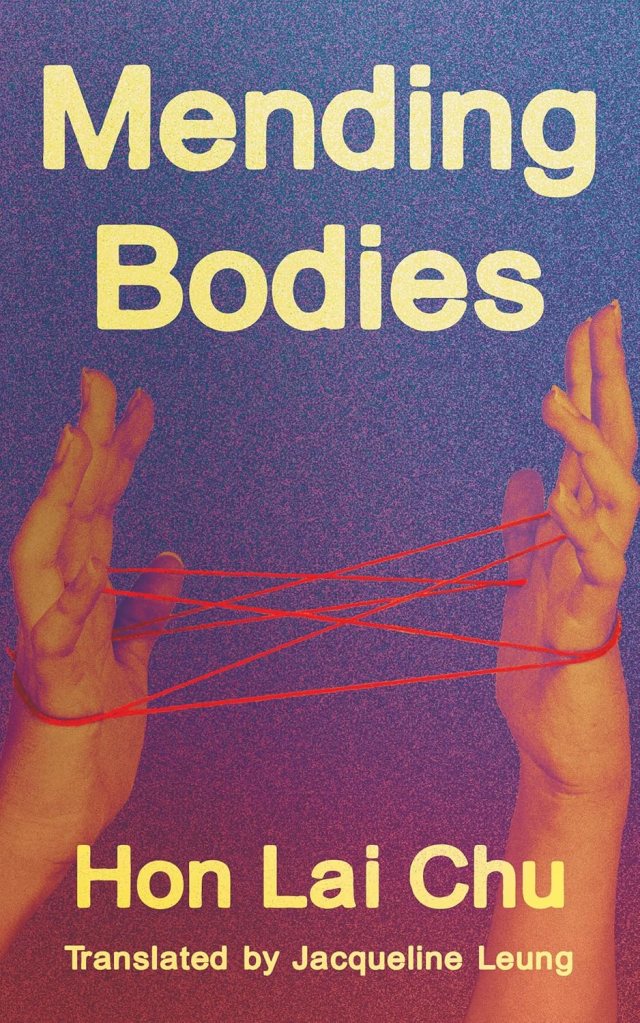
Hon Lai Chu, an established Hong Kong novelist, wrote Mending Bodies in 2010 and created a dystopian city where conjoined men and women are accepted and even celebrated. Fifteen years later, translator Jacqueline Leung debuted her first full-length translation, transposing Hon’s world into another alienated setting. Through Hon’s brushstrokes, the world of Mending Bodies is distant yet familiar: people move in and out of hospitals and slums, their original names forgotten after the widely known conjoinment surgery. Like its namesake, conjoinment surgery fuses two people together while stripping away their identities. The translator, Jacqueline Leung, has given a twist to the word “conjoinment” for the new world Hon had imagined and documented years ago. To capture the unimaginable possibility of joining two people’s bodies together, Leung derives the process and union of “conjoinment” from the existing English words “conjoin” and “conjoined”. Written in the first person, the novel is interwoven with “my” dissertation, case studies, and case reviews that test the fine line between the unconjoined and the conjoined, life and death, the individual and the couple. Hon has constructed a nightmarish context, and Leung has utilised the ambiguities and foreignness of English to render Hon’s world captivating, with an undertone of suppression and melancholy.
The English title Mending Bodies translates the original title while preserving both imagery and word count. It captures the connection between two bodies, with the “-ies” signifying plurality. More than that, the choice of the gerund form “mending” over the past participle “mended” is striking. The word “mending” suggests that the conjoinment surgery gaining popularity in “my” city is a continuous process, even after the procedure has been completed. The “-ing” in the title foreshadows a narrative of something ongoing yet unpleasant. Scars and marks remain after conjoinment, as the two bodies both heal and reject one another. The process of binding two people together is not a single, definitive act like the stitching of clothes; there are wounds that must continue mending and tending. With that in mind, the title and translation introduce Hon’s novel to English readers by connecting them with a dystopia that resonates with traditions in English literature. Yet rather than portraying the protagonist as a heroine, “me”, the sole and dominant voice in Mending Bodies, is a young woman too defeated and fatigued to resist social norms. Her character arc is not one of defiance but of quiet resignation—“my” voice overlaps with her curiosity about and criticisms of conjoinment.
Set in a city where conjoinment laws have been passed, more young people around “my” age choose to undergo conjoinment, believing it to be for the greater good of society. While “I” believe that my university friend and roommate May will remain as free-spirited as ever, she shocks me by announcing her decision to conjoin and urges me to do the same. The novel can be read both as a stream of consciousness exploring “my” views on conjoinment and as a case study—a rough draft of “my” undergraduate thesis. In the final stages of tertiary education, “I” find myself unchallenged academically, yet inwardly torn between fascination with and repulsion from the idea of conjoinment. Throughout the narrative, the choice between being unconjoined or conjoined is a constant struggle. “I” never comprehend why conjoinment is deemed good for everyone, having grown up in a single-parent household with a melancholic mother. Yet from my mother’s perspective, she evolves from indifference to embracing conjoinment so fervently that she attempts to persuade “me” to undergo it, lest I end up as lonely as she has been.
Criss-crossing between chapters titled “A Meeting of Fish”, “Outline”, and “Case Study”, “my” first encounter with Lok unfolds in a setting that blends the atmosphere of an aquarium with the fish tanks of Hong Kong’s Chinese restaurants. Before meeting Lok and contemplating conjoinment, “I” already felt as though “I” were not myself, pretending to be someone unknown. Conjoinment only worsens this sense of dislocation, as “I” become lost within the new relationship forged with Lok. In the first chapter, through Hon’s prose and Leung’s translation, “I” am juxtaposed with other living creatures: “Every now and then I dolled myself up to try to become someone else” (p. 13); “I found it hard to recall our new name. At events, whenever people asked me to introduce myself, my mind would go blank and I would stagger into an awkward pause” (p. 16). “I” feel deprived of control—over “my” body, “my” name, “my” dissertation, even over when “I” rise and where “I” go. Knowing myself means rejecting Lok, yet it seems “I” cannot escape being bound to him in the end. “I” was not resolute enough to fight against the changes of my fate, realising too late that “by the time I realized just how critical this was, I was already a poor swimmer flailing in a maelstrom” (p. 16). “I” try to capture how “I” confront my fear, but it is only when it is too late that “I” recognise my own entrapment.
The final line of the first chapter is aptly translated, faithful to both the literal and emotional sense in English and Chinese: “After typing out the last sentence, I lifted my head and looked out at the sky. It was a wide expanse of gray, the underbelly of a fish swimming high over me” (p. 21). As a bilingual reader fluent in both languages, the translation of “the underbelly of a fish” leaves me unsettled. In English, “underbelly” suggests vulnerability or darkness; in Chinese, it evokes the image of a dying fish. Within Chinese culture, a fish turning upside down to reveal its underbelly is a bad omen. That line, therefore, does more than describe the grey hue of dawn—it foreshadows “my” fate in contemplating the joining of my body with someone “I” actually detest. It is a harbinger that this union will not end well.
Among readers encountering Mending Bodies for the first time, I find it difficult to compare my feelings between the original Chinese and the translated English versions. Despite being a first-time reader, I sense that the English text introduces an added uneasiness through its intermingling of genres, including personal narrative, academic writing, and diary-like records. In translation, these genres appear more disjointed than expected. English lends “my” academic writing an ambiguity between subjectivity and objectivity, rendering “my” research on conjoinment, conjoined twins, and those who have endured unimaginable losses following separation surgeries strangely haunting, for they mirror the changes in “my” own mind: from reluctance towards conjoinment, to submission, and finally to acceptance in joining with Lok.
“I” witness “my” best friend May drifting away after her conjoinment with a man “I” can scarcely recall. I later visit Auntie Myrtle, who lives in a desolate part of the city years after her own separation from a man she no longer loves, before making up “my” mind about the final decision. The case studies and literature “I” have researched blur the boundary between reality and imagination. They render “my” encounter with Bak almost delusional and make “me” question reality itself, as when a surviving conjoined sister must come to terms with a new body for which she is unprepared. The research convinces not only “myself” but also “my” future readers that conjoinment—and its eventual undoing—are experiences both unimaginable and deeply unsettling. Only those who have undergone them could truly convey how excruciatingly lonely and painful the aftermath can be. The careful blending of genres and the deft translation make “my” case, oscillating between realism and academic inquiry, all the more convincing and leave subtle clues pointing to “my” final decision.
The English translation also heightens the novel’s dystopian and depressive atmosphere, intensifying the sense of alienation and awkwardness that permeates Hon’s city. Yet there are inevitable limitations in the loss of wordplay achievable only through traditional Chinese characters. While reading the novel, I often wonder how Leung chose the English equivalents for Hon’s names—“my” experimental subjects Bak and Lok, the man with whom “I” am conjoined. There are moments in the novel where the names Lok and Nok appear confused, and in Cantonese “Nok” means “music” whereas “Lok” means “happiness”. As the narrative deepens, I am drawn into decoding the original and translated names of Professor Foot and Auntie Myrtle. Are Foot 足 and Myrtle equivalents of 桃? Were their original names intended as puns reflecting their personalities? It is unfortunate that some of Hon’s intended wordplay inevitably disappears in translation.
A recurring theme throughout the novel is the alarming presence of male domination. The pervasive influence of male figures in the protagonist’s life is subtly depicted yet made more explicit in translation. In the hotel scene with Professor Foot, his measurements, touches, and gazes send chills through me. As a man who holds power over “my” academic life, Professor Foot remains an obscure and inscrutable presence. Other men “I” encounter are likewise imbued with varying shades of patriarchal dominance. Lok, “my” conjoined partner, is a disturbing figure—repulsive, like a fish. In the Sleeping Clinic, the descriptions of how Lok places his hands on “my” body as though playing piano keys are deeply unsettling. Throughout the novel, Lok never truly perceives “me” as an equal; instead, he regards “me” as someone who must fulfil society’s expectations of conjoinment. Once our bodies are joined, Lok merely wants “me” to assist him, implying that “I” should emulate our doctor’s muted wife—meek and compliant.
What is more disturbing is that this novel portrays a world in which women willingly conform to the roles prescribed by men. Against the backdrop of male egocentricity, fathers are conspicuously absent. Both “my” and Lok’s mothers are portrayed as lost and erratic. While Lok’s mother forces him to play the piano, “my” mother grows despondent when “I” reject her proposal to undergo conjoinment as soon as possible. As readers, we cannot be certain whether the mothers’ bodies were ever conjoined—like Auntie Myrtle’s generation—but it is intriguing to question why these women harbour such inexplicable obsessions with the body itself.
Mending Bodies is not a pleasant book to read. Yet its unpleasantness does not stem from the work itself but from how the novelist and translator expose the absurdity of a world that blindly believes there is only one path to happiness: to find a partner, to conjoin, and to conform unquestioningly to societal expectations. Those who dare to question this path—or who voluntarily seek separation—are deemed deviant and abnormal. But in a society governed by a single rule, who has the authority to define whether conjoined or separated bodies are the true deviants? Despite the disturbing ambience that Hon has created and Leung has so deftly rendered, it is a privilege for bilingual readers like myself to access their work. I eagerly anticipate reading more publications from each—and from both—of them.
How to cite: Tam, Tin Yuet. “Who’s Afraid of Not Conjoined Bodies?: Hon Lai Chu’s Mending Bodies.” 14 Nov. 2025, chajournal.com/2025/11/06/bodies-mending.


Tin Yuet Tam is a Hongkonger who writes about arts and culture. She has written critiques on performing arts in Chinese, for example, her theatre critiques can be found in Hong Kong Repertory Theatre’s Repazine. She has also been writing poetry, reviews, interviews, and essays in English. Tin Yuet’s poetry has been featured in Canto Cutie and Voice & Verse Poetry Magazine. When she is not writing, you might find her strolling along the streets for hours just to immerse herself in cities. She currently resides in Toronto, Canada. Find her work on Instagram: @walk_talk_chalk [All contributions by Tin Yuet Tam.]
 Cha
Cha 