
茶 FIRST IMPRESSIONS
茶 REVIEW OF BOOKS & FILMS
[REVIEW] “From Silence to Sound: Kaori Lai’s Microhistorical Poetics of the White Terror” by Serena De Marchi
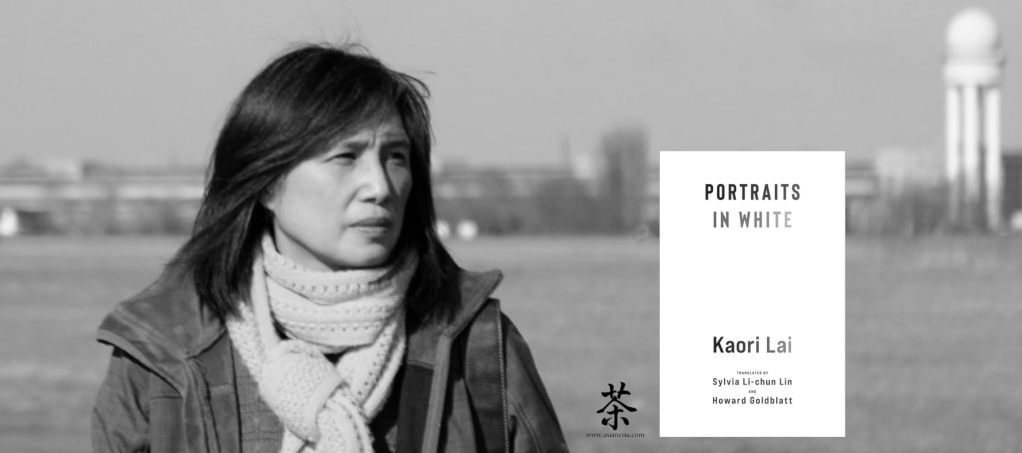
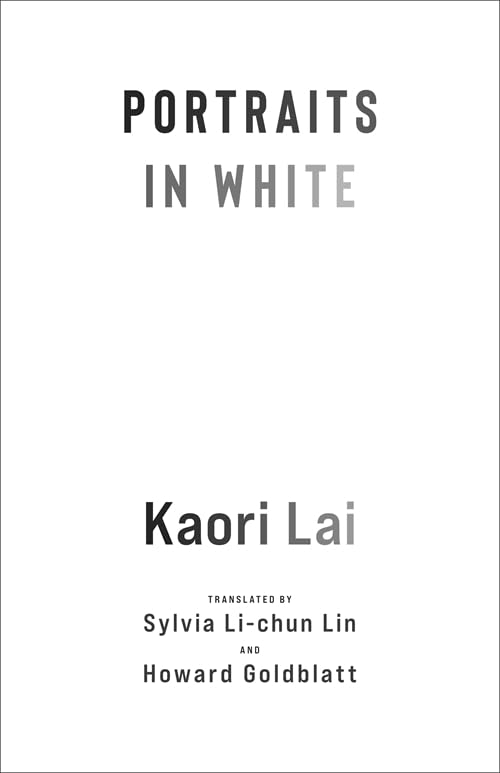
Kaori Lai (author), Sylvia Li-chun Lin and Howard Goldblatt (translators), Portraits in White, Columbia University Press, 2025. 272 pgs.
The colour white is usually associated with purity or cleanliness, but in Taiwan, in relation to political history, it can evoke an entirely different range of sentiments.
The White Terror 白色恐怖 is the name given to the period of authoritarian rule under the Nationalist Party (Kuomintang, KMT) from 1949 to 1987, which was marked by martial law, political persecution, and the systematic silencing of dissent. The term “White Terror” originally derives from the counter-revolutionary violence of royalist forces in post-revolutionary France, where “white” symbolised conservative reaction against “red” revolutionary movements. This label was later adopted for other periods of reactionary repression, including Taiwan’s.
Yet in the chromatic texture that makes up our everyday life, white is also, arguably, a “non-colour”: it remains diffused in the background, against which everything else takes shape. How, then, can such colourlessness be portrayed? This question became the point of departure for Taiwanese writer Kaori Lai (Lai Hsiang-yin 賴香吟, b. 1969) in Portraits in White. In the book, whiteness is the canvas upon which Lai sketches the outlines of ordinary “lowercase people” 小寫的人,1 who find themselves entangled in the larger mechanisms of history.
Portraits in White, published in Taiwan in 2022 as Baise huaxiang 白色畫像 (INK), has recently been released in its English version by Columbia University Press, translated by Sylvia Li-chun Lin and Howard Goldblatt. The book comprises three independent yet interconnected short stories, each focusing on the life of a fictional “lowercase person.” The first, “Mr. Ch’ing-chih,” follows a young man who comes of age in the early years of KMT rule. Having graduated from a teacher’s college and later drafted into the military, Ch’ing-chih’s scholarly talent earns him a post in the Political Warfare Division, where he becomes both instrument and observer of the state’s apparatus of persuasion. He later returns to civilian life and resumes teaching while Taiwan moves through the transition from Chiang Kai-shek’s hard authoritarianism to Chiang Ching-kuo’s softer leadership.
The second story, “Ms. Wen-hui,” traces the precarious life of a working woman whose education and identity are quietly undone by political transition. Raised and educated under Japanese rule, Wen-hui works as a housemaid for a Japanese family in her youth. However, with the end of the war and the establishment of the KMT regime, her Japanese education becomes useless, and her ability to speak and understand Mandarin is limited. Forced to navigate these political and personal uncertainties, as her husband has suddenly passed away, the woman moves from one household to another and eventually finds a more stable position serving a local doctor, who later loses his social status for publicly sharing his political views. Her story reveals the vulnerability of many Taiwanese women caught between the legacies of Japanese colonialism and the hierarchies of Nationalist rule.
The third and final story, “Miss Casey,” follows an educated young woman who leaves authoritarian Taiwan and settles in Europe, first in Paris and then in Berlin. Abroad, Casey, together with a network of other members of the Taiwanese diaspora, experiences democracy, protest, and freedom. As a result, her worldview, including her understanding of Taiwan’s history and politics, undergoes a radical transformation, although she remains emotionally connected to her homeland by a lingering nostalgia that coexists uneasily with the freedom she has found in exile.
Lai’s approach to narration, with her focus on ordinary people and her threading through seemingly insignificant details that nonetheless reveal entire cultural and social systems, is essentially microhistorical. Microhistory is a method of historiographical research that emerged in the late 1960s and 1970s within Italian and French academic contexts, and was popularised by Carlo Ginzburg’s influential study The Cheese and the Worms (1976), which reconstructed the worldview of a sixteenth-century miller from fragmentary Inquisition records, demonstrating how even an apparently unremarkable figure could illuminate the cultural logic of an entire era.
In this book, like a microhistorian, Lai weaves her stories from the margins, building around small gestures or objects, whispered dialogues, and hummed tunes. Through these details, she reconstructs the emotional atmosphere of Taiwan’s martial law period, showing readers how politics can infiltrate the most ordinary spaces of daily life. One moment that strikingly exemplifies the author’s microhistorical approach occurs in “Mr. Ch’ing-chih,” when the protagonist is casually conversing with a relative (his wife’s uncle) at a party. The uncle first teases the young man for being overly earnest (“People like you who were in school for so long could be a bit dense”), but then asks him:
“[…] Tell me the truth, they said the light was turned off when the votes were being counted. It that true?”
“Can we not talk about this, Uncle?”
“All right, all right. We won’t talk about it. We won’t.”
The uncle’s question alludes to a widespread suspicion that the KMT rigged elections by deliberately inducing blackouts during ballot counting, but it also exposes the differences between two generations and two social worlds. Ch’ing-chih is educated, well integrated into the system, and trusted by his superiors, whereas the uncle has no political connections and lives on the margins with an old concubine as his de facto wife. In the space of a few lines, Lai reveals the microphysics of power (to borrow Foucault) at work even within familial interactions, exposing how authoritarian control operates through ordinary speech and social hierarchy.
Lai’s microhistorical gaze is also reflected in her use of language(s) to capture the layered social realities of post-war Taiwan. The original text includes Mandarin Chinese, Taiwanese, Japanese, French, and German. The use of Taiwanese is particularly meaningful: Lai inserts it mainly in the dialogues between characters (as in the exchange between Ch’ing-chih and his uncle mentioned above) and provides Mandarin glosses to translate it. This layering of languages evokes the historical tensions that shaped everyday speech in KMT-ruled Taiwan. During the White Terror, the government banned the public use of Taiwanese (along with Hakka and indigenous languages), yet in daily life people continued to speak it. The novel reflects this historical tension between authoritarian efforts to erase the Taiwanese language and its resilient resurfacing in everyday speech acts. In the English version of the novel, much of this linguistic layering is necessarily lost, yet Lin and Goldblatt, as they aptly explain in the “Translators’ Note,” strive to reproduce this dynamic through subtle modulations of tone and register, rendering the dialogues in a slightly more colloquial English to suggest the familiarity conveyed by Taiwanese speech.
The polyphony evoked in Portraits in White is not limited to language, but also resonates in Lai’s use of music and song as media of affective memory. In the story that closes the book, “Miss Casey,” the narration is consistently built upon multiple musical references: Taiwanese ballads, Japanese wartime songs, French chansons, and German cabaret. These sonic elements anchor the protagonist’s life to the places she inhabits, tracing her shifting sense of belonging as she renegotiates her identity in Europe. Indeed, the very opening scene of the story features a famous 1950s song by Taiwanese singer Chi Lu-hsia 紀露霞, called “Sunset Hills” 黃昏嶺.2 In the scene, Casey, an elderly woman with failing eyesight, finds herself humming the tune while strolling through her city, Berlin:
Eyes gazing toward my hometown, I sit under a banyan tree—
Her voice cracked at the words “banyan tree”—the pitch too high. Chi Lu-hsia was still the best, so Casey stopped singing, no longer in the mood. Why was she thinking about home at her age? Besides, banyan trees were only found there; where she was now, homesick people would be thinking about lindens.
These intertextual and at the same time extratextual sonic objects mark precise points in the narrative, signalling Miss Casey’s evolving relationship with Taiwan, which oscillates between nostalgia, identification, and the impossibility of belonging. Once again, in this use of song, we find traces of Lai’s broader microhistorical project: the preservation of historical memory through sensory, specifically auditory, detail.
All the sounds that Kaori Lai evokes throughout the text, including the voices, the languages, and the songs, make Portraits in White a polyphonic archive of Taiwan’s White Terror. By attending to the small, the ordinary, and the fragile, Lai demonstrates how literature can make history resurface and resound within everyday life, while at the same time revealing the subtle ways in which state violence lingers even in the most mundane of occasions.
In a sense, this book also represents the author’s attempt to make sense of her own past. As she states in the afterword to this translated edition, Lai positions herself as someone “who came later.” She is the daughter of Ch’ing-chih, Wen-hui, and Casey. She belongs to the generation “who has grown up with ‘re-created memories’,” and thus her writing may be understood as an art of interrogating and reassembling the past, of giving shape and voice to what usually remains indistinct, dissolved into the background. In tracing these subtler reverberations of Taiwan’s authoritarian past, Lai transforms memory into method, a way of rereading and retuning history through the white noises of the present.
- The term is owed to the writer and editor Wu Jih-wen 吳繼文, as referenced in Lai’s afterword to the Taiwanese edition of the book. ↩︎
- https://www.youtube.com/watch?v=7Ao_lIPLwaI ↩︎
How to cite: De Marchi, Serena. “From Silence to Sound: Kaori Lai’s Microhistorical Poetics of the White Terror.” Cha: An Asian Literary Journal, 31 Oct. 2025, chajournal.blog/2025/10/31/white-terror.

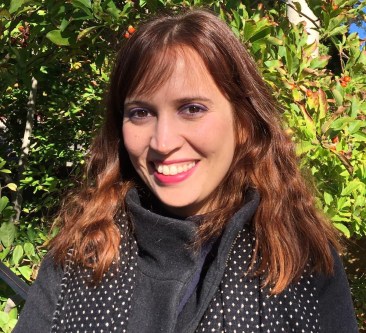
Serena De Marchi is adjunct professor at Ca’ Foscari University of Venice. She is interested in contemporary Sinophone fiction that plays with memory and history, lived and imagined spaces, narrative bodies. [All contributions by Serena De Marchi.]
 Cha
Cha 