

📁 RETURN TO FIRST IMPRESSIONS
📁 RETURN TO CHA REVIEW OF BOOKS AND FILMS
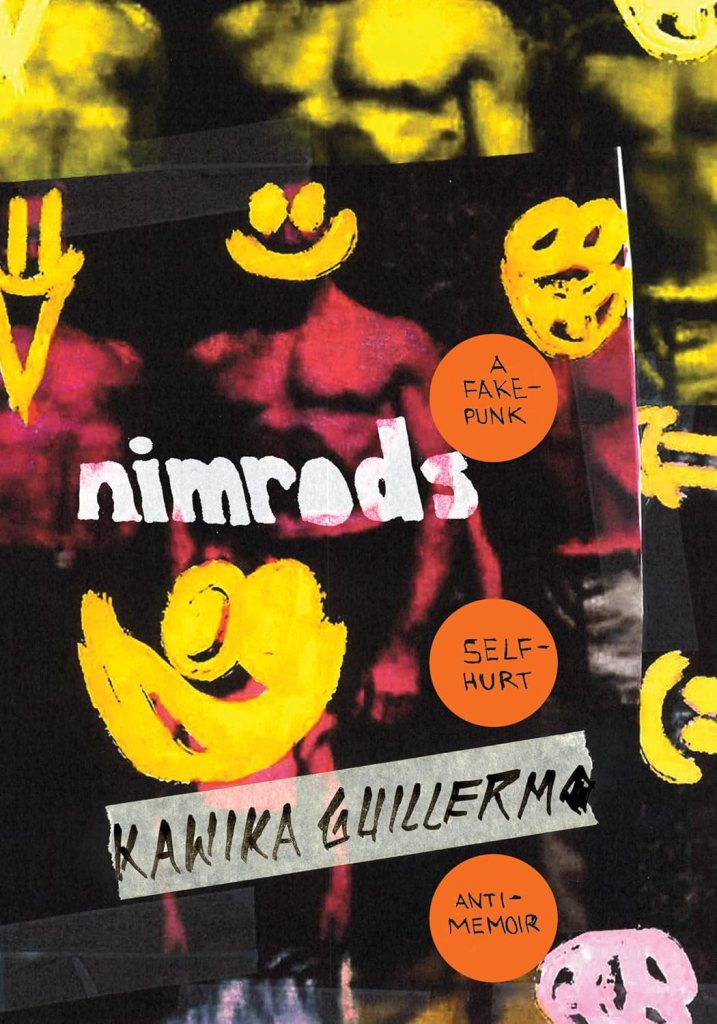
Kawika Guillermo, Nimrods: A Fake-Punk Self-Hurt Anti-Memoir, Duke University Press, 2023. 240 pgs.
Fuck ’em all. Squares on both
sides. I am the only complete
man in the industry.
—Burroughs, Naked Lunch
and fuck you and I love you and
fuck you and I love you […]
—Guillermo, Nimrods
Because I do not know just how to begin, much less complete this appraisal, this judgement of this carnival macabre rampage of pain & parenthood & the upbraided past within a pilloried personal present, I’ll invoke a list—a germane thing to do in this case since Kawika Guillermo‘s Nimrods is a book of lists in the form of twin and triple cinema, autotheory, Joycean jocoseriousness, redacted epistles, crucifying portraits of the artist as a young dog, and a hardcase annotated scripture-inspirited half-book-long comitragic haibun-bent drama. Altogether, Nimrods integrates, among other things, (i) a half-ironic, hyper-informed critique of scholarly (i.e., institutionalised & normalised pan-Marxist indoctrination) anti-white-male hegemony, (ii) a celebratory excoriation-cum-encomium of a patriarch & the inheritances of fatherhood & fiscal class, (iii) a devastating treasure trove poison pill of agonisingly beautiful & poetic disclosure, and (iv)1 a memoir negated (the Anti- of the subtitle) only insofar as Nimrods is very much psychically about the here and now, not “the faraway and long ago”; Nimrods is about events ongoing, not those “beyond recall”—to broaden Abigail McCarthy’s now-narrow genre demarcations.
But the above list of, markedly (and already annoyingly and redundantly overdetermined) four, is not the list I originally meant to list. My intended litany chronologically incorporates all my favourite lines, or pearls—to use the language of Walter Benjamin for the found-word phrases fashioned into a found poem—from Guillermo’s heartbreaking & discomfiting Nimrods. Each of these “pearls” would be suitable for the title of this review, which I’ve left blank principally because this Fake-Punk Self-Hurt Anti-Memoir shall not, to go Biblical in light of the missionary legacy the aggrieved author inherits, be minimised by a single biocidally beautiful pearl, no matter how stunningly devastating the selected pearl-as-title happens to be. (I’ve now used “devastating” severally, all in the space of four sentences; I cannot shake this qualification, one handed to me by Cha editor-in-chief Tammy Lai-Ming Ho when she suggested I review Guillermo’s third creative—as opposed to classically academic; though I’d champion this creatical [creative + critical] book over almost all the dozens and dozens of monographs I’ve forced myself to duly dispatch—“devastating book”.) So2 here’s the list of suitable, albeit not-catholic-enough, pearls that an engaged3 reader might apostle for the title of this gospeller review:
—this book began in the preoccupations of the professorial confession
—this book began & began & will begin again
—being the mixed-race straight-presenting white-passing all-perpetrating / son of an eye-rolling / wmaf
—I make money teaching kids to hate their parents
—the past is not an archive / it’s the white cousin a / ski / ing you at your grandmother’s funeral how you learned to / speak English
—hide your heart until it / grumbles like thunder / that pounds your body / into the storm
—He sings / momma loves her ba-by and turns off the headlights so we can see the stars
—It seems unfair to say that about someone who loved me so much
—some have said that the Irish were the black people of Europe
—and something’s still wrong with Frank Chin
—I’m the American yokel, the arrogant overpublished chauvinist who stands tall while the smoke around him clears
—a bad time to walk the streets of a multicultural city in a costume that said your face is my punchline
—#4 you worked far harder, for far longer, for far less pay / than I ever will / and you are white
—other wallflower pornamentation
—our kind of skinship: // his radiance // reigns the radical of // her roots
—the homoerotic homophones of the bye boi bi boys
—Manhood was a game I could never win
—“it is the duty of all women to be cheerleaders for their husbands”
—how small and narrow the boxes are / for little boys
—my life if anything is an attempt to destroy the legacy (even if no one ever reads my work, even if I die in obscurity, fuckers, I’m taking you with me)
—I still visit my white family. I eat their food and take their money / for my birthday
—I can’t imagine the shame of watching your darker-skinned twin sons clean up after the white bullies
—the eyes of a moral overseer, the face of a ticking watchman all wounded up
—I remember bruises, sores, slaps, sirens, & how […]
—the way we marshal words even / when they have ceased to open any locks
—your kids won’t be in that gobbledygook they’d have right christian names
—And I cannot write that down
—suicide is several things all decided at once
—O demon / strably id / le shrugs
—we brown stalk reverse colonialism / de-cold war
—we ALPHA DRAGON RACE CRITICAL CHADS
—-FAKE ECONUT FATFUCK SYNTHETIC IMPOSTER BANANA APPROPRIATOR
—“I ride I write I writhe”
The list, my register, this from Guillermo’s yet longer book-long syllabus, is now but halfway reproduced. Yet I can’t go on. Yet. Yet. Though I’ve kept reading & rereading, though I’ve kept studiously underlining & encircling, as though the not “Fake-Punk” Nimrods interpellates its reader (whether “he she they” be critically dispassionate4 or criminally coincided) into a Sisyphean endlessness, as though this non-faux junk & punk book is festooned on a spiral so the reading, the immersion, the recognition, the horror the horror won’t/can’t/shan’t ever end—this notwithstanding the concluding three-part epode, and the envoi, and the acknowledgment, and the bibliography, with only the last of these being in any sense conventional, and so we, just like Guillermo & his Father & his Son, do à la Beckett go on. And on. So …
Camus, of course, recommends that we imagine Sisyphus as happy, given that the only freedom (of thought) is the freedom of attitude. And Guillermo né Patterson? As author, as narrator, as character, not so unlike the Joan Didion-narrated character Joan Didion in Joan Didion’s dextrously surreptitious spy(!) novel Democracy (1984), Kawika Guillermo, akin to the Nimrod of his title—Nimrod appearing in “Genesis” as the ur-antihero of the Western canon, a Nimrod being much more than “an inept beast of folklore,” as well as much more than “the fake punk but good” one-hit wonder 1997 Green Day album—so Guillermo encodes into his human-all-too-human confession Nimrods—Kawika Guillermo, as author & subject, cannot be imagined as or confined by or relegated to any singular countervailing emotive exemplum. Existenz as tocsin ad infinitum. “Sometimes the referent is beyond words,” he says & shows—& we, the readers, so passionately catenated to this multi-dimensional affective agent, sustain.
Guillermo is too too complete to be abstracted. He’s too estimable; he traduces traducement—this not in spite of but on account of his acknowledged, his never abnegated, flaws. “Hippocratic oath / for writers first,” Guillermo avows, “be not a hypocrite.” He’s too critically accoutred & beleaguered & championed (never have I ever met a professor more fêted, more fancied, more hallowed, more lacked by his Hong Kong students). A flawed hero all at once in lust & trust with Ophelia & Laertes & Horatio & Polonius. Too Hamlet squared & squired & queered. And righted by his revered late wife Y-Dang. The writer & critic & instructor & traveller exposes as much when he follows Y-Dang’s advice, not only by assembling & releasing this self-recrimination whilst his father lives on, but also by duly thanking Samuel James Patterson alongside his (Guillermo’s) son Kai Troeng in envoi 186 of the book’s 215, thereby reconciling his own long-resisted patrilineal line, not to mention, which ironically is the most overt form of mentioning, Derrideanly belauding his father by deconstructing him all memoir long. To deconstruct a heritage, one must indeed perpetuate said heritage, so Guillermo so horribly, so humanly, so admirably, so beautifully, so complexly, so devastatingly grasps & gasps.
- I’ll stop at four because, in both Cantonese and Mandarin, the number four (四)—sei and sì, respectively—is a homonym of death, and thereby unlucky, and Kawika Guillermo established his considerable academic chops first in Nanjing and then in Hong Kong before relocating to Vancouver and completing this personal volume determined by death, including the reiterated, punctuated death of Guillermo’s queer uncle ______ to HIV complications, the deferred relating of the near-death of his then-infant son Kai Troeng, the continued improbable survival of his charismatic and dipsomaniacal father, Samuel James Patterson, and the devastating premature death of his Khmer wife and fellow academic, Y-Deng Troeng. ↩︎
- It is the patriotic duty of all Canadians, perhaps most noticeably in the prairies, and in oral intercourse of whites like me especially, to commence and conclude every other sentence with “So.” Speaking of whites—which Nimrods is both a condemnation and an acknowledgment of—here I am, the father of a white-passing “mango,” “mongol,” “MIXED,” “MONGREL,” “HAPA,” “HALFU,” “MUTT” blue-eyed toddler, she too the product, like Guillermo himself, of a “wmaf.” And here I am, dolorously remembering Toni Morrison’s first novel and devastatingly relishing Guillermo’s first memoir (this if we do not also read his first “fiction,” Stamped (2018), as a memoir-à-clef) while endlessly exulting in how perfect strangers from Hong Kong, to Shenzhen, to Shanghai, to Singapore, to Kuala Lumpur, to Bangkok, to Phuket, to Bali have stopped my Cantonese wife and me in the street to guilelessly and gutfully luxuriate in our dirty-blonde daughter Lam Ling’s bluest eyes. ↩︎
- Redundant. You’re not really reading Guillermo if you’re not white knuckling it the whole blessèd/pugilistic way. ↩︎
- An impossible positioning; an opium of the individual is this near-impossible-not-to-mainline book—but this ingestion manifests in a slow, self-violent sense, as though the junk, grain by devastatingly belovèd grain, can be parcelled into an uncountable infinity of ever-at-once badder yet better trips, each escape a greater, grainier, grittier revelation, each disenthralling in fact a deeper indwelling, an abiding, a sticking around, a patriarch whose hated yet longed-for embrace mercifully spurns ever letting go. ↩︎
How to cite: Polley, Jason S. “’_______________________________’”: Rererecapitulating Kawika Guillermo’s Devastatingly Wondrous Nimrods: A Fake-Punk Self-Hurt Anti-Memoir.” Cha: An Asian Literary Journal, 16 Oct. 2025, chajournal.blog/2025/10/16/nimrods.


Jason S Polley is an Associate Professor of English at Hong Kong Baptist University, where he teaches modern fiction. His passions extend beyond the seminar room—to Indian English fiction, long-distance running, motorcycling, skateboarding, turtle husbandry, and the works (to be brief) of Joan Didion, Anthony Powell, Naguib Mahfouz, Proust, Flaubert, Stendhal, and Defoe. Yet his truest love is his blue-eyed daughter, Jacynthe Milagros Lloy—Jacyn the Miracle Joy (alias Jacyn Jr!; alias Lam Ling; alias Lin Ling)—who was already at 30 months (2.5 yrs) at home in English, French, Cantonese, and Hok Lo, a northeastern Guangdong dialect that, as Popo tells him, drifts somewhere between Cantonese, Hakka, and Min Nan Hua. Jason (Sr.) has published articles on John Banville, District 9, Jane Smiley, Watchmen, Wong Kar-wai, House of Leaves, Bombay Fever, Joel Thomas Hynes, R. Crumb, critical pedagogy, David Foster Wallace, and sex work in Hong Kong, alongside encyclopaedia entries, most recently, on a range of Indian authors. He is also co-editor of the essay collections Everyday Evil in Stephen King’s America (2024), Poetry in Pedagogy (2021), and Cultural Conflict in Hong Kong (2018). [All contributions by Jason S Polley.]
 Cha
Cha 