
📁 RETURN TO FIRST IMPRESSIONS
📁 RETURN TO CHA REVIEW OF BOOKS AND FILMS
Winifred Dongyi Wang, Dissection of the Moon, Accent Edition, 2025. 232 pgs.

Dissection of the Moon is a hybrid work—a knotted thing. It unspools the lines drawn across gender, culture, nation, language, and time, only to entwine them again in the figure of its narrator: a young Chinese woman who leaves Beijing for New York. Yet her childhood in Beijing haunts her, so that each step she attempts to take forward in her American life is also a step backward—or rather, inward—into her memoryscape. The strands of the knot remain distinct, yet inextricable. Their interrelation is ever in flux; a tug on one thread sends ripples through the others, subtly shifting the entire configuration. This relational tension is evident even in the smallest gestures, as when she hesitates to share a pear with Ryan, her noncommittal romantic interest:
This moment felt like a locked gate standing between me and the Chinese language. I didn’t want to explain to him the connection between “separation” and “sharing a pear”… I was trapped in a maze of my own language’s making. You can’t describe the ocean to someone who’s never seen it.
Splitting a pear (fēn lí), a homonym for separation (fēnlí), is a negative superstition so powerful that the narrator’s father once refused to share the fruit with her—though ultimately, he leaves the family. Ryan, a white American, knows nothing of this—and would scarcely make the effort to understand. The language barrier between them is also a barrier between worldviews, for language, of course, does not exist in isolation from its cultural context. Yet within the narrator, this division is not so cleanly drawn: “A pear was a pear, a pear would disappear, whether it was eaten by me or rotting by itself, a pear was a pear, a pear without any connotation attached to it unless people bestowed something upon it.”
“Rose is a rose is a rose is a rose,” wrote Stein, the seminal figure of modernism. The field of references for this pear is not confined to either Eastern or Western frameworks: the pear wears many symbolic faces, much like the moon throughout the book—and one face does not negate another. No this or that, no either or. The semiotic worlds coexist. A pear can hold, at once, the linguistic superstition passed down from Chinese father to daughter and the law of identity, traceable to Plato’s fundamental laws of thought. The hierarchy between these two systems is effaced. In the narrative, far more space, reflection, and emotional weight are given to the meaning of pear as separation than to the Steinian allusion.
In the book, linearity is compromised as a means of resisting the myth of progress. When the narrator burns herself while attempting to cook eggs for Ryan, she is at once transported to the first time she was burned by hot oil—not in her cramped Bushwick apartment but in a palatial Beijing home; not while making eggs but while watching a much older man stir-fry tofu; and the man is not Ryan but Zhang Bin, the environmental official who had repeatedly raped her at the age of fourteen. Zhang Bin is a constant haunt (“All this time,” she reflects while thinking of Ryan, “I had only been thinking of Zhang Bin alone in my head”), but the book is keenly aware that this gendered and sexual violence is not exceptional. It is normalised within a Confucian society that objectifies girls and values their submission—even as it purports to grant them greater agency in the tumultuous transition to modernity.
One illustration of this strikes close to home: the narrator’s father hits her mother. This is known by the entire family yet never acknowledged—an open secret so pervasive that the act itself is a lesser taboo than speaking of it. The mother resigns herself to the abuse, a lesson she unwillingly imparts to her daughter: endure in silence. “Sexualising myself was never a choice,” the narrator writes, reflecting on wearing yoga pants to attract her crush. She then recounts how middle-aged men would compliment her “growth”—a coded reference to desirability: “‘Tall’ is synonymous with beauty, elegance, and attractiveness—a sure sign of good legs. Legs are the pathway to patriarchal desire.” The narrator was in middle school at the time, going through puberty.
It is not only memories of sexual violence that seep into her present life. Entire chapters unfold in the narrator’s youth—from the story of her first crush to her brief friendship with Li Zixuan, a false friend who was, at her father’s behest, using the narrator as a sexual bribe to Zhang Bin. Other chapters recount experiences the narrator did not live herself: Ryan’s and Zhang Bin’s childhoods, and the love story of her parents before their relationship disintegrated. In the nonlinear narrative, past and present intertwine—even at the grammatical level—as the narrator shifts tenses, as if to suggest that within the interior, there is no clear demarcation between now and then. Her past is as real and present as the actual present—at times, more so. She lives in her memories as surely as she does in Bushwick, where she is attempting to locate her agency, her place, and her sense of self.
Dissection of the Moon likewise refuses to conform to boundaries between cultural and literary traditions. The book abounds in wordplay, double meanings, and cultural references rooted in the English language and its heritage, while also moving fluidly through a field of references drawn from the Chinese. The prose makes agile leaps—“dancing around while he was high as the Tower of the Babel”—and at other moments lingers in imagery of aching beauty: “She spent decades perfecting this one pot of noodle soup, watching her children venture further and further away in the rising steam of a reunion written in the cycles of sun and moon.” Some passages brim with such lushness they may appear overwritten at first glance—but reconsidered in light of the narrator’s desperation to make sense of herself amid the hedonism, displacement, and tumult of her life, this language, pushed to the point of overflow, feels exactly right.
What do I love most about this moon? I think nothing shows it more powerfully than my favourite passage from the book, which I cannot resist quoting in its entirety:
I recognized him. Like Cleopatra, confidently emerging from the finely woven carpet to meet Caesar for the first time; like Zhaojun, clutching the scepter of the Han Empire, preparing to walk into the unknown West amidst the cold winds of the frontier; like Joan of Arc, with the sharpest of swords ready to be drawn from its scabbard; like Yang Yuhuan, on the highest stage of Chang’an’s grand parade, lifting half of the Tang Dynasty with the tip of her toe, exchanging that fleeting glance with Emperor Xuanzong; like Hürrem Sultan, who already knew the golden age of the Ottoman Empire would unfold beneath the hem of her skirts; like Li Qingzhao, who, through the jolting carriage of her turbulent life, would still complete The Record of Bronze and Stone with all her learned wisdom without Zhao Mingcheng; like the young Elizabeth I, hearing from behind a veil that her father had sentenced her mother to death, vowing to flatten the world stained by men; like Empress Cixi, unshaken at the dawn of the Eight-Nation Alliance’s siege; like Emily Dickinson, writing, “This is my letter to the world that never wrote to me,” with serene acceptance.
Within the space of a single paragraph, we blaze across immense histories and geographies, burning straight through binaries—indelible moments in the human record uttered in the same breath as the present the narrator inhabits, falling in love. Lines are drawn not to divide but to entwine, so that gestures transcending borders find resonance across the distances of time and space—from Cleopatra meeting Caesar, to the power of Yang Yuhuan’s legendary beauty to move dynasties, to the narrator recognising her love in real time. The awe we feel at such vast historical sweep is held in equal weight with the gravity, intensity, and poignancy of a single life: the narrator’s story is no less than any moment made mythic by history. What a book—or, to borrow a phrase from the opening chapter, what “an absolute pageant.”
How to cite: Kim, Heather Y. “Knotted Threads: Memory, Language, and Violence in Winifred Dongyi Wang’s Dissection of the Moon.” Cha: An Asian Literary Journal, 8 Aug. 2025, chajournal.blog/2025/08/08/moon-dissection.

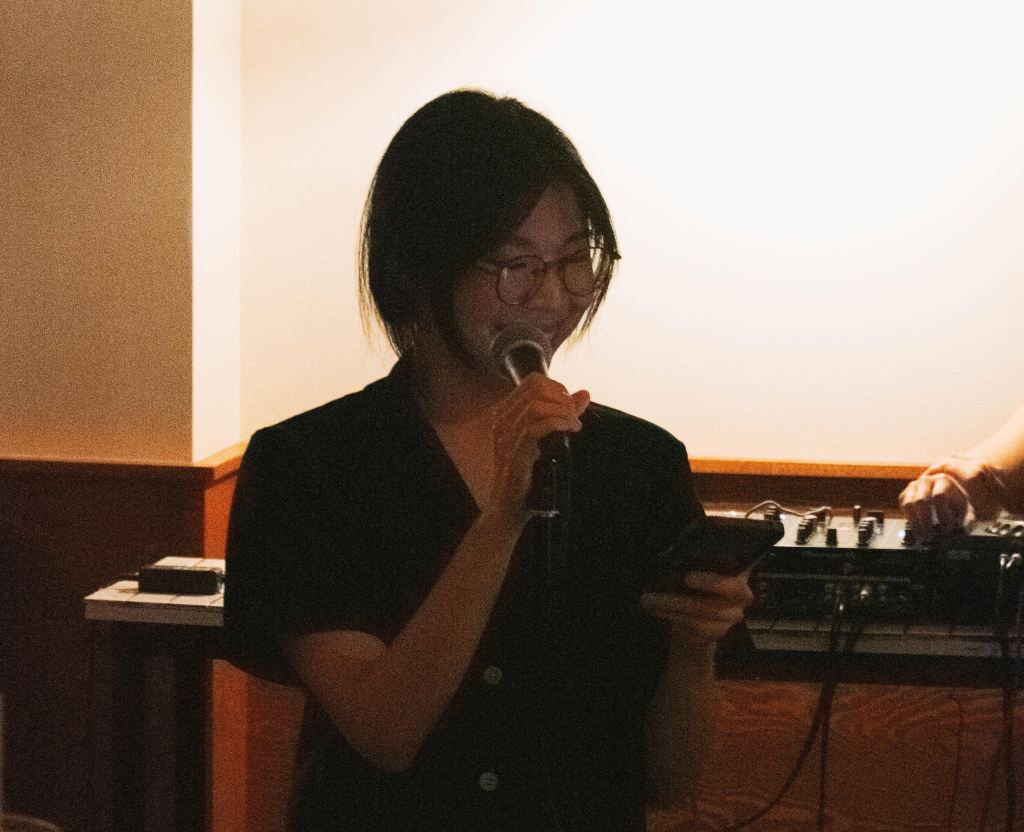
Heather Y. Kim is a daughter of Korean immigrants. She is currently a Publishing Fellow at Accent Sisters, and she holds an MFA in Creative Writing from NYU.
 Cha
Cha 