
茶 FIRST IMPRESSIONS
茶 REVIEW OF BOOKS & FILMS
[FIRST IMPRESSIONS] “Between the Libretto and the Lion Rock: Bizet’s Carmen in Hong Kong” by Jonathan Han
Warren Mok (producer) and Jia Ding (director). Bizet’s Carmen, Opera Hong Kong, 2026. Hong Kong Cultural Centre Grand Theatre, 7-10 May.
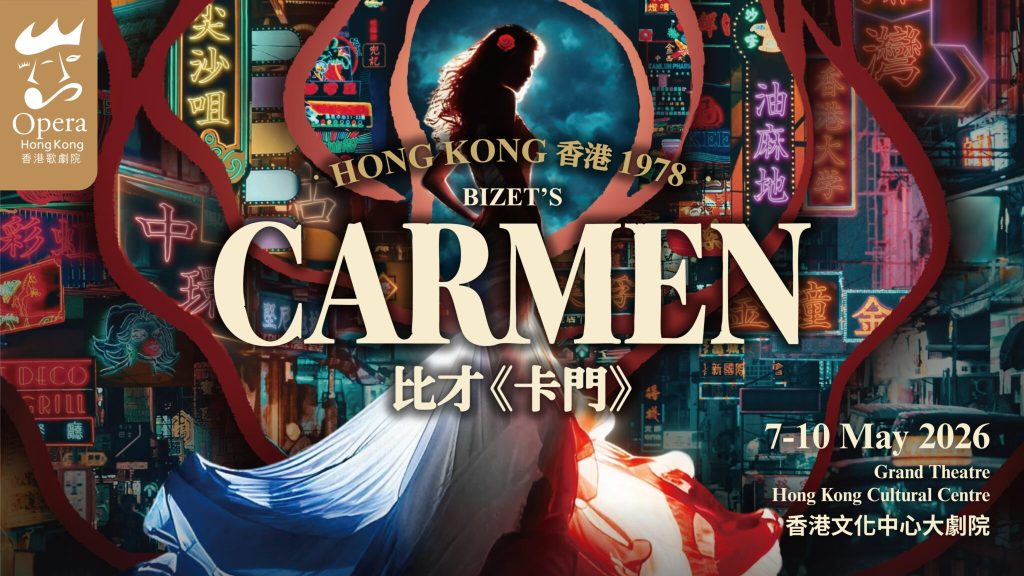
As part of the French May Arts Festival, Opera Hong Kong staged a production of Bizet’s Carmen. Produced by Warren Mok and directed by Jia Ding, the production adapts a classic French opera to a time and place the programme describes as “when miracles seemed to happen every day, enriching the lives of its citizens with hope and vitality”: Hong Kong in 1978.
Such adaptations are not uncommon. Simon Stone’s modern production of La Traviata, for example, brings the cast to the 21st century, turning the protagonist into a social media influencer. But by transposing Carmen across continents and centuries, the question immediately raised is whether this is a forced exercise and marketing hack, or a performance where the characters and themes of the original can be successfully translated.
In the original Carmen, a Spanish soldier, Don José, falls in love with a gypsy girl who lends her name, Carmen, to the opera’s title. They meet outside a factory in Seville, and José is torn between his duty as a soldier and his love for Carmen. Adding to the complexity, the village sweetheart Micaëla brings a letter from his mother, asking him to return and marry Micaëla. José’s subsequent indecisiveness affects his relationships, and Carmen soon moves on to the matador, Escamillo.
Of these primary facts, only two are changed. First, instead of a soldier, Don José is a police officer in the Hong Kong police force, dressed in their iconic green uniform. Second, the city is now Hong Kong. These artistic decisions result in an immediate incongruity when Micaëla is introduced as a girl from Mainland China, carrying a red, white and blue bag. Every main character retains their name, likely a restriction imposed by the original and unalterable French libretto.

However, the opera is more at liberty to adjust the presentation of the unnamed supporting cast. A hawker sells magazines with pin-up girls, shouting “Mai lei tai mai lei gan” (“埋嚟睇,埋嚟揀”). Cantonese is used liberally during the entr’acte, the interlude between acts. At one point, a woman with curlers in her hair, not unlike the landlady in the film Kung Fu Hustle, admonishes her husband for leering at the factory girls, once again a likely nod to the Stephen Chow comedy.
The primary reference to Hong Kong film culture is the portrayal of smugglers as triad members. At the end of the second act, Don José bows to a Chinese deity with a joss stick as part of his initiation into the triad. Dressed in leopard-skin shirts and draped with gold chains, the classic triad attire is an iconic, if not stereotypical, throwback. These references, as well as the beautiful set design, ground the opera in a convincing backdrop.
But these are superficial effects. The themes of unbridled love, fatalism, and the juxtaposition between freedom and possessiveness are not substantially altered to fit Hong Kong. For example, Carmen uses cards to divine that her fate is to die with Don José, rather than the more traditional Chinese methods of divination.

The decision not to make such substantial changes once again speaks to the nature of the opera as an art form, where the primary ideas are delivered by French lyrics that are hard to change incrementally. The result is an exercise in maximising what can be changed, rather than a diligent balance between the original meaning and the translated setting. The incongruity, however, is overcome by the overwhelming commitment to both sides: the beautiful performance of Bizet’s music and the heartwarming homage to Hong Kong’s cultural traditions.
How to cite: Han, Jonathan. “Between the Libretto and the Lion Rock: Bizet’s Carmen in Hong Kong.” Cha: An Asian Literary Journal, 20 May 2026, chajournal.com/2026/05/20/carmen.


Jonathan Han is a Hong Kong-based writer. His work has appeared in Essays in Criticism, Hong Kong Review of Books, and Asian Review of Books. His chapbook Quinquennial was published by Pen and Anvil Press. Follow his Substack @jhantheman. [All contributions by Jonathan Han.]
 Cha
Cha 