

茶 FIRST IMPRESSIONS
茶 REVIEW OF BOOKS & FILMS
[FIRST IMPRESSIONS] “The Art of Waking Up Words: Tammy Lai-Ming Ho’s If I Do Not Reply” by Anders Kølle
Click HERE to read all entries in Cha
on If I Do Not Reply.
Tammy Lai-Ming Ho, If I Do Not Reply, Shearsman Books, 2024. 110 pgs.

Tammy Ho in Chicago, November 2024
This is not a review of Tammy Lai-Ming Ho’s latest poetry collection, If I Do Not Reply. It is not a review for the simple reason that the term “review” implies repetition—seeing something again, seeing something twice—which aligns poorly with Ho’s work. She does not encourage reviews or repetitions but rather urges us to open our eyes and see as if for the very first time.
Her world, the world she shares with the reader, is one of uniqueness and remarkability—not of revisits. Words uttered twice are already half asleep. Vistas recollected lose their sharpness. But to look and name as if for the very first time is to allow our world to surprise us: to be surprisingly beautiful, surprisingly brutal.
Ho’s work brims with names. She names the joys, the streets, the corners—she names the dishes, the dangers, the tyrants. Above all, the name at the heart of her book is Hong Kong—a city, a place, a people bursting with names, often doubly so, in both English and Cantonese. What are all these names good for? What purpose do they serve in her writing? While some poets are deliberately vague about the place and time of their work, Ho is emphatically precise—situating us firmly within the city: three sparrows lined up neatly on a swing in Yuen Long, a goldfish bought in Mong Kok, stray dogs in Tin Shui Wai.

Illustration of Ho’s poem “Maybe” by Jason Li
Paradoxically, the universality of her writing stems from this focus on specificity. What others attempt to achieve by avoiding the particular, Ho accomplishes through it. Poetry seems to have little to express—nothing to convey—without engaging with the most unique, the least common, the utterly singular: this street rather than that street, these palms rather than those, this kiss from these lips rather than any other. Nothing in Ho’s poetry is replaceable, nothing interchangeable, nothing repeatable.
Where words so often drift into abstraction and lose their vitality, Ho revives them by naming. And for poetry that seeks not only to delight but also to challenge, this awakening is vital. Words that are fully awake may also be vigilant—attuned to nuance, to contrast, to truth. For instance, this distinction: a promise of freedom is not the same as freedom. Or this one: Hong Kong is not China.
One rarely has to guess what Ho thinks or believes; she almost always states it with striking clarity. There is little occasion for the usual games of hide-and-seek that some critics relish—those games that invite them to excavate words and works, returning triumphantly with insights just a fraction sharper than their peers’. The art of hermeneutics, after all, loses some of its mystique when the treasures are not concealed but placed plainly on the page, accessible to readers of all ages and diverse backgrounds.
Ho’s poetry, in this sense, is not art for art’s sake. The “problem,” if one can call it that, is that she has something urgent to say—and the weight and urgency of her message demand the clearest expression and the most luminous, sharpest forms. To mistake this clarity for simplicity, however, is to misunderstand it entirely. More importantly, it is to ignore what her clarity resists and opposes: in an age of political doublespeak and manipulation, clarity becomes a weapon aimed squarely at oppressors; in streets veiled by tear gas, clarity is both an exit and a means of survival. If smokescreens of any kind are employed to obscure injustice, violence, and cruelty, then poetry must counteract them by naming, specifying, and bringing these truths into the light. The content of Ho’s work—her subject matter—demands an unapologetic crystal of language, unafraid of illuminating too much.
If I Do Not Reply is, in itself, a reply—a multifaceted and brilliant one. It is a reply to oppression; it is a reply to injustice; it is a reply to the streets and daily life that surrounds her. Ho responds to the beauty of her city with the same passion and sensibility with which she confronts the bullies and tyrants. And, ultimately, If I Do Not Reply is a reply to our time—an era of relentless noise, incessant chatter, and endless communication, where words and language are too often taken for granted. This collection invites us to consider the power and possibility of silence: the silence that interrupts speech, cuts across conversations, and brings discourses to an end. For without silence—without the pause that gives words their weight—no reply can truly hold meaning or value.
How to cite: Kølle, Anders. “The Art of Waking Up Words: Tammy Lai-Ming Ho’s If I Do Not Reply.” Cha: An Asian Literary Journal, 29 Jan. 2025, chajournal.com/2025/01/29/if.

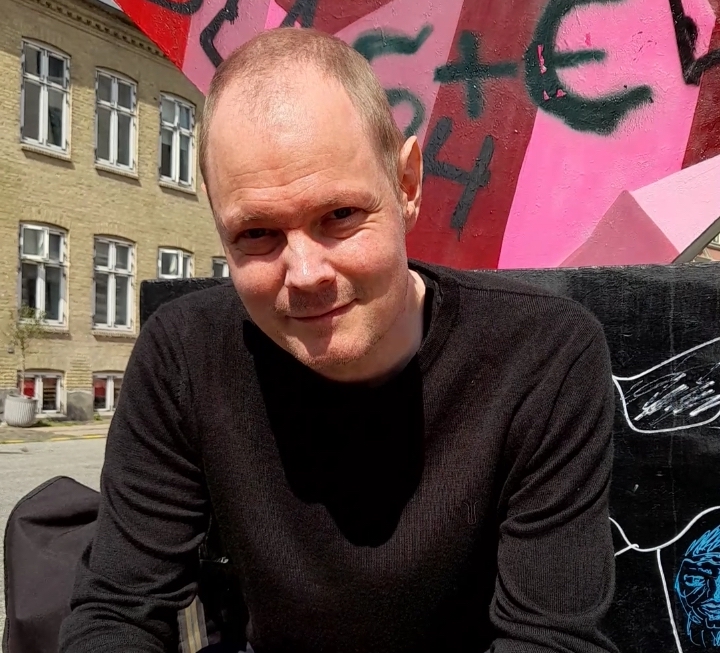
Anders Kølle is lecturer of Communication Arts at Khon Kaen University, Thailand. Holding a PhD in Media and Communications from The European Graduate School, he has taught art and philosophy at several universities, including the University of Copenhagen and Assumption University, Bangkok. His work focuses on contemporary encounters between philosophy and art, and on art’s potential to produce new modes of thinking and create new forms of critique. His publications include On Being Ridiculous (Delere Press, 2024), The Technological Sublime (Delere Press, 2018), and Beyond Reflection (Atropos Press, 2013). [All contributions by Anders Kølle.]
 Cha
Cha 