
📁 RETURN TO FIRST IMPRESSIONS
📁 RETURN TO CHA REVIEW OF BOOKS AND FILMS
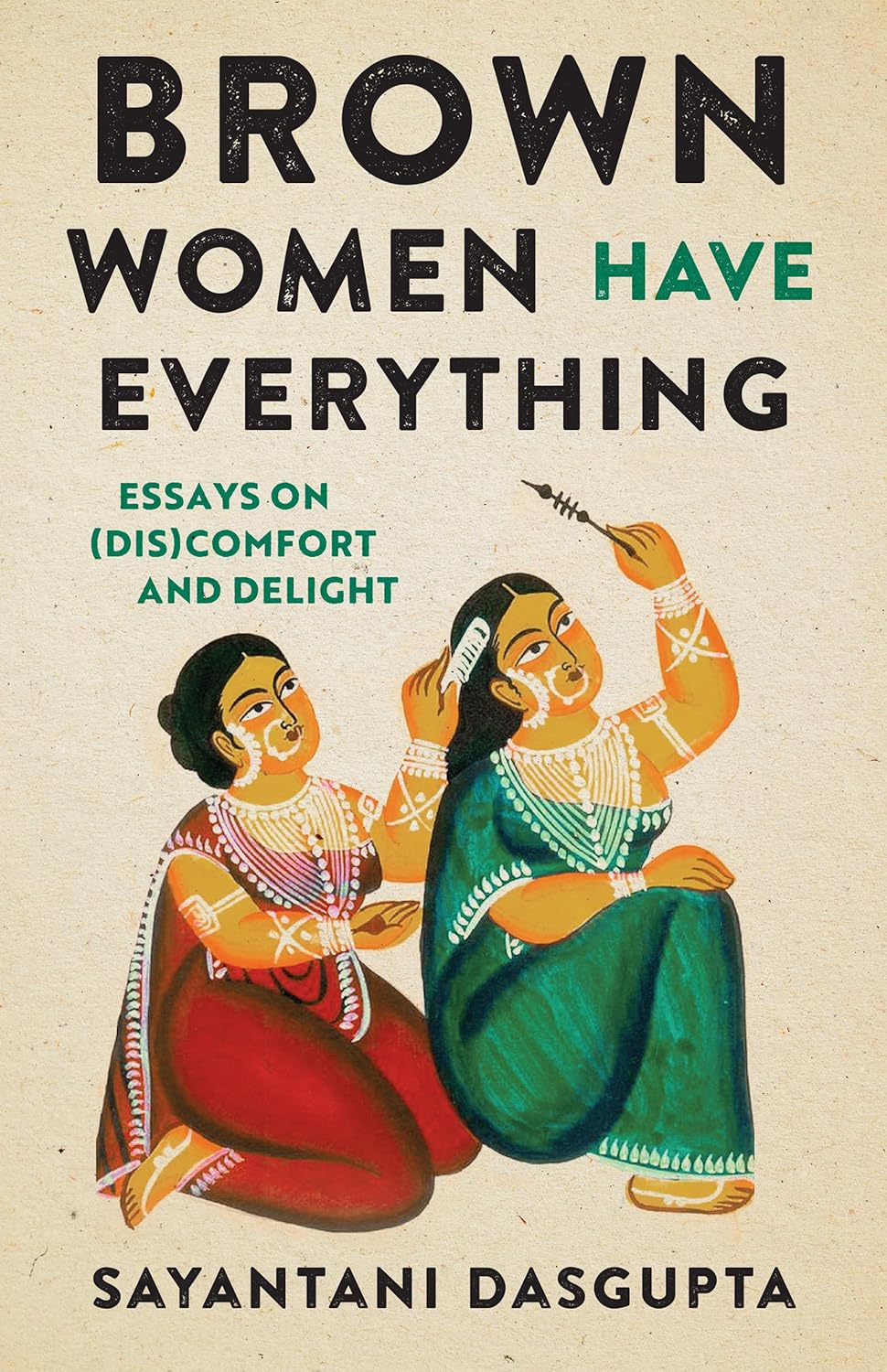
Sayantani Dasgupta, Brown Women Have Everything: Essays on (Dis)comfort and Delight, The University of North Carolina Press, 2024. 180 pgs.

When you cheerfully but firmly believe that your brown-woman existence is the result of cosmic forces, you can more than adequately respond to two white women who, unfiltered and without self-awareness, declare, “Of course, you got the job. Brown women have everything these days. They get all the jobs.” You simply tell them they’re wrong.
When an awe-inspiring tale you read as a child infuses you with the curiosity and courage of its characters, you can intrepidly leave your beloved Delhi home, family, and friends for an MFA creative writing programme in faraway Moscow, Idaho with only enough money saved to see you through the first semester.
When you are exuberant about your birthday—
I love it fiercely and ferociously. I want a massive song and dance about it. I want your cards and letters. I want a citrusy cake. I want all the dark chocolates and tubes of nice hand creams.
—in unabashed self-celebration that is not about ego, but about gratitude for the gifts in your life and the good sense to use them, you understand your worthiness despite the broken perceptions of some men in your life who have shamed you for your body.
Sayantani Dasgupta’s essay collection Brown Women Have Everything, among other things, addresses racism, body shaming, and the challenges of making your home in a new country.
As a brown woman who now lives away from her own country, I read this book, nodding in recognition, in agreement, in solidarity with Dasgupta’s experiences and insights. But even if I weren’t any of those things—brown, a woman, and most recently, an immigrant—I would be charmed by her book, her humour that sometimes bites, sometimes nudges you in the ribs; her compassion that elevates and heartens us; her vulnerability that she readily examines.
Like any writer, she writes to understand the world and the people in it, including herself. Maybe especially herself, and how she is both received and perceived as she moves in different spaces—geographical, professional, social. In her exploration, she encounters and offers up for consideration issues such as privilege, racism, the intellectual and emotional facets of multilingualism, the exoticising of another culture (hers, for instance), and guns in America.
This is Dasgupta’s second book of essays. I reviewed her first collection Fire Girl: Essays of India, America, and the In-Between several months after its release in 2016. I wrote that those essays “reflect on the necessity of feminism, the pervasiveness of sexual harassment and abuse, and the consequences of ignorance”.
She does not abandon those themes in Brown Women Have Everything because they are part of our everyday world. But the new essays are more personal and introspective, a look through related but distinct essays of how she came to be and how she has continued to engage with and learn from opportunities and goals she has pursued as well as unexpected circumstances she has found herself in. “Becoming This Brown Woman, Or, Three Glorious Accidents”, the first essay in the collection, recounts her serendipitous beginnings involving her birthdate coinciding with the date of correspondence between her grandfathers (who were not yet her grandfathers since she had yet to be born) regarding the suitability of their respective offspring for marriage to each other. If it’s a nearly bend-over-backward overreach to establish a cosmic connection, it’s a delightful one.
The other two glorious accidents, aside from having been born into her particularly loving family, were a childhood filled with books that took her to distant places and cultivated her sense of curiosity and courage; and her family’s move when she was five from Bengali-speaking Kolkata to Hindi-speaking Delhi where she also began to learn English, the language that would become her mode of creative expression.
From these three glorious events, Dasgupta emerges a multilingual lover of books and storytelling with a dream of entering an MFA programme in creative writing in America. In pursuit of that dream, she ends up in a small Idaho university town where she fields such questions as “Is India a country or a continent? Have you ever had ice cream? Does your family own an elephant?” Eventually she becomes a professor at a university in a medium-size city in North Carolina where she learns that “Your mama raised you right” is not an invitation for her to embark at length on the many virtues of her mother.
In the meantime, there are other things to deal with.
Like racism.
And what is it that one calls people like you these days?
Like the ill-treatment and exploitation of adjunct professors in academia, when she was admonished by a senior faculty member for having applied for and won a summer teaching stint in Italy because she was “taking opportunities from tenure-track and tenured faculty members like himself”.
Like when the word “compatibility” is used by a friend to refer to her body size and shape.
I knew what he meant. “Compatibility” was a big word. I was a big girl.
Like when strangers avidly share their experience of India, testing her good humour and restraint.
Yes, it is so awesome that you went to India that one time and ate curry! No, that’s all right, I don’t need the recipe.
Like guns.
Plus, in America, I always, always live with the fear that the person in front of me or behind me or anywhere around me could be carrying a gun and that any action of mine could provoke them to pull it out.
And yet, Dasgupta knows there is much to celebrate in who she is and the life she has made.
… it dawns on me afresh: I’m the first woman in my family to visit Italy, to be so far from home, and amid people who don’t look a stitch like me. I am overcome by the privilege of the moment.
She thinks of her great-grandmother, whom she never met, and who was married at ten years old.
I wonder what she would have made of her life if she’d had the same opportunities as me. If she too could have sat by a flower-lined stone staircase, sipping hot coffee that someone else made for her, reading fluently in a language that she wasn’t born to, scribbling notes in the margin with the sole purpose of engaging some twenty-somethings, knowing, at the end of the day, that she had played a role in expanding her world and those of others in her care.
These are among the lines that hit me most directly as I read Dasgupta’s related yet also individually themed essays. They express a sentiment that many of us, and especially brown women, will recognise. Whether or not we are here through cosmic grace, many of us can lead lives of opportunity and privilege despite the racism and misogyny inherent in the systems that govern our lives. And any privileges we might enjoy are a stark contrast to the lack of opportunities available to our great-grandmothers, our grandmothers, even our mothers. We honour that, as Dasgupta shows us, by making the most of what has been given us and helping others do the same.
How to cite: Miscolta, Donna. “”Expanding Our World: Sayantani Dasgupta’s Brown Women Have Everything.” Cha: An Asian Literary Journal, 11 Sept. 2024, chajournal.blog/2024/09/11/brown-women.


Donna Miscolta is the author of three books of fiction, the most recent of which is Living Color: Angie Rubio Stories. She has received the Doris Bakwin Award for Writing by a Woman, the Next Generation Indie Book Award for Multicultural Fiction and three International Latino Book Awards. She was a finalist for the American Fiction, Nancy Pearl, and Washington State Book awards. Her work appears in many journals and anthologies, and a recording of her work is part of the Library of Congress PALABRA Archive. She has an essay forthcoming in the Hypertext Magazine anthology inspired by the overturning of Roe v. Wade. Works-in-progress include a novel about aging siblings and essays about family, identity, and heritage. She recently moved from Seattle, Washington in the United States to Málaga, Spain. She blogs at donnamiscolta.com.
 Cha
Cha 