
📁 RETURN TO FIRST IMPRESSIONS
📁 RETURN TO CHA REVIEW OF BOOKS AND FILMS
Zhang Yimou (director), Raise the Red Lantern, 1991. 125 min.

Raise the Red Lantern, directed by Zhang Yimou and based on Su Tong’s novella Wives and Concubines (1987), begins with Songlian (Gong Li), a nineteen-year-old woman, agreeing to become the fourth wife (or third concubine) of a wealthy man following the death of her father. Against her wishes, she leaves behind her university schooling and reluctantly settles for an unremarkable existence. What follows is a series of disappointments she experiences in a strict patriarchal household.
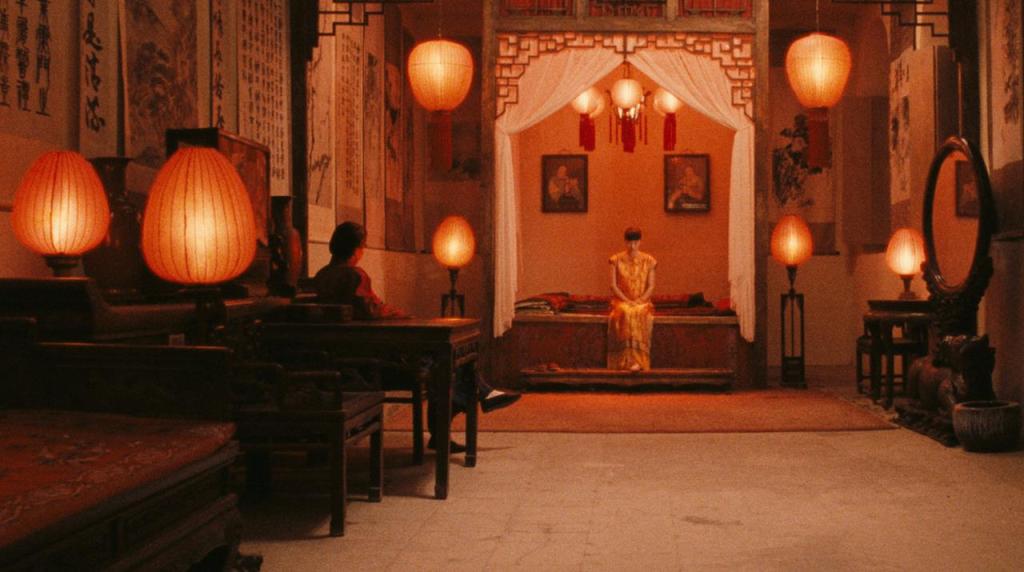
Set in Republican China of the 1920s, the film has relevance beyond that time and space. The rigid patriarchal system reduces the four wives or “mistresses” to mere numbers, and their relevance in the household fades as soon as their youth leaves them. Only Songlian, the fourth wife, due to her university education, realises this, while the other women accept their fate. The only glimmer of hope lies in Songlian‘s moments of defiance, which she continues to show despite the crushing weight of the oppressive system. This unsettling feeling of entrapment is echoed in the claustrophobic setting, where each mistress is relegated to her own house within the master’s compound. Confined in their limited spaces, they exist in isolation, with little chance of ever breaking free.

Lanterns are lit in whichever house the master chooses to visit
The “lantern” in the film’s title serves as a contradictory symbol. Lanterns are lit in whichever house the master chooses to visit, and the film subtly suggests that their glow, along with the sensuous massages the chosen wife receives that night, symbolises longevity. However, a deeper look reveals a different truth: the lanterns represent male entitlement and the devaluation of women in a patriarchal society. Though lanterns hold a revered place in Chinese culture, in the film, they also become instruments of oppression and objectification. For me, as someone unfamiliar with this cultural context and who has always associated lanterns with celebration, the film offers a strikingly different and eye-opening perspective.
Often, in patriarchal societies, ageing women are discarded as used goods. This ugly reality runs in the film from the start to the end. The fourth wife ends up being “the madwoman in the attic”, recalling the figure of the madwoman in Charlotte Bronte’s Jane Eyre (1847) and its postcolonial and highly intertextual “prequel”, Jean Rhys’s Wide Sargasso Sea (1966). In all these cases, the neglected and oppressed wife is denied the right to express anger at her mistreatment; instead, her frustration is dismissed as hysteria. Just as Bertha Mason in Jane Eyre is depicted as a “madwoman,” the fourth wife in Raise the Red Lantern is similarly portrayed as hysterical. This parallel highlights the universal nature of patriarchal oppression, evident both in China and the West. In patriarchal and misogynistic societies, ageing is seen as a natural process for men, but as a flaw in women. Both men and women perpetuate this system—men by enforcing patriarchy, and women by participating in it, often against their own interests.
Although Raise the Red Lantern is set in China and focuses on the struggles of Chinese women, the themes of male entitlement and the treatment of women as second-class citizens resonate universally. These issues are familiar even to those outside this cultural context, as similar patterns can be found across different countries and societies. Women often remain trapped in loveless marriages, not just out of helplessness, but also due to the financial security that marriage provides. The film starkly reveals that marriage is less about love and more about ownership and property rights, exposing the institution’s transactional nature beneath its romantic facade.
Throughout the film, the face of the master is blurred. What makes the film compelling is that it’s not centred on a single individual, but rather on a broader critique of patriarchy. It highlights the pervasive belief among men that women are valued as objects when young but deemed worthless with age—a mindset that transcends cultures. The use of the blurred face symbolises the universality of this issue, allowing for multiple interpretations.
Raise the Red Lantern has been widely praised for its historical significance and artistic merit, but its relevance extends to the present day. Even in the 21st century, women continue to fight for reproductive rights and bodily autonomy, while facing impossible beauty standards that reinforce the enduring notion of women as mere objects.
How to cite: M, Fathima. “The Absence of Female Desire and Patriarchal Oppression: Zhang Yimou’s Raise the Red Lantern.” Cha: An Asian Literary Journal, 9 Sept. 2024, chajournal.blog/2024/09/09/red-lantern.



Fathima M teaches English literature in a women’s college in Bangalore, India. She likes hoarding books and visiting empty parks. [Read all contributions by Fathima M.]
 Cha
Cha 