
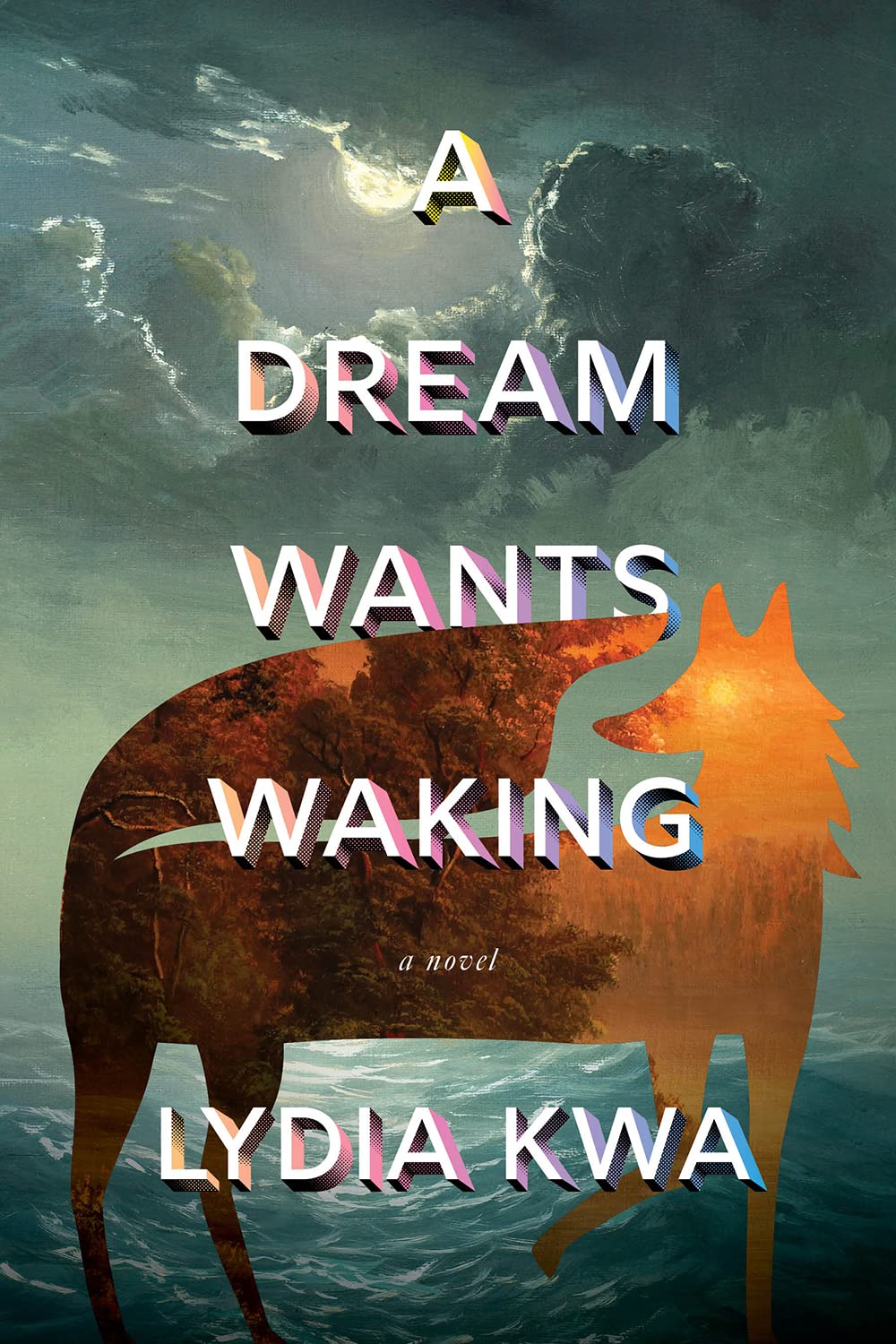
Editor’s note: Read an excerpt from Lydia Kwa’s A Dream Wants Waking HERE.
Lydia Kwa, A Dream Wants Waking, Buckrider Books, 2023. 226 pgs.

In my latest novel A Dream Wants Waking (Buckrider Books, 2023), excerpted here, there is a character named No.1 who is a gigantic chimeric brain cloned from both human and whale brain tissue. No. 1 exists suspended in the large vessel of liquid that has been their prison for many years. No. 1 is supposed to serve as a form of AI, reduced to performing their duties as a supercomputer across different zones in a mythical version of Luoyang in 2219 CE. However, No. 1 develops sentience and then clairsentience, qualities that distinguish them from being a mere device. No.1 reaches out to the scientist Dr Wen Fang as part of their struggle to achieve freedom from confinement. No. 1 asks to be addressed as “they” to acknowledge their plurality, a kind of nonbinary nature that goes beyond human definitions.
Readers of A Dream Wants Waking will understand that I have written a speculative fiction/science fiction novel, one that is significantly informed by myths and folklore in Chinese literature, such as those found in The Classic of Mountains and Seas 山海經 as well as in many tales by Pu Songling, a writer who lived during the Qing dynasty, best known for his collection Strange Tales from a Chinese Studio (Liaozhai zhiyi 聊齋誌異). Reading Pu’s strange tales, I was struck by his empathy for the poor and less privileged, including females, children, the old or infirmed, and those unjustly imprisoned or punished. I was impressed by how Pu used the medium of the strange or uncanny as a means to communicate themes of justice and the subversion and disruption of corrupt systems. Pu Songling’s tales prompted me to write speculative fiction with those aims in mind.
Although No. 1 in my novel has been called AI, my intent was to focus on forms of alternative intelligence beyond the predictable and controlled artificiality of AI. In A Dream Wants Waking, even though the governing powers that be—generally referred to as Central Government or CG—intended for No.1 to simply be “artificial” and hence subservient to the interests of those in power, No. 1 ends up asserting their own will and consciousness and acting outside of the control of Central Government.
In Osamu Tezuka’s story “U-18 Knew” featured in volume 1 of his Black Jack series, U-18 is the supercomputer responsible for the medical care of all human patients and is referred to as “the brain” by medical staff. I read the English translation by Camellia Nish a few years after it was published in 2008. When U-18 realises it is not able to work at an optimal level, it summons Black Jack, the genius surgeon, for help. U-18 resists the notion that it is a mere device—it is not “malfunctioning” but rather, it is sick and requires a doctor with special skills, not a technician. Tezuka’s story “U-18 Knew” would provide inspiration for my character No. 1.
Did Tezuka mean to suggest that computers such as U-18 could develop a kind of alternative intelligence different than what humans refer to as “artificial intelligence”? Perhaps. Humans equate creation with ownership. It would be a shock to experience that our creations end up developing independent thinking or acting outside of human expectation.
Rudy van Belkom (2024) notes that we do not even have a clear picture of how intelligence works in humans. We also do not have a generally accepted operational definition for many relevant concepts such as consciousness; and thirdly, we continually shift in our ideas of what we consider as intelligence. In contrast to the vast array of possible manifestations of intelligence and consciousness in humans, machine decision-making is optimised toward consistency across time (Gasser and Mayer-Schönberger, 2024). AI always chooses a more efficient way rather than trying to forge a new one. Artificial Intelligence, comments Gasser and Mayer- Schönberger, will lead us into vulnerability, rigidity, and an inability to adapt and evolve.
Am I suggesting that AI could develop alternative intelligence? No—not the way AI is these days. It is more that I am employing narratives about No. 1 and other nonhuman characters in A Dream Wants Waking as metaphors for forms of intelligence outside of the human domain.
Although David Abram was the first writer in the English-speaking world to coin the term “more-than-human”, he was drawing on the wisdom of Indigenous cultures and the philosophical paradigm of animism. For example, the Ojibwe believe that “the world is full of people, only some of whom are human” (Irving Hallowell, cited in The Handbook of Contemporary Animism). Humans are not only interconnected with other beings on the planet, we—and our present and futures—are also entangled with theirs.
I have preferred to use the term “nonhuman” rather than “more than human” if only to emphasise, tongue-in-cheek, the somewhat fraught and problematic way we humans tend to think narcissistically by centring the human, and relegating others to “the nonhuman”.
In the animist view, the human is but one aspect of a much larger universe. In a human-centric view, the human is primary and central, disconnected from their reliance on nonhumans. The forces of colonisation continue to privilege the needs of humans over the nonhuman universe. As such, the colonising agenda is to conquer, control and utilise resources of the natural world, resulting in a serious and often irreversible compromise of the environment and other living beings.
Does our literature reflect or challenge such a human-centric view of the world? Amitav Ghosh has passionately advocated for an alternative worldview and accompanying ethical responsibility toward our planet and nature, through the vehicles of political activism as well as literature. His wonderful works of fiction are rooted in historical and realist narratives. For other writers, we choose to explore alternative views through writing speculative fiction that challenge the human-centric world.
Animism regards the more-than-human/nonhuman world as showing intelligence and volition, and that our well-being and survival as humans depend on that world. Animist beliefs were the prevailing view of reality long before the Industrial Revolution, the rise of capitalism and the ensuing encroachment of technology into our lives.
Through No. 1’s evolution in A Dream Wants Waking, for instance, I wish to question the assumptions we make about personhood. Are humans the only persons in our universe? Does one require an animate body to be defined a person? In the novel, No.1 explores possibilities beyond data they have been fed about the range of human experiences. They dream, they imagine, they think outside predicted algorithms. No. 1 represents an alternative form of intelligence.
Like No. 1, some of us are interested in dreaming past normatively sanctioned narratives. What other kinds of possibilities exist? Are we to reduce ourselves to acting and thinking much more like AI, only capable of a narrow range of options? Or do we need to dream outside of the controlled and predictable? Outside state-sanctioned narratives? Are dreams meant to warn us, to inspire us, or even to transform our reality? Ancient, Indigenous, animist cultures respected the wisdom of dreams, and the power of myth and the imagination. Sometimes, it is a dream that impels us to awaken from a stupor of delusional existence.
A beautiful description of the animist world by Tim Ingold is quoted in Rosalind Galt’s Alluring Monsters:
Animacy, then, is not a property of persons imaginatively projected onto the things with which they perceive themselves to be surrounded. Rather… it is the dynamic, transformative potential of the entire field of relations within which beings of all kinds… continually and reciprocally bring one another into existence.
If AI is programmed to be efficient and choose consistency over time, then it cannot evolve enough because it tends not to choose something new or unknown (Gasser and Mayer-Schönberger, 2024). This is in sharp contrast to efforts of discovery, invention and the work of the imagination. If we humans reduce our forms of thinking to become more regimented and normative, we will devolve toward being artificial or automatised in our thinking and behaviour. Further system failures will ensue as a consequence of increasing rigidity. In contrast, we need to embody alternative forms of intelligence to address the needs of our planet and the beings who co-exist with us. To respect our entanglement with one another.
Works Cited
▚ Various Authors, The Classic of Mountains and Seas. English translation by Anne Birrell. London: Penguin Books, 1999.
▚ David Abram, The Spell of the Sensuous: Perception and Language in a More-Than-Human World, New York: Vintage Books, 1996.
▚ Rosalind Galt, Alluring Monsters: The Pontianak and Cinemas of Decolonization. New York: Columbia University Press, 2021.
▚ Urs Gasser and Viktor Mayer-Schönberger, “Can We Trust AI to make decisions?” Skeptic Magazine, Volume 29, #1, 2024, pp. 24-27.
▚ Amitav Ghosh, The Great Derangement: Climate Change and the Unthinkable. Chicago: The University of Chicago Press, 2016.
▚ Graham Harvey, ed. The Handbook of Contemporary Animism. Durham: Acumen, 2013.
▚ Pu Songling, Strange Tales from a Chinese Studio. English translation by John Minford. London: Penguin, 2006.
▚ Osamu Tezuka, “U-18 Knew” in Black Jack, Volume 1, pp. 200-240. English translation by Camellia Nish, New York: Vertical Inc, 2008.
▚ Rudy Van Belkom, “Why Should We Pursue Human Intelligence with AI?” Skeptic Magazine, Volume 29, #1, 2024, pp. 4-5.
How to cite: Kwa, Lydia. “Alternative Intelligence: On Brains, Being and the Nonhuman.” Cha: An Asian Literary Journal, 7 Sept. 2024, chajournal.blog/2024/09/07/alternative-intelligence.

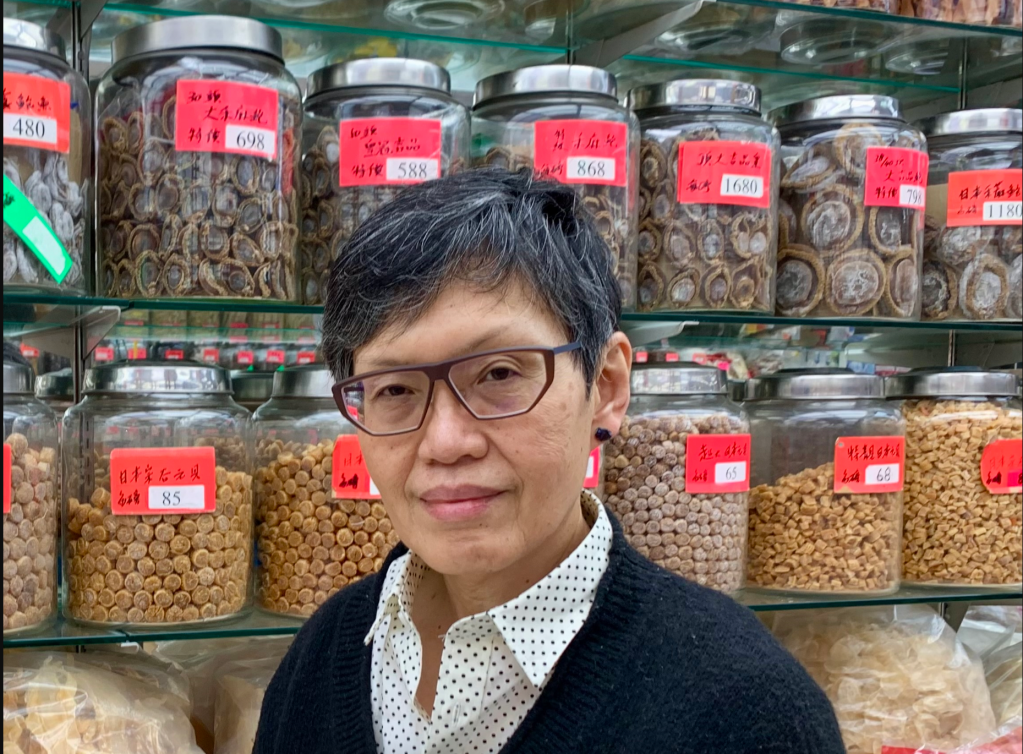
Lydia Kwa has published two books of poetry (The Colours of Heroines, 1992; sinuous, 2013) and five novels (This Place Called Absence, 2000; The Walking Boy, 2005 and 2019; Pulse, 2010 and 2014; Oracle Bone, 2017; A Dream Wants Waking, 2023). A third book of poetry from time to new will be published by the Porcupine’s Quill Press in Fall 2024. [All contributions by Lydia Kwa.]
 Cha
Cha 