
📁 RETURN TO FIRST IMPRESSIONS
📁RETURN TO CHA REVIEW OF BOOKS AND FILMS
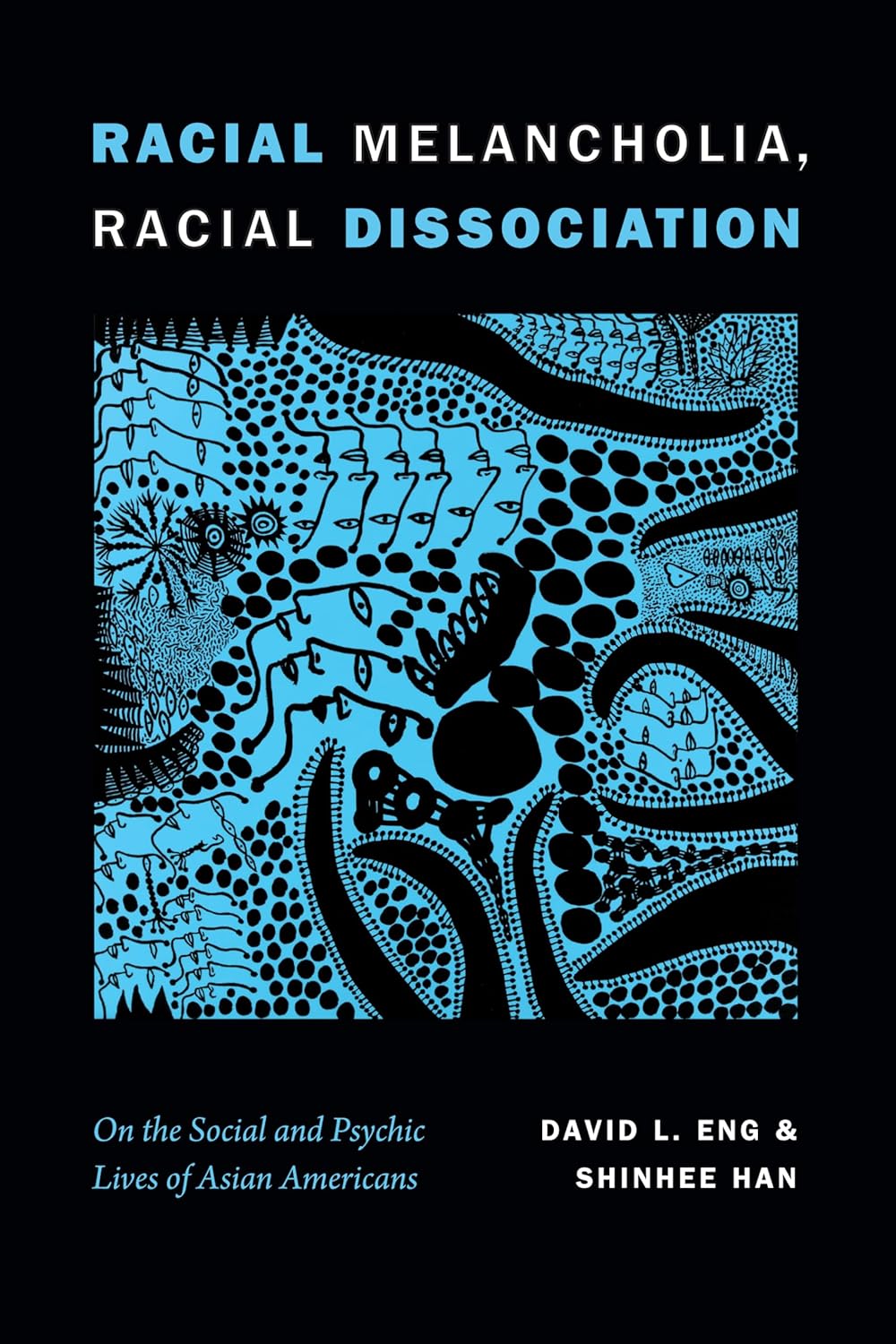
David L. Eng and Shinhee Han, Racial Melancholia, Racial Dissociation: On the Social and Psychic Lives of Asian Americans, Duke University Press, 2018. 232 pgs.

Asian Americans are pervasively seen as a monolithic, unproblematic demographic fulfilling the model minority myth. David L. Eng and Shinhee Han’s Racial Melancholia, Racial Dissociation: On the Social and Psychic Lives of Asian Americans begins a groundbreaking conversation of looking at clinical case history—cases in which Asian American students have failed to live up to the stereotype—to depathologise the Freudian notion of melancholia and introduce a novel psychoanalytic theory called “racial dissociation” that incorporates the Asian American student-patient experience relating to immigration, assimilation and racialisation within a discourse traditionally focused on white vis-à-vis black.
Eng is a second-generation Chinese American male humanities professor, and Han is a 1.5-generation Korean American female psychotherapist. They met at Columbia University and collaborated on a research publication in 2000 titled “A Dialogue on Melancholia”, reproduced substantially in the monograph as Chapter 1. Their approach is unorthodox: it is humanities-based, intersecting psychoanalytic theory with Asian American legal and political history, literary and cultural productions, and importantly, critical race theory (an area of academic studies focused mainly on juridico-political material inequality).
The monograph is divided into two parts: Part I examines Gen-X student case histories from the 1990s by deploying an analysis of Asian American legal exclusion, Homi K. Bhabha’s idea of mimicry, and selected literary and cultural productions of the time. Part I also examines the psychic conflicts of transnational adoptees using Melanie Klein’s psychoanalytic theory “good and bad objects”, nuancing it to “good and bad racialised objects” (82). Part II conceptualises the idea of racial dissociation by exploring the dispersed deterritorialised psychic conflicts experienced by parachute minors (as encapsulated by D.W. Winnicott’s idea of the “psychic nowhere”, and the “ego distortion” of the “true and false self”), and how this psychological condition affects gay parachute minors in the 2000s. Thus, Racial Melancholia valuably tracks two decades of case histories and formulates certain key observations about the differences between Gen-X second-generation and Gen-Y first-generation Asian American students. For example, the book observes that Gen-Y gay parachute students feel less stigma and are less preoccupied by their “coming-out” event than Gen-Xers; they may even see it as passé. One limitation is that all the case histories deal with a relatively well-off class of Asian American students.
Racial trauma is not new: writers from Dubois to Baldwin, Fanon to Toni Morrison (all of whom this monograph references) have explicated and depicted the psychically devaluing impact of racial bias. The recent spate of critical race theory publications by Ibram X. Kendi, Robin D’Angelo, Afua Hirsh, Reni Eddo-Lodge, to name but a few, certainly implicate the continuous psychic burden of racial inequality borne by racial subjects. Similarly, Racial Melancholia rejects the idea of race as a fixed biological property and embraces race as relation, where race is perceived as an ever-changing, constitutive relationship mediated by history and socio-legal processes of inclusion and exclusion. Importantly, it highlights the continuing dominance of Cheryl Harris’s whiteness as property, an institutional privilege supported by a juridico-political framework that essentially legitimises it. The monograph is especially attentive in unpacking how narratives such as the model minority myth and middleman thesis have been mobilised to situate an Asian American minority as “social buffer between the black slave and the white colonial master” (16) while maintaining a dichotomised discourse of black versus white.
Of the various chapters in Racial Melancholia, Chapter 1 has perhaps the broadest applicability to Asian Americans overall in its treatment of intergenerational trauma, although “trauma” is a word the authors are leery of using, considering it too nested in its association to the Holocaust. The analysis compares the case of Elaine, a second-generation Korean American female college student, who suffers from intergenerational transference of her parents’ failure to achieve the American dream, to Rea Tajiri’s 1991 documentary film History and Memory, in which a Japanese American girl has inexplicable nightmares gradually revealed to be reenactments of her mother’s internment during World War Two. While acknowledging that many literary and cultural productions have explored intergenerational racial trauma, it strikingly revisits Freud’s notion of melancholia, which he considered pathological—a mourning without end, in that the melancholic “knows whom he has lost but not what he has lost in him” (3). It underscores how historical and traumatic losses are displaced from the social external world into the internal psyche. In Freud’s idiom, a loved object brought into “the shelter of the ego” (37) is redirected into self-hate. Racial Melancholia argues that this process obscures the influence of collective history in configuring identity and the psyche. By foregrounding this point, it brings it from the unconscious into the conscious.
Similarly, in the case of Nelson, a first-generation Japanese American student with chronic depression, his childhood experience of being shamed for his mispronunciation of English words, and his mother admonished for not speaking English to him at home, has deeper consequences in the way it disrupted mother-child attachment and brokered a compromised relationship to his mother culture through a disavowal of his mother tongue. The analysis compares his experience to Monique Truong’s short story “Kelly” (1991) in which a Vietnamese student in 1975 imagines writing letters to her absent friend about her alienating classroom experience in North Carolina.
Psychotherapy commonly treats both Elaine and Nelson’s cases as private, individual dilemmas, disregarding the roles played by social history in configuring identity and psyche. By reframing the process of racial assimilation as a negotiated continuum between mourning and melancholia, the analysis depathologises melancholia, redefines these psychic processes as “conflict” rather than “damage”, and shifts the “incremental, long-term, and cumulative traumas” (20) associated with the daily experience of institutional racism back to the social, intersubjective race as relation domain.
As significant as this is, certain theoretical questions remain. Can Gen-X case histories speak equally to Gen-Y and beyond? How much should specificities of racialised experience between first-generation and second-generation immigrants matter? Are all Asian American social histories equivalent—be it Chinese, Korean, Japanese, Vietnamese; or do the magnitude, tenor, nature and particularities of racialised suffering translate into different manifestations of racial melancholia? Though multiple but overlapping, does subsuming these multiplicities under the broad banner of Asian Americanness reproduce the structuralism of whiteness as property, mimicking lines of inclusion/exclusion prevailing among racial groups? If the objective is to widen and deepen the social discourse on psychoanalysis and critical race theory, does the minimal presentation of two case histories add important insights that a more thorough literary or cultural production analysis would not have achieved? If the implications are for therapeutic address, what clinical pathways would this broader understanding of racial melancholia help determine?
Chapter 2 presents Mina, a Korean transnational adoptee who manifested an idealisation of her white adoptive mother (good) while reviling her Korean birth mother for abandoning her as a baby (bad). This stark polarity of love and hate also translated for Mina into a general racial hatred of “pampered” Korean Americans, racist anomie, and envy of other adoptees whose birth mothers came in search of them. The turning point was Dr Han’s revelation of her pregnancy, and her identity as Korean, which helped Mina see the clinic as a racialised third space, and her therapist as a racial transitional object (an expansion of D.W. Winnicott’s theory of “the thumb, the doll or the tattered blanket” as “first possession” of the transitional object for an infant in negotiating difference and similarity, self and other) (87). The racial transitional object is an important third space with reparative potential. When Mina understood that Dr Han was a Korean mother who embodied aspects of her idealised white mother but had not given up her child, she was able to create the psychic possibility that good and bad existed in both mothers and that these qualities moved between racial divides, transitioning her to racial reparation.
Less persuasive is the broad applicability to Asian Americans, whether first or second generation, millennials or generations beyond, of racial dissociation in the problematic formation of a cohesive self out of the multiple selves that parachute minors develop as a result of their peripatetic schooling experiences. The growing trend of parachute kids, first noticed in the early 1990s, increased by staggering numbers in the 2000s. They are “parachuted” to America for elementary and high school studies, some as young as eight, distanced from the intimate support networks of family and kinship, lacking an understanding of American racial history, and without clear immigration aspirations. In Chapters 3 and 4, Racial Melancholia explores the more extreme pathologies of failed adjustment and mental health issues exhibited by parachute minors. There is Yuna, a Korean parachute minor shipped to Australia and then America, who suffered from alcoholism and bulimia. There is Yung, a Chinese parachute minor who was similarly first shuttled to the Philippines and then to America, and who suffered from panic attacks. Of the two, Yuna presents a more extreme pathologised dissociation and a “false self” through her self-destructive behaviours. She is consigned to a “psychic nowhere”. The authors cite Philip M. Bromberg’s theory of “feeling like one self while being many” (122) as an example of adaptive rather than pathological dissociation. Yuna, however, displays a maladaptive ability to “stand in the spaces” of her multiple realities. Yung, by contrast, is high-functioning, but his dissociation stems from a sense of personal failure and a feeling of “wasted life”. Both cases illustrate the dilemma suffered by parachute children of unwilling separation and loss at the heart of failed adjustment to a new geographic home.
By contrast, the gay parachute minors fare better, as they welcome the sexual freedom offered in the West. However, Dr Han saw an increasing number of cases of gay parachute students suffering from panic attacks that were not ostensibly related to sexuality and race. Christopher, who is Chinese, leads a highly regulated, compartmentalised and dissociated existence, like “an automaton”. Neel, who is Indian, is overly conscious of his dark skin and obsesses over a failed relationship with his Nordic boyfriend. The analysis posits that the politics of race and sex are more obscure in a colourblind post-racial America that has witnessed the death of anti-miscegenation laws, the legalisation of gay marriage, and the election of a black President. It argues that this neoliberalism is a smokescreen, because it diffuses and obscures racialised experiences, such as the persistence of the model minority myth and an acceptance of sexuality within a subscribed atmosphere of meritocracy, freedom and colourblind opportunity. In other words, “queer liberalism is only the latest historical instalment of whiteness as property and race as relation” (171). Social norms and ideals may have shifted, and we may have adjusted but not progressed in terms of racial and sexual equality. Racial losses and grief become repressed within the unconscious, and dissociation results.
The limitations of therapeutic address—students who come for treatment are obviously going to be suffering the more extreme consequences of dissociation—mean that the monograph does not present us with studies of Bromberg’s “adaptive dissociation”, cases which include not just students, millennials, but many Asian American demographics who feel displacement, of being in a psychic nowhere, and yet are able to stand in multiple spaces and exist as multiple selves, all while bearing the psychic costs of racial dissociation intrasubjectively rather than intersubjectively. What sorts of racial dissociation do they manifest, and could they perhaps benefit from therapeutic pathways towards racial reparation?
Using critical race theory and a humanities-based approach to clinical case studies to broaden the psychoanalytic theories on melancholia, attachment, dissociation, reparation and the unconscious has enormous implications for psychotherapy, yielding a generative conceptual framework for race as relation and psychic states. Racial Melancholia begins that work. Still, let us remind ourselves, a beginning means that a lot more work remains to be done.
How to cite: Chiew, Elaine. “A Groundbreaking Conversation: David L. Eng and Shinhee Han’s Racial Melancholia, Racial Dissociation.” Cha: An Asian Literary Journal, 13 Aug. 2024, chajournal.blog/2024/08/13/melancholia.



Elaine Chiew is the author of The Light Between Us, The Heartsick Diaspora and the editor/compiler of Cooked Up: Food Fiction From Around the World. A two time winner of the Bridport Prize, her stories have been anthologised in the UK, U.S. and Asia, including The Best Asian Short Stories 2021, and being broadcast on BBC Radio 4, In a former career, she was a U.S. trained attorney with a degree from Stanford and worked in New York, London and Hong Kong. She currently edits, reviews, writes freelance, mentors and teaches creative writing. She is based in London. [Read all contributions by Elaine Chiew.]
 Cha
Cha 