
📁 RETURN TO FIRST IMPRESSIONS
📁 RETURN TO CHA REVIEW OF BOOKS AND FILMS
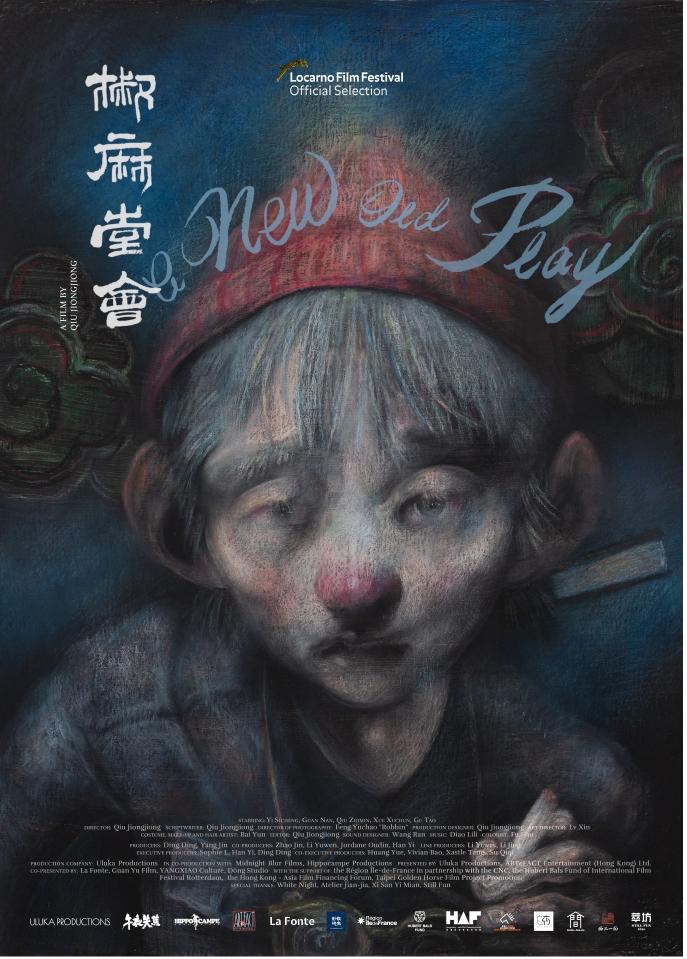
Qiu Jiongjiong (director), A New Old Play, 2021. 179 min.

After watching this film you will briefly be aphasic, with equal amounts of excitement and despondency, and your inherent aesthetic order will seem dysfunctional. Suffice it to say, I want to watch it again.
The century-long history of life unfolds in a staggered manner on the stage. At the beginning of the film, the protagonist Qiu Fu is already dead. The divine beings Ox-Head and Horse-Face, entrusted by the King of Hell, are ordered to escort Qiu Fu to the netherworld for reincarnation. The film’s narrative reviews Qiu Fu’s life, starting from the early 20th century when he first joined the Sichuan “New-New” troupe, then growing up to become a famous opera performer, slowly revealing the ups and downs of the troupe’s experiences through historical events such as the establishment of the Republic of China, Warlord Era, Sino-Japanese War, Cultural Revolution, and Great Leap Forward.

The Sichuan “New-New” troupe
A New Old Play (title in Chinese: 椒麻堂會) is also a family memory of the director Qiu Jiongjiong, and the prototype of the character Qiu Fu is his grandfather. “椒麻” refers to the flavours of Sichuan cuisine, and “堂會” refers to the places where the powerful and influential invited artists to perform back in the day. As individuals, we have always been participating in the era of 堂會, so this film is actually about the relationship between art and power.
People who like this film must be nostalgic. In Qiu’s films, characters that belong to or retain the spirit of the old times often appear incredibly vivid. They become individuals with extraordinary experiences under the camera lens, in the meanwhile, they possess the flaws inherent to being human, such as Qiu Fu, who lies in bed smoking opium; or the sharp-tongued lady, all of them are with jesters’ spirits.
In the film, the solemn desolation on the face of the adult Qiu Fu embodies the tragic core of the jester, while others represent various manifestations of the jester. They embody the jester spirit, a narrative style of black humour. After Qiu Fu’s death, he meets Crooky on the road to the underworld. Crooky says: “I heard you died, and I was so excited I couldn’t sleep all night.” Crooky is detached from the overall narrative, yet he can offer a subjective perspective that allows everyone to see the ups and downs of the theatre troupe’s fate.
Another representation, the Chicken Foot, is similar; you can understand him as a medium of communication between the human world and the divine world, or as a messenger between the audience and the author. Because Crooky appears to be physically large and very silent, his partner must be particularly lively and talkative, which is a typical comedic setup. A good manifestation is when the Chicken Foot shows his true form and starts to crow, which represents the final bloom of individual life. I admire the jester, as the jester archetype embodies the most rebellious essence within the smallest of individuals, including their tragic nature. They stand on the margins and tell jokes. In most films, the jester often appears as a supporting character without a personal character arc. However, the jester can also become the protagonist. Although the jester cannot change anything, such a humble character is also worthy of having a place in the era’s grand assembly, maintaining their dignity with black humour.

The intricate interplay of tradition and modernity
A New Old Play spans a long period, bringing out the narration of grand history through individual stories, which has a very strong literary nature on the textual level. Under such a historical narrative that spans time, I would like to elevate the form and aesthetics of the film to the highest level, that is, to discuss it in terms of film poetics. For David Bordwell’s theory, film is about creating something that exists within a historical context, to produce specific effects.[1] The film offers us a unique visual world, the approach to staging and expression that is close to theatre is more like a rhetorical device. The theatrical staging, which is full of stage presence, uses studio shooting and physical imitation of natural landscapes to replace a large number of real location shoots, creating a wonderful feeling for the audience as if they are watching a shadow play in front of a curtain. The film studio is very small, essentially a 400m² circus tent built on an abandoned basketball court. With artificial natural light and the intonation of Sichuan opera actors, the “drama” quality naturally emerges. The borrowing of traditional drama stage techniques, the varied narrative angles, the characters that jump in and out of the story, and the use of art to express fantasy and spiritual aspects together create a highly formalistic film. It deliberately breaks the instinct of movies to deceive the truth, constantly reminding us that this is the Sichuan opera world of the ancestors seen, heard, imagined, and created by the author. This is a manifestation of the film’s high authorship.
Scene after scene unfolds like a scroll, highly pictorial, and all the images are about the depth of time. Watching a film is a feeling akin to viewing a painting, with horizontal movement serving as the most important visual language of the entire film. This not only showcases the spatial structure of the stage but also embodies the struggles of countless individuals with significant differences. A New Old Play crosses several decades to present the repetitiveness and similarity of human history, then transforms this sense of heaviness into the lightness of “a fleeting moment”, akin to a mournful sigh. However, this sigh lasts for half a century before it is finally heard by us.
Film creators often wonder, what is the best form? The answer is actually self-evident: the form that is closest to the content it expresses is the best form. The true void is closer to reality. They do not ignore the various facts in the long river of time; instead, they transform them into other forms to be remembered. The use of artistic expression in a virtual state is precisely the right of artists to express themselves freely.
[1] Bordwell, D. (2012). Poetics of cinema. In Poetics of cinema (23-68). Routledge.
How to cite: Chen, Octavia. “Poetics of Cinema Under Jesters’ Spirits: Qiu Jiongjiong’s A New Old Play.” Cha: An Asian Literary Journal, 6 Jun. 2024, chajournal.blog/2024/06/06/new-old-play.


Octavia Chen is a writer and filmmaker based in Hong Kong. Her short films were selected in several film festivals such as the 2020 Global Short Film Awards Cannes and won the Humanitarian Award from AFI Cannes. She had a master’s in Directing from the School of Visual Arts in New York and an MFA in Creative Writing from the University of Hong Kong. Visit her website for more information. [All contributions by Octavia Chen.]
 Cha
Cha 