

茶 FIRST IMPRESSIONS
茶 REVIEW OF BOOKS & FILMS
[REVIEW] “To Experience A World That No Longer Exists: Ch’oe Myŏngik’s Patterns of the Heart” by Jack Greenberg
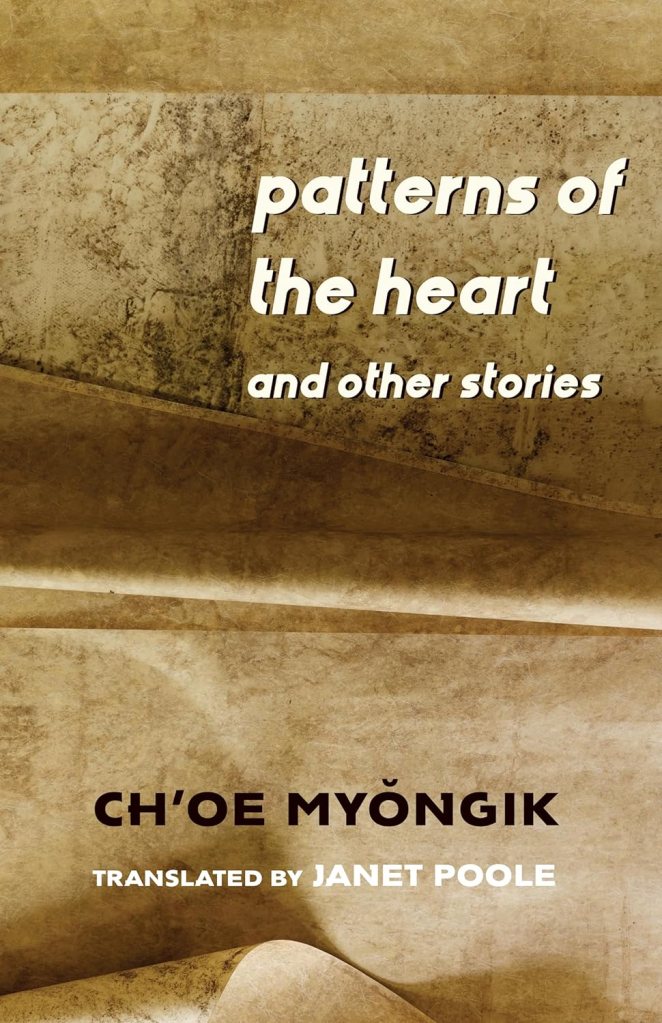
Ch’oe Myŏngik (author), Janet Poole (translator), Patterns of the Heart and Other Stories, Columbia University Press, 2024. 278 pgs.
If you go into any branch of Kyobo, the largest bookstore chain in South Korea, it is almost certain that you will not find any of Ch’oe Myŏngik’s novels or short story collections on the shelves. Today, Ch’oe has been virtually forgotten. He is no longer considered a significant figure in the Korean literary canon, and until now his work has not been translated into English. Ch’oe, however, was a bold and crucial contributor to modern literature in 1930s Korea. As Janet Poole notes in her fascinating introduction to the volume, Ch’oe soon won critical praise for his short story debut and rose above his contemporaries as “an exquisite architect of the short story form” (viii). The tragedy of there being two Koreas is the reason that Ch’oe’s reputation disappeared and that his creativity has been ignored for so many decades. For most of his life, Ch’oe was a resident of Pyongyang; he never “defected” to the North but his decision to remain there rather than migrate south meant that his work was blacklisted in South Korea until its authoritarian government fell and gave way to a process of democratic transition (xxii). This, along with his higher profile role in the North Korean cultural establishment, helps explain the difficulties even today in rehabilitating his legacy and the lack of interest, if not coolness, of South Korean readers in discovering what his work has to offer.
That said, Patterns of the Heart, despite its sometimes stilted prose, will reward readers with even the faintest interest in Korean literature or history. The collection, which is to be published in April by Columbia University Press, invites readers to experience a world that no longer exists and is taught from a different perspective in their history books. The collection presents eight stories with varied themes—some psychological, others clearly ideological. They are ordered chronologically and were published between 1936 and 1952. Set in places that will be unfamiliar to most readers, each piece offers insight into the lives of marginal people as the society around them shifted due to tumultuous events and rapid changes; first during the oppressive years of Japanese colonial rule, then amid liberation, and ultimately throughout a bloody and brutal period of war that devastated the peninsula and left no soul untouched in one way or another.
Ch’oe’s debut story, “Walking in the Rain”, takes place in the narrow laneways of the developing periphery of Pyongyang. It focuses on the internal conflict that can arise when a person is exposed to values that they cannot fully accept. The protagonist Pyŏngil’s solace in life comes from reading and it is by devoting himself to his foreign books that he manages to ease the pain of his dreary reality. However, when Pyŏngil becomes acquainted with a photographer who owns a portrait studio on the way from his workplace to his boarding-house, his solitude is disrupted. Once they take to drinking, the photographer’s judgmental attitude is revealed as he attempts to impose his own values and ideas. He admonishes Pyŏngil for being stuck in his own intellectual world and says he ought to save his salary to fulfil materialistic aims. Pyŏngil is thus forced to re-evaluate what happiness is or should be. In the end, Pyŏngil’s uncomfortable thought cycle is broken by the photographer’s sudden death in a typhoid epidemic. He takes it as a sign that he should continue to live as his authentic self. Vowing to rededicate himself to his books, he returns to his isolated existence with the hope that the “strangers [around him] on the roadside remain strangers…forever” (31).
As in other parts of the world during the early twentieth century, sex trafficking was rife in Japan’s colonial empire, with young Korean women taken across the border, forced into prostitution in the puppet state Manchukuo’s brothels. Set on a passenger train heading to the frontier, “Ordinary People” is an indictment of our indifference to the plight of the exploited. It is a grim reminder that despite it seeming like a clandestine activity on the fringes of society, trafficking very often happens in the wide open, under the noses of ordinary citizens. Despite obvious signs, like the victim not being in possession of her own train ticket and clearly under duress from her pimp, the passengers around her look away and abdicate their moral responsibility to intervene. The victim is ignored while the perpetrator is protected, excused, and understood. It is a lesson that bystander behaviour makes a real difference. Despite the passage of time, the biting message of this story continues to resonate. Sadly, the trafficking of vulnerable North Korean women and girls into the sex trade in China remains a serious human rights issue today while sex trafficking is an industry that rakes in extremely high profit in South Korea by preying on the poor and marginalised.
The stories in the second half of the book, with their overt political content, diverge greatly from those in the first, like the engrossing “Patterns of the Heart,” and “A Man of No Character.” The earlier stories are more literary works, featuring pitiful characters entangled in complicated relationships and emotional situations. Here, I’ll spotlight three of the later ones that captivated me from beginning to end.
Maekryong (“barley hump”) is an expression that refers to the period before the first spring harvest when farming communities suffer greater hardship from food shortages caused by the depletion of winter grain supplies. In “The Barley Hump,” we see how this period was experienced in the final years of Japanese imperialism as Ch’oe exposes the variety techniques the colonial overlords employed to subjugate the Korean people.
The main character is an ailing intellectual and writer named Sangjin who exiles himself to S village to bide time until liberation comes. Sangjin is a victim of Japan’s suppression of the Korean language. Having published in his mother tongue, he is deemed a corrupting influence on the youth and compelled to resign from his teaching job in Pyongyang. But even in the provinces, an intellectual like Sangjin represents a threat to the colonial order, and thus the authorities are hell-bent to manufacture a case against him. Consequently, they seize the few books that he has not hidden away, suspicious that their “unwholesome sounding fin-de-siècle titles” (155) are camouflage for more dangerous, subversive materials.
The intellectuals’ hardships are juxtaposed with those harsh realities experienced by the poor peasant class. The author represents the later primarily through Ingap and his tenant farming family. On one hand, we see Ingap and other youth from S village “compelled… to stamp out the light of their own lives” (161) through forced conscription in the Japanese military. On the other, their families are reduced to poverty because of agrarian policies, like the Rice Collection System, which hinged on the forcible extraction of their livelihoods.
The story ends on a hopeful, albeit propagandistic note. Hirohito’s unconditional surrender gives way to heady days of hope and action. The youth return alive and Sangjin is reunited with the Korean-language books he had to bury beneath piles of straw. Above all, he witnesses the slogan “land to the peasants” transformed from an abstract idea to a concrete reality on account of the Land Reform Law passed by the government of Kim Il-sung, whose cult of personality is evident throughout the text. But as the peasants celebrate the relegation of the “barley hump” to the bygones of history, today’s readers know that Ch’oe overestimated the future. North Korean’s peasants will face pains of hunger and starvation as long as the Kim regime remains in power. Economic mismanagement and multilateral sanctions exacerbate the country’s chronic food insecurity, and this means that there are still many more barley humps that the peasants must climb.
In “The Engineer”, Hyunjun is turned over to the “Railway Security Unit” after being arrested by “the bastards” for no specific reason. Secretly, he is a member of the Workers’ Party, and these circumstances give him the opportunity to commit sabotage. Acting without any orders, he manages to derail an American military train carrying weapons, ammunition and soldiers only to surrender his life in the process.
Meanwhile, in “Young Kwŏn Tongsu”, the titular protagonist’s life is upended by the red baiting of “evil reactionaries”. His siblings were “disappeared”, the Americans bombed his factory, and he is chased from his home. No sooner he is hauled in by the National Defence Forces, beaten, and then shipped off to work in a “living hell”—a POW camp which held members of the People’s Army. When the chance to escape comes, rather than flee as far as possible Kwŏnreturns and hatches a plot to save all his comrades.
During the Korean War, each sides kept prisoners in harsh conditions and rounded up those suspected to hold sympathy for the enemy. Both stories reflect the North’s resentment over how its own people were treated in captivity. They are stridently anti-American and anti-South Korean. The author makes no attempt to hide their ideological agenda. Along with the collection’s final story, “Voices of the Ancestral Land”, they share a theme of sacrifice and aim to valorise “brave” and “selfless” actions carried out for the sake of the North’s cause.
While I cannot say that I was able to connect with much of this anthology on an emotional level, I was intrigued by the concepts behind the stories. I also appreciated how the author crafted complex characters and created atmospheric settings. Especially when they reach the second half of the book, readers would be wise to remember that the stories were written for North Koreans by a writer who had to ingratiate himself to a certain extent with the new regime. At the very least, acknowledge them for their historical value as well as their uniqueness in the English publishing sphere.
How to cite: Greenberg, Jack. “To Experience A World That No Longer Exists: Ch’oe Myŏngik’s Patterns of the Heart.” Cha: An Asian Literary Journal, 13 Mar. 2024, chajournal.com/2024/03/13/patterns.



Jack Greenberg resides in Seoul where he is pursuing a master’s degree at Korea University’s Graduate School of International Studies as a Global Korea Scholarship recipient. He is a former management consultant and originally hails from Toronto, Canada. Jack regularly contributes to KoreaPro, an online subscription resource that provides objective insights and analysis on the most important stories in South Korea. His writing has also been featured in The Korea Times and Asian Labour Review. He is interested in housing issues and urban development and enjoys documenting changing cityscapes through photography in his free time and travels abroad. Follow his work on Twitter at @jackwgreenberg. [All contributions by Jack Greenberg.]
 Cha
Cha 