
📁 RETURN TO FIRST IMPRESSIONS
📁 RETURN TO CHA REVIEW OF BOOKS AND FILMS
Click HERE to read all entries in Cha on People from My Neighbourhood.
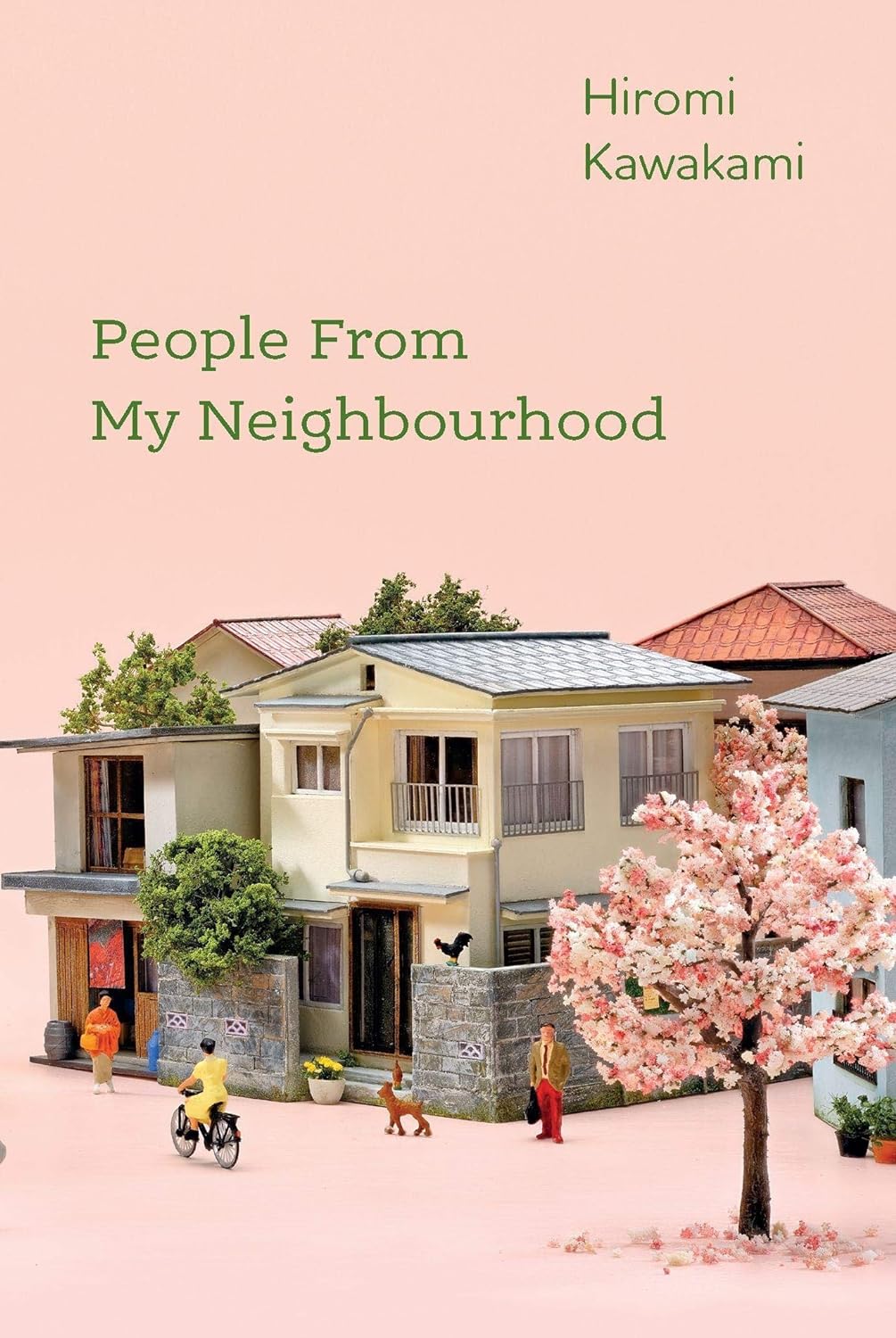
Hiromi Kawakami (author), Ted Goossen (translator), People from My Neighbourhood, Granta Books, 2021. 96 pgs.

“Why did you come here?” I asked him once. He thought for a moment. “It’s a secret,” he said at last.
Hiromi Kawakami concludes the first story (read: bite-sized, delicious little segment) of her collection on the precipice of knowing and unknowing. With secrecy, curiosity, it leaves you wanting to know more, to explore more, to understand the ins and outs of this strange neighbourhood. In this first story, an unnamed character stumbles across a child hidden underneath a white cloth by a tree. Just three pages span the length of thirty years—following the narrator and this unhuman “child”, who they have come to love.
The thirty-six pocket-sized stories in Kawakami’s People From My Neighbourhood take us through a tiny world—one fictional neighbourhood existing outside the limitations of space, time, and sense. A crotchety old chicken farmer, a principal of a school for dogs, a demon-faced woman running what seems to be the only restaurant in town (affectionately called the Love), these are just a few of the characters that Kawakami so meticulously gives tenancy to in her fictional town.
Our unnamed, untitled, really unknown protagonist weaves us in and out of the lives of their neighbours, growing and changing with them. In an almost voyeuristic approach to telling the lives and tales of people and non-people (ghosts, beings, animals…) from their neighbourhood, this narrator lives on the balcony, watching from above, sometimes judgementally, at all that will happen next.
It’s equal parts mundane and otherworldly, boring and riveting. A visual balance of sorts is created throughout each of the stories in the collection. While some follow very ordinary structures and plot lines, others give way to universes beyond our human limitations.
Kawakami blurs the lines between reality and imagination. Chance encounters cause intimately satisfying moments, such as one between the owner of the Love and the old man in “The Tenement”:
Yet the old man is still living in the tenement. “Aren’t you a ghost yourself? the woman from the Love asked him, but he just laughed. Then he went down to Ramen Five and polished off the ramen-and-fried-rice special, with side orders of Chinese chive dumplings and pickled bamboo shoots, in the twinkle of an eye.
It is also in “The Tenement” that the beginnings of a description of the strange town that this novel occupies begin to unfold. The old man in this story follows a strict and predictable routine (much like many other neighbours), and one facet of his routine is a three-day period once a year where he takes off on an adventure around town. The district he lives in is described as “so small he could have covered every street in less than half an hour”.
Multiple characters appear to be staples of the neighbourhood, dancing in and out of several stories. Familiar faces known to everyone, with backstories, histories, and growth as a character might ensue over the course of a sprawling, detailed novel.
Kanae is a gruff, daredevil delinquent ready to push the limitations of her neighbourhood, even if that means trouble, makes several appearances, dipping in and out of stories. In “Brains”, she is described straight off as “a mean kid”. As time and space change and later throughout the course of these stories, however, so too does our feelings toward Kanae. She becomes intricate, detailed. Perhaps the meanness early on stems from influence from her oldest sister.
Kiyoshi Akai and his nasty little dog, feared by just about everyone in the neighbourhood, also take residence in this narrative. He’s quickly painted out to be the know-it-all kid, privileged and uncaring. While seemingly insignificant near the beginning, Kanae’s older sister infiltrates several stories, instilling fear with her leadership and inevitably gaining enough traction to fulfil her goal of “world domination”, (and have statues created in her image, of course).
In this book, however, you cannot simply write off any character for who they are in one short, short story. Characters who are unlikeable develop nuances that force you to sympathise, or at least spark a curiosity. Pathetic characters become loveable. Power-hungry characters become just. Each story is a pebble on either side of a scale, creating a constant but steady motion of tipping back and forth, but always remaining somewhat in balance.
A sense of collectiveness thrives in the neighbourhood, causing it to function like a beehive–with roles, responsibilities, and an understanding of what needs to be done in order for the neighbourhood to keep on. While evident throughout the many stories in People From My Neighbourhood, it’s particularly prominent in “The Hāchiro Lottery”. Call it an unspoken rule, or something so ingrained in everyone’s minds that it feels inherent, but in this tale, a lottery is held, causing the losing family to have to care for Hāchiro, and orphaned child known for wreaking havoc among the families of the neighbourhoods with his huge appetite and penchant for causing trouble in school.
Rules and tradition dominate the neighbourhood and the people within it fall monotonously into line… waiting their turn at the front of the music house to be let in at 3 o’clock sharp on your birthday, spending money after school to play the baseball game (which has nothing to do with baseball), climbing to the top of the sand mountain at the sand festival. In this neighbourhood, each day is like opening a portal door to a world that is equal parts “mundane and mythical”, as the blurb on the back cover suggests.
Sometimes the colloquial hive mind of the neighbourhood loses its balance and its inhabitants fall out of sync with one another. In “Falsification”:
It was Romi Kawamata who told me about the secret yet intense war that was being waged in our neighbourhood… according to Romi, lots of places in the neighbourhood were undergoing minor changes. Why was that happening?
In this tale, it is Romi’s sister Dolly whose fantastical powers of manipulation cause both physical changes within the neighbourhood, such as doors shifting to the left or the roof of a building shapeshifting, and psychological changes, as she harnesses the ability to alter peoples’ memories. As most conflict is handled in People From My Neighbourhood, the anxiety-inducing instability of this story and threat to the general peace and order kept in the neighbourhood is put to an abrupt and halting end, as the “war” being waged is simply called off restoring mostly everything to its state before the chaos.
Another instance of this discordant imbalance in the neighbourhood arises with the rivalry of two girls, both named Yōko. Back and forth these two fight, about who has the better school principal, who is more fashionable, whose post-graduate successes were worthier of praise… the rivalry drive Yōko One mad, mad enough to cast a curse that the universe throws right back at her. In this universe, nobody wins, and the rest of the neighbourhood must bear the weight of all its inhabitants–good and bad.
Kawakami’s collection of stories is a powerful rumination on how bizarre it is to be human and to be human amongst other humans (and in many cases here, nonhumans). People From My Neighbourhood makes room for everyone’s quirks—whether charming or detrimental to the whole of the human race. Kawakami is creating modern folklore right before our eyes. Each story, each character, each being is posed not as an answer, but as a question, an invitation for further rumination on the creations in this collection.
How to cite: Haong, Kailee. “How Bizarre To Be Human Amongst Other Humans: Hiromi Kawakami’s People from My Neighbourhood.” Cha: An Asian Literary Journal, 25 Feb. 2024, chajournal.blog/2024/02/25/people-neighbourhood.



Kailee Haong is a queer Khmer-Chinese-American writer and editor. She holds an MFA in Creative Writing from Eastern Washington University. Her work has been published in Split Lip, Moss, The Inlander, Lilac City Fairy Tales, and elsewhere. She writes & resides in the Pacific NW.
 Cha
Cha 