
茶 FIRST IMPRESSIONS
茶 REVIEW OF BOOKS & FILMS
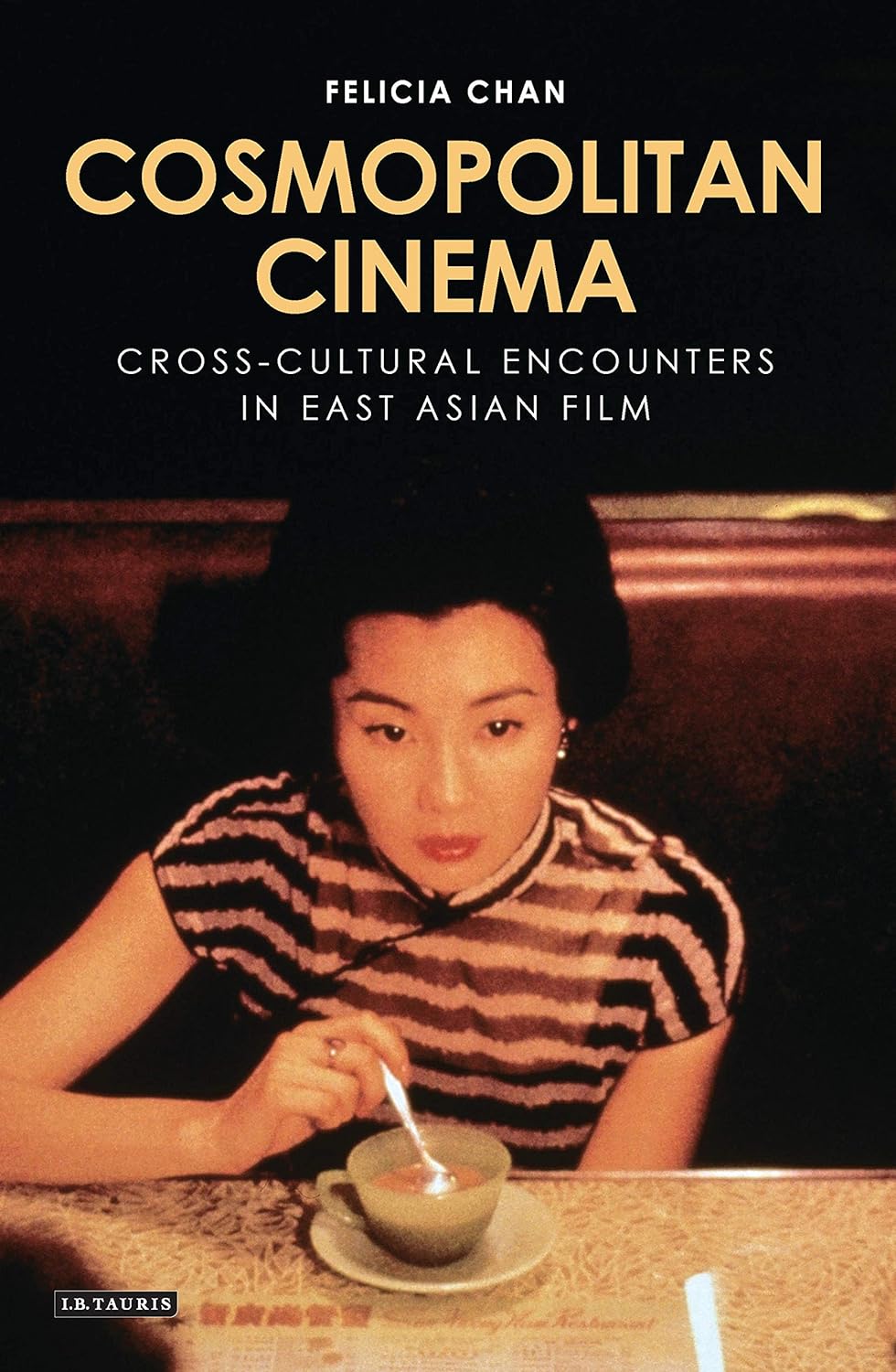
[REVIEW] “When Cosmopolitanism Traverses Across the Screen Beyond Subtitles—Felicia Chan’s Cosmopolitan Cinema: Cross-Cultural Encounters in East Asian Film” by Kathy Nguyen
Felicia Chan, Cosmopolitan Cinema: Cross-Cultural Encounters in East Asian Film, Bloomsbury, 2017. 224 pgs.

Cosmopolitanism envisions an alluring and egalitarian promise: a world founded on, inclusively open to, and welcoming of pluralities and differences. At its historical core, etymologically rooted in the Greek’s idea of a kosmopolitēs, cosmopolitanism imagines a home, regardless of geographical location, borders and distance, is anywhere and everywhere where a cosmopolitan, or a cosmopolite, as Felicia Chan and several writers also synonymously delineate, is a global citizen of the world (2, original emphasis). To be a cosmopolite implies a certain requisition of not limiting the self or being rigidly attached to singular provincial and cultural perspectives. But rather, a cosmopolite believes in and understands the existence of multiple worldviews and positionalities, regardless of the inevitable conflicts that diverge away from a familiar perspective. Yet, there remains a disconnect between a shared idealistic vision for the future and the slow inequitable progress or even stagnations of the present reality. Ideas of cosmopolitanism, much like diversity, equity, and inclusivity initiatives implemented everywhere and elsewhere, inevitably lead nowhere because at most, institutions promote them in ways that are disingenuous and performative. BIPOC and marginalised communities are still expected to perform a disproportionate amount of mental labour when institutions continue to institute a Eurocentric and whitewashed framework.
Ruminating on the possibilities of cosmopolitanism, Luke Sunderland sees its connections to feminism, “anti-racist and anti-slavery movements, and to minority rights” where attempts to dismantle and resist the all too familiar prevailing conservative culture and “white male elite hegemony” (70). But these practicalities remain rooted within a privileged myopic view of the world. Sunderland also cautions that “we must remain vigilant against a narrow or superficial cosmopolitanism: cultures can always be taught and studied along insular, nationalistic, and imperialist lines, and much depends on attitudes and configurations” (72). Perspectives presented as modern are neither new nor groundbreaking, most of which hinge on conveniently forgetting colonial histories and their continued legacies and impacts. Cosmopolitanism frames its progressive visions by encapsulating seminal and cyclical ideas from the past to shape a present-future modernity, but these too are veiled by familiar cultural and historical stagnations: classist ideas constructed to exclusively benefit and protect the privileges of the elite while willfully perpetuating inequities. Instances such as how a white person can travel cross-culturally and assimilate seamlessly while BIPOC and marginalised communities, immigrants, migrants, and refugees attempt to—are expected to—similarly assimilate, they are denigrated, becoming displaced and invisible stateless non-citizens. What remains is a jarring recurring reality: cosmopolitanism is a realm built on exclusive monolithic citizenry. How is it that a global citizen of the world, the travelling cosmopolite, can exist and belong everywhere, in every corner and juncture upon arrival while others that seek refuge and sanctuary from elsewhere are maligned as non-citizens who don’t belong?
Whether firmly rooted in idealisations of optimism and romanticism, the cosmopolitan dream is pervasive and enduring. Translating this cosmopolitan universe through cinematic optics to visualise its optimistic futurity is further explored in Felicia Chan’s Cosmopolitan Cinema: Cross-Cultural Encounters in East Asian Film. Cosmopolitan cinema resides in an exploratory, even investigative lens. Chan describes a cosmopolitan cinema as a collective filmography that “does its best work when it enables us to talk and think of cosmopolitanism as a critical mode of understanding cultural practices and relations” (6). Given the equivocal nature that encapsulates a passive interiority in art, films, too, are layered with similar multicultural, dimensional layers and historical or otherworldly possibilities where the lens simultaneously emphasises the interiority and the exteriority of diverse cultures and histories. For Chan, cinema personally translates, or perhaps even activates, nostalgia, all of which “shapes one’s encounter with the medium on screen” (3-4). Encounters—a word that Chan actively and repeatedly returns to—are essential, all of which necessitate disorienting the familiar to refamiliarise and raise awareness of the lingering resonances and impacts of recognising differences. Chan describes “cosmopolitan ‘encounters’” as encounters that “take place through questions of text via multilingualism, translation and self-reflexivity, and questions of context, via festivals, histories, marketplaces, performances and critical approaches” and within a cinematic scope, a cosmopolitan encounter is described as “requir[ing] a body on which that encounter may take place” and “occurs of places with dimensions of materiality and temporality”, all of which include the process and politics of translating films, whether through dubbing or subtitling, and cinematic encounters and experiences (8, 119, 136). Further dwelling on these cosmopolitan cinematic encounters, travels, and border crossings that traverse across screens, Chan investigates the following questions: (i) “Does cinema offer a safer space through which border-crossings and foreign encounters may take place? (ii) Or does it, in doing so, reinforce the domination of institutional structures of power? and (iii) Can cinema perhaps offer imaginative possibilities and new dimensions for how different social, cultural and critical relationalities may be advanced?” (6). While these questions emphasise the desired multiple frameworks of cosmopolitanism and a seemingly polycentric approach in creating a cinematic cosmopolitan universe—or a diverse multiverse of sorts—a cosmopolitan cinema continues to catalogue the very idea of foreign encounters.
Chan recognises that “world” cinema denotes a sense of “foreignness, but it is a position that can be selectively applied to different cultural contexts and positions” (8). Navigating between being a stranger and a foreigner, identity descriptions that are too often conflated, in films, cultural and liminal spaces further exist, contested, and navigated. Given how Chan’s book was published in 2017 and given how language continually changes and develops over time, does the more inclusive category of international films that has seemingly replaced foreign films position the same multicultural and multilingual cinematic cosmopolitan encounters that Chan describes? Two years later, in 2019, Bong Joon-ho’s film Parasite would win the Palme d’Or at Cannes, and then became the first Korean film to win Oscars for both Best Picture and Best International Feature Film in 2020, winning Best Film Not in the English Language at the BAFTA Film Awards in 2020, also winning Best Foreign Language Film at the Golden Globes in 2020, among many others. Given the rigidity of semantics, there are nuances between foreign and international such as foreign positioning “someone from another country” whereas international implies “being placed between multiple countries/nations.” Perhaps it doesn’t matter and too much emphasis is placed on the precarity of cinematic semantics and technicalities when lexicon consistently changes in form and meaning. As a vague term itself, cinema encapsulates an entire filmography of world cinema. And even then, Samhita Sunya believes world cinema “appears in a variety of iterations: a descriptor contrasted to national cinema” (31). Films described as either foreign or categorically defined as world cinema cause internal tensions because the category deviates from a perceived hegemonic standard. Are cosmopolitan films inherently foreign? And are cultural encounters, whether through cinema or elsewhere, foreign because we’re stepping into a distant cultural space that’s unfamiliar? And who is the foreigner? Through a Eurocentric and whitewashing cinematics lens, English is often the lingua franca; outside of this established cinematic tongue, why are other films from other countries where the native tongue isn’t English differentiated as foreign but are globally distributed everywhere, beyond borders?
There are a number of writers and scholars who caution about the superficial layers of cosmopolitanism. While the term and its many theoretical implications overlap with multiculturalism and globalism, it’s not synonymous with either. Chan, too, recognises the distinction between them and examines the connection, even contentions, between “‘the difficult normativeness’ of language, universalism and translation in cinema,” specifically “multilingual cinema,” which are films that move “beyond the use of two or more languages within a film” (19). Much focus has been prioritised on optimising how language migrates beyond borders and transcends a national normative cinematic lens that centre linguistic pluralities shared across and between screens. Encounters occur when films follow and travel with multiple stories—interconnected or not—across multiple cultures and countries; at times, language barriers are presented to heighten and complicate the relationships—or a weighted cultural burden—between the simultaneous disconnection and connection of multilingualism and code-switching. Closely reading Wong Kar-wai’s films such as 2046, the spiritual sequel to the acclaimed In the Mood for Love, Chan notes how Wong shows the seamless linguistic exchange in both Cantonese and Mandarin, two languages with subtle phonological differences: Chow speaking in Cantonese (Tony Leung Chiu-wai’s native language) while Bai Ling speaks in Mandarin (Zhang Ziyi’s native language) (30). If the “spectator”—a descriptor that Chan uses—isn’t fluent in either language, the dialogue in 2046 feels and sounds fluid, the exchanges flowing seamlessly. A dominant normative language is confronted and often challenged when multiple tongues, accents, and dialects amalgamate into a single frame, in a shared space. When Chow or Bai Ling “exclusively” respond in their native language, it could signify an intentional directorial decision, or a subtle response of sorts, of cross-linguistic framing, the politics and hierarchical structure of language, and the migration of and between multiple languages. Chan, however, makes a compelling point that Wong perhaps intentionally frames each character’s “exclusive use” of their native language without disregarding the other presents Wong’s decision to portray and “maintain their mutual exclusion” and setting Hong Kong as a distinct geographical backdrop presents how Hong Kong is a cosmopolitan city that is “at the crossroads of Asia” where diverse cultures “interact and intersect” (30, 29). Some of the many defining themes in Wong’s films capture the language of loneliness and longing by quietly yet sensually exploring characters navigating and inhabiting temporal and spatial locations where missed connections intersect with that very loneliness. Linguistic mutual exclusions, in this framing, reinforce the exterior openness and seemingly intimacy of spaces that poetically contrast with a lingering loneliness that creates even more distance in between those spaces.
Yet, the cosmopolitan paradox persists when identities and cross-cultural and cross-linguistic encounters remain in cultural contention with one other at every corner and intersection that are difficult to reconcile. Since the handover of Hong Kong from the United Kingdom to China on July 1, 1997, after 156 years of British rule, Hong Kong’s intra-conflict resides in its perpetual identitarian renegotiations and renavigations that are further complicated by its geopolitical conflicts with China (Chan 27). And since politics are intrinsically interwoven in films, stories that centre on Hong Kong are impacted since the handover. In 2021, Abid Rahman reports that Hong Kong instituted a censorship law that bans films that are critical of China or against their security interests. An essential aspect of cosmopolitan cinema is its spectatorial global and multicultural engagement shared on and between screens. As Rahman notes, Hong Kong’s censorship law questions how media and content will be internationally distributed or streamed by Netflix, Amazon, and YouTube. While cosmopolitanism does acknowledge and attempt to confront geopolitical divides, conflicts, and historical decisions, what happens when censored films lose their narrative voice? Chan dedicates a section, “Must Cosmopolitanism Speak?” after examining the border and beyond crossing politics of translations and subtitling. Exploring language and silence in A City of Sadness, a historical Taiwanese film directed by Hou Hsiao-hsien, Chan observes how the “dynamics of speech and silence,” a strong reference to Tony Leung Chiu-wai’s character, Lin Wen-ching, who is deaf and cannot speak in the film, which is convenient for Leung, who was not fluent in Mandarin at the time, travel “through international markets” (51) and pirated versions of the film that are streamed by other obscured, illegal websites or uploaded onto YouTube without any regard to copyright. With the prevalence of pirated films illegally released on DVD, Blu-ray, or proliferated on streaming online platforms elsewhere, will there be a cultural shift that redefines how cosmopolitan films travel across borders in an era when films and content are banned due to state governance, regulations, and extreme jingoism? And moving beyond Hong Kong and China, how are cosmopolitan films defined if they are politically silenced during a time where criticism is banned and censored as we’re regressively moving towards another anti-creative, anti-critical, and anti-intellectual age?
As another vague word and concept, world also exists in contention because of how it’s placed, or misplaced, within context or in-between cultures (Chan 12). Various iterations of a “world”, as Chan envisions, can exist in the “realm of imagination: fictional worlds, imagined pasts, reconstructed memories, all constitute worlds of a sort, along with conglomerations of people, societies, institutions, and environments” (12), and all that encapsulates a cosmopolitan world. Of course, this very abstraction popularly provides a multitude of reimagined and speculative possibilities that builds on an infinite cosmopolitan universe that’s both adaptable and translatable onscreen. A strong, clear, but repeatedly incomplete focus on an exploratory parallel universe that reimagines histories or evokes either subtle or direct sociopolitical and cultural commentary that reframes several obscured and untold stories and histories blur the spatial boundaries between the cinematics lens and societal reality.
Cinema captures memories, problematising and historicising them. The first sentence in their article, “Cosmopolitanism: Its Past and Practices”, Glenda Sluga and Julia Horne immediately assert how “Historians have only recently rediscovered the idea of cosmopolitanism as a way to understand past societies” (369). Some films tell stories that are historically unknown, unwritten, and undocumented as a way of dismantling the canonisation of how different historical legacies are retold in an identical singular perspective. Chan, likewise, opines a familiar assertion about how historical films are regarded: they memorialise an unforgotten past but offers a space to engage the present with and “through the past” (57). A re-examination and re-engagement with the past in a contemporary landscape is a means to not repeat the past; it’s a way to address and confront history in hopes of progressing to a more inhabitable and sustainable future, however optimistic and impossible this desire may be. But one question that haunts storytelling in films, or in any medium and format, and everywhere else is: who has the right to tell/retell and claim history, especially when histories are complicated and multifaceted? Who gets to document histories that are not their own and how do colonisers confront their own problematic historical legacies?
A history retold and reimagined hinges on a tinted romanticised nostalgia. Much can be said regarding the migratory nature and plight of memories and Chan, too, ruminates on how “cosmopolitan memories are travelling memories” because they not only cross borders but “take on different forms and speak to different audiences” (68). While the familiar argument of travelling memories is evocative, Chan doesn’t extend the discussion beyond how “new audiences” can be engaged with how film globally travels (76). Her close reading of Ang Lee’s adaptation of Eileen Chang’s novel Lust, Caution, while interesting, largely focuses on the performative aspects and aesthetics of the film with few explorations on the historical legacy and the many complicated political memories woven in. There are direct references to how the film redocuments the political tensions and memories of China being under Japanese occupation and how the impossibility of reconciling nationalism and romance (69), and like most films that use history as a background to foreground a tragic love story, between national allegiance and romance, one inevitably has to be sacrificed.
A question that continues to linger: what makes a film uniquely cosmopolitan? Films that are deemed modern explore similar topics that Chan describes: “haunted by history” (129), encounters embodied by multiple temporal and spatial locations, and the politics of language and multilingualism. Films, in an ever expansive growing genre named and renamed, offer a universe, a contentious one. Still, films might only exist as a creative medium to singularly be remembered as only that: a moving framework that explores and envisions an imaginative possibility in a present reality that is fraught with impossibility. Is it just that, a promise that can only be fulfilled onscreen?
Bibliography
▚ Chan, Felicia. Cosmopolitan Cinema: Cross-Cultural Encounters in East Asian Film, I.B. Tauris, 2017.
▚ Rahman, Abid. “Hong Kong Passes Censorship Law Banning Films Against China’s National Security Interests.” The Hollywood Reporter, 27 Oct. 2021, hollywoodreporter.com/movies/movie-news/hong-kong-film-censorship-law-1235038330/.
▚ Sluga, Glena, and Julia Horne. “Cosmopolitanism: Its Pasts and Practices.” Journal of World History, vol. 21, no. 3, 2010, pp. 369-73.
▚ Sunderland, Luke. “Cosmopolitanism.” Transnational Modern Languages, Liverpool University Press, 2022, pp. 69-76.
▚ Sunya, Samhita. “Problems of Translation: World Cinema as Distribution History.” Sirens of Modernity: World Cinema via Bombay,” University of California Press, 2022, pp. 31-49.
How to cite: Nguyen, Kathy. “When Cosmopolitanism Traverses Across the Screen Beyond Subtitles—Felicia Chan’s Cosmopolitan Cinema: Cross-Cultural Encounters in East Asian Film.” Cha: An Asian Literary Journal, 24 Feb. 2024, chajournal.com/2024/02/24/cosmopolitan-cinema.


Kathy Nguyen received her PhD in Multicultural Women’s and Gender Studies from Texas Woman’s University and she is currently an Assistant Professor of Ethnic and Gender Studies at Metro State University in Saint Paul, Minnesota. Her works have appeared in Gulf Coast, Drunk Monkeys, Short, Vigorous Roots: A Contemporary Flash Fiction Collection of Migrant Voices, which is a 2022 Foreword INDIES Finalist for Anthologies, Food of My People: The Exile Book of Anthology Series, diaCRITICS, Kartika Review, FIVE:2:ONE, Fearsome Critters, which was selected as the Editors’ Choice for Top Contributor in Hybrid Work, The Activist History Review, and elsewhere. She was a former Short Fiction Section Co-Editor at CRAFT Literary. She is interested in the political origins, renderings, and the poetic yet nostalgic stagnations of pre-1975 nhạc vàng. Broadly, in her writing, she is interested in further exploring the precarious hierarchical structure of language and its connection to people living in an indefinite threshold that oscillates between translatable and untranslatable words. Her first chapbook is forthcoming. [All contributions by Kathy Nguyen.]