

茶 FIRST IMPRESSIONS
茶 REVIEW OF BOOKS & FILMS
[ESSAY] “Tragedies of Inequality: Bong Joon-ho’s Parasite and Jordan Peele’s Us” by Jonathan Chan
Bong Joon-Ho (director), Parasite, 2019. 132 min.
Jordan Peele (director), Us, 2019, 116 min.

The sociologist Teo You Yenn has argued that attention to inequality contains two questions: “first, what is the field of power and politics in which any given case lies? Second, what are the differential consequences for people and groups when the field of power and politics is not flat?”[1] As the British journalist Simon Tisdall remarked in 2019,
Recession, stagnant or falling living standards, and austerity programmes delivered from on high have shaped [young peoples’] experience. As a result, many current protests are rooted in shared grievances about economic inequality and jobs. In Tunisia, birthplace of the failed 2011 Arab spring, and more recently in neighbouring Algeria, street protests were led by unemployed young people and students angry about price and tax rises—and, more broadly, about broken reform promises. Chile and Iraq faced similar upheavals last week. [2]
In the time since, these pressures have similarly informed protests in Hong Kong and Thailand. The viscerality of this rage is defined by a feeling of stasis: the impossibility of social mobility, of owning a home, or of breaking out of unemployment, one exacerbated by the cleavages induced under the COVID-19 pandemic since 2020.
Film serves as a vehicle for these sentiments in its capacity to depict the mutuality of the rich and the poor. Kaila Philo describes a new wave of cinema concerned with inequality as “the New Proletarian Cinema”, remarking, “These films showcase the difference between nightmares and realities: Nightmares connote the potential to wake up, whereas realities may never end.”[3] This sense of perpetuity is apparent in several well-received recent films, including The Florida Project (Sean Baker, United States, 2017), Capernaum (Nadine Labaki, Lebanon, 2018), Roma (Alfonso Cuarón, Mexico, 2018), and Shoplifters (Hirokazu Kore-eda, Japan, 2018).
While tragic narratives in their own right, they present a sharp distinction from another recent slate of films that take income inequality as their starting point. Director Jordan Peele describes this genre as the “social thriller”, taking elements of suspense and horror to augment instances of oppression in society. As he describes these films, “The bad guy is society—these things that are innate in all of us, and provide good things, but ultimately prove that humans are always going to be barbaric, to an extent.”[4] Herein, such films take the feelings of indignity and powerlessness arising from material inequality as that which inheres in the logic of a tragic narrative.
Bong Joon-ho’s Parasite (South Korea, 2019) and Peele’s Us (United States, 2019) could be described as such tragedies of inequality, with their ravenous global reception suggesting resonance with contemporary audiences. As Andrew Chow notes:
Us shares a startling number of commonalities with Parasite: they each focus on the clash between two mirrored families of four, one privileged and one oppressed; they sow a contrast between large, airy houses and seedy underground spaces; and are informed by house invasion tropes and horror genre frameworks. [5]
Both filmmakers approach inequality by way of spatialisation, mutual recognition between their characters, and an inevitable eruption into violence. The tragic situations articulated are those of despair: there are no resolutions in their films, only rampant bloodshed and fear.
Parasite and Us feature a geospatial literalisation of inequality through the use of underground sets. In doing so, they draw on a lineage of fear toward the subterranean, of troglodytes that emerge from beneath the earth to supplant those above it. The British writer Robert Macfarlane remarks, in his book Underland, that:
… a densely stacked modern cityscape leads, inevitably, to a new geography of inequality that requires reading in vertical terms. Broadly speaking, wealth levitates and poverty sinks. Privilege prefers to distance itself from the mess of the street […] and tends only to delve below ground when that delving offers security or privacy. [6]
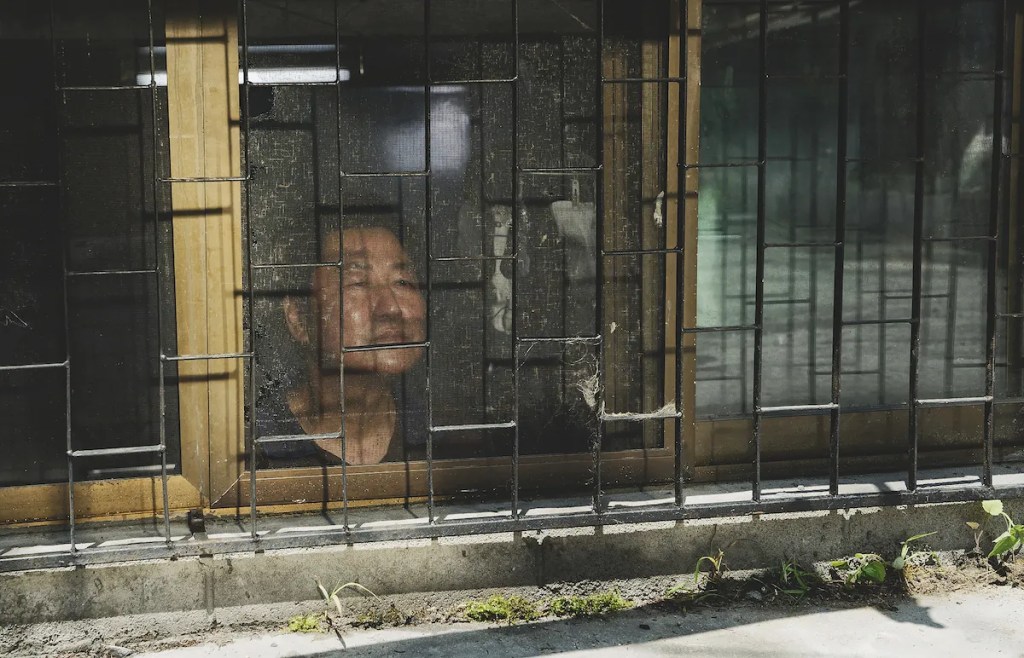
The apartment’s window reveals an alleyway
In Parasite, this takes several forms. The first is in the home of the film’s central family—Kim Ki-taek (Song Kang-ho), his wife Chung-sook (Jang Hye-jin), his son Ki-woo (Choi Woo-shik), and his daughter Ki-jung (Park So-dam) live in a small, semi-basement apartment. Bong’s camera angles are frequently oriented upwards, especially as the apartment’s window reveals an alleyway where urinating drunkards are visible. This is set in contrast to the Park family, whose luxurious bungalow is located on the hills overlooking Seoul. The Kims’ gradual infiltration into the Parks’ home is accomplished by nefarious means after a friend introduces Ki-woo to the Parks to tutor their daughter in English. The Kim family take on “parasitic” qualities as they draw on the Parks’ wealth, fulfilling the roles of art tutor, chauffeur, and housekeeper. This sense of material ascension is intensified by upward-facing shots each time they climb the hill to the Parks’ home.
The enfolding of high and low is torn asunder during a period of heavy rain—while the Parks’ bungalow is unaffected, the Kims’ basement apartment is completely flooded and they are forced to take shelter in a school auditorium. The sense of a spatial divide is furthered as Park family patriarch Dong-ik (Lee Sun-kyun) consistently comments on Ki-taek’s “smell”. [7] Ki-taek’s daughter Ki-jung remarks that their damp scent is a “basement smell”, an irremovable trace of their “low” position in society. [8] In a particularly humiliating scene, Ki-taek hears Dong-ik remark that he smells like “an old radish” or “people who ride the subway”.[9] This furthers the imagining of inequality via spatiality, primarily through symbols of the underground world.
The spatial divide between high and low in Parasite is intensified by the revelation that the previous housekeeper Moon-gwang’s (Lee Jung-eun) husband Oh Geun-sae (Park Myung-hoon) lives in a secret underground bunker in the Parks’ house. Driven into hiding by loan sharks, Geun-sae emerges only when the Parks are out, to be fed by his wife. Such is his comfort underground that he remarks, “It feels like I was born here.” [10] Geun-sae is characterised as a different kind of parasite, one whose existence is ensured by the material provision of the Park family.
This takes on a perverse reverence as Geun-sae pins on his wall newspaper clippings of Dong-ik and his achievements as a tech executive and give thanks to him each day. While the Kims render services unto the Parks and receive material reward, Geun-sae’s survival is underwritten by the payments given to Moon-gwang as the Parks’ housekeeper. The verticalisation of economic relations in the film thus creates a distinctly visual sense of this hierarchy. As E. Alex Jung describes it, the house “becomes a map of class psychology and the resentment that simmers beneath the surface”. [11]
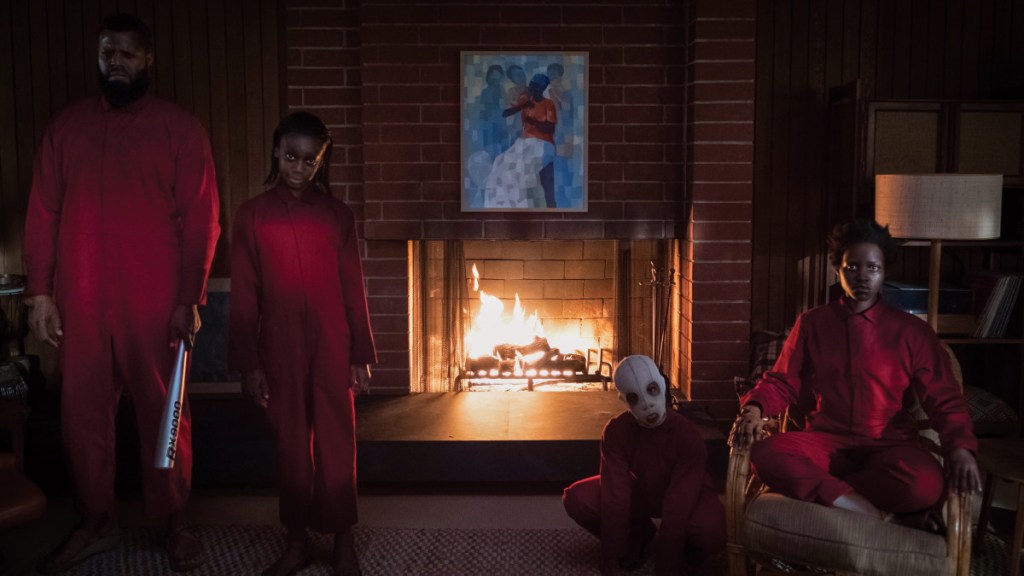
Wilson family’s home is invaded by their doubles, eerie mirrors who wear red jumpsuits
Us, by contrast, dramatises this economic intersubjectivity through the figure of the troglodyte doppelgänger. While on holiday at a lake house in Santa Cruz, the Wilson family’s home is invaded by their doubles, eerie mirrors who wear red jumpsuits. Introduced as the “Tethered”, each function as a bizarre counterpart to their overworld companions. Husband Gabriel’s double, Abraham, is bearded and burly; daughter Zora’s double, Umbrae, is sinister and without eyebrows; son Jason wears an ape mask while his doppelgänger wears a cloth mask because of a facial deformity; and mother Adelaide’s twin, Red, is the only one who can speak, her voice croaking into intelligibility. The invocation of the subterranean is foregrounded through the “tethering force” that links the overworld and underworld.
The horror of encountering the double is underscored by their forced mirroring of their overworld counterparts. The constitution is unilateral: the tethered have no choice but to mimic the movements of their mirror image. The solution, as posited by Red, is “The Untethering”. She describes a divine vision: “a line of blood on the soil that stretched as far as I could see”. [12] The link that Peele draws out with inequality is unclear. Does he mean that American society is constituted by the suppression of an underclass? His allegory is complicated, as Red reveals the origins of the doppelgängers:
The soul remains one, shared by two. They created the Tethered so they could use them to control the ones above. […] But they failed, and they abandoned the Tethered. [13]
By invoking the trope of secret US government experiments, Peele alludes to the clinical, planned nature of inequality. Unlike the Kim family or Geun-sae, the Tethered receive no material sustenance from their overworld counterparts but are condemned to mimic their experiences in gruesome variations. This feeling of inescapability draws the film back into the remit of social inequality, the injustice of coercion, but the intractability of relational ties.
In establishing the spatial and socioeconomic disparities between their wealthy and poor characters, but also in the impossible mutuality of their relations, Bong and Peele each create an interminable knot in their narrative. There can be no reconciliation between the Kim family, Moon-gwang, and Geun-sae: the Kims need the material security enabled by their ruse and to release the two from their bunker would expose their secret. For the Wilsons and their Tethers, it is a matter of survival: the liberation of the tethered soul can only happen once their overworld counterparts are killed. The films recall Seneca’s tragedies in their bloody resolutions, with bodies mangled, bludgeoned, and stabbed. The artifice of bourgeois serenity is ruptured by the violence of a resentful underclass.

Parasite’s climax comes during a birthday party for Da-song, the Parks’ youngest son
Parasite’s climax comes during a birthday party for Da-song, the Parks’ youngest son. Ki-taek and Chung-sook labour to help with preparations, whether by cooking, grocery shopping, or setting up tables and chairs in the garden.[14] Having lost their home to floods, the Kims’ resentment simmers with every blithe instruction from Yeon-gyo. Geun-sae’s emergence from the bunker, facilitated by a penitent Ki-woo, leads to the intense unravelling of the birthday party—Geun-sae smashes Ki-woo’s head with a rock, and, armed with a knife, rushes onto the lawn unnoticed by the assembled party guests, stabbing Ki-jung in the chest. The blood splatters, the guests scatter, and Chung-sook wrestles him to the ground, stabbing him with a meat skewer. Da-song faints at the sight of Geun-sae, having been traumatised by an encounter with him in the past. Dong-ik orders Ki-taek to drive Da-song to hospital. However, incensed by Dong-ik’s covering of his nose in response to his “smell”, Ki-taek instead stabs him before fleeing the scene. [15]
At the film’s conclusion, the conflict between the Kim family and Geun-sae ceases to be one of simple material competition. Their aspirations of socioeconomic ascension are rendered illusory as they all return to a position of stasis, particularly as it is revealed that Ki-taek has taken Geun-sae’s place in the bunker to avoid imprisonment for the murder. Bong’s narrative craftsmanship is on full display in this complex interplay between his characters. E. Alex Jung remarks that
In Parasite, the scam ultimately reveals something more insidious: that wealth is always built upon poverty and that the two are locked in a constant struggle. The poor wish to be rich, and in order for someone to be rich, someone else must be poor. [16]
This circularity finds no means of resolution, but alludes to the broader conventions of “social horror”: tragedy arises from the entrapments of broader socioeconomic structures and the attendant sources of friction, competition, and rage between people that ensue from it.
While extreme violence erupts near the end of Parasite, it is brought to the forefront in Us as the Tethered profess a desire to supplant their overworld counterparts. The “untethering” they aspire to is a fracturing of the literal determinism enacted upon their bodies. As with Parasite, the tropes of the home invasion are evident as domestic objects are transformed into instruments of horror and suspense. Yet, Peele’s anti-materialist strain is clear as the Tethered not only acquire the possessions of their overworld counterparts, but are also killed by them. The weapons of choice for the Wilson family each represent a particular strain of American aspirationalism—Gabe kills Abraham with the propeller of a boat, Zora hits Umbrae with a car, and they kill their neighbours’ Tethered counterparts with golf clubs. The material goods that the Tethered hope to acquire are instrumental in their undoing, even if one might find a crudeness to the metaphor of material goods bashing Peele’s characters over the head.

An encounter as children
The film’s final confrontation between Adelaide and Red presents its most cutting twist, but also permits the possibility of a mutual influence. Red declares to Adelaide that her ability to dance sets her apart from the rest of the Tethered. The film cuts rapidly between shots of Adelaide executing ballet moves with finesse and Red being jerked around violently as her perverse parallel. Adelaide finally suffocates Red with the handcuffs that were put on her at the beginning of the film, foreshadowing the revelation that Red is not Adelaide’s tethered parallel. Rather, during an encounter as children, Adelaide had dragged Red to the underground facility and taken her place on the surface world.
This shift in polarity throws the entire film off-kilter. Adelaide is the only tethered individual to have reversed her fate, but is not made any more sympathetic for it. With Parasite, our attention is drawn to the irreconcilability between competing desires and aspirations. In Us, reconciliation is not a possibility but an impediment. The Tethered can only be accorded dignity by supplanting the determining forces of the overworld. In Peele’s cinematic reimagining of inequality, the invisible, seemingly indestructible forces that uphold society portend the perpetuity of tragic situations. As he puts it:
For us to have our privilege, someone suffers. That’s where the Tethered connection, I think, resonates the most, is that those who suffer and those who prosper are two sides of the same coin. [17]
If one way to think of tragedy is to meditate on the avoidable nature of violence, these social horror films probe us as viewers to consider our embeddedness in systems that create the conditions for daily violence. As critic Dana Stevens says in her review:
By the end of Parasite, the audience is uncomfortably aware of our complicity with an economic system that allows such deep class divisions to rule our lives and structure our everyday interactions. [18]
Our sympathies are displaced by this expansive psychological terrain, for there are no characters whose convictions remain illegible to the viewer. Walking away from these films, we may become more attentive to the sense of indignity that structures our interactions with those of disadvantaged backgrounds, more attuned to the inevitable cliché that the pandemic has laid bare vocational and economic inequalities that had previously been unseen by most.
Notes
[1] Teo You Yenn, “Inequality as analytical lens”, Teo You Yenn, 11 August 2019.
[2] Simon Tisdall, “About 41% of the global population are under 24. And they’re angry…”, The Guardian, 26 October 2019.
[3] Kaila Philo, “Paradise Lost”, The New Inquiry, 16 January 2018.
[4] Jada Yuan and Hunter Harris, Hunter, “How Get Out, the First Great Movie of the Trump Era, Got Made”, New York Magazine, 5 February 2018, pp. 28–35.
[5] Andrew R. Chow, “Bong Joon-Ho on Violence in Film and the Influences Behind Parasite”, TIME, 11 October 2019.
[6] Robert Macfarlane, Underland: A Deep Time Journey (UK: Penguin Random House, 2019), p. 150.
[7] Bong, Parasite.
[8] Bong, Parasite.
[9] Bong, Parasite.
[10] Bong, Parasite.
[11] E. Alex Jung, “Bong Joon-ho’s Dystopia Is Already Here”, Vulture, 7 October 2019.
[12] Peele, Us.
[13] Peele, Us.
[14] Bong, Parasite.
[15] Bong, Parasite.
[16] E. Alex Jung, “Bong Joon-ho’s Dystopia Is Already Here”, Vulture, 7 October 2019.
[17] Shannon Miller, “Jordan Peele explains how privilege influenced Us in an exclusive clip”, The A. V. Club, 4 June 2019.
[18] Dana Stevens, “Parasite Is the Best Movie of the Year So Far”, Slate, 10 October 2019.
How to cite: Chan, Jonathan. “Tragedies of Inequality: Bong Joon-ho’s Parasite and Jordan Peele’s Us.” Cha: An Asian Literary Journal, 6 Jan. 2024, chajournal.com/2024/01/06/parasite-us.


Jonathan Chan is a writer and editor of poetry and essays. Born in New York to a Malaysian father and South Korean mother, he was raised in Singapore and educated at Cambridge and Yale. He is the author of the poetry collection going home (Landmark, 2022), which was named a 2022 Book of the Year by SUSPECT. Previously a participant in the Singapore International Film Festival’s Youth Jury & Critics Programme, his writing on film has appeared in Stories Journal, Film Criticism, and Quarterly Literary Review Singapore. More of his writing can be found at here. [All contributions by Jonathan Chan.]
 Cha
Cha 