

茶 FIRST IMPRESSIONS
茶 REVIEW OF BOOKS & FILMS
[REVIEW] “An (Im)possible Document: A Review of Karen Cheung’s The Impossible City” by Luca Griseri
Click HERE to read all entries in Cha
on The Impossible City.
Karen Cheung, The Impossible City: A Hong Kong Memoir, Penguin Random House, 2022. 352 pgs.
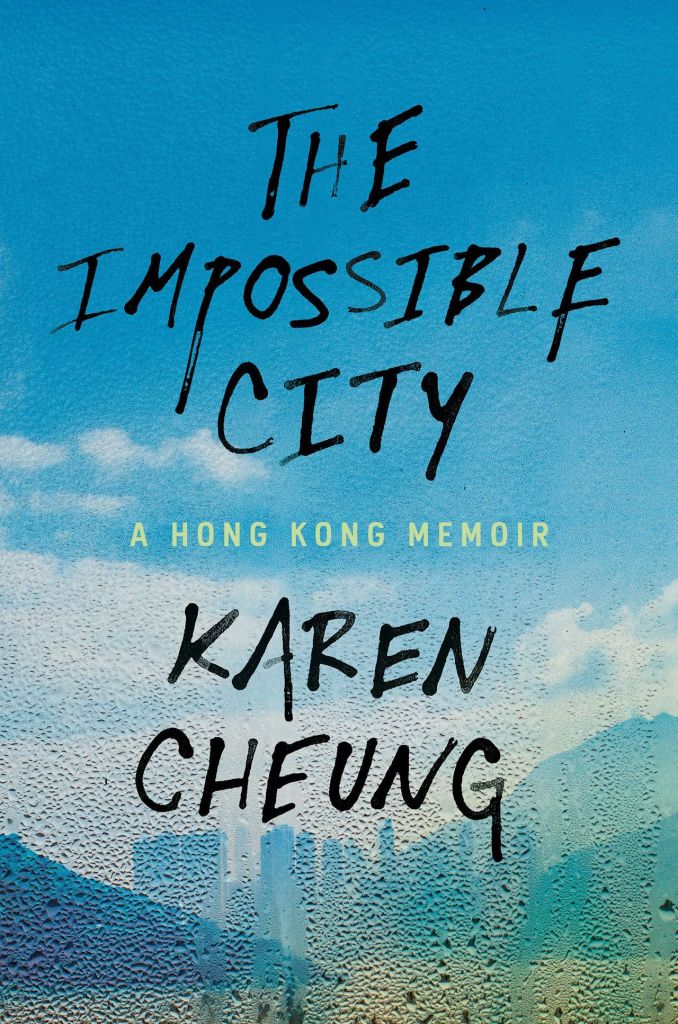
Karen Cheung’s The Impossible City: A Hong Kong Memoir is a work of fine balance. Specific to a place and time (Hong Kong from the 1990s to the 2020s), it is an evocative and at times miniaturistic portrait of the city. But rather than miring the narration in details, its specificity becomes a springboard from which Cheung tackles more general issues. The result is a fascinating book: never sentimental or unquestioning about its subject matter; measured in its analysis; but also, pained and deeply felt.
This is not an in-depth review of the events of 2014 or 2019. Readers can find more detailed accounts of recent Hong Kong’s history in Louisa Lim’s The Indelible City or Ho-Fung Hung’s City on the Edge, for example. But if The Impossible City does not even attempt to provide all the answers, it never loses sight of the important questions that need to be asked.
The book is made of loosely connected chapters, all very different in tone: some are elegiac in their evocation of Hong Kong while others are brutally personal (the recollection of Cheung’s family relations and her mental health). They are complemented by more general reflections where the author distances herself from the subject matter and discusses the implications of her own narration. These general meditations add a deeper meaning to the rest of the memoir.
Stylistically, this structure creates freshness, helped by Cheung’s penchant for a striking turn of phrase, such as when she muses on Sai Wan (西環), the area of Hong Kong Island where she lives as an adult, and concludes that “for a moment, there was a sliver of what this city could have become. And that is why we’re still here”. Some of her descriptions of people and places have a cinematic quality: for example, when she recalls being driven through the Tate’s Cairn Tunnel, a scene that brings to mind the ending of Wong Kar-wai’s film Fallen Angels.
❀
IMPOSSIBLE WHAT
In Cheung’s account, Hong Kong is indeed an impossible city and, true to the book’s multilayered structure, its impossibility spans different levels, from the concrete to the abstract.
At a fundamental level, it is the impossibility of fulfilling one’s material aspirations in the city, such as getting on the property ladder, or accessing essential services like mental health support.
There is also an emotive dimension to Hong Kong’s impossibility: “impossible” as an epithet, an exasperated, at times angry cry from someone who desperately tries to challenge what is outrageous and save what is at risk of being forgotten. Hong Kong can only be impossible because it is loved: as Cheung writes, “maybe this is what it means when we say we love this place – we recognise all of its imperfections, and still refuse to walk away”.
Beyond that, a third type of impossibility provides a deeper significance to the whole memoir: it is the impossibility of understanding the city (any city, really) in its entirety through any one single narrative. There are just too many stories, there is always too much difference: any narrative that claims to represent the whole city is either naive or wilfully misguided.
This is evident in the chapter where Cheung reflects on the limits of representation and the price one pays in choosing what and how to narrate. Whether it is an officially sanctioned account or the international media’s fascination with only a narrow representation of the city (a place of rebellion and protest), the author is distrustful of any unifying narrative about Hong Kong. And quite rightly so: she challenges the reader to peel away any one dominant discourse to discover the multiple stories that coexist (sometimes hidden, sometimes repressed) alongside the mainstream ones. Understanding a place, she implies, requires absorbing these other narratives.
Accepting this epistemological impossibility also means that choosing one narrative over another is never inconsequential: because different stories are always present, the dominance of a specific discourse over others is caused by an intersectionality of factors such as ethnicity, money and education. Even the choice of language (such as writing in English in a city where the majority of the population speaks Cantonese) contributes to this dynamic—a point that the author eloquently elaborates upon. Her reflections on language are particularly insightful and have been extensively discussed in other reviews (for example, by Jimin Kang in the Los Angeles Review of Books).
❀
POWER EVERYWHERE
For me, these multiple viewpoints and narratives are better understood as manifestations of power. If we use Michel Foucault’s analysis as our framework, we notice that power really is everywhere in The Impossible City: in the hands of the government, for sure; in traditional family ties; in gender relations, certainly. But, no less significantly, it is also dispersed across society, where no-one is ever completely powerless: it is found among activists; alternative musicians; bookshops and neighbourhood shops resisting the threat of closure; villagers reclaiming their ancestral homes. In other words, among all those who try to create different identities and narratives. And the duality of power that Foucault described is on display throughout the memoir: control, closure, and exclusion on the one hand. But also: construction, possibilities, alternatives, imagination. Not to say that this is a fight between equal forces—but the power advocated by The Impossible City is the power to dare create different narratives where one can affirm oneself.
Ultimately, this is the most constructive message of the memoir: among all this inescapable impossibility and pained love, there remains the power to (re)claim the city. The book reminds us that, no matter how difficult creating these new representations is, it is possible to affirm one’s personal memories; to create a new personal mythology that evades clichés and mandated narratives.
❀
A DOCUMENT
So, the city’s impossibility is a pre-condition for the power to imagine different narratives. But all this would surely be in vain if these were not preserved and communicated: a key message of Cheung’s book is that one of the many ways a city can vanish is when the multitude of its stories is forgotten.
With this in mind, the memoir should be read primarily as a document, a record of something that is at risk of disappearing. And as a document, The Impossible City tries to push against an archive, once more in a Foucauldian sense: archive not as a physical place or a collection of historical records but more conceptually as the set of rules that determine what is remembered and what is lost; what is said and who gets to say it.
In this case, the archive is made of the mainstream interpretations of what Hong Kong is (or is supposed to be): at the very least, The Impossible City wants the reader to appreciate what is found beyond the city’s mainstream cultural exports and official accounts. Cheung is realistic about how much she can achieve (“writing about a place cannot keep it from disappearing,” she observes) but clearly sees the need to preserve and remember (future readers “will know what we cannot unknow”) as the main reason for writing.
However, this book is not just a repository: the reader will not find a fully formed alternative narrative, complete in all its details and ready to be taken as it is. In fact, Cheung does not even specify what such a narrative should look like. Instead, it seems to me that she wants the book to be a starting point, a guide from which the reader can create their own personal document of Hong Kong. And in a very practical way, she provides the tools for doing so. I have already mentioned the places off the beaten path that are described throughout the memoir. In addition to these, the lists of favourite films, poets and non-Cantopop singers serve a similar function. Inevitably coming across as rushed and not particularly elaborated upon, stylistically these are the least accomplished parts of the memoir. And yet, they play an important role: they are the building blocks from which the reader can create their own personalised alternative vision of the city.
This is the challenge thrown at us by the memoir: to help save Hong Kong from disappearing, Cheung wants us to create our own document of the city, using her work as a companion. Venture into a different neighbourhood, she urges us; try a previously unknown film director, poet or musician; appreciate them and then move on to further explorations. It will not be long before a new narrative emerges out of these discoveries, to complement the mainstream ones that we were already familiar with.
And what should come out of this intellectual and physical exploration is not another grand, all-encompassing narrative. The alternative to a sepia-tinted nostalgic longing for the past, or to the place frozen in the expectations of international media, is something else altogether. It is what I would call a “mythology of the micro”: pluralistic and personal, made of many different stories. It might include superstition, mundane preoccupations, dubious eateries, little-known artists, hidden music venues, neighbourhoods at risk of gentrification—all of them recorded because they have value in their own right and not because they are parts of an overarching grand narrative. In other words, a mythology that celebrates everyday living and renders a city distinctive in its normality.
In the end, it is this ordinariness that is worth documenting; and it is by knowing this ordinariness that we can start to understand the city (any city, really).
❀
FROM HONG KONG TO THE WORLD
All this takes us to a final reflection. This document of alternative local narratives that is The Impossible City: who is it really for?
It is a very intimate and very local piece of work. Many reviews, including those published in this journal, emphasise its importance as an example of Hong Kong stories written by a Hongkonger. Yet, for me there is something more. I do not think it belittles the importance of this memoir as a local story if we say that it resonates beyond its specificity (for example, among readers who do not live in Hong Kong) because it touches on something more fundamental and general.
On a basic level, many of the issues that Cheung describes are structural in contemporary societies around the world: for example, the way international media operates (which impacts what is said and how places are narrated). And there are obvious similarities in the challenges that people face in many metropolises (such as, the inability to get on the property ladder, or the difficulty in accessing basic forms of social welfare).
However, for me the relevance of The Impossible City is deeper and more epistemological: quite simply, Cheung poses the questions that all of us should ask.
A reader outside Hong Kong will notice the reasons why Hong Kong is impossible; examine the power dynamics that this impossibility creates; see an opportunity in the mythology of the micro that pushes against an established archive—they will look at all this and recognise that none of it applies only to Hong Kong. Beyond the specifics of history and society, there are learnings that are relevant to other places.
Of course, I do not mean that events in Hong Kong could simply be repeated somewhere else. Instead, what can be applied beyond the context of the city is a personal check on how and how much we know, a different way of questioning. How many times do we fall on cliched and lazy interpretations? When was the last time that we looked beyond the standardised views of history and society, repeated simply because of convenience? Which narratives do we accept at face value, and do we know the price for our compliance? Do we simply admire the architecture without bothering to understand a place?
Read this way, The Impossible City is a call to pay attention and be inquisitive; explore and record different narratives; be curious and not settle for the established interpretations. We should do this, the book teaches us, because it is in the local, the mundane and the forgotten that the questions that really matter—the ones that transcend a specific location and time—reveal themselves.
How to cite: Griseri, Luca. “An (Im)possible Document: A Review of Karen Cheung’s The Impossible City.” Cha: An Asian Literary Journal, 23 Aug. 2023, chajournal.com/2023/08/23/power-everywhere.



Luca Griseri (he/him) studied history and postmodern philosophy in his native Italy. After obtaining an MBA from the University of Warwick (UK), he embarked on a career in marketing and over 18 years lived in London, Kuala Lumpur and Singapore. He is currently based in Penang, where he indulges in his passions: running, hiking in the forests and eating street food. [All contributions by Luca Griseri.]
 Cha
Cha 