

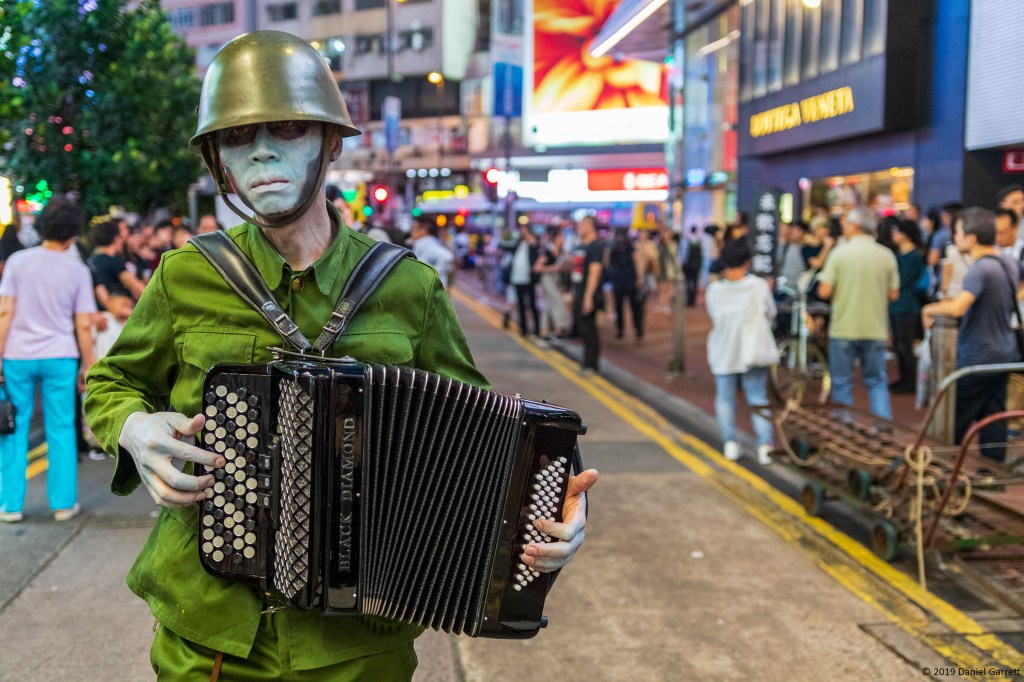

Performance Art in a “City Without Protest”
Hongkongers have long visually resisted the domination of the Chinese communist Leviathan and its collaborators in the Hong Kong Special Administrative Region (HKSAR) regime. From supporting the democracy movement in China in 1989, to Hongkongers’ walk in the sun in 2003, to the pro-democracy 2014 Umbrella and 2019 Water Revolutions, the Lion Rock’s protest culture had been at the fore of visual resistance to tyranny—so much so that many took for granted that protests, especially monumental ones of millions of Hongkongers in the streets and annual candlelight vigils for the victims of Tiananmen, were banal rituals that would persist until 2047. For many observers, protests in Hong Kong had become just another day in the city—even if it was a city that was “dying”. That changed in 2020 as the twin pathogens of the COVID-19 pandemic and Xi Jinping’s totalitarian national security logics and enemification and securitisation of Hong Kong, ravaged the earth and cleared the streets.
HKSAR apparatchiks duplicitously exploited the pandemic to crush the Water Revolution as a mortal threat and suppressed backlash using dubious draconian COVID-19 measures, just as the Chinese Communist Party (CCP) used pandemic security discourses to enemify the United States as an existential threat to humanity. Then, on 1 July 2020, the CCP summarily executed “One Country, Two Systems” (OCTS) with the imposition of a Hong Kong National Security [martial] Law (NSL) declaring a state of exception so as to quell anti-communist sentiment and pro-democracy voices. This rescinded Hongkongers’ promised freedoms codified in the Basic Law. Thus ended the territory known for decades as the “City of Protests”.
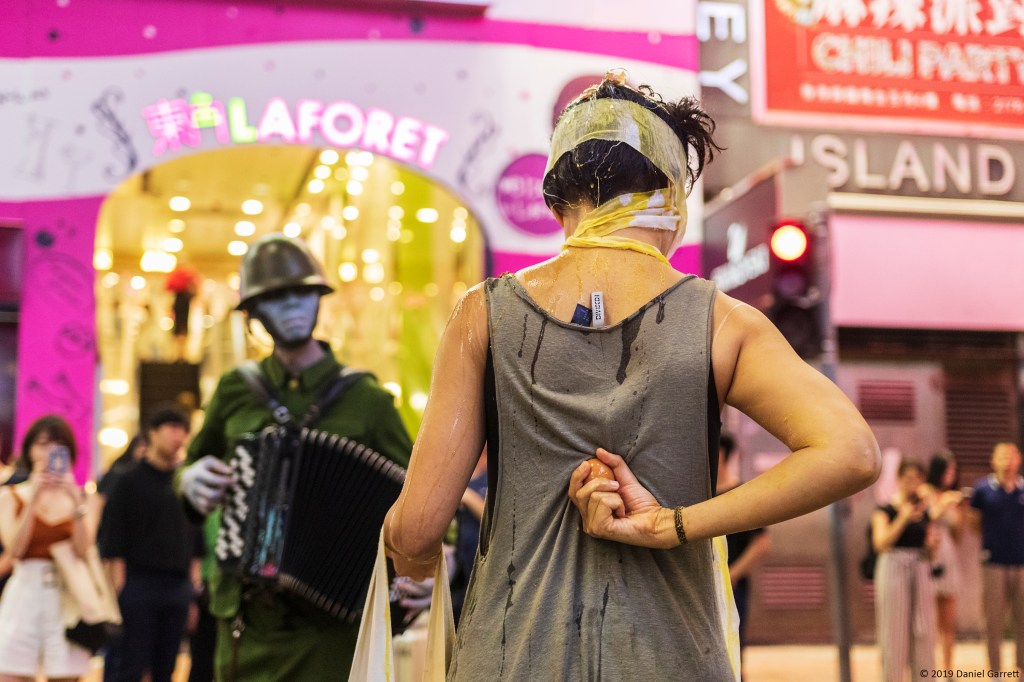
Until 2020, protests had been the most visible cultural and symbolic icon of OCTS’s vitality and Hongkongers’ political participation—more than its electoral participation in unfair elections for positions with no real power—or, as the post-NSL environment demonstrated—its rule of law and independent judiciary. As I argued in my 2014 monograph on Hong Kong protest culture, the visibility, visuality, and visual culture of the city’s protest ethos constituted a form of visual argumentation and resistance that disrupted Chinese claims of “nothing to be seen”. Hongkongers’ visual resistance degraded Beijing’s ability to claim that everything was OK, i.e., it was just another day—be it Hong Kong, or Tiananmen. Yet, as observed in Hong Kong surrounding the anniversary of the 34th anniversary of the Tiananmen Massacre, a visual corrective to this false CCP narrative of normality is discernible in the emerging role of performance art in the “City Without Protests”.”

Historically, Hong Kong performance art, due to diminutive and ephemeral characteristics, received only marginal consideration. This was due to an image-event-saturated environment where hundreds of salient protests yearly competed for eyeballs and screens. However, today, in an NSL police state when protests of any size are prohibited or are severely circumscribed by the totalitarian national security police state, individual or small collective acts of performance art as “one’s duty” arguably have become the most courageous and visible acts of visual resistance in a Kafkaesque Hong Kong Special Absurdity Region.
How to cite: Garrett, Daniel. “Just Another Day: Daniel Garrett.” Cha: An Asian Literary Journal, 4 Jun. 2023, chajournal.com/2023/06/04/daniel-garrett.


Daniel Garrett (PhD) is an author, documentary photographer, political scientist, and visual sociologist with Securing Tianxia LLC studying Chinese security and visual politics, and securitisation of Hong Kong. A doctoral graduate of City University of Hong Kong, he investigated the power politics of “One Country, Two Systems” under China’s new national security framework. He is the author of Counter-Hegemonic Resistance in China’s Hong Kong: Visualizing Protest in the City. Dan was banned from Hong Kong after testifying at the US Congressional-Executive Commission on China’s hearing on the 2019 protests. He is a former photographic contributor to Hong Kong Free Press. [All contributions by Daniel Garrett.]
 Cha
Cha 