
{Return to Cha Review of Books and Films.}
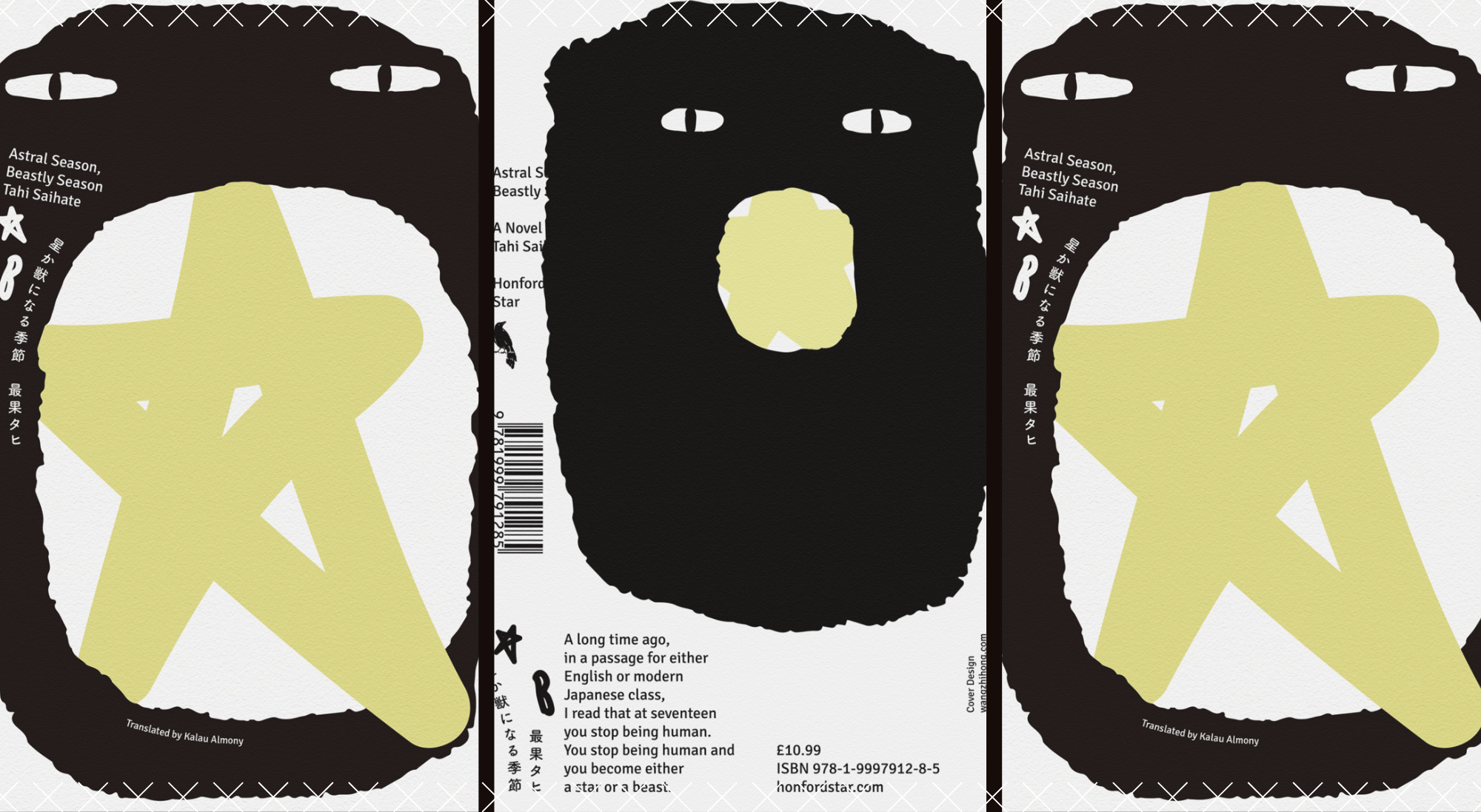
Tahi Saihate (author) and Kalau Almony (translator), Astral Season, Beastly Season, Honford Star, 2021. 144 pgs.

Tahi Saihate’s Astral Season, Beastly Season, translated from the Japanese by Kalau Almony, is an odd, beautiful, intimate and sad novel. It begins with the irresistible premise of two high school students, Yamashiro and Morishita, deciding to prove the innocence of their favourite J-Pop idol, who has been accused of murder, by committing a copycat crime and taking the blame for both, and it ends with the tremors of trauma shattering individuals and communities.
The story consists of two parts. The first, eponymously titled “Astral Season, Beastly Season”, was initially published in Japan as a short story in 2014. The second, a sequel, “The Season of Reckoning”, was written in response to the popularity of the first. Though the two stories were written separately, as it were, together they form a single narrative exploring the depths of teenage obsession and the striving for understanding and connection.
We begin with Yamashiro, a shy, deeply insecure teenage boy, obsessed with Mami Aino, an up and coming J-pop idol, who is accused of murdering her ex-boyfriend. The story is his confession to her, giving us an intimate view of the logic behind his actions. As he stalks her house trying to get any insight from what her family is telling the police, he spots a classmate—Morishita, popular and similarly obsessed with Mami Aino.
The two make an uneasy alliance. Yamashiro is the archetype of the unpopular kid at school. He feels distant from his classmates, and projects his own perceived inferiority and self-resentment onto others. This manifests itself most clearly in the deep misogyny he exhibits, particularly towards Aino, but which is really directed at all women he sees as “trying”:
When cute girls wear makeup that doesn’t suit them just because some model promotes it, and that make up actually makes them ugly, I want to tell them they’re ugly. And if those girls get embarrassed, I think that’d be great. I want to walk down Takeshita Street in Harajuku looking down on everyone.
Tahi Saihate’s Astral Season, Beastly Season, translated by Kalau Almony.
This clearly goes beyond teenage immaturity and is rather a reflection of his own lack of self-worth, the misogyny being a response seeking to elevate him by bringing others down. Of Aino he says that “she’s an ordinary person who gets by on just effort, and that’s why she’s so cute.” It’s the attempt to transcend herself, or the mediocrity Yamashiro sees in her, that makes her worthy of his scorn, and which helps him feel better about himself, and which drives his fandom.
Coming together with the archetypal popular boy in his class, Morishita, and finding they have the same obsession, is a shock which pulls Yamashiro out of his bubble. Morishita has a kind word for everyone; girls like him, and he has a wide circle of friends. In Yamashiro’s eyes, there’s nothing to hate about him, and the position this accords Morishita allows him to challenge his classmate’s misogyny. In response to one of Yamashiro’s outbursts, he says:
Being hardworking is a kind of talent, too. … I liked watching [Aino] work hard. Dancing, singing on stage like she’s having fun. I was trying hard, too. I thought I was trying hard. But then there was someone else trying harder than me, and still, she was having fun. When I realised that, I had no choice but to like her.
Tahi Saihate’s Astral Season, Beastly Season, translated by Kalau Almony.
Fundamentally, Yamashiro is alienated from his classmates, and in an effort to make himself feel better he projects his feelings onto others. Morishita brings him out of this first by agreeing to the plot to prove Aino’s innocence, and second, by challenging his friend’s attitude. As more murders follow, we increasingly see Yamashiro become less alienated from his classmates, but not because he opens himself up—but rather because we see them reaching out to him. His alienation is his own fault, as much as feeling insecure, unloved, unpopular and average can be a teenager’s fault, anyway. Ultimately, he wants to abandon the plot to prove Aino’s innocence, because he feels that to her he is “nothing more than an insect” and that even if they succeed she wouldn’t notice them. Even when others offer him the acceptance he seems to crave, he is too far into himself to notice.
In the second part of the book we are moved years ahead and the book focuses on Watase and Aoyama, two of the boys’ classmates, who have been left scarred by the killing spree in the wake of Mami Aino’s murder accusation.
Here again we have a contrast between the protagonists. Watase is a university student, having done well in her university entrance examination, she now studies at the prestigious University of Tokyo. Aoyama, on the other hand, struggles to find himself. After the events of the first part of the book, his grades slip, and ultimately even his family gives up on pushing him to succeed. They meet at a café, because Aoyama has given an interview to a local paper about the murders, defending the killer, or humanising him at least.
On the one hand, Watase feels guilty about her own feelings, that she was able to move on. Internally, she wants to scream: “It’s not wrong to smile like normal at how delicious your food is, right? To live, to be alive, to still be happy.” Aoyama, however, thinks that she should feel guilty, and he tells her so. What this points to, and what Yamashiro and Morishita’s relationship points to as well, is that our feelings are our own responsibility. None of the four protagonists seem able to experience the world as outside of themselves, and it’s not just through youthful inexperience. It seems rather that Saihate is trying to make a deeper point about how difficult it is to represent our inner lives to others.
In an email to the Japan Times, Saihate writes that “as long as you have a sense of self, you can’t escape feelings of alienation. Communication is often thought of as sharing feelings, but feelings can never be completely understood by another, separate individual.” This can easily be read into the book—each of the characters is striving to be understood and faces a wall where others can’t see themselves in their shoes. Everyone in the novel is extremely focused on themselves above all else and is ready to project their feelings onto others. We, as readers, can see how each of the characters is surrounded by a supportive set of peers, they themselves are blind to this.
Though I have been reluctant to try to analyse the characters’ motivations as being reducible to their youth, the language and framing of the book does lend itself to this interpretation. Kalau Almony’s translation keeps the language simple (which isn’t to say it is simplistic), in line with how a teenager might describe the story in their own words. The confessional style in which both parts of the book are written draws us into the teenage protagonists’ inner worlds. While they feel alienated from others, as readers we are allowed to get much closer than that, much closer even than the protagonists would realise. Almony, in the same Japan Times mentioned above, is quoted as saying that he wanted to preserve the “roughness of thought, the strangeness or randomness in the original”—those are the qualities one might easily ascribe to a teenager’s writing or thought process.
Ultimately, Saihate’s book is impressive in its depth. One could approach it from many angles, for instance to look at the way in which it presents the gendered way in which the characters relate to each other, or the way in which it presents Japanese social expectations of teenagers. Saihate is best known as a poet, so the way in which the narrative and language cut in so many ways should be unsurprising. The ambiguities with regard to how to interpret this novel suggest that we might read Astral Season, Beastly Season as a poem. Poetry, after all, stretches the limits of language, and attempts to wring out of it every last bit of meaning from every word and sentence. In this way this novel extends the boundaries of genre and contributes a premise to the argument for why more poets should write prose.
Also see this review in Cha:
How to cite: Spipowicz, Maks. “Roughness of Thought: A Review of Tahi Saihate’s Astral Season, Beastly Season.” Cha: An Asian Literary Journal, 16 Nov. 2021, chajournal.blog/2021/11/16/tahi-saihates-seasons/.


Maks Sipowicz is a writer living and working in Naarm (Melbourne), Australia. His critical writing has appeared in Australian Book Review, Sydney Book Review, Meanjin, among other places. He regularly writes criticisms for Second Space, and you can follow him on Twitter @callmesipo.