
{Written by Ari Santiago, this review is part of Issue 46 of Cha.} {Return to Cha Review of Books and Films.}
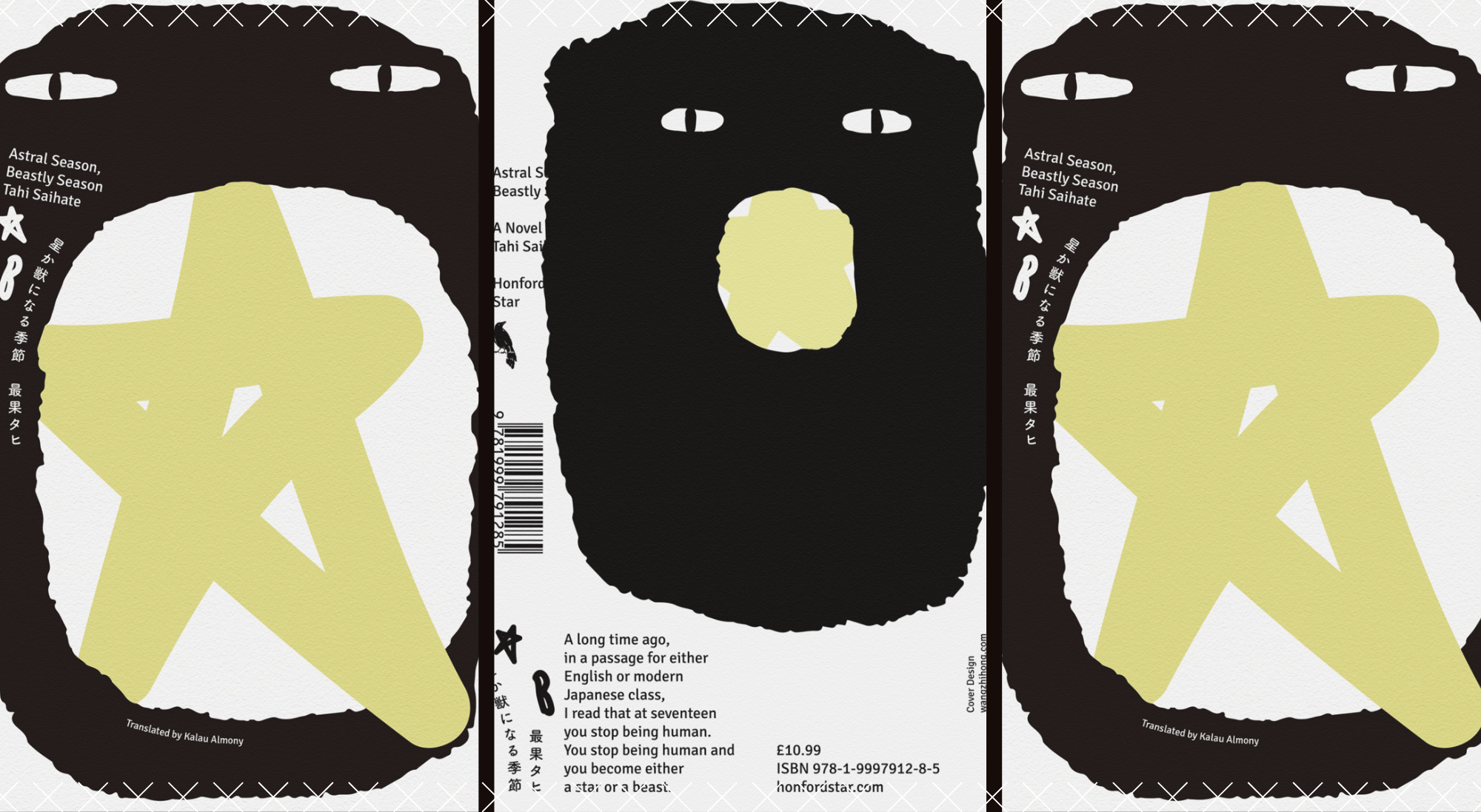
Tahi Saihate (author) and Kalau Almony (translator), Astral Season, Beastly Season, Honford Star, 2021. 144 pgs.

Contemporary young adult fiction has a preoccupation with classification: Hogwarts sorts its students into four houses; Panem’s disenfranchised youth belong to one of twelve districts, which they’re unlikely to leave in their lifetimes; Ravka’s grisha are divided into three orders, and then further into various subdivisions. Tahi Saihate’s debut novel Astral Season, Beastly Season isn’t quite what you’d call YA, but it does present a stark sorting scheme of its own for its adolescent protagonists: “They say that at the age of seventeen, you either become a star or a beast.”
The novel’s opening teases a few possible interpretations for these terms. The “star”, for instance, might refer to Mami Aino, an idol suspected of murder, or it might refer to the young victim of the crime, whose body was chopped up and arranged in the shape of a star. The beast, naturally, would then be the murderer. But Mami’s crime isn’t the only one in the novel. Upon learning she’s under suspicion, two of her fans come together to commit copycat murders to draw attention away from her—opening up further possibilities as to who the beasts really are.
The novel’s first part, which lasts for roughly half its length, deals with the copycat murders. It’s told in a letter addressed to the idol from one of the conspirators, high school student Shota Yamashiro. The letter recounts his and his partner Morishita’s escapades at a gripping pace, but also provides insights into Yamashiro’s thoughts. They lay bare his discontentment with his horribly banal life, as well as his ambivalent feelings toward Mami Aino. The direct access to Yamashiro’s innermost thoughts is contrasted with the illusive personage of Mami. The motivating figure of the entire first act appears only through the eyes of those who worship her as a star, or suspect her of being a beast. And, as a reader being addressed in her stead, I found myself at first wondering idly, then with increasing fervour, what she thought of the words Shota addressed to her—or, indeed, if they would ever reach her at all.
If nothing else, the novel deserves credit for such effective use of the infamously unwieldy second-person perspective.
The novel’s second half focuses on the aftermath of the murders and is told from the perspective of one of the female students who had been in the orbit of Yamashiro and Morishita. She returns to her hometown years later to meet another classmate—another “survivor”, she later thinks, considering any one of them could have been a victim—who had also been close to the pair of conspirators, and who had been interviewed about the events of that traumatic year.
His account is hardly what one would expect, however, describing the murderer as a good guy. The encounter goes from tense to turbulent when another of the bereaved, a brother to one of the murder victims, accosts the young man over his statements. The killer couldn’t have been good, he argues, because he was a murderer. The class had been deceived. A stranger, who knew nothing of the young man before he turned murderer, nonetheless claims this moral certainty.
Can a killer be a good guy? Can a star be a beast, or a beast a star? This question, which expands on Yamashiro’s doubts and moves into the realm of public discourse and history, lies at the heart of the second chapter. Yet despite how directly the story addresses this question and how fiercely it grapples with it, it offers no easy answers. “Yes,” Morishita would seem to say, unconcerned as he was with the possibility that Mami Aino could be a killer. “Yes,” the eulogizing student would agree, maintaining that even killers have good in them—and that the world mustn’t forget that. But theirs is the position of the dissenting minority. Murderers can’t be good guys. Star or beast. Once you enter adulthood, society only lets you choose one.
The novel joins a long and colourful tradition of literary works and texts in other media concerned with the youth’s position in Japan’s broader cultural narratives. Violent youth loomed large in Japan’s psyche from the 1980s to the early 2000s, manifesting itself in fictional works such as Koushun Takami’s Battle Royale; real-life archetypes such as roaming gangs of delinquents; and in liminal cases, like that of so-called “Nevada-tan,” a grade schooler who killed her classmate with a box cutter, and had her image wrought larger than life on internet forums. Yet, since the turn of the century, new images of dysfunctional youth have appeared. Rather than violently defying norms, these ones simply fell short of them: the obsessive otaku, and the reclusive hikikomori.
Saihate’s novel clearly draws on both images of monstrous adolescence, but is concerned with questioning rather than reifying them. Killers and recluses alike, and dropouts, suicides, layabouts and underachievers too, are all products of a system that tyrannically forces youth to conform to needlessly rigid categories. If they are monsters, it is only because of the corners they are driven into.
While the novel employs imagery endemic to Japan, its concerns are universal. Violence is becoming increasingly and disturbingly commonplace among young people, who, across the world face school shootings, murderous dictatorships, and repressive regimes—and are painted as monsters for lashing out in turn.
Astral Season, Beastly Season takes familiar images and blends them into a disturbingly new mix. It is relentless, intense, and never loses sight of the questions at its heart, nor its unyielding demand that they be given the hard answers they deserve.
Also see this review in Cha:
How to cite: Santiago, Ari. “Lashing Out: A Review of Tahi Saihate’s Astral Season, Beastly Season.” Cha: An Asian Literary Journal, 04 Jul. 2021, chajournal.blog/2021/07/04/astral-season-beastly-season/.


Ari Santiago graduated with an MA in Literary and Cultural Studies from the University of Hong Kong, and is currently based in Metro Manila, doing freelance and independent work in content marketing, tabletop game design, and narrative design for games. Their work has been published on Play Without Apology. [All contributions by Ari Santiago.]