
{Written by Jimin Kang, this review is part of Issue 46 of Cha.} {Return to Cha Review of Books and Films.}
Click HERE to read all entries in Cha on Aftershock.
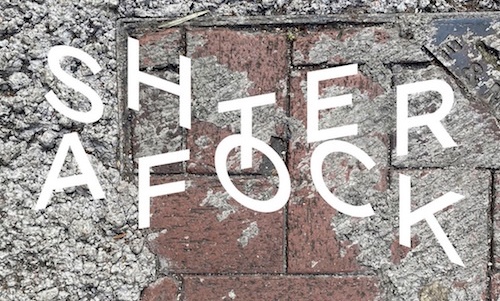
Holmes Chan (editor), Aftershock: Essays from Hong Kong, Small Tune Press, 2020. 93 pgs.

Aftershock: Essays from Hong Kong begins with a Hong Kong deep in dystopian terrain. Rubber bullets smash into umbrellas held by quivering students, who brace themselves as projectiles scream a block away. The chaos persists, chapters later: well-dressed bankers roll up their sleeves to pull bricks from the pavement prior to a protest; children, shunned by their parents, wander the roads eating a slice of bread a day. Before surrendering himself to police, a young protester asks a journalist for a piece of paper so he can write a note stating, as his campus burns around him, that he will not commit suicide.
We never learn whom the protester is trying to convince. But he convinces the journalist, Jessie Pang, that in his gesture is the ragged pulse of the chaos happening in their shared city. It is dozens of gestures like these that have become the testimonies present in Aftershock, essays braided “into a lifeline”, as Holmes Chan, the book’s editor puts it, that helps us hold space for a city utterly transformed in the short span of two years.
At its core, Aftershock seeks to be the missing puzzle piece for the much-publicised story of contemporary Hong Kong. By weaving together 11 first-person essays by contributors based in Hong Kong, Taiwan and mainland China, it challenges the hegemony of Hong Kong’s “newsified” narrative: that of a city caught in a geopolitical struggle explained through numbers, soundbites and official statements. Instead, it’s a project that has offered some of Hong Kong’s most important newsmakers and witness bearers—young journalists working on the ground for outlets like Reuters and the South China Morning Post—the opportunity to tell their own Hong Kong stories as personally as they’d like, without the restraints of the market or the movement of international news.
The result, a slim 90-page volume, published by Small Tune Press in May 2020, is a work that blends memory and commentary to create a literary collage of Hong Kong’s recent trauma—or, in Chan’s words, “writing that came with less armour or baggage, the kind that was willing to keep me company as I banged my head against the wall”.
Having grown up in Hong Kong, I, like Chan, was desperately in need of company as the city of my childhood became unrecognisable to me, seemingly overnight. A few days before I read Aftershock for the first time, the Chinese government had enacted the National Security Law in the semi-autonomous territory I called home. It’d been a year since the anti-extradition protests of 2019, when over a million Hongkongers protested in opposition to China’s increasing control of the city; so much had changed in a year, and nobody seemed to know where the changes were heading.
This book doesn’t claim to know the answer, either. But reading it feels like sitting down with each of its contributors for a long conversation, held in the privacy and warmth of somebody’s home. Its purpose is not to educate curious readers about the social and political context behind Hong Kong’s protests, but rather to dialogue with those seeking to go deeper. Many of the book’s essays, after all, assume a pre-existing intimacy with the city’s landmarks and lingo. The “Hong Kong” quality of its prose is unmistakable: the names of the city’s besieged universities are presented exclusively as acronyms, in the way Hongkongers refer to them; the chapter “Feathery Down” by Elaine Yu—an elegy for a unique brand of Hong Kong girlhood forged at the intersection of Chinese and Western cultures—ends with the heart-wrenchingly Hong Kong image of a man crushing a cockroach with a carton of lemon tea. Images of sweat-drenched backs and abalone dinners are cues for the tastes, sights and smells of a Hong Kong that, despite its recent transformations, has remained the same in many ways.
The absence of “newsy” contextualisation of these images suggests that they don’t serve as visual means to an expository end: they are the end—they are Hong Kong. A city whose story is not limited to time-sensitive geopolitical power play, but rather encompasses all of what it is, has been, will always be: a place known as home, where its residents—regardless of whether or not the world is watching—are standing on ground that is shifting everyday beneath their feet.
Torn-paper collages by Hong Kong artist Jeffrey Yeung accompany the chapters, offering a visual nod to the way fragments can be collected to create images both haunting and elegant as a whole. There is a distorted gavel that resembles a yo-yo; a hand opening what looks like a bleeding globe; an owl-shaped beast with a single, open eye, glaring at the reader. Images extend into the prose, where, in certain essays, the inclusion of Chinese quotes and terms in their pictorial forms offer an important reminder to English-language readers. These stories are ones rooted in a place with an entirely distinct language for its treasures and traumas; a reality that doesn’t require a foreign gaze or a foreign language in order to be legitimised. Chan puts it eloquently in his preface, writing that none of “the ink that [had] been spilled in Hong Kong” since 2019 had ever fulfilled him. “I don’t need to have my reality explained,” he writes. “I just want five minutes of honesty.”
In insisting so firmly on its own terms, Aftershock encourages the question of who the book is for, beyond the writers who, like Chan, sought a break from the constant interpretation of Hong Kong for foreign readers. With whom do the writers seek to share their five minutes of honesty? If the answer is a local audience that understands the city’s lingo, then what constitutes a local audience? In other words, the perennial question of a postcolonial city: who is—or can be—a Hongkonger?
On the one hand, the local texture of the book signals an audience already familiar with Hong Kong. But on the other, Aftershock achieves the difficult yet indispensable task of inviting each of its readers—Hongkonger or otherwise—to become a local. It does so by inviting us to escape the soundbites of impersonalised media, and instead enter into a literary space where the city and its struggles become highly personal.
And they already are personal. On a universal level, Aftershock is an interrogation of language: how do we find language for a time in which no words arrive, or in which language might betray us? “Voiceless”, a chapter penned by an anonymous writer based in mainland China, ends with a desolate confession: after describing the trauma of being doxxed on the internet for pro-Hong Kong views, “I lost my voice,” the author concludes, “and I have no idea when I will recover.” In “The Adversary”, Chan illustrates the ways in which language—and in particular, the language of violence—is manipulated by smooth-talking spokespeople who muddy truth with abstraction. “Hong Kong is being remade and recontextualised by violence,” he writes, “and my deepest fear is that our language cannot reckon with it.”
The book also probes, at great length, the complexities of the journalist’s job as gatekeeper of the news. In “After He Fell”, Jessie Pang explores the emotional struggle of covering one’s home city: “it felt like a tug of war between the truth and personal feelings,” she writes. Pang is candid about her experience of guilt, knowing that, at the end of each reporting day, she still had “an option to go home safe and sound,” unlike many protesters. In “Faces at a Window”, Hsiuwen Liu questions how, as a Taiwanese journalist writing about Hong Kong, storytellers might frame the events of one city in a way that appeals to another without being reductive. “No one and no place needs to be idealised,” she writes. “I wished that Hong Kong’s protests could be understood on their own terms, and be remembered for its complex nature, its many dimensions.” But what if these dimensions are manipulated in order to serve conflicting interests? Both Holmes Chan and Rachel Cheung explore the frustrations of having one’s testimony be refuted or reworded: sometimes by authority figures like government officials and police chiefs, but at other times—and more insidiously—by editors who “cherry-pick information, impose someone else’s agenda, and edit reports into alternate versions of reality”, as Cheung says.
Increasingly, the middle point between bearing witness and writing about it is being lost as journalists in Hong Kong are prevented from bearing testimony at all. When the government charged 47 democracy advocates with subversion of the National Security Law in late February 2021, journalists were restricted from covering bail proceedings by a Hong Kong court. In January, police visited the newsrooms of the pro-democracy news outlets Apple Daily, InMedia and Stand News demanding documents related to candidates who ran in an unofficial primary election (organized by pro-democrats) held in July 2020.
As witness-bearing is threatened in Hong Kong, how will we remember the city from here? Will we remember it with fear, as Hsiuwen Liu dreads is happening in Taiwan? Will we remember it with the nostalgia Sum Lok-Kei holds for the campus where he grew up, which he was forced to escape in his twenties? With the love Karen Cheung feels and captures in her “slow stories” on Hong Kong life, or the hope Jessie Pang harbours in her belief that “there will be light in the darkest hours”?
Whichever it will be—and it’s likely to be a combination—Aftershock reminds us that that future will in large part be determined by the city’s youth. Three of the essays come to life on college campuses where student protesters stood front and centre, and it’s worth noting that all of the book’s contributors were below the age of 30 at the time of the book’s publication. They represent a generation of young people born with the promise of an independent Hong Kong until at least 2047, the agreed-upon year for the handover as established by China and Britain back in 1997. That is the year when these writers, and the young people they write about, will reach the ages that often dominate the top realms of the political, social and economic institutions that make cities and countries what they are. That pave the path towards all they can be.
It’s telling that, in contrast to its beginning, Aftershock ends with a scene of relative normality despite the remnants of chaos. Sum and his sister, who is a decade younger than him, are walking to the supermarket near their childhood home on the campus of the Chinese University of Hong Kong. They don’t talk about the violent clashes that occurred the month before—the very violence Sum and his parents escaped. “I hope she’d never grow up,” Sum writes. “I hope she’ll never have to live through what we did.”
But will she? Although the hyper-visible scenes of protest have dimmed in Hong Kong in recent months, largely due to the ruthless consequences established by the National Security Law, the ground in Hong Kong has not stopped shifting. Since the book’s publication in 2020, approximately 50,000 people have left the city for good. Hundreds of democracy activists are either in exile or facing charges for subversion against the Chinese state. New teaching materials from Hong Kong’s education bureau on the National Security Law, designed for elementary school children, analogise the limiting of freedoms to asking someone to turn down music that is too loud.
In many ways, Hong Kong remains in dystopian terrain. Amid the disconnection that dystopia imparts on its victims, Aftershock is a book that offers its company like an old friend. For people like myself, writing and thinking about the city from far away, it’s an indispensable companion that reminds us that, despite how much news we might follow and how frequently, we must always ask ourselves if we can be listening more closely, more compassionately. After all, the loss of a home could happen to any of us. Hong Kong has come to stand for something personal in all of our lives. It should serve as a reminder that, even when our worlds are falling apart, we can—and must—bear witness. Because testimony will always prevail.
Also see these reviews in Cha:
- “Hong Kong Unstable Fault Lines: A Review of Aftershock” by Jennifer Anne Eagleton (8 May 2021)
- “Traces that Haunt the Scene: A Review of Aftershock” by Cherrie Kwok (27 April 2021)
How to cite: Kang, Jimin. “Testimony Will Always Prevail: A Review of Aftershock.” Cha: An Asian Literary Journal, 08 Apr. 2021, chajournal.blog/2021/04/08/aftershock/.


Jimin Kang is a writer from Seoul, South Korea and Hong Kong. Currently studying Spanish and Portuguese at Princeton University, she will be studying Comparative Literature and Critical Translation at Oxford University in the fall of 2021. Previously, she has written journalistic articles, opinion pieces and personal essays for international publications including Vox, The Nation, TIME, Atlas Obscura, and others. Kang’s “To the Cat Feeder in Hong Kong” was published on Hong Kong Protesting in September 2020.