
📁RETURN TO FIRST IMPRESSIONS
📁RETURN TO CHA REVIEW OF BOOKS AND FILMS
Click HERE to read all entries in Cha on Strange Beasts.
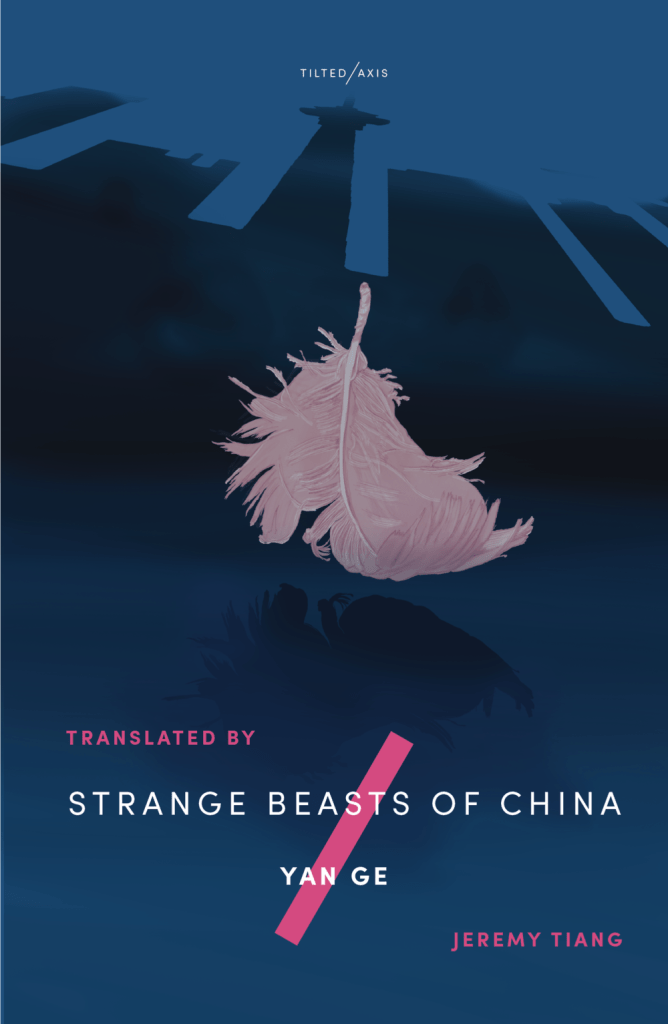
Yan Ge (author) and Jeremy Tiang (translator), Strange Beasts of China, Tilted Axis Press, 2020. 314 pgs.
Strange Beasts of China begins with a note on terminology. “兽 [shòu]—beast”, it says, is not a “neutral word for animal”, but one that “denotes the absence of humanity, and carries the connotations of savagery and wildness”. The term’s prejudice—for lack of a better antonym to neutrality—is one of the novel’s central concerns. Told from the perspective of an unnamed narrator, a zoology dropout-turned novelist, the book unfolds in a series of episodes, each of which details the protagonist’s encounters with the various beastly citizens of Yong’an. With this premise, the novel can be approached in a number of ways: as a fantasy tale, as a kind of serial fiction, as a story about stories and those who tell them, and, of course, as something that is all these at once.
In terms of the fantastic, the book immediately impresses. Yan Ge has a knack for envisioning beasts whose distinguishing features are striking and, if not original, then at least inspired and unconventional. Take, for example, the first chapter’s description of the sorrowful beasts:
Sorrowful beasts are gentle by nature, and prefer the cold and dark. They love cauliflower and mung beans, vanilla ice cream and tangerine pudding. They fear trains, bitter gourd and satellite TV.
The males of the species are tall, with large mouths and small hands, scales on the insides of their left calves and fins attached to their right ears. The skin around their belly buttons is dark green. Other than that, they’re just like regular people.
The females are beautiful – slender figures with reddish skin, long, narrow eyes, ears a little larger than normal. For three days at the full moon, they lose the ability of human speech and squawk like birds instead. Otherwise, they’re just like regular people
Sorrowful beasts never smile. If they do, they can’t stop—not until they die. Hence their name.
Yan Ge’s Strange Beasts of China, translated by Jeremy Tiang.
Similar passages introduce each of the novel’s chapters, which each focus on a different type of beast. Like the one above, they highlight a range of attributes, including the beasts’ often asymmetrical anatomy, as well as their eclectic dietary preferences. And while these may seem arbitrary, they conceal portents that manifest, often with terrifying implications, as each episode reaches its end. It’s a testament to both the author’s sprawling imagination and her precise control of narrative structure.
That said, beastliness in Yong’an isn’t simply a matter of the body, but also of history and tradition. The sorrowful beasts settled along a riverbank because of their proclivity for damp, and set up a textile factory. Despite the popularity of their fabrics, however, exorbitant taxes mire them in poverty. The females, who can mate with human males, would sometimes marry into wealth in order to escape. Yet these partnerships are fraught: hormone treatments suppress the brides’ beastly nature, erasing their memories as beasts in the process. It is only when a sorrowful beast suffers a fatal allergic reaction to an experimental treatment that the public becomes aware of this practice.
This attention to history, heredity and subjection to societal control call to mind the experiences of minority populations—but the beasts’ strange embodied natures irrupt into the narrative, precluding any clean, or possibly trite parallels. Speaking to a young sorrowful beast, the narrator learns that what humans call smiles are, for them, expressions of suffering. So does a sorrowful beast die because they smile? Or smile because they are dying? Yet even as a sorrowful beast runs through the city on the brink of death, it is not their demise but their smile that so fascinates the bystanders: “Old people said they’d die without regrets now, having lived to see the smile of a sorrowful beast.”
The beasts play an active role in Yong’an’s local mythology. In some ways, this, yet again, resembles the experiences of ethnic minorities. The mythological origins or innate qualities ascribed to the beasts are often used to justify relegating them to the societal margins. For example: the sorrowful beasts’ “placid natures” makes them ideal for hard labour; the prime beasts, “sturdily built” and descended from condemned criminals, make for prime security guards. However glamorous these positions are made to seem—prime beast guards are something of a trophy for employers and establishment—they ultimately imprison the beasts within stories not of their own making.
Yet here, too, the beasts’ fantastic, inhuman natures assert themselves. The sacrificial beasts—a powerful species named for the males’ tendency toward self-destructive violence—were the city mascot until they were deemed “too depressing”. And when their gruesome suicides inspire too many imitative acts, the government takes drastic measures to address the situation. There are, of course, dark machinations at work behind the response. But by the time the narrator learns of them, it’s too late to do anything. She confronts the authority of zoological experts on one hand and, on the other, the bitterness of families whose loved ones’ lives concluded too early. Against these, she realises, there is nothing that a story can do.
It’s intriguing, considering the idea of stories as alternative discourse has gained traction in recent years. Memoirs, “own voices” fiction, and confessional poetry have all been touted as means by which marginalised communities can push back against the repressive and reductive narratives of science and the law. The narrator’s plight reveals the limits of such resistance. Even as humans and beasts alike seek her out to have their stories shared to the world, she finds herself constrained by the demands of her outlet, editor and readers. Whatever nuance she might find in the lives laid bare before her is lost in the stories she ultimately publishes. There is no time in her serialised fiction for the kinds of slow revelations that Strange Beasts itself revels in. Similarly, her acclaim as a novelist often becomes a hindrance as well. The Professor’s derision is a constant, if minor problem. A greater challenge is the way writers are relegated to society’s margins—discussions are all too easily shut down with a simple “I’m looking forward to your next novel”. In this aspect, she is not so different from the beasts whose stories she tells.
As mentioned earlier, scrutinising the boundary between human and beast is one of the novel’s major thrusts. This becomes a personal concern as the narrator is increasingly entwined in the stories of the beasts. With each episode, the boundary separating her from their world blurs: in part because of the bonds she forms with them, but mostly because of the bonds she finds already connecting them—which had simply been obscured by the most prevalent and prejudiced of Yong’an’s mythology. Myths that her own stories cannot displace.
Nonetheless, by raising the question at all—and indeed, by doing it with such deftness—the novel seems to insist that there is a certain power in stories. Across all the novel’s episodes, stories serve both as a catalyst to action and a pathway to truth. They forge bonds among people with disparate origins, experiences and aspirations. And while they may not serve as a bulwark against the nefarious myths that plague society, they nonetheless offer a refuge from them—or to use the term more often associated with fiction, an escape.
And while the topic of escape has been discussed largely in tales of fantasy, it’s pertinent to all of the “ridiculous” genres that the narrator dabbles in—romances, melodramas, tales of serendipity and destiny—the very formats that make up the novel’s episodes. “Just a love story,” the narrator remarks of a mysterious, seemingly inscrutable incident in the second chapter; yet there is reason behind the apparent randomness. This does not mean it is no longer a love story—it simply means that “just” love stories are often unjustly dismissed as such.
To borrow words from Tolkien’s famous defence, one must distinguish between “the Flight of the Deserter” and “the Escape of the Prisoner”. Strange Beasts is exemplary of the latter. When it revels in the strange, fantastic and fanciful, it does not do so in denial of conventional reality. Both the text and its narrator are keenly aware of the many prejudices that work daily to manage a city’s denizens. It simply suggests that stories—especially love stories—address this best by being “just” that: moody, cheeky, in turns cynical and romantic, inimical to straight answers, and ever open to admit even the strangest possibilities.
Other reviews on the same work in Cha:
- “Strange Beasts of China: Harnessing Zhigual and Magic Realism to Satirise Othering” by Cyril Camus (16 November 2022)
- “The Unconcealed Rebellion, Cynicism, Bravery and Romanticism of Being Painfully Young: Reviewing Strange Beasts of China” by Jacqueline Leung (16 January 2021)


Ari Santiago graduated with an MA in Literary and Cultural Studies from the University of Hong Kong, and is currently based in Metro Manila, doing freelance and independent work in content marketing, tabletop game design, and narrative design for games. Their work has been published on Play Without Apology. [All contributions by Ari Santiago.]
 Cha
Cha 