
{Written by Cyril Camus, this review is part of Issue 46 of Cha.} {Return to Cha Review of Books and Films.}
茶 FIRST IMPRESSIONS
茶 REVIEW OF BOOKS & FILMS
[REVIEW] “The Flock of Ba-Hui: Lovecraft’s New England Nightmares Meet the Mythical Geography of China” by Cyril Camus
Oobmab (author), Arthur Meursault and Akira (translators), The Flock of Ba-Hui and Other Stories, Camphor Press, 2020. 234 pgs.

The past decade has shown that H.P. Lovecraft’s cultural influence is as strong and as widespread as ever, with adaptations and references to him in popular culture abounding. The author, and his most famous creation, Cthulhu, appeared in 2010, under the parodic aliases Char Gar Gothakon and H.P. Hatecraft, in Scooby Doo! Mystery Incorporated, and under their real names in Bruce Brown’s children’s comics trilogy Howard Lovecraft and the Three Kingdoms (2012-2014) and its 3D-animated film adaptations (2016-2018), while Cthulhu became Eric Cartman’s pet in several episodes of South Park in 2010. The Dark Lord of R’lyeh also got his own Funko Pop! figure in 2015. In a more serious mode, Guillermo Del Toro’s Sisyphean quest to get studio funding for his film adaptation of “At the Mountains of Madness” has become an ongoing dark epic in itself. Sean Branney and Andrew Leman’s H.P. Lovecraft Historical Society released a new mock-old movie, The Whisperer in Darkness, in 2011 (after already giving us a silent expressionist adaptation of “The Call of Cthulhu” in 2005), as well as about fourteen audio drama adaptations of Lovecraft stories and of The Call of Cthulhu role-playing game campaigns in their wonderful Dark Adventure Radio Theater imprint. They also distribute a German film adaptation of “The Colour out of Space”, Huan Vu’s Die Farbe (2010). US filmmaker Richard Stanley released his own version of the same story, starring Nicolas Cage, in 2019, and the now retired king of comics, Alan Moore, released the two parts of his immense saga on Lovecraft, Neonomicon (2010) and Providence (2015-2017). There were also, in 2016, Victor LaValle’s novella “The Ballad of Black Tom” and Matt Ruff’s novel Lovecraft Country, two fascinating literary pieces of hijacking of the Cthulhu Mythos in the purpose of undermining Lovecraft’s famously extreme racism. Finally, Japanese artist Gou Tanabe’s magnificent manga adaptations of “At the Mountains of Madness,” “The Shadow out of Time” and “The Colour out of Space”, published from 2016 onwards, have provided a fitting aesthetic climax and transition to the next decade to this ever-growing body of enthusiastic Lovecraftiana.
By “transition to the next decade,” I mean to point out that one of the very interesting new additions that have helped kickstart the 2020s’ Lovecraftverse expansion this year also comes from Asia. The Flock of Ba-Hui is a collection of five stories, four of which were initially posted on a Chinese weird fiction website called The Ring of Wonder, by an author whose username is Oobmab (“bamboo” in reverse). They were translated into English and collected in book form by translators whose pseudonyms are Akira (which could be a reference to Akira Kurosawa, or to Katsuhiro Otomo’s Akira, or to many other elements of Japanese culture, or it could be a real name) and Arthur Meursault (the full name of the protagonist of Luchino Visconti’s 1967 film The Stranger, called only “Meursault” in the original 1942 novel by Albert Camus). The collection was published in February by British-Taiwanese company Camphor Press, and the translators also provided a fifth story of their own, which is used as a frame narrative for the four others.
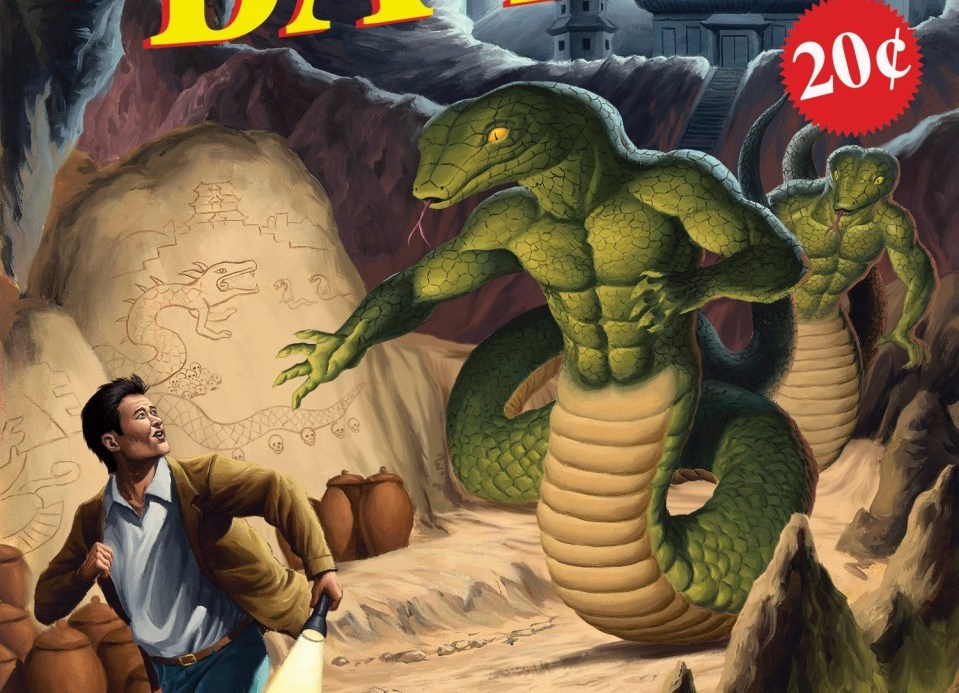
Oobmab’s first and titular story is the tale of a “researcher” (an anthropologist or archaeologist) whose friend and colleague Zhang Cunmeng, from the Sichuan Cultural Anthropology Institute, went mad after claiming to have discovered a hitherto unknown troglodytic civilisation in the mountains of western Sichuan, and then disappeared after escaping from the Humane Mental Hospital of Chengdu in May 2009. The narrator first goes over all the facts of his friend’s comings and goings over the two years prior to his disappearance, to try to understand what happened and, above all, to get an idea of the location of his mysterious discovery. Then, with other scholar friends, he organises an expedition in the mountains to try to find the place and, hopefully, to find Zhang. The rest of the story mirrors the last act of “At the Mountains of Madness” (1931), as the explorers plunge deeper and deeper into the strange cave they discover, and reconstruct, through disturbing and confusing murals, the mores and rituals of the “Ancient Country of Nanyu.” All along, they think the monsters painted on the walls are metaphorical representations of the humans who painted them. Then, like Dyer and Danforth, who are forced to acknowledge that there’s a real living Shoggoth in the depths of the dead city beyond the Mountains of Madness, Oobmab’s narrator is finally led to believe, either that he’s momentarily lost his mind, or that the giant serpent god Ba-Hui (which is suggested to be a Chinese name for Yig, from Lovecraft and Zealia Bishop’s 1928 story “The Curse of Yig”) exists, his half-snake, half-human priests exist too, and Zhang Cunmeng has become one of the latter.
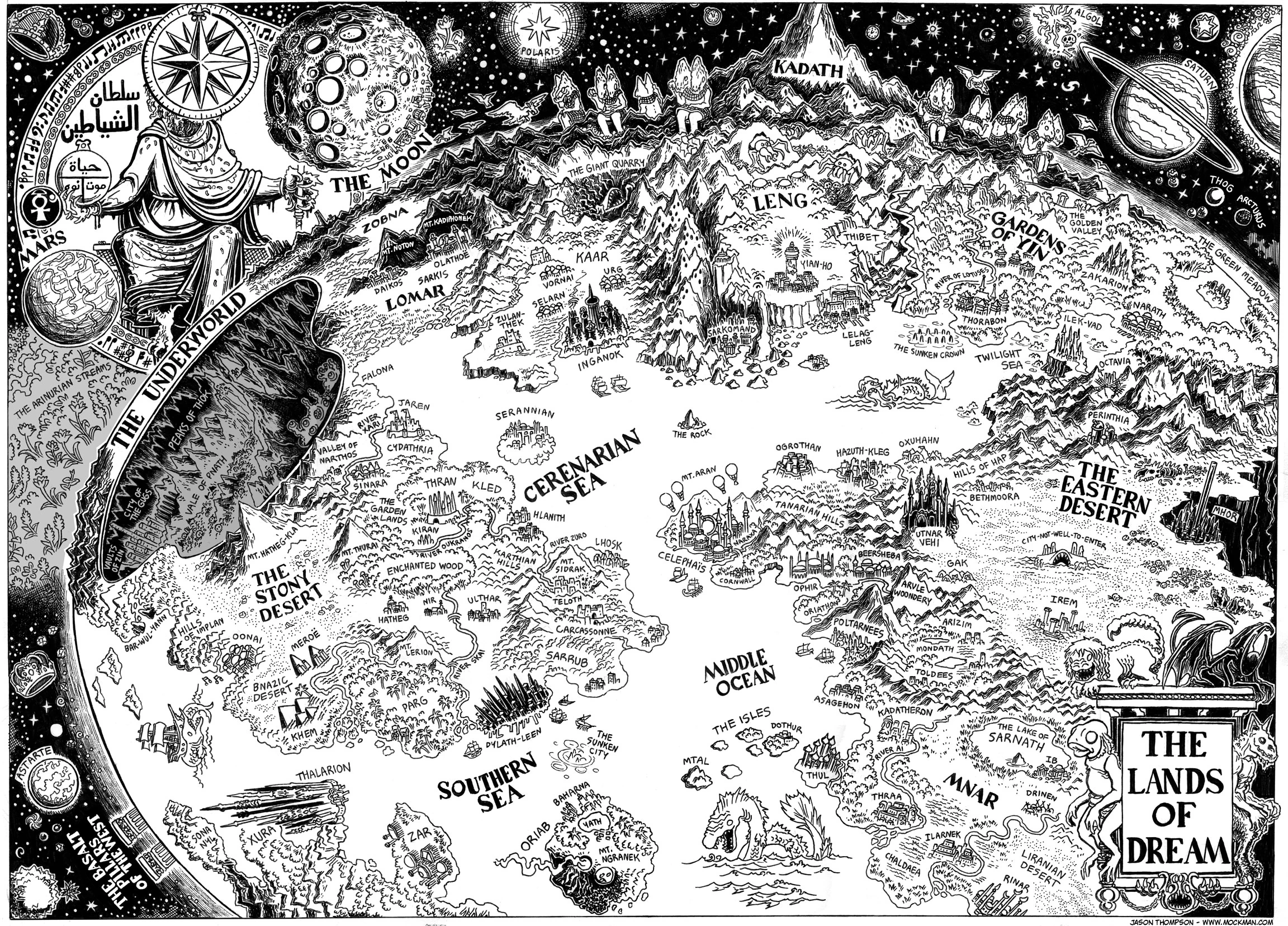
The second story, “Nadir,” is recounted by a “Dreamer” and takes place in the Dunsanian Dreamlands depicted in the twenty-odd stories and novellas known as Lovecraft’s “Dream Cycle”. In an unnamed city near the harbour of Hlanith, an artist called Nebuchadnezzar sets off to climb up the staircase of a mysterious tower whose origin is long-forgotten, but which reaches beyond the clouds and is rumoured to lead to the Hall of the Gods. Nebuchadnezzar pursues the drug-induced dream(-within-a-dream) vision he had several years earlier, of a most perfect and breathtaking land he’s never heard of. Since he obsesses over it and has been unable to paint it satisfyingly, he wants to see it again, and he thinks he will be able to do so from the top of the tower. After a seemingly interminable ascent, he reaches the top, but what he sees is actually the frozen void of deep space. This close contact with the immensity of the dark beyond the clouds traumatises him, but not as much as the realisation, when he reaches the bottom of the tower again, that his home city has now disappeared, and that, for the inhabitants of the land around the tower, there has never been a city there.
The narrator of “Black Taisui” is called “the Historian”, and its protagonist is a quasi-septuagenarian named Lao Mingchang. The story starts in August 2013, when Lao’s corpse is discovered, and everybody is at a loss as to why the corpse is as decayed as if he had been dead for months, although he was reportedly alive a few days before. Using the diaries of the departed, the narrator moves on to reconstruct the last years of his life, and the quest that led him to his strange death. A retired academic from the archaeology department at Shandong University, Lao has moved to Qingdao, where he would die, because the climate is healthier, but he soon takes to researching the history of a shady branch of his family which resided in Qingdao in the early 20th century. They were involved in the smuggling of unidentified materials, and were the leaders of a cult called the “School of Longevity”, which claimed to have the means of staving off death forever, and everybody feared the very noisy rituals they conducted at night in their house. Lao plunges further and further into his investigation, so much so that he moves into his ancestors’ former homestead, only to discover, too late, that the house is not as deserted as it seems, that his forebears’ occult interests are much more than pretensions, and that the Lao family and the School of Longevity are far from defunct. This theme of the deep dive into horror by way of a study of one’s own genealogy is obviously very reminiscent of Lovecraft’s 1927 novel The Case of Charles Dexter Ward, or the end of his 1931 novella “The Shadow over Innsmouth” (and the smuggling, quest for longevity, and secret tunnels under the house, are also very reminiscent of The Case of Charles Dexter Ward). “At the Mountains of Madness” also shows up, as a more explicit intertext, since the eponymous “taisui”, the dark, living and self-regenerating organic material that the School of Longevity smuggles and eats in order to prolong life, is actually either a small compressed Shoggoth, or a small part of a Shoggoth.
“The Ancient Tower” is told by an “anthropologist” who, after a first field trip exploring the Tibetan Plateau in an unspecified year, decides to spend several nights in an ancient stūpa erected near a lake lost among the hills of Qinghai. The construction of the building seems to have stretched over several millennia, deep into prehistory, long before Buddhists had the opportunity to adopt it as a stūpa. The narrator is particularly intrigued by a thangka (a traditional Tibetan Buddhist religious painting on cotton) found in the tower, and which depicts a civilisation beyond human memory, whose culture seems to mix several incompatible periods, and whose people are not always portrayed as humans or as anything biologically recognisable. Trying to find the source of the spectral shrieks locals claim to have heard around the stūpa, the anthropologist encounters more than he bargained for, as he comes into contact with the Great Race of Yith from Lovecraft’s “The Shadow out of Time” (1934-1935), with the Valusian Serpent-Men from Robert E. Howard’s “The Shadow Kingdom” (1929) and other Kull stories, and from several other strange species from the Cthulhu Mythos, making the stūpa the stage for a giant crossover of all the tales connected to the Shining Trapezohedron that stars in Lovecraft’s “The Haunter of the Dark” (1935).
Finally, Akira and Arthur Meursault’s frame story depicts a dialogue in an “abandoned farmhouse in the remote regions of western China […][,] among the remote Himalayan foothills […].” An unidentified narrator, who is apparently very knowledgeable in the Lovecraftian occult, has gathered those people he calls “the Researcher,” “the Dreamer,” “the Historian” and “the Anthropologist,” and he prompts them to tell their stories successively, by showing them objects that played a role in those dark adventures (an ancient document that helped the Researcher find the cave of Ba-Hui, one of the paintings made by the painter in the story of the Dreamer, a “taisui”, and the thangka found in the Tibetan stūpa). There is no description of the five characters, and the reader is led, by omission, to believe that they’re all ordinary humans. In the last part of the story, after the end of “The Ancient Tower”, it is revealed that the narrator is actually a Mi-Go, one of the fungus-based winged crustaceans from planet Yuggoth that star in Lovecraft’s “The Whisperer in Darkness” (1930), and the four narrators of Oobmab’s embedded tales are actually just four living brains conserved in the same kind of canisters the Mi-Go used in Lovecraft’s story to stock Henry Akeley’s brain.
The locations are all named here, not for the sake of exhaustivity, but to give the reader a sense of how important location is in the book. Whereas Gou Tanabe chose to take Lovecraft’s stories as they are and directly transpose them to a typically Japanese narrative form (manga), but with painstaking faithfulness to old-fashioned American names, to New England (and Antarctic, and Australian) locations, and to the slightest details of the original prose narratives, Oobmab’s stories are, on the contrary, delivered in the exact same medium as Lovecraft’s (prose literature, from short story to novella), but the recurring themes, loose structural motifs, and key figures of the Cthulhu Mythos are very resolutely relocated to various areas of China, and subtly blended with elements of Chinese culture. So those stories are not adaptations despite some structural traits that recall some specific stories. They are not either, or at least not only, a continuation of the Cthulhu Mythos like the stories initially written by Lovecraft’s friends August Derleth, Frank Belknap Long, Robert Bloch, etc., and undertaken since then by countless Western published authors and writers of fan fiction alike. Although they do add to the Mythos, they are also akin to the kind of transcontextualisation Akira Kurosawa imposed on Macbeth and King Lear in his movies Throne of Blood (1957) and Ran (1985), or to what Neil Gaiman did to his own “Sandman mythos” when he wrote the “fake” traditional Japanese tale The Dream Hunters in 1999 (Gaiman because Oobmab relocated an author’s whole mythos to a new country and culture, not a specific story; Kurosawa because Oobmab, like Kurosawa and unlike Gaiman, actually comes from the country and culture to which he relocates the Mythos—or at least I assume as much from Oobmab’s writing in Chinese for a Chinese website).
In all of the three Oobmab stories actually located in China (rather than the Dreamlands), the author provides very precise indications of location, be they geographical, administrative, historical and archaeological. Besides, passages depicting the exploration of regions where ancient evil will be stumbled upon are riddled with lengthy descriptions of landscape worthy of a tourist’s guidebook, or in popular culture an 18th century British Gothic or Romantic novel. Here is part of the introduction to the discovery of the cave of Ba-Hui:
Early the next morning, we bid farewell to the roiling waves of the Dadu River to follow its tributary the Nanya upstream to the southern country, where it carved through the ascending hills all the way to Chestnut Plains. My memory of that part of the trip has already faded to a haze—I can recall only the dull fog that choked the skies, the pallid sunlight that trudged to the unbroken, undulating mountain range; and those few furtive glimpses I could catch of sunlight glinting weakly off the Nanya as it ran by the highway. At first we saw only crude thatch huts for local night watchmen, but soon we noticed homes of pitch-black wood in the old style seemingly placed at random. […] We soon left the noise of the village behind us, driving ever deeper in. At last, we submerged into a silence knowable only in the wilderness. The roadside vegetation became lush and murky, higher and thicker in layers until it resembled the walls of an immeasurable labyrinth, enclosing us within. The wheels struck the potholes on the rugged little mountain road. Something in the grappling leaves and twigs seemed alive, beckoning, guiding us on our wandering way to an unknown world. Over the shadowed viridian maze towered a mountain range of majestic peaks and precipitous cliffs. In the distance, on the exposed ash-grey granite of those high cliffs, the jungled gleam of shrubs reticulating like scales gave us the striking impression of some gargantuan beast […].
This portrayal of Sichuan’s mountains is sublime in spirit (in the sense of Edmund Burke’s conception of the term, i.e. an aesthetic of awe rather than mere admiration), as it insists on the “dullness” and “pallor” of the weather, the gigantic nature of the mountains, and generally imbues the surrounding nature with an air of menace (through the metaphor of the “labyrinth” that “encloses in” the explorers’ car, and also by first calling it “wild,” “jungled,” and then gradually multiplying the allusions to the fact that the environment seems “alive” and that it looks like a wild and dangerous animal―significantly for this story, a reptilian beast, with “viridian […] scales”). The same kind of vocabulary, and therefore atmosphere, can be found in “The Ancient Tower,” when the narrator is exploring another part of the Tibetan Plateau, located in Qinghai rather than Sichuan:
That afternoon, as the sun was setting, a lake as calm and flat as a mirror appeared amidst the rolling hills to the northwest of the truck, rousing my interest at last. Though I could see only the section of the lake visible between the gaps of the low foothills, this was enough for me to conclude that it was indeed a very wide stretch of water. Through the valleys winding betwixt the hillsides that accompanied our road I beheld a mountain of immense height to the north of the lake. At that moment the setting sun in the west was cresting against the mountain’s snowcap, bathing the white peak in an eerie shade of lavender. Down at the base of the mountain, a low rugged hill was sandwiched between the lake and the mountain itself, creating a steep transitory zone. Scattered throughout were enormous exposed grey rocks and sparse meadows of pale yellow that comprised the bulk of the plateau’s landscape.
Although he preferred the synonym “eldritch,” Lovecraft certainly used the word “eerie” regularly – six times in his essay Supernatural Horror in Literature (1936)—to describe the kind of fantastic fiction he favoured, and it also appears in “The Curse of Yig,” “The Dunwich Horror” (1928), “The Festival” (1923), “The Ghost-Eater” (1923), “Herbert West―Reanimator” (1921-1922), “In the Vault” (1925), “The Nameless City” (1921), “The Outsider” (1921), “The Transition of Juan Romero” (1919) and “Under the Pyramids” (1924). Besides, it has been used by others to describe his fiction. So, generally speaking, it is one of those adjectives readily associated, in people’s minds, with Lovecraft’s work, although none is as widely and obviously seen as inherently Lovecraftian as “cyclopean”, because of his famously frequent use of it. “Cyclopean” definitely appears in The Flock of Ba-Hui too, at least three times―although, to be fair, one of those is in the last part of the translators’ framing story. Oobmab uses it in “The Flock of Ba-Hui” (very aptly, to describe a huge tunnel carved inside the cave the characters explore), and in “The Ancient Tower” (to describe a stone staircase built under the stūpa, and which will lead the narrator to the syncretic horrors he’s about to discover). However, to be clear, the penchant for very detailed description is not reserved only for sublime landscapes emerging from the Tibetan wilderness, seemingly perfect settings for the irruption of Lovecraftian horror. Here’s how the Shangdong city of Qingdao is introduced (clearly in terms of the Beautiful rather than the Sublime) in “Black Taisui”:
The small building was tucked away on a hillside situated in the northwest of Xiao Yushan, next door to Qingdao Ocean University. I have walked there many times; it is a charming place to live. The surroundings are quiet and peaceful, and few vehicles pass through. The entrance of the building leads onto Yushan Road as it winds down from the top of Xiao Yushan. The cream-colored fence of the university campus, perpetually smothered with creeping ivy, lines the opposite sides of the street. Quaint and elegant brick-red campus rooftops in the European style loom over the lush walls, creating an adorable little corner that invites one to explore deeper. […] Through the main entrance is a stretch of verdant pine trees and bushes, and once past the bushes there stands a European-style building that was constructed during the Japanese occupation. […] After passing through the university gate and continuing along the outer wall, you will arrive at a crossroads. South from the crossroads―past several more modern-style buildings―there is a lively and popular beach; to the east you may follow the quiet alleyways and the sycamore trees, eventually entering an old world filled with tiled roofs, elegant stone arches, rough granite façades, and cobbled streets. It’s a place where time seems to have stood still.
This drive to document all sorts of worldly landscapes before plunging the reader into Lovecraftian netherworlds is not altogether idiosyncratic, either for Lovecraft or Oobmab, since, as Maurice Lévy points out in his book Lovecraft: A Study in the Fantastic (1985; translated from the original French by S. T. Joshi in 1988): “It is well known that the truly fantastic exists only where the impossible can make an irruption, through time and space, into an objectively familiar locale.” Yet, in the same chapter of his book, Lévy also insists on the deeply personal connection of Lovecraft towards the New England “Dwellings and Landscapes” that provide the majority of his stories’ settings:
New England was also Lovecraft’s native soil, the only point on earth with which he could totally identify. This obscure emotion of belonging, of rootedness, was for him the primordial condition of all plenitude. […]
New England is the province of marvellous cities that Lovecraft so often visited and so dearly loved: Providence, Boston, Marblehead, Salem, Newport. In those cities the past surfaces and affirms itself at each street corner, and all the homes have a single history; it is a place of profound towns, rooted in the homogeneous tradition of Puritanism […].
New England, with its deep forests, its marvellous landscapes, its wild mountains, its rugged coast gouged with gulfs, is certainly a place with a potential for adventure and mystery.
Just as the sublime mood given to the Tibetan mountainscapes of the previous passages can recall the Lovecraftian vision of New England wilderness as summarized by Lévy, the description of Qingdao’s townscape bears many similarities with the qualities that endeared New England towns to Lovecraft. “[C]reeping ivy,” “Quaint and elegant […] rooftops in the European style,” “cobbled streets,” “a place where time seems to have stood still,” all those phrases as well as the historical reference to the Japanese occupation certainly match Lovecraftian fondness for “profound towns” where “the past surfaces and affirms itself at each street corner”―although the same reference to the Japanese occupation, as well as the numerous mentions of streets and neighbourhoods’ names, or the name of the province appearing within the name of the university, make sure that the country where “Black Taisui” takes place cannot be confused with New England.
So, while “exploring” the book, one will definitely “discover” two predictable schemes that are subtly blended together: anchoring the appearance of Cthulhian creatures in the cultural and physical landscapes of modern-day China, and anchoring literary explorations of modern-day China in the mood and language of the fantastic and horror in general, and of Lovecraft’s fiction in particular. Another, typically Lovecraftian way in which Oobmab mixes the two cultural universes is by making his protagonists ponder over lists of “occult” books, just as Lovecraft did when he constantly name-dropped his imaginary reading list, from Abdul Alhazred’s Necronomicon to Ludwig Prinn’s De Vermis Mysteriis to the Comte d’Erlette’s Culte des goules or Friedrich von Juntz’s Unaussprechlichen Kulten. In Oobmab’s stories, the lists are a little different from the average Lovecraftian forbidden book inventory. Only one of Lovecraft’s fictional grimoires and scrolls is featured in “The Flock of Ba-Hui”’s list: the Seven Cryptical Books of Hsan, from “The Other Gods” (1921) and “The Dream-Quest of Unknown Kadath” (1926-1927)―two stories of the Dream Cycle. There’s also a mention of the Necronomicon, but in Akira and Meursault’s frame story. All the other books name-dropped by Oobmab are existing Chinese books of strange tales, mythology or quasi-mythological history: Wang Jia’s Forgotten Tales of the Eastern Jin (from the eponymous period, c. 317-420 BC), Masters of Huainan of the Western Han (c. 139 BC), the Tale of King Mu, Son of Heaven (c. 296 BC), the Classic of Mountains and Seas (2nd century BC or partly before) are listed in “The Flock of Ba-Hui”, and Records of Universal Harmony (c. 618-907 BC) is added in “Black Taisui”. For some reason, Records of the Great Wilderness, which appears in both stories, is listed in addition to the Classic of Mountains and Seas in “The Flock of Ba-Hui,” although it’s actually a part of the Classic of Mountains and Seas.
In sum, The Flock of Ba-Hui simultaneously sets tales of the Cthulhu Mythos in carefully fleshed-out and explicitly Chinese contexts, gives these Chinese settings an aura of Lovecraftian horror using various basic literary tools as shown with the passages quoted above, places the whole undertaking under the aegis of classical Chinese mythology by making famous old books about it the go-to references for the characters to understand what happens to them, and incorporates a fictional book that is part of the Cthulhu Mythos (the Seven Cryptical Books of Hsan) in the reference list otherwise made of books of Chinese mythology. In other words, Oobmab’s collection works in different ways to make the Cthulhu Mythos part of Chinese geography and mythology. It creates a fictional space in which Lovecraft’s monstrous deities and New England nightmares are welcomed in their midst by the traditional Chinese fantasy world’s denizens, the vengeful and lovelorn ghosts, shapeshifting spirits and trickster gods that people the pages of the Classic of Mountains and Seas, of Pu Songling’s classic 18th-century collection Strange Tales from a Chinese Studio, or of Hong Kong movies like Ching Siu-tung’s A Chinese Ghost Story (1987) or Chih-Hung Kuei’s Hex (1980).
This incorporation work is multi-faceted and pervasive. Another example of it is the renaming of some Lovecraftian monsters. The “Elder Things” from “At the Mountains of Madness” become “the Amphiura Gods”―after a species of starfish, which makes sense considering the appearance of Elder Things (see Gou Tanabe’s depiction). “Yig” becomes “Ba-Hui” (which might mean something like “legless dragon from Sichuan”, according to the indications of a translator’s note). “Shoggoths” become “taisui”―a polysemous word whose various meanings usually evoke the regenerative properties corresponding to Shoggoth flesh’s death-defeating properties according to the story (and there’s a link to mythology again, since, among other things, “taisui” is a linghzi mushroom “frequently mentioned in […] the Classic of Mountains and Seas” and “used in immortality elixirs in ancient times,” according to a translator’s note). In all these ways, Oobmab’s stories are clearly a kind of Kurosawan or Gaimanian transcontextualisation like the ones cited earlier, and a hyphen between two antipodean imaginaries, rather than mere “pastiche” as Lovecraft’s friends’ Cthulhu-Mythos-related stories often were.

Now, a question that obviously comes to mind is whether The Flock of Ba-Hui is a worthy example of the “cosmic horror” Lovecraft describes, in Supernatural Horror in Literature, as the essential quality horror writers must strive for in his opinion (“The true weird tale has something more than secret murder, bloody bones, or a sheeted form clanking chains according to rule. A certain atmosphere of breathless and unexplainable dread of outer, unknown forces must be present”). If the effect of a horror story on a reader’s sense of dread or lack thereof is entirely subjective (it can even be argued that horror fiction is actually reassuring rather than frightening), the themes of cosmic horror are certainly there in the stories of The Flock of Ba-Hui. The titular story does not merely focus on the horrible discovery of the existence of a huge snake monster worshipped by anthropoid snake priests and their half-simian, half-humanoid slaves. The unfurling of the events in the cave shows that the real reason for the protagonist’s fear and dismay is much more specific, less obvious, and more devastating, than the mere realization that there are monsters, and that they have killed many humans and are likely to attack again.
Here’s a summary of the illuminating structure of the “exploration” passage: the first murals show humans being transformed into snake priests and the explorers deduce that their new status as priests is metaphorically rendered by depicting them as anthropoid snakes; then later the whole “Nanyu” civilisation of mass human sacrifices is painted on the walls with its various and monstrous social strata, and the researchers still believe the various creatures are just metaphors for the various social roles of humans in “Nanyu” society; then they discover the skeleton of one of the half-ape, half-human monsters, yet they still believe at least the snake-men on the murals are just metaphors; finally, the narrator, while alone, runs into two living snake priests, one of which calls him by his name, and the fact that it called him by his name is the last thing the “Researcher” reveals in the very last words of the text (in a pretty typically Lovecraftian melodramatic last-second twist).
What this structure says is that the problem is not that there are dangerous monsters hidden somewhere in the mountainous caves of Sichuan. One of the real issues is that, contrary to what the characters try to deny throughout the story, there is an incomprehensible force that can erase at will the biological boundaries between human and snake, and which can also make some humans devolve into subhuman pre-historic semi-apes. The second issue is that these outrageous transformations are not just a thing of the past, something barbarians accepted, just as readily as they accepted mass human sacrifice: since apparently Zhang Cunmeng, the missing anthropologist, fled the lunatic asylum in order to become a snake priest, and has succeeded in doing so, it is a metamorphosis that Ba-Hui can still cause today, and there are civilised humans today who are willing to undergo this change. All these abject fears of blurred boundaries between humanity and inhumanity are exactly the ones that come to play when the narrator of Lovecraft’s “The Outsider” understands that the monster he sees is his own reflection in a mirror; when the narrator of “The Shadow over Innsmouth” finds out that he is blood-related to the batrachian Deep Ones and the Innsmouth residents who miscegenated with them, and that he is gradually transforming into a Deep One himself; or when the narrator of “The Lurking Fear” (1922) realizes that the ape-like monsters hiding in the Catskills and which regularly attack and savagely kill people are actually the Martense family, devolved into inhuman half-beasts after centuries of isolation and inbreeding.
The same kind of idea (of existential fear for the integrity of humanity) can be found in Meursault and Akira’s frame story, when the reader discovers that the narrators whom they were led to think of as living humans are not, and in Oobmab’s “Black Taisui,” as it depicts humans eating the flesh of a formless, immortal monster (the Shoggoth), and then becoming, themselves, immortal and inhuman, leaving behind them their own decayed corpse, as a snake shedding its skin. Besides, the protagonist of “Black Taisui” ultimately partakes in this ritual of abjuration of one’s humanity, in a pattern that again recalls the anti-humanist choice of the narrator at the end of “The Shadow over Innsmouth” (although the transformation and blending of the human into the inhuman is effected through eating, not through sex, which allows “Black Taisui” to set aside Lovecraft’s racist pet theme of the corrupting power of miscegenation). In “The Ancient Tower,” it is mostly the boundaries of space and especially time that are erased when the narrator encounters, stepping into the present from their various time realms through archways erected under the stūpa, people from remote historical periods and creatures from various Lovecraft stories, supposed to come from pre-human times (and post-human times as well, as the Coleoptera that will rule the world after the disappearance of humans, according to the Great Race of Yith’s records in “The Shadow out of Time,” guest-star in Oobmab’s story too). So here the scale of the fear’s object is less existential than ontological, making it even more about how the cosmos works, and what unspeakable forces can disturb it. Finally, one could almost see a joke on the notion of “cosmic horror” in “Nadir,” the story set in the Dreamlands. Indeed, it is technically the story of someone who sees the cosmos right before his eyes, and it scares him. So it may be the most direct and literal way of depicting “cosmic horror” a writer could ever have come up with.
In a nutshell, The Flock of Ba-Hui is, in several regards, a very interesting and worthy addition to the Lovecraftverse/Cthulhu Mythos and to horror and fantastic literature. To fans of Lovecraft’s fiction all around the world, it provides a new extension that is faithful to what constitutes the thrills of the Cthulhu Mythos and at the same time departs significantly from the decidedly Western-centric inspiration and atmosphere of both Lovecraft’s original tales and most of the storyworld that has been built around them. For a Western reader in particular, the way Lovecraft’s creations and mood are, to some extent, “sinicized” can only count as cultural added value, rather than the additional “level of strangeness” that John Minford, a translator of Pu Songling’s Strange Tales, saw as a potentially upsetting “problem” for such a reader. For Chinese-speaking readers and writers alike, The Flock of Ba-Hui opens a door for Chinese horror, demonstrating once again the availability of Lovecraft lore and the weird tale vibe for any interested author, and their miscibility in other cultures than the aggressively WASP one from which they sprung. Such productive appropriation is nothing new to Chinese genre fiction. Some special effects in a piece like 1980s HK movie A Chinese Ghost Story (namely, the Tree Demoness’s gigantic tongue, and the branches behaving like tentacles that emerge from it at some point) recall the aesthetics of Lovecraft, or at least the way he has often been translated to the American movie screen. However, this is probably mostly because A Chinese Ghost Story seems to partly take inspiration from Sam Raimi’s Evil Dead films and those films were, themselves, arguably influenced by Lovecraft’s works. A work like the novel Valley of Terror (2009) by Zhou Hahoui ostensibly teases the reader with a seemingly supernatural mystery about demonic forces, rooted in Chinese history and mythology and the Xishuangbanna rainforest in Yunnan; but it ends with the trope recognizable from Conan Doyle’s novel The Hound of the Baskervilles (1901-1902) or famous knock-offs like Joe Ruby and Ken Spears’s cartoon series Scooby-Doo, Where Are You! (1969-1970): the supernatural menace is a hoax created to cover up criminal activity. Yet again, this is not completely new in this part of the world, as criminals hiding behind fake curses/ghosts/demons can at least be traced back to some other HK movies: Chih-Hung Kuei’s Hex and Curse of Evil (1982) for example.
All those works offer very fresh and exciting new perspectives on the tropes they appropriate (much more so than some Western rewritings of The Hound of the Baskervilles, like Christophe Gans’s 2001 French film Brotherhood of the Wolf). Likewise, The Flock of Ba-Hui’s Chinese perspective on, and recontextualisation of, Lovecraft’s Cthulhu Mythos offers a fresh and larger, globalized perspective on what has become an essential part of the culture of horror fans all around the world. Besides, judging by Akira and Meursault’s English rendition of it, Oobmab’s writing is fairly pleasant, nodding here and there to Lovecraft’s famous purple prose without overdoing it the way the US author often did. Finally, the translators’ idea, of adding a frame story of their own, was a brilliant one. This structure is entertaining, and it allows the translators to add to their illuminating footnotes another channel for subtly clarifying some of Oobmab’s disguised references to the Mythos, without shattering the atmosphere of Oobmab’s stories. After reading The Flock of Ba-Hui, one hopes that Camphor Press will publish other stories by Oobmab or by other Ring of Wonder users.
How to cite: Camus, Cyril. “The Flock of Ba-Hui: Lovecraft’s New England Nightmares Meet the Mythical Geography of China.” Cha: An Asian Literary Journal, 5 May 2020, chajournal.com/2020/05/05/flock-of-ba-hui/.


Cyril Camus teaches English to post-secondary students at Lycée Ozenne in Toulouse and is an associate member of the Centre for Anglophone Studies at Toulouse University. He is the author of Myth and Fabulation in the Fantasy Fiction of Neil Gaiman, originally published in French in 2018, with an English-language edition published by McFarland in August 2026. He also wrote the historical horror novel Grand Guignol, published in October 2026, which had previously appeared with another publisher, in a slightly different version, under the title Sang de bœuf between 2019 and 2025. His academic publications address Neil Gaiman, Alan Moore, comics, music, and postmodern fantasy. He also co-edited a 2021 journal issue on societal and environmental collapse in fantasy and science fiction. Further information is available on his website. [All contributions by Cyril Camus.]