
茶 FIRST IMPRESSIONS
茶 REVIEW OF BOOKS & FILMS
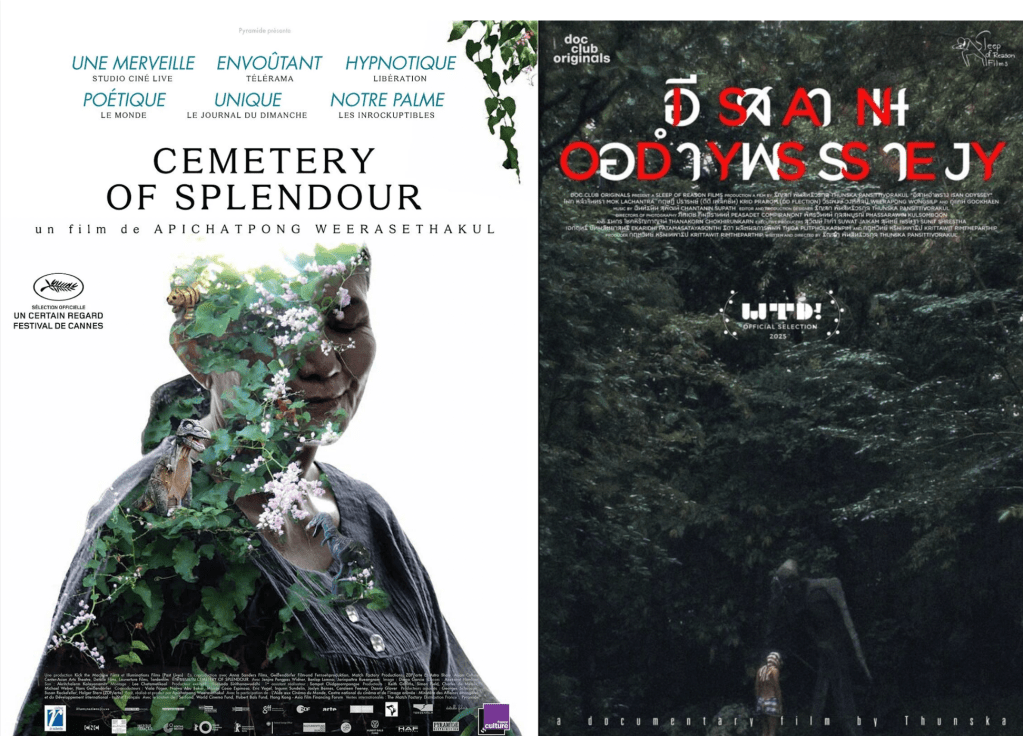
[ESSAY] “Sleep, Baby, Oh Don’t You Sleep: Thailand’s Northeast in Apichatpong Weerasethakul’s Cemetery of Splendour and Thunska Pansittivorakul’s Isan Odyssey” by Peixuan Xie
❀ Apichatpong Weerasethakul (director), Cemetery of Splendour, 2015. 120 min.
❀ Thunska Pansittivorakul (director), Isan Odyssey, 2025. 80 min.
The night train from Bangkok to Nong Khai departs at 20:25. The steward who prepares the beds wakes all the passengers at 5:30 in the morning, just before Udon Thani, with another hour remaining before we reach our destination. Along this route, we slowly chug into Isan, Thailand’s region of twenty north-eastern provinces, with Nong Khai the final point on the Mekong River, facing the Laotian capital of Vientiane.
Despite expecting a sleepless night, I fell asleep before 22:30. On the firm pallet of the bunk bed, I thought of Apichatpong Weerasethakul’s Cemetery of Splendour, the story of a hypersomnia epidemic. In his Isan, to sleep is as compelling as to act or to exist.
Bodies in slumber are carried out of cinemas, shopping centres, and park gazebos, even from meals of sticky rice and grilled dishes.
In a hospital ward converted from an old school in Khon Kaen province, soldiers are brought back for treatment after mysteriously falling asleep. Their hibernation comes and goes like a storm in the monsoon season, abrupt yet not irreversible. Bodies in slumber are carried out of cinemas, shopping centres, and park gazebos, even from meals of sticky rice and grilled dishes, an Isan classic, and returned to the hospital as if in death. A nurse recounts that she could never remain awake as a student in Isan, for warring kings beneath an ancient burial ground recruit people’s reveries to wage their everlasting battles. Family members of some soldiers hire a young local medium, Keng, to communicate with them in their prolonged dreams, while those without attendants are assigned volunteer caregivers. Coloured lights, beaming from ivory-shaped lamps installed beside each hospital bed, are used to soothe their dreams.
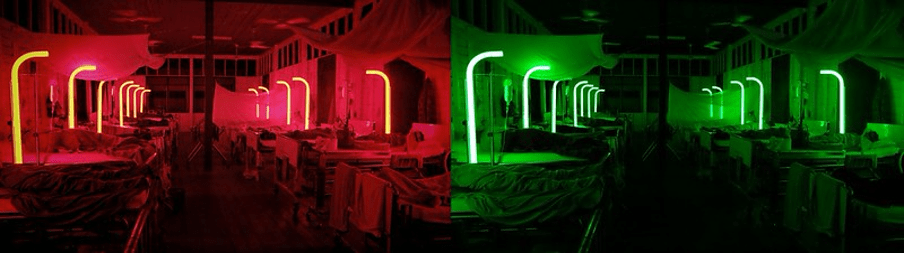
Photo credit: Prachatai English
The film unfolds as a volunteer, Jenjira, watches over a young soldier, Itt, and moves in and out of entangled worlds of reality and reverie, her own and his. The two converse on many subjects: stereotypes of skin tone, accents, and complexions across different Thai regions, the Deep South and Isan, the ever-ebbing waters of the Mekong’s tributaries, infrastructure projects that seem to extract to the very depths of the soil, ancient kings and palaces, and alternative forms of healing. Still within his dream world, realised through Keng’s intermediary body, he describes to her the majestic palace in which he dwells.
There are moments they inhabit and observe: working poor sleeping at neon-flashed bus stops, a tentative romance between Jenjira and an American tourist in a time of economic hardship, twin Laotian goddesses dazzling a wet market, meditation classes for languishing health workers on a hot afternoon beside the soldiers’ drowsing beds, children playing among tractor-made laterite dunes at a new development site, and a portrait of General Prayut Chan-O-Cha, who overthrew a civilian government in 2014, hanging on the wall, the post-coup country under his supervisory gaze. These are things that resist narration and defy dissection.
The distinct regional elements, set against a pervasive background of globalised developmentalism and urbanisation, which Apichatpong explores through a magic-realist film, may appear abundant, yet they do not feel chaotic. Like a slow passage through dimly lit dinghies at dusk, the water guides gently and without words. Somnolence remains a quiet central anchor, together with the dream world it engenders, drifting through the possibilities and impossibilities of life in Isan and beyond.
Culturally and ethnically Lao since the thirteenth century, as part of the Kingdom of Laos, and historically rebellious, Isan has long been regarded by Bangkok as the “troubled Northeast,” from harbouring the “Holy Man’s uprising” in the early twentieth century to the Thai communist insurgency during the Cold War. Its socio-economic marginalisation, therefore, is scarcely surprising. As the poorest and most populous region in Thailand, with the lowest rates of educational attainment, many people from Isan are compelled to migrate to larger cities in search of low-paid work. If deliberate impoverishment resembles a crippling sleepiness, an extended nightmare from which it is difficult to awaken, then the steady outflow of its population, drawn into the grinding machinery of urban capitalist development, becomes a ritual that sustains this condition.
When confronted with circumstances that one cannot alter or fully comprehend, falling asleep may appear to be a form of surrender, an easy retreat from reality into non-reality. Yet it may also be understood as a form of quiet resistance, a withdrawal from imposed obligations and coerced participation, and an opening towards alternative modes of existence. When impoverishment, extractivism, marginalisation, and militarism solidify into lived reality, remaining asleep can become an act of refusal, a gesture of dissent, even of inversion, whereby dreaming serves as a passage towards a desired, rather than an experienced, world. Isan may seem dormant, yet its psychogeographic rhythms continue to pulse. Dreams and realities remain fluid in Apichatpong’s vision.
Towards the end, the young medium tells Jenjira that, if she wishes to leave the dream world, she need only open her eyes very hard and wide. But what if nothing happens? Apichatpong offers no definitive answer. Instead, he allows Jenjira’s gaze to linger, piercing through the tractors and playing children at a construction site, one of many that relentlessly fracture the ground beneath her feet.
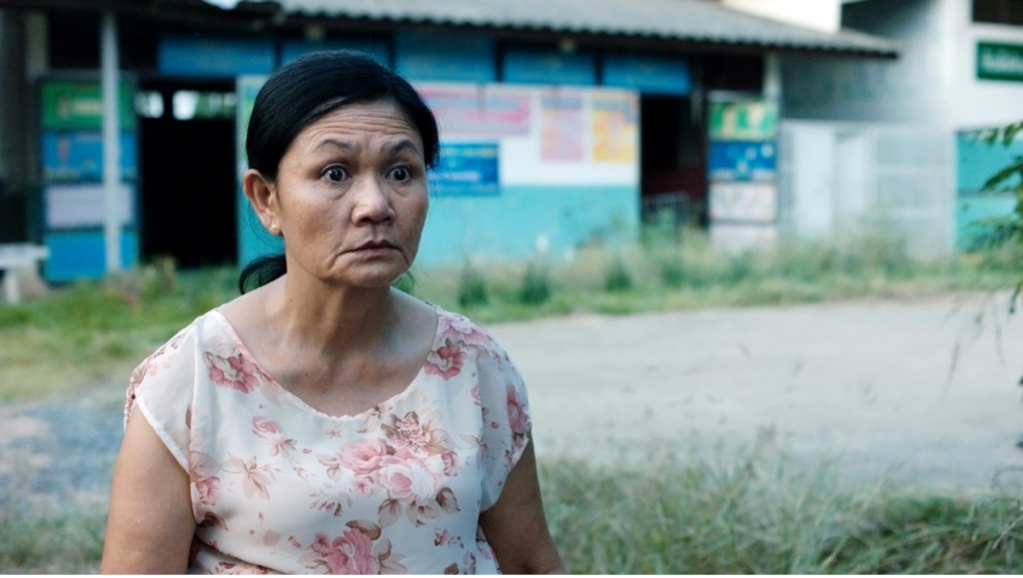
Image: Cemetery of Splendour
Perhaps the answer to this thorny question may be found instead in Thunska Pansittivorakul’s Isan.
In contrast to Apichatpong’s meandering, pastoral portrayal, Thunska’s Isan Odyssey, an intervention a decade after Cemetery of Splendour, is clamorous, dynamic, and utterly sleepless, like an urgent message that cannot be restrained behind an eager, clipped tongue. Sweltering and gasping, yet sincere.
Hybrid in documentary form, the film tells as much as it shows, woven through fragments of movement and sound, febrile or restrained, yet invariably unsettling. A myth recounts a son snatched by the Naga, the serpent guardian of Southeast Asian waters, as his mother crosses into Laos. A mor lam troupe, rooted in Laos and the Isan region, performs through all-night village tours. Two men sing of a woeful exodus from what is now Laos into present-day Thailand and of the forced assimilation of indigenous peoples into a Thai identity. A Siri voice narrates Thailand’s anti-communist campaigns of the 1960s, while a topless man dances frantically in the woods near a democracy monument. A group of young people are asked what they know of Jit Phumisak, the renowned Marxist historian and activist persecuted in Isan. A village strives to preserve its Phu Tai traditions. A tree branch inadvertently casts a shadow over a portrait of the royal family. A young activist bathes, dresses, and, illuminated by the glowing dusk of the Mekong, guides the audience through sites marked by silencing, enforced disappearance, and the murder of Isan-based activists advocating for democracy and justice. When he too crosses into Laos, he contemplates paintings that openly denounce the brutality of French colonial rule.
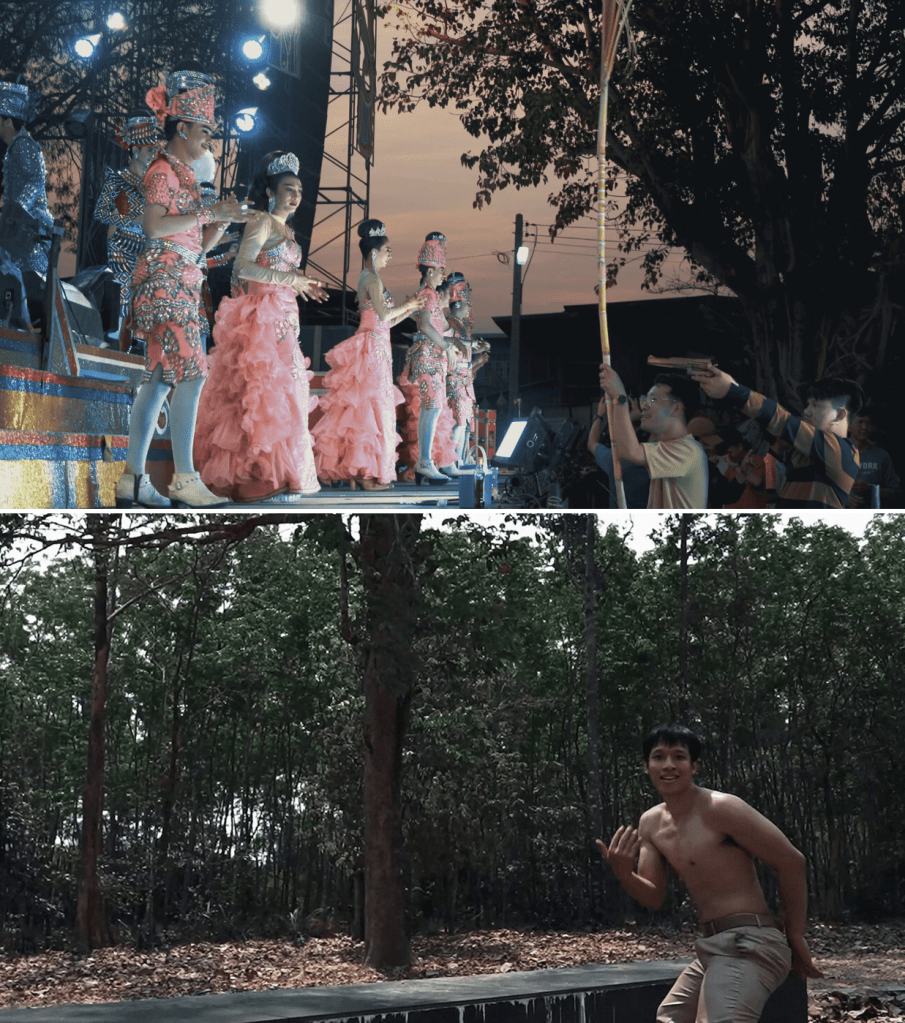
Images: Isan Odyssey
The film conducts a razor-sharp examination of the structures of power in Thai politics, one that readily leaves the audience gasping.
Central to the inquiries and explorations of Isan Odyssey are questions that are both poetically political and profoundly ethnic. By engaging with both dimensions, the film conducts a razor-sharp examination of the structures of power in Thai politics, one that readily leaves the audience gasping. When the logic of dominance and oppression prevails, ethnic injustice, along with the authoritarian imposition of conservatism and other forms of inequity, emerges as an interconnected consequence. If the stripped bodies of students at Thammasat University were left to bake beneath the brutal sun, hanging from unforgiving tree branches for their commitment to democracy, how could one not expect the sun and the trees to re-enact such violence when ethnic communities seek to preserve what is distinctively their own? When calls for change and reimagining are immediately construed as subversive threats to be extinguished, no one can sleep easily.
Past and present alike, Isan does not shrink from resisting this dogma of dominance and oppression, despite the twin pressures of forced integration into a national identity of “Thainess” and systematic exclusion from socio-political decision-making. During the Vietnam War, five of the eight United States military bases in Thailand were located in Isan, supplying bombing campaigns over Vietnam and Laos and serving to deter communist insurgency. In the post-war period, centralised extractive policies and nationalist impositions followed, suppressing demands for cultural preservation alongside greater socio-economic equity. It is evident that passive acceptance was never a viable option. As Thunska demonstrates in the documentary, Isan became a gathering place for pro-democracy students and communist guerrilla fighters within its dense forests during the 1960s and, more recently, a stronghold of the “red shirt” protesters, who challenged military and elite-backed conservative royalism and called for a more equal and just social order during the political upheavals of 2010, 2015, and 2019. In this context, resistance assumes the form of sleeplessness, a refusal to drift into a coerced night.
Resistance, in turn, gives rise to reimagining, renewal, and re-existence.
Both somnolence and insomnia emerge as modes of resistance. Resistance, in turn, gives rise to reimagining, renewal, and re-existence. Perhaps what Apichatpong and Thunska suggest to their audience, and to Isan itself, is that it matters little whether one chooses to close one’s eyes in an imposed silence, conjuring alternative realities and possibilities, or to dispel the night through song, movement, and a restless wakefulness. Neither path should be taken lightly.
How to cite: Xie, Peixuan. “Sleep, Baby, Oh Don’t You Sleep: Thailand’s Northeast in Apichatpong Weerasethakul’s Cemetery of Splendour and Thunska Pansittivorakul’s Isan Odyssey.” Cha: An Asian Literary Journal, 7 Apr. 2026, chajournal.com/2026/04/07/thailand-northeast.



Peixuan Xie‘s research focuses on peace and conflict and she occasionally writes about other things. [Read all entries by Peixuan Xie.]
 Cha
Cha 