
茶 FIRST IMPRESSIONS
茶 REVIEW OF BOOKS & FILMS
[REVIEW] “Between Golf and Karaoke: Locating Filipino Identity in Rafael Manuel’s Filipiñana” By Ciro Quiapos
Click HERE to read all entries in Cha
on Filipiñana.
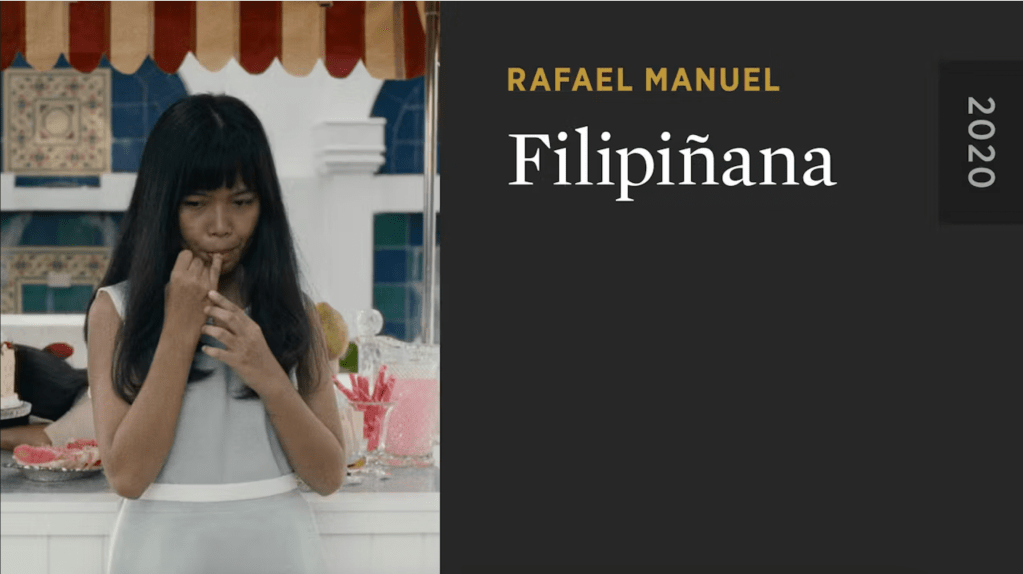
Rafael Manuel (director), Filipiñana, 2020. 24 min.
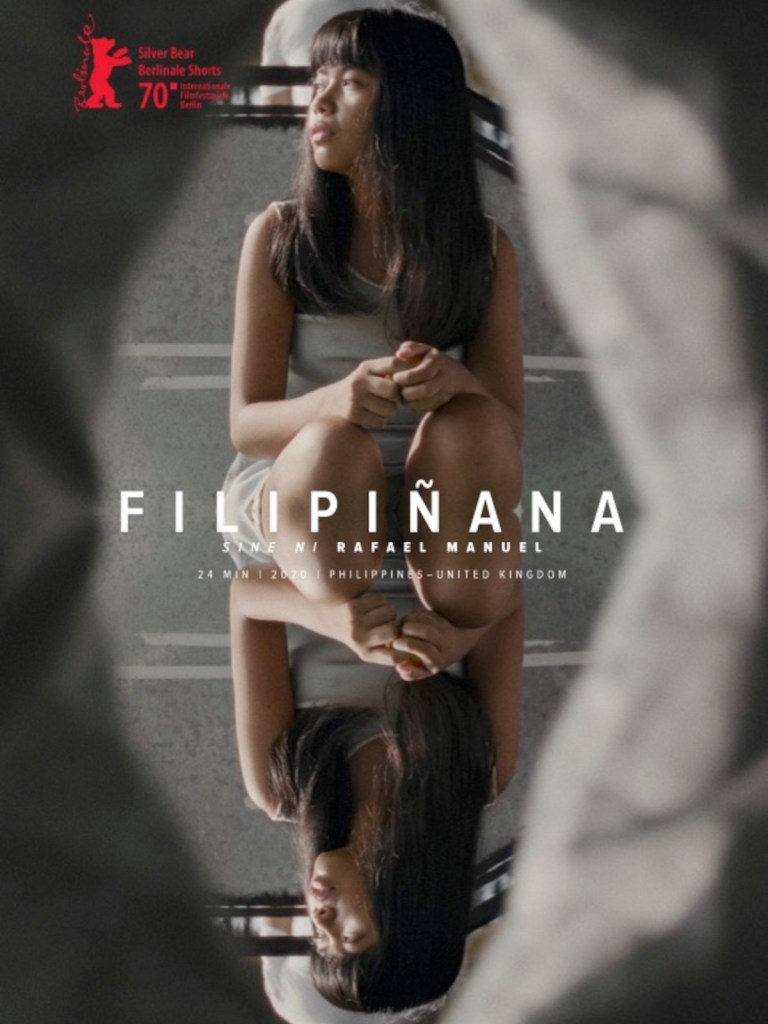
Before Rafael Manuel’s directorial debut at Sundance with his 2026 film Filipiñana, he had directed a short film of the same name and concept as his film school thesis in 2020. This review examines that short film.
The narrative follows Isabel, a young Filipina employed at a golf club in a role she herself cannot define. When asked what her position is, she does not know. She constantly hums a melody whose lyrics she cannot recall.
The film opens with a sequence of golf shuttles bearing small Philippine flags that flutter in the wind as they arrive at the course. They are met by caddies in immaculate white uniforms. Isabel enters wearing the same uniform, indistinguishable from the others, as though she were not the protagonist of the film. She is stopped by the club manager, a Filipina dressed in a blazer while eating turon. The manager lectures her on who may enter the golf course: golfers and caddies. She then asks Isabel what she is. Isabel replies that she does not know.
It is a striking choice to begin a film entitled “Filipiñana” at a golf course, a sport introduced by the British while constructing railways in the 1880s.
It is a striking choice to begin a film entitled “Filipiñana” at a golf course, a sport introduced by the British while constructing railways in the 1880s. The first course was built in Intramuros, where remnants of Spanish colonial architecture remain. Before asking what it means to be Filipino, we have long accepted that Filipino identity entails cultural hybridity, shaped by Spanish and American colonisation and by the Japanese occupation. The opening sequence thus establishes the film’s position on the ambivalence of Filipino identity. The Philippine flag waves atop a vehicle servicing an imported sport. The manager speaks Filipino and eats turon, yet dresses in Americana. These contradictions are deliberate. They stage an identity that is hybrid yet hierarchical.
This postcolonial condition also contains an internal conflict: the replication of colonial hierarchies within Filipino society itself. In one scene, the manager instructs a worker to perform his task more quickly. Golf, as a sport predicated on the control and ownership of land, becomes a metaphor for dominance. When Filipinos ceased labouring in the haciendas of colonial masters, elite families and politicians acquired and privatised vast properties of their own. Even under a sovereign government, farmers and Indigenous communities continue to lose agricultural and ancestral lands. The 2024 docufiction feature Tumandok, recipient of the Cinemalaya Best Film award, portrays the struggle of an Ati girl who travels between mountain and city to raise one million pesos to secure certification of her community’s ancestral domain and assert their rights amid killings and the destruction of crops.
)
Homi Bhabha, in Location of Culture (1994), argues that culture emerges not from the fixed positions of coloniser and colonised, but from the interstitial spaces in which they encounter one another. Golf, despite its reputation as a highly expensive and luxury sport, has become a culture in itself in the Philippines. At the University of the Philippines, the foremost state university in the country, a golf club has been established for students (Bengo, 2023). Yet, contrary to its promotional claim that “golf is for all”, this assertion is untenable. Golf demands vast tracts of land and substantial financial resources for its high-maintenance operations, all for the exclusive use of a limited membership. Exclusivity constitutes its central form of power. The UP community has not universally welcomed its establishment, and several students have openly condemned it.
She may know little about golf, yet she recognises that she does not belong in that space, as evidenced by her evident disinterest in her task.
In this respect, Filipiñana does not present Filipino identity as hybrid in any celebratory sense, but as fractured along class lines, where colonial residue is sustained by Filipinos themselves. Isabel may be read as a figure of resistance. Her professed ignorance of her role as the girl who places the ball on the tee is not mere naivety, but a refusal of the alienation imposed upon her. She may know little about golf, yet she recognises that she does not belong in that space, as evidenced by her evident disinterest in her task. Her denied entry to the golf course is determined not solely by her job description, but by her socio-economic position as a Filipina without the means to participate in such a sport. In the postcolonial condition, the social economy that stratifies society further destabilises any coherent notion of what it means to be Filipino. Does Filipino identity entail the freedom to participate in any pursuit? Or does it instead mark exclusion from domains such as golf, whose codes remain inaccessible?
Filipiñana reinforces the persistence of internalised colonisation through its imagery: staff members wearing salakot and carrying nipa-woven bags retrieve balls struck by Filipino golfers, reproducing the visual logic of colonial servitude.
At times, exclusion generates a desire to partake in what is reserved for the privileged.
Denial does not invariably produce resistance. At times, exclusion generates a desire to partake in what is reserved for the privileged. In one scene, Isabel furtively tastes the icing of a cake in an alfresco dining area when no one is present. A co-worker warns her that employees have been dismissed for lesser transgressions, namely theft. Later, she sits on a chair, smoking, as she contemplates the expansive green landscape of the course. Exclusion fragments identity, and within that fragmentation emerges the longing to experience privilege, however fleetingly.
This fragmentation assumes an additional complexity for women in the postcolonial Philippines. Tens of thousands of Filipinas marry foreigners as a pathway towards economic mobility and stability (Youvan, 2024). Yet, in crossing borders, identity is renegotiated within new cultural formations, producing hybrid spaces that are at once liberating and burdensome. These spaces entangle women in expectations of representing the nation through the roles of wife and mother.
In the film, when a colleague asks Isabel about the tune she is humming, she replies that she cannot recall the lyrics. However, in a karaoke bar with her co-workers, she sings the words to “Si Pilemon” with clarity. The lyrics seem to bring the melody into focus, momentarily dispelling the ambiguities of where she stands and who she is. In moments of identity crisis, one seeks sites of comfort. For many Filipinos, the karaoke room functions as such a refuge. Although karaoke did not originate solely in the Philippines, it has been reconstituted within local culture as a space between comfort and expression, where voices are raised above the muted and often fraught discourses surrounding what it means to be Filipino.
How to cite: Quiapos, Ciro. “Between Golf and Karaoke: Locating Filipino Identity in Rafael Manuel’s Filipiñana.” Cha: An Asian Literary Journal, 1 Apr. 2026, chajournal.com/2026/04/01/identity-Rafael-Manuel.

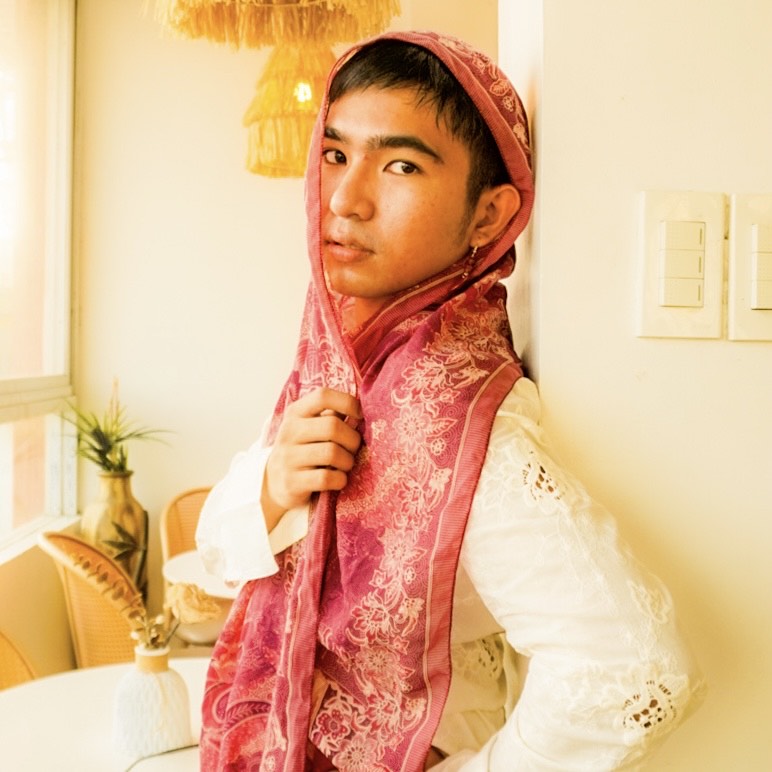

Ciro Quiapos is a Bachelor of Arts in Film student at the University of the Philippines Diliman, currently working on a thesis film about growing up in a transnational family. Raised as a queer child in Batangas, they aspire to see characters on screen who resonate with the ambiguities of identity, and their work remains an ode to this experience. Their 2024 short film, Katalonan, which centres on a precolonial queer priestess, was a finalist in the ALT-R Heroes 2025 Competition and was screened in Thailand. They were recently accepted as a fellow in the 2nd PELIKULA Places Writing Workshop, which focuses on Southern Tagalog Region cinema, as well as in the first Philippines Graphic Literary Workshop for flash fiction. In their free time, Ciro plays the gamelan and other indigenous musical instruments.
 Cha
Cha 