
Editor’s note: Elaine Tsai’s essay traces Taiwan’s layered history before turning to Ghost Month, whose rituals of burning joss paper and offering food shape her childhood summers. These practices lead into reflections on ancestor worship, her father’s death, and beliefs about spirits returning on the seventh day. Drawing on cases of claimed reincarnation and cross-cultural visions of the underworld, she situates personal memory within broader metaphysical traditions.

[ESSAY] “Ghost Month and the Afterlife” by Elaine Tsai
There is an island country off the coast of China, shaped like an upside-down scalene triangle with a short tail, verdant when seen from satellite imagery. In 1590, Portuguese sailors glimpsed Taiwan from the sea and were struck by its beauty, famously exclaiming “Ilha Formosa!” (“Beautiful Island”). They named it Formosa and became the first Europeans to set foot on its shores. In the decades that followed, the Dutch and the Spanish colonised parts of the island in the 17th century, before it was unified under the Qing Dynasty in 1683. Centuries later, Japan colonised Taiwan from 1895 to 1945, after which it assumed its present form.
The forests are lush and untamed, blanketing the ancient mountains only a few minutes from the cities; its capital holds one of the tallest buildings in the world. Clouds cling to the deep-green mountains, their fertile humidity emblematic of the forests’ vitality. Cutting through the clouds and descending to the whirring view from a car window, one sees waterfalls slicing down the mountains with speed, especially after heavy rain, over slick, rich, rouge-ochre earth, like the tips of capillaries in fingers, with a nourishing, pristine purity suspended in time. Leaves rustle, birds sing, and cicadas roar in immersive, harmonious unison with the majestic, crashing, cerulean-blue oceans that border the island and the smaller islands surrounding it.
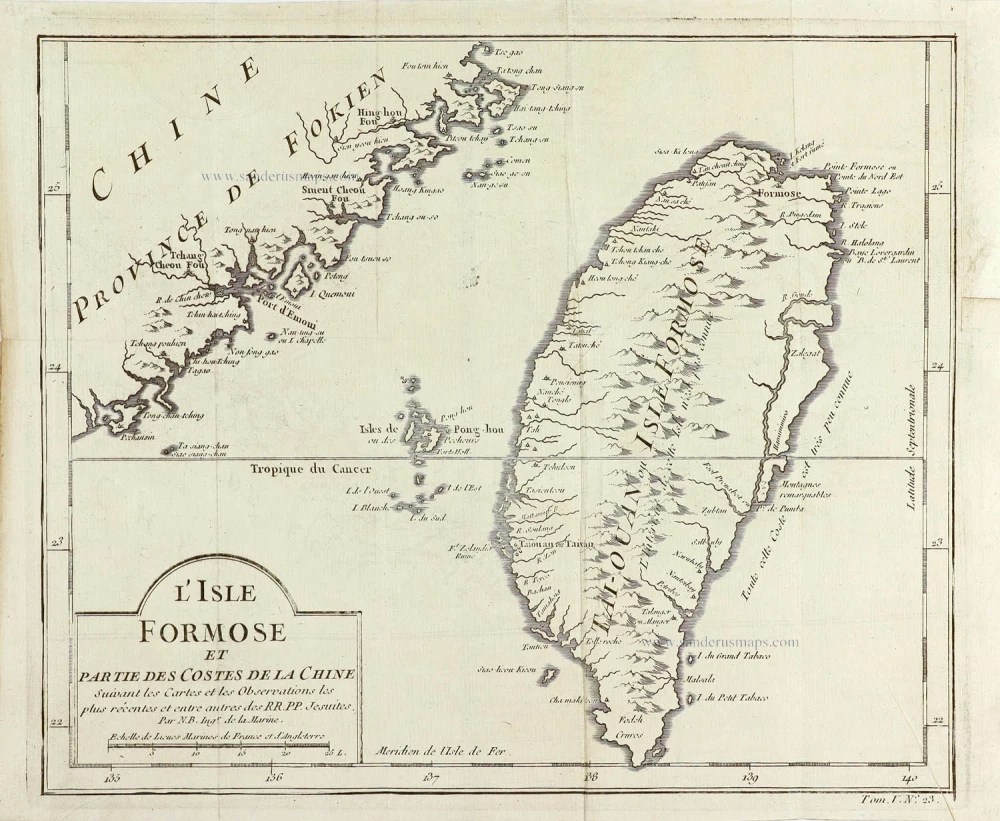
Antique map of Taiwan (Formosa), by Jacques Nicolas Bellin
Whether by coincidence or some hidden order of the universe, summer break coincided with Ghost Month.
This is the home of my parents, Taiwan. Growing up, I spent my summers here. Whether by coincidence or some hidden order of the universe, summer break coincided with Ghost Month, a Taoist and Buddhist festival in Taiwan, which takes place during the entire seventh month of the lunar calendar, falling on different dates each year and thus varying across a span of time between late July and September. It is believed that during this period the gates of Heaven and Hell open, allowing ghosts to enter the earthly realm. This is how I came to learn about an important part of my heritage that I had never been taught or able to experience in America.
)
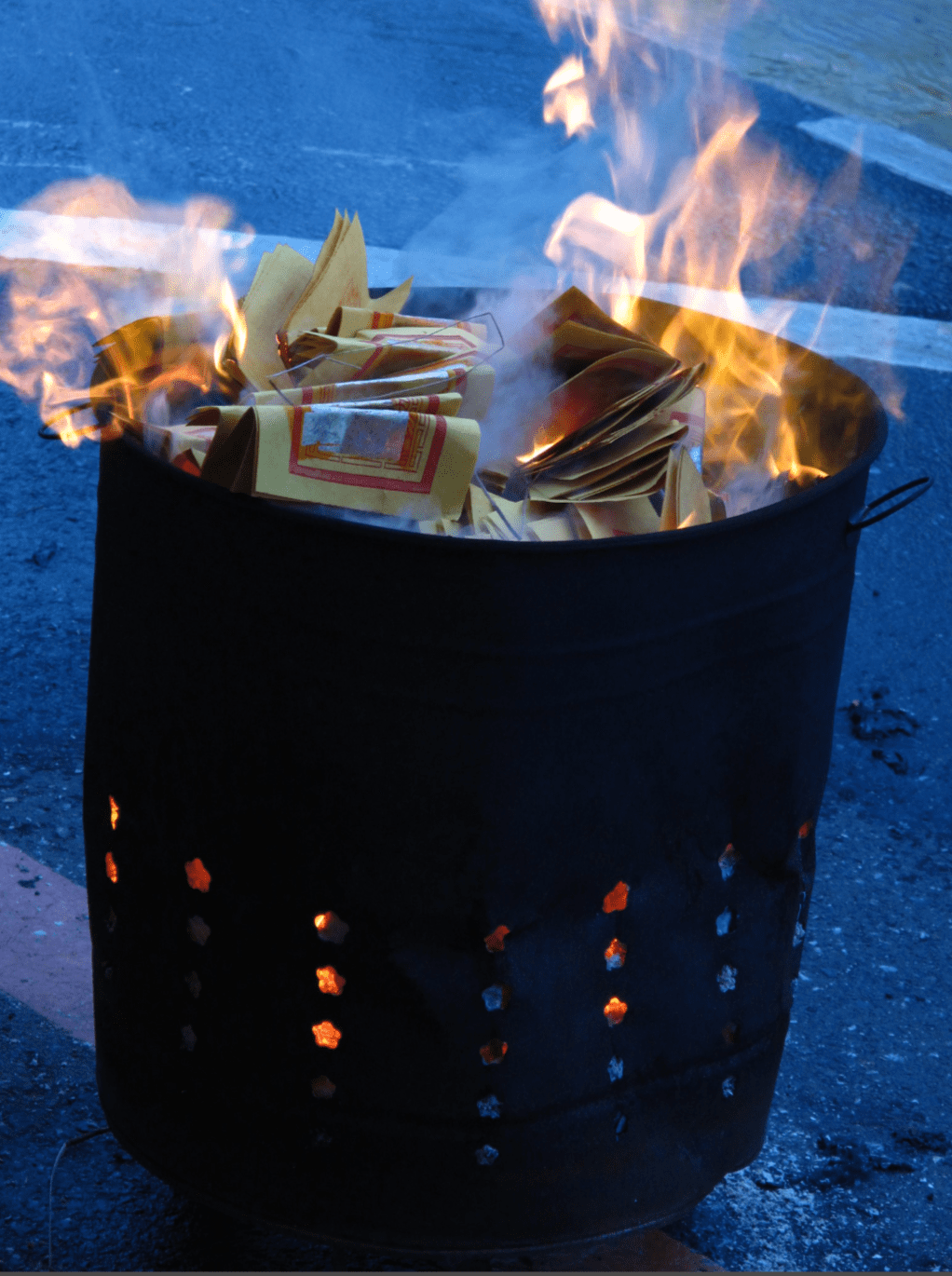
In the car ride from the airport to my grandparents’ home, I see people burning fires in metal buckets with patterned holes on their sides along every street. The Taiwanese burn paper money for the ghosts. The smoke of burning joss paper fills the air in brown-grey fumes. It is swelteringly hot and humid, as it was then, as it always is at this time. And always, during this period, tables are set outside homes and shops, laden with generous amounts of food arranged in neat groups, with lit incense placed beside these offerings.
It is said that when the fire burns intensely and the paper money disappears rapidly, ghosts are nearby, competing for it.
What is particularly striking is that fire and incense burn unusually quickly during this month. I watch as a man throws a handful of paper money into a metal bucket, and the flames leap to nearly double their previous height. It is said that when the fire burns intensely and the paper money disappears rapidly, ghosts are nearby, competing for it. When lit incense is placed upon a bed of raw rice, the burning ember drops almost immediately, as though inhaled in a single breath. This is regarded as an inexplicable phenomenon, believed to signify the presence of ghosts.
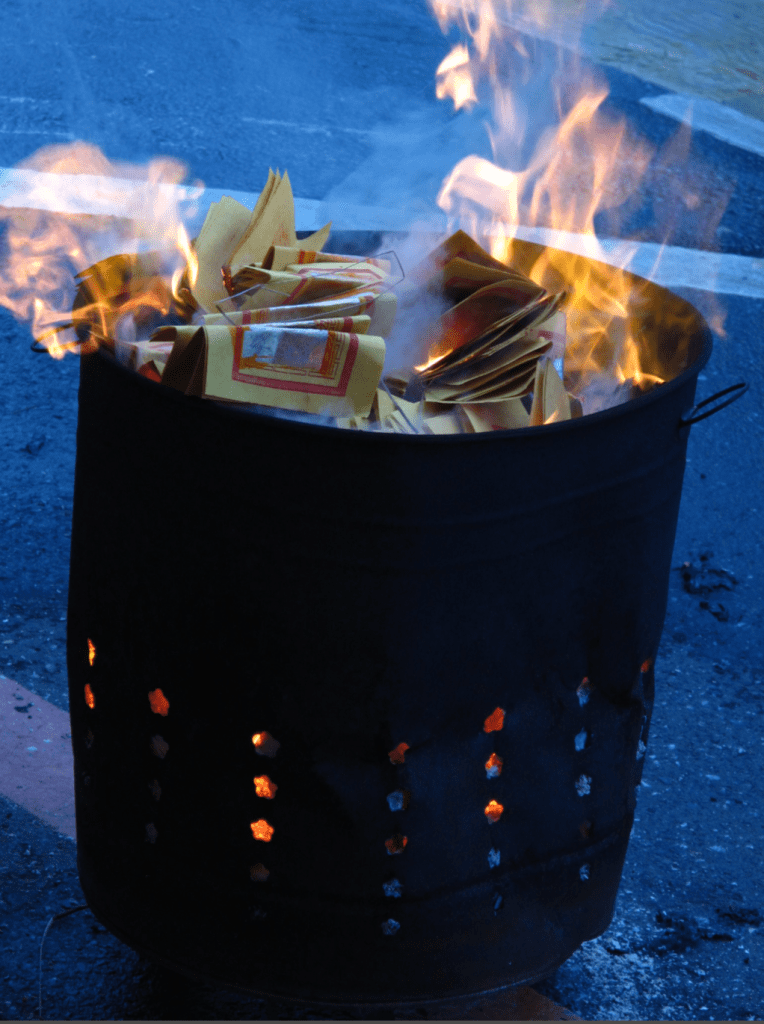
Burning joss paper during Ghost Month in Taiwan. Photo by eazytraveler
There are certain rules to observe during Ghost Month. One should not move house, make investments, or marry. One should avoid taking photographs in dark places or going out at night. Swimming is discouraged, as ghosts are said to drag people underwater so that they may be reborn. Purchasing a new car is also avoided, as it is believed to attract misfortune and spirits, increasing the likelihood of accidents. Indeed, accidents and misfortunes are said to occur more frequently during this month, attributed to ghostly interference. To counteract this, many offerings are made, such as burning paper money and presenting food. This is called Ghost Month Pudu (鬼月普渡) or Hungry Ghost Festival Offering.
“But how do the ghosts eat the food?” I ask my mother.
“The ghosts absorb the food’s essence. Afterwards, we can eat it,” she replies.
)
Ancestor worship is a Chinese custom, though it is also practised in many other parts of the world. Its social, non-religious aspect is rooted in the value of filial piety, which is central to Chinese and Taiwanese culture. Descendants must pay respect to their patrilineal ancestors, who are regarded as deities capable of imparting wisdom and fulfilling wishes. Worship usually takes place at a shrine within the home. Food offerings are made, much as they are during Ghost Month, though in smaller quantities. As ancestors are seen as having nurtured and established present circumstances, and as continuing to watch over their descendants, this veneration signifies both respect and the repayment of one’s spiritual debt.
When I arrived at my paternal grandparents’ house, the first thing we did was go to the shrine and pay our respects: “Thank you for taking care of us, we are home.” It did not matter what religion I practised. Although I had begun attending Church in the United States at the time, partly due to my mother’s attempt to discipline my brother and me, as we fought constantly, and although praying to deities other than God made me uncomfortable, since the Bible instructs believers not to worship other gods, I complied. One could not defy one’s elders in Taiwanese culture. I was, after all, just a child.
Perhaps it was the formalised ritual of kneeling before one’s ancestors while holding incense sticks, offering prayers of gratitude and wishes, and concluding with three deliberate bows, but the act felt significant and connected me to my roots. My brother and I always knew whom we were addressing: “great-great-grandparents” and “great-grandparents,” and later my father was included, and then my grandfather eight years afterwards.
Although the Church taught that there was no reincarnation, my Taiwanese summers, spent praying to my ancestors and witnessing the rituals of Ghost Month, combined with episodes of Unsolved Mysteries (1987- ) that my mother loved to watch, which frightened my brother and me deeply, as well as other stories and certain strange experiences of my own, left me open to the concept of an afterlife and the existence of ghosts.
)
The veil between the physical world of the living and the unseen spirit realm is thought to be thin, accessible to children, animals, and those particularly sensitive to psychic energies. In Taoism and Buddhism, it is said that only the innocent, such as children or those who retain a childlike purity of heart, and bodhisattvas, beings who delay Nirvana in order to assist suffering souls on Earth, are able to see ghosts and gods. Animals, too, are believed to possess an acute sixth sense, including the ability to anticipate earthquakes.
During Ghost Month, dogs appear more sensitive and bark more frequently. Just before my father passed away, the dogs in my neighbourhood began barking incessantly on the day he returned to our home in the United States on 1 July. The moment he entered the front door, the neighbourhood dogs barked in an alternating chain from morning until 8 p.m., continuing each day until 16 July, when my father was admitted to hospital. Only then did they fall silent.
Approximately 2,500 cases of children who claim to remember past lives have been studied. In such cases, various inexplicable phenomena occur. For instance, children have demonstrated the ability to speak foreign languages to which they have had no prior exposure. These children claim to recall previous lives and possess accurate knowledge of real places, people, and events connected to those lives, which no expert or scientist has yet been able to explain. Two of these cases are particularly striking.
)
The first concerns two-year-old James Leininger, who, on 1 May 2000, in a picturesque home in Louisiana, began experiencing nightmares of being trapped in a burning plane. He would also shout words such as “Natoma” and “Jack Larsen.” James claimed that he had been shot down by the Japanese. He possessed detailed knowledge of Second World War fighter planes that astonished his parents and frequently drew scenes of aerial combat. His father later traced “Jack Larsen,” who proved to be the close friend of James Huston, a Second World War fighter pilot who died in Natoma Bay when his plane was shot down by the Japanese.
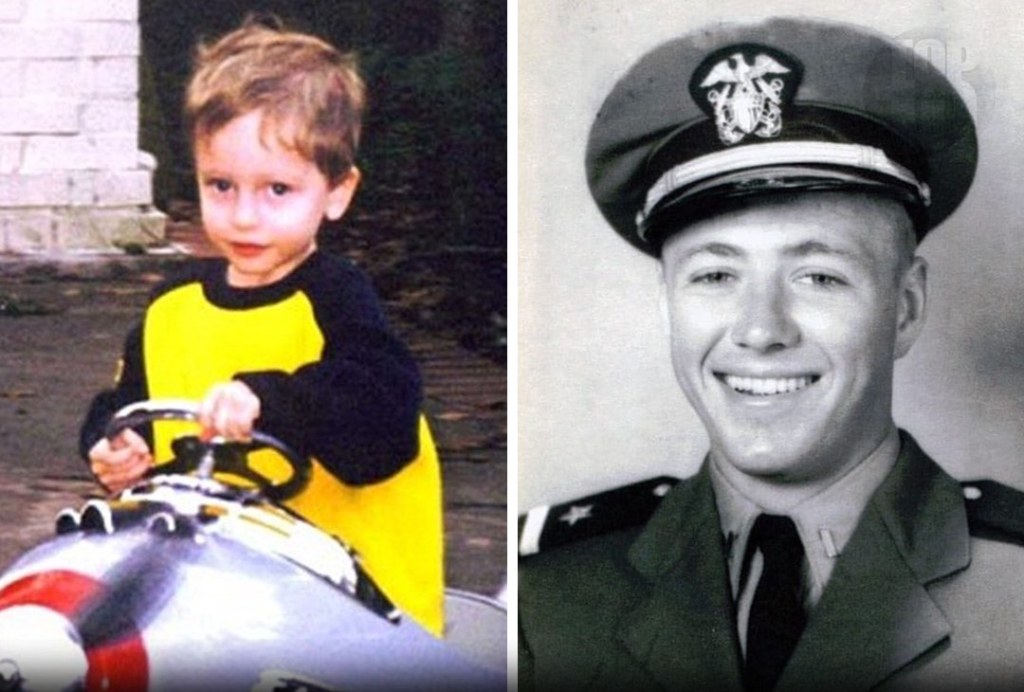
James Leininger and World War II pilot James Huston
)
Another particularly memorable case attracted the attention of Gandhi himself.
In 1926, in India, Shanti Devi was born. At the age of four, she began speaking about her past life and later revealed her husband’s name, Kedar Nath. He was located, and a meeting was arranged. After questioning her, Nath confirmed that Devi appeared to be his deceased wife. The case drew the attention of Gandhi, who dispatched a group of fifteen leaders, parliamentarians, and members of the press to investigate. Devi was able to direct a driver to her former home without assistance and identify her previous life’s parents within a crowd of more than fifty people.
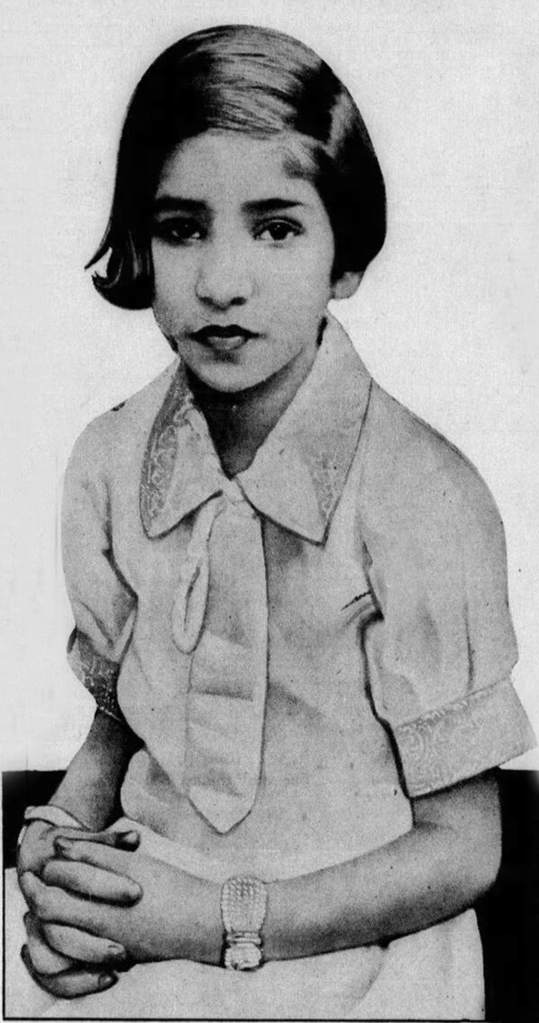
Shanti Devi as pictured in a 1937 Indian newspaper
What I found particularly compelling is that Devi claimed to remember the moment of her death and her subsequent journey in the afterlife. At the moment of death, she described being enveloped in a “profound darkness,” followed by a bright flash of light in which four radiant young men carried her away in a cup. Under hypnosis, she stated that she saw the Hindu god Krishna presenting each deceased person with a record of their deeds, both good and bad, before determining their fate. She was then led to a golden staircase and saw a river “clean and pure as milk.” “She said she saw souls there and they appeared like flames in lamps.”
Could this be analogous to the River Styx, which separates the earthly realm from the underworld in Greek mythology? In Chinese cosmology, the earthly realm is likewise separated from diyu (地獄, literally “earth prison”), a vast, bureaucratically ordered underworld of judgement and punishment, by the Wangchuan River (忘川河, literally “River of Forgetfulness”), a shadowy passage that souls must cross as they transition into the realms of judgement. Diyu is traditionally described as comprising eighteen levels of Hell, each corresponding to specific sins and forms of retribution, through which souls must pass before reincarnation. This landscape is intersected by multiple rivers and infernal bodies of water, bearing a striking resemblance to Dante Alighieri’s depiction in The Divine Comedy (1308-1321).
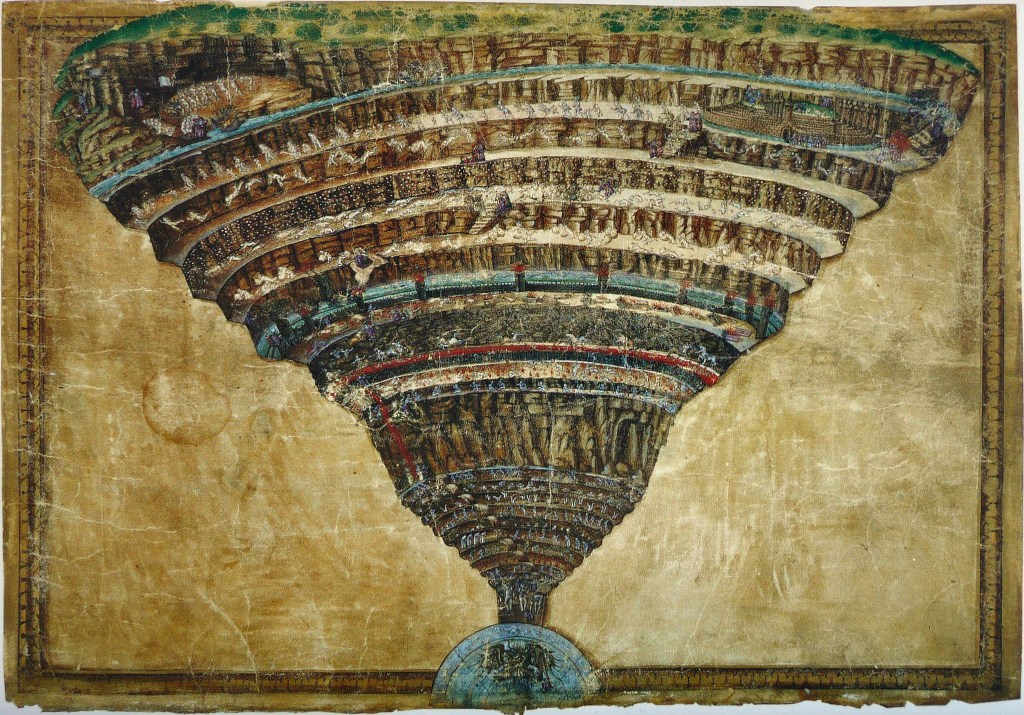
Sandro Botticelli, “La voragine infernale” (“Map of Hell”), c. 1480 to 1490, pen and ink with tempera on parchment, produced for an illustrated manuscript of Dante Alighieri’s The Divine Comedy, Vatican Library.
)
In Chinese mythology, the Wangchuan River is described as a putrid river of blood, unlike the sombre waters of the River Acheron or the dark, toxic Styx, with the Naihe Bridge (奈何橋, literally “Bridge of Helplessness” or “Bridge of Forgetfulness”) spanning it. Although both Dante’s rendering of the ancient Western concept of Hell and the traditional Chinese conception of diyu include rivers and bodies of water, the rivers of diyu are uniformly putrid and designed for punishment rather than functioning as boundaries, symbolising past sins and karma.
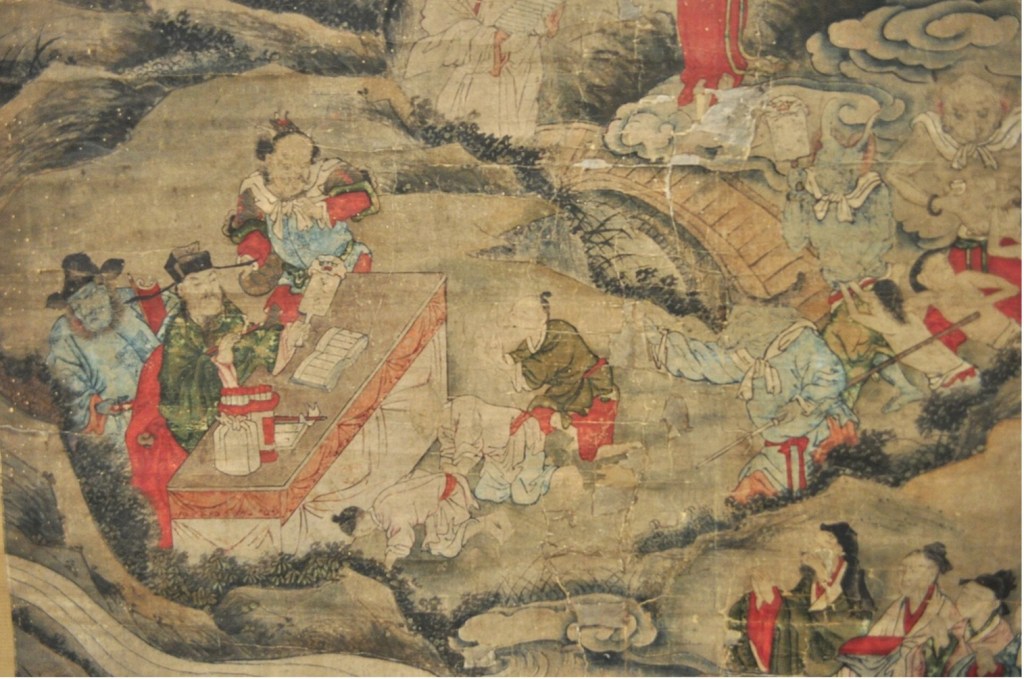
Tenth Hell from the Series: Buddhist Ten Judgements of Hell, 17th Century (Detail of Scroll 7). Art Gallery of Greater Victoria, Victoria, Canada.
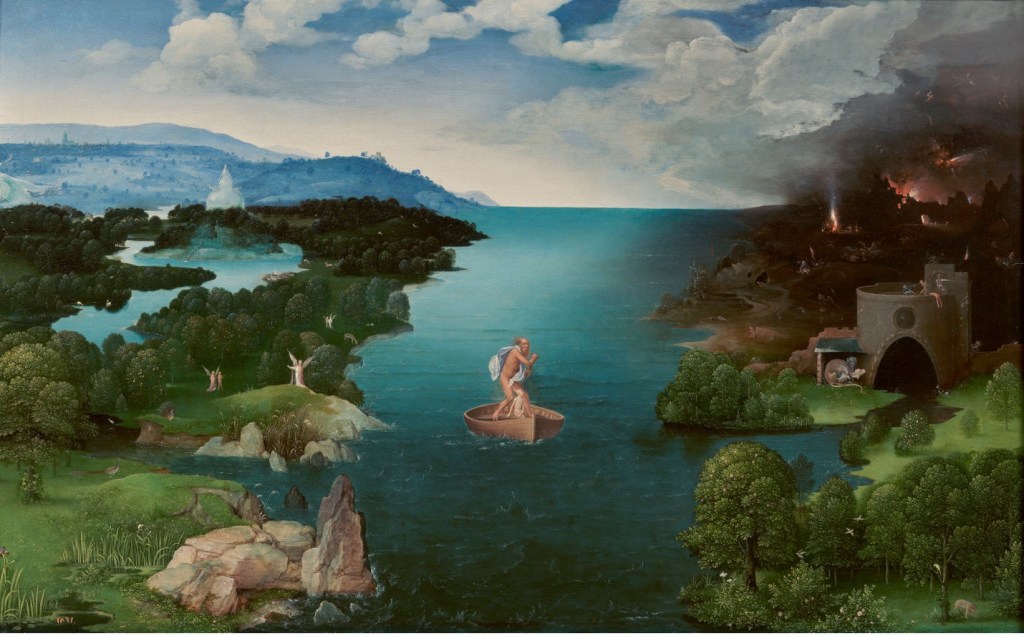
Landscape with Charon Crossing Styx by Joachim Patinir, 1515-24. Museo Nacional del Prado, Madrid, Spain.
An old woman named Meng Po (孟婆, literally “Old Lady Meng”) waits at the final, tenth court of diyu, just before the point of reincarnation. She prepares Meng Po Tang (孟婆湯, literally “Old Lady Meng’s Soup”), also known as the Soup of Oblivion, made from herbs and water drawn from the Wangchuan River, mixed with the tears of souls, tears that embody the joys, regrets, and sorrows of their past lives. Every soul must drink this potion to forget its memories before being reborn unburdened.
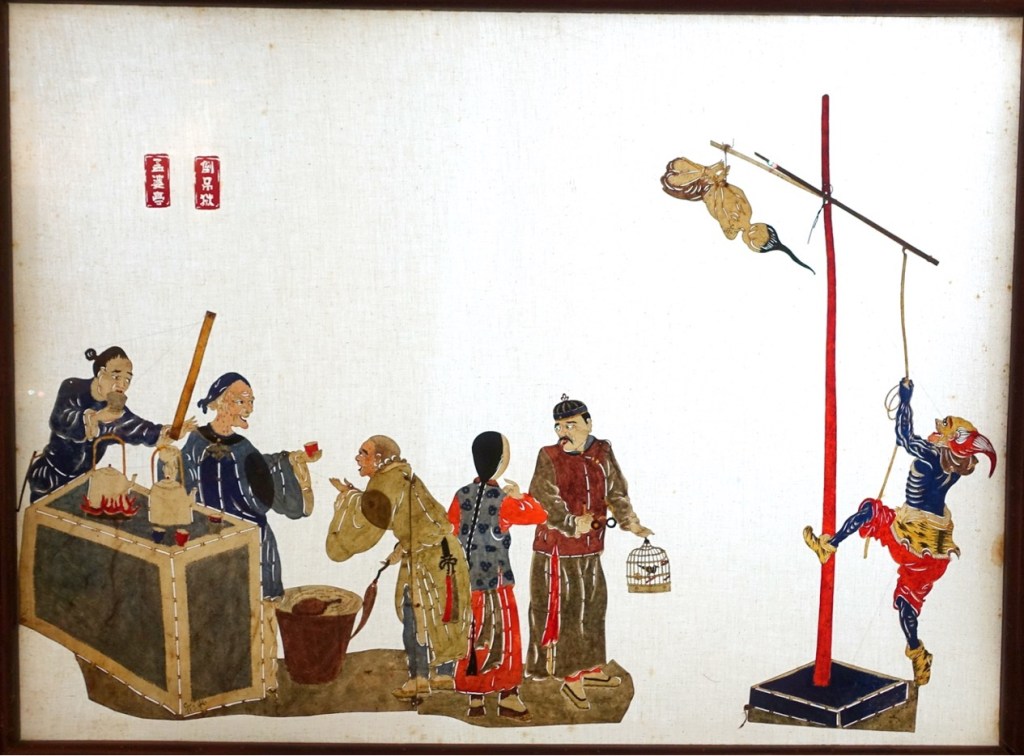
Meng Po cooks Five-Flavoured soup. Puppet scene documented at the Sichuan University Museum (四川大学博物馆) in Chengdu, Sichuan, China. (Public Domain).
In Greek mythology, the river Lethe, associated with the spirit of forgetfulness, is one of the five rivers of the underworld. Those who drink from it lose all memory of their earthly lives. Orpheus, regarded as a prophetic figure, instructs certain souls to drink instead from the Lake of Memory, Mnemosyne, a detail recorded on a gold Orphic tablet from the second or third century BC, now housed in the British Museum. In Chinese belief, some individuals are able to avoid drinking Meng Po Tang, which is said to result in children who retain memories of past lives, such as Devi and Leininger.
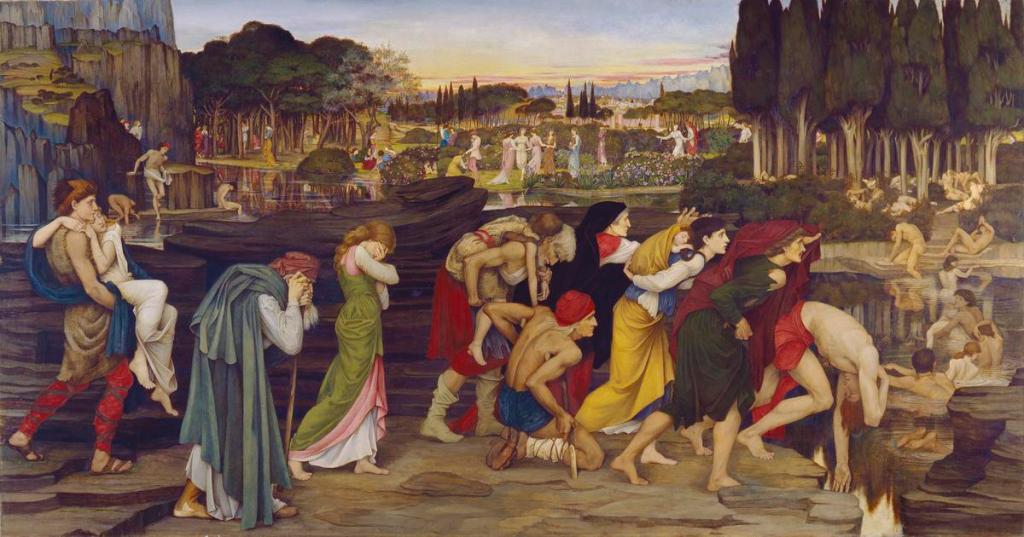
The Waters of the Lethe by the Plains of Elysium by John Roddam Spencer Stanhope (1829-1908). Manchester Art Gallery, Manchester, UK.
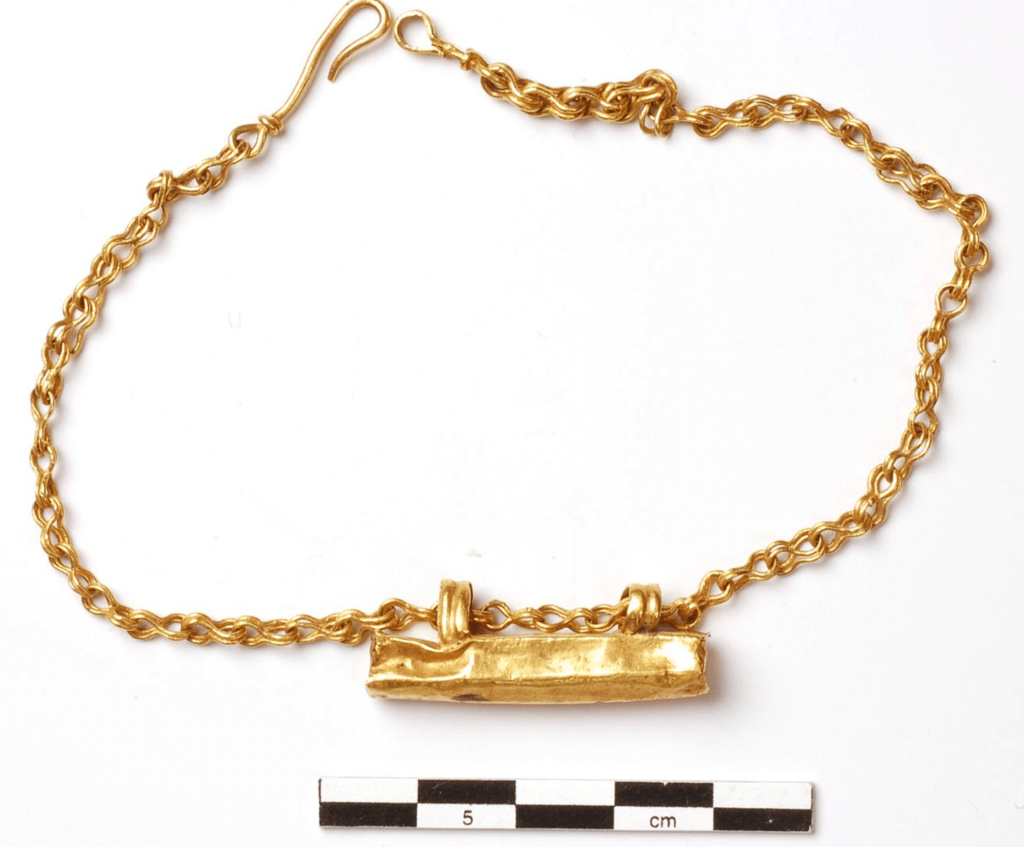
Chain and pendant case containing a gold tablet incised with a Greek alphabetic text guiding the owner to the underworld, sometimes described as an Orphic inscription. More information.
)
Cases of reincarnation are not limited to children but include individuals of all ages. It is believed that past lives may be accessed through hypnosis in a practice known as “past-life therapy,” which has been employed by clinical professionals to treat phobias and trauma. Dr Brian Weiss, M.D., initially sceptical, reported curing a patient using this method, an experience that profoundly affected him and led him to publish his account. His book, Many Lives, Many Masters (1988), became widely known and contributed to discussions within both the psychiatric community and the broader public.
Phobias are sometimes interpreted as indicators of the manner of death in a past life. It is also suggested that birthmarks may carry over as physical traces of fatal wounds. Ian Stevenson, M.D., investigated several cases involving rope-like birthmarks in children who claimed to recall past lives. In one case from Burma, a child’s statements corresponded to the life of a man who had been murdered in a neighbouring village two years before the child, referred to as HW, was born. The victim, identified as NT, had been bound with rope around the ankles and thighs and thrown into a well.
HW’s mother, who was pregnant at the time, passed the well as the police were retrieving the body. When HW was born, the child exhibited rope-like birthmarks and constrictions around the legs. HW’s detailed descriptions of NT’s death and the disposal of his body remain unexplained by scientific means.
The belief that ghosts released during Ghost Month drag swimmers underwater in order to be reborn reflects the idea that the body is not intrinsic to the spirit but rather a temporary vessel through which the soul passes. It is conceivable, within this framework, that NT’s soul entered HW’s still-uninhabited foetal body as the mother passed the site. Such forms of transference are often considered normal within cultures that practise healing through out-of-body experiences.
)
Although out-of-body experiences may occur naturally, such as during lucid dreaming, and are commonly reported in near-death experiences, they can also be deliberately induced. Methods include ancient meditative practices such as kundalini yoga, the ritual use of psychedelic plants among indigenous groups, and shamanic traditions across cultures.
My yoga teacher, who grew up in a yoga ashram in Hawaii, recounted a story about the ashram’s owner. He practised kundalini, a discipline regarded as dangerous if performed incorrectly. It is described as intensely painful, often characterised as a sensation akin to “a fire up your backside,” as the kundalini energy, or life force, ascends from the root chakra at the base of the spine. Through deep meditation, he was said to enter a state in which his spirit left his body. During these periods, he would lie motionless for a week without food, water, or bodily functions. My teacher’s mother was responsible for maintaining his physical body, cleaning it with cloth and water while he remained in this state.
Out-of-body experiences may also be induced through the use of psychedelic plants, a practice that has existed since ancient times and has been employed for healing, rites of passage, and divination.
On a cold winter day in Providence, Rhode Island, I was spending time with a friend when I noticed a book he had been reading lying on the table. It was titled Plants of the Gods (1979), written by Richard Evan Schultes, a professor and director of the Botanical Museum at Harvard University, Christian Rätsch, president of the German Society for Ethnomedicine, and Albert Hofmann, the discoverer of LSD. It was through this book that I learned about a flower that continues to fascinate me, the Angel’s Trumpet, which has been cultivated for millennia in indigenous cultures. Indigenous communities caution against the indiscriminate use of this plant, reserving its use for shamans. I also learned about the shamanic healing process, in which a medicinal plant is prepared by the shaman and given to the patient, who begins to hallucinate and recount visions that the shaman then interprets in order to facilitate healing.
Shamans serve as intermediaries between two worlds, capable of traversing both realms in order to aid their communities. In certain cultures, they are also able to guide individuals on journeys through the spirit realm. In Taiwan, those wishing to connect with a deceased loved one may do so through a Taoist-alchemical process known as Guan Luo Yin (觀落陰, literally “to observe or descend into the realm of the dead”). This practice resembles guided tours in the physical world, yet unfolds as a spiritual journey through the unseen realm. Although its precise origins remain uncertain, accounts in Chinese religious and folkloric traditions, sometimes associated with practices dating back to the Han dynasty, describe rituals through which the living seek contact with departed souls.
Only those who are particularly sensitive, sincere, or pure of heart are able to pass through the gates when guided by a deity.
In a room within a consecrated temple, participants sit blindfolded on chairs under the guidance of a Master. Although many are able to approach the threshold of Hell, not all can enter. Only those who are particularly sensitive, sincere, or pure of heart are able to pass through the gates when guided by a deity, an occurrence considered rare.
Sanmao, a renowned Taiwanese writer who travelled extensively and lived for several years in the Sahara Desert with her Spanish husband, Jose Maria Quero y Ruiz, underwent Guan Luo Yin for a second time following his death. As the participants recognised her, an air of anticipation filled the room. The ritual commenced, and they were instructed to search for a light and, upon finding it, to follow it. They were warned not to eat any fruit or accept offerings encountered along the way, as doing so might prevent their return to the earthly realm.
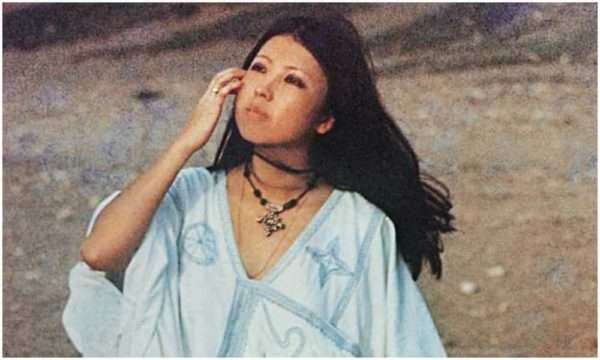
Sanmao (1943-1991)
With three taps of a ritual rod, the Master began to chant, and those who reached the threshold were instructed to raise their hands. After the third attempt, among all those present, Sanmao alone succeeded in crossing. She reported seeing a sphere of light and, as the Master continued chanting, exclaimed that she felt herself floating, suffused with a sense of bliss.
Dr Stevenson’s analysis of near-death experiences, published in the Journal of Psychiatry, indicated that, although the subjects were predominantly white American Protestant women, 50 per cent reported a sense of unity with God, 49 per cent saw beings of light, 72 per cent appeared to enter an otherworldly realm, 77 per cent experienced an out-of-body state, and 74 per cent described a sensation of their soul becoming lighter than their physical body. Similarly, when Sanmao crossed into the spirit realm, she perceived an orb of light and experienced a feeling of weightlessness.
After some time, the Master asked whether the light remained. She nodded, and he continued to guide her. The light grew increasingly radiant. Sanmao then cried out that the light had transformed into Guan Yin, the bodhisattva of compassion and mercy. The Master instructed her to request access to her Book of Life and Death, and Guan Yin granted the request.
The book appeared instantly, large and luminous, its pages resembling thin sheets of gold. It bore her name, date of birth, place of birth, and her father’s name. It also stated that she would write twenty-three books in her lifetime, at a time when she had completed nineteen. Beneath the age of thirty-six appeared the words “husband lost,” corresponding to the year her husband died. Beneath the age of forty-five there were no words, only an image of a flower with a white centre encircled by red. She was told that at forty-five she should remarry after ten years of mourning. At the time, she had not yet reached her forties. She ultimately wrote twenty-three books. However, contrary to what was recorded, she died by suicide in a hospital in Taiwan at the age of forty-seven. I believe this was due to the enduring grief of her husband’s death; had she remarried, perhaps her fate might have been different.
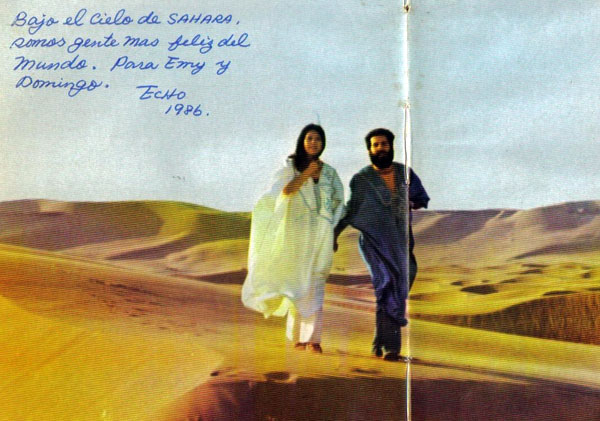
Sanmao and Jose Maria Quero y Ruiz
)
In Chinese culture, it is believed that those who die by suicide are unable to pass on until the end of their allotted lifespan. Their spirits are said to remain in a form of imprisonment, reliving the moment of death until the time they were destined to die. Only then are they permitted to pass on and reunite with deceased family members and loved ones. By contrast, those who die at their appointed time are believed to return to the earthly realm on the seventh day after death to visit their families. This visitation occurs again on the forty-ninth day, which is considered the final return.
For those who seek tangible signs of such visits, some Taiwanese families spread a layer of flour across the floor of their homes on the seventh day. By morning, footprints are sometimes said to appear.
Seven days after my father passed away, he returned home.
Seven days after my father passed away, he returned home. My mother told me that all the bedroom doors had been opened to the width of a single person’s body. When my father was alive, he would check on my brother and me as we slept, opening each door just wide enough for himself to pass through.
The significance of the number seven is striking. Ghost Month falls in the seventh lunar month, and the deceased are believed to return on the seventh day after death and again forty-nine days later. In Chinese culture, the number seven symbolises holiness, mystery, and harmony, representing the union of yin and yang, the feminine and masculine forces of the universe. I speculate that through this union the realms align, as though interlocking pieces, generating an energy that dissolves the boundary between worlds and permits passage between them.
This idea resonates with Pythagorean numerology, in which seven signifies spirituality and the pursuit of wisdom. I find it noteworthy that seven is also my life-path number.
There is a sense of completeness associated with seven: the seven colours of the rainbow, the seven days of creation in the Bible. In ancient Egyptian architecture, proportions of three, four, and seven were employed, with three representing the divine triad, four the material realm, and seven the union of both. This union of the material and the spiritual constitutes living existence, extending from the microcosmic to the macrocosmic in infinite progression.
The present moment, encompassing all that exists both visibly and invisibly, forms the point from which the cosmos unfolds. The wheel of samsara turns eternally, and all souls endure suffering until a rare few attain liberation through Nirvana. According to the law of conservation of energy, energy is neither created nor destroyed. I interpret this to mean that, after death, the spirit persists, either reborn or existing within the spiritual realm, until all lessons have been learned. Yet the bodhisattvas choose to remain. Compassion, perhaps, is even more profound than liberation.
Whatever is meant to be will be, and all things happen for a reason. I am grateful to exist within this life, to experience, to grow, and to contribute in whatever way I can. To borrow from Ulysses (1922) by James Joyce, I trust in the “signatures of all things I am here to read.”
Bibliography
▚ Boechler, Ethan, Allison Campbell, Jordan Hanania, James Jenden, and Jason Donev. “Law of Conservation of Energy.” Energy Education, 27 Sept. 2021. www.energyeducation.ca/encyclopedia/Law_of_conservation_of_energy.
▚ Brennan, Zoe. “Reincarnated! Our Son Is World War II Pilot Come Back to Life.” Daily Mail, 28 Aug. 2009. https://www.dailymail.co.uk/femail/article-1209795/Reincarnated-Our-son-World-War-II-pilot-come-life.html.
▚ Colville, Alex. “Hell’s Bittersweet End: Meng Po, Goddess of Forgetfulness.” SupChina, 18 Jan. 2021. www.supchina.com/2021/01/18/hells-bittersweet-end-meng-po-goddess-of-forgetfulness.
▚ “Tablet; Pendant; Case.” British Museum. www.britishmuseum.org/collection/object/G_1843-0724-3.
▚ “Get to Know Orphism of Greek Mythology.” Greek Boston. www.greekboston.com/culture/mythology/orphism.
▚ “Ghost Festival.” Wikipedia. www.en.wikipedia.org/wiki/Ghost_Festival.
▚ Greyson, B., and I. Stevenson. “The Phenomenology of Near-Death Experiences.” The American Journal of Psychiatry 137, no. 10 (1980): 1193–96. https://doi.org/10.1176/ajp.137.10.1193.
▚ Hartzman, Marc. “The Mind-Boggling Tale of Shanti Devi, the Indian Child Who Claimed She Lived Twice.” All That’s Interesting, 20 Mar. 2021. www.allthatsinteresting.com/shanti-devi.
▚ Hill, J. “Thoth.” Ancient Egypt Online, 2010. https://ancientegyptonline.co.uk/thoth/.
▚ Kumantong. “Taoist Sorcery: Understanding Chinese Magic.” Kumangtong 4D Power. http://taoist-sorcery.blogspot.com/2014/03/taoist-tour-to-hell-to-visit-dead-guan.html.
▚ “Lethe.” Wikipedia. www.en.wikipedia.org/wiki/Lethe.
▚ Lopate, Phillip, ed. The Art of the Personal Essay: An Anthology from the Classical Era to the Present. New York: Anchor Books, 1994.
▚ Pollan, Michael. “Power Steer.” The New York Times Magazine, 31 Mar. 2002. https://www.nytimes.com/2002/03/31/magazine/power-steer.html.
▚ Schultes, Richard Evans, Albert Hofmann, and Christian Rätsch. Plants of the Gods. Rochester: Healing Arts Press, 1992.
▚ Smale, Aaron. “Psychic Distance in Creative Writing.” University Writing and Speaking Center. https://www.unr.edu/writing-speaking-center/student-resources/writing-speaking-resources/psychic-distance-in-creative-writing.
▚ Stevenson, Ian. “Ropelike Birthmarks on Children Who Claim to Remember Past Lives.” Psychological Reports, 2021. http://www.med.virginia.edu/perceptual-studies/wp-content/uploads/sites/360/2016/12/STE53.pdf.
▚ Tucker, Jim B. “The Case of James Leininger: An American Case of the Reincarnation Type.” Explore 12, no. 3 (2016): 200–7. https://doi.org/10.1016/j.explore.2016.02.003.
▚ Ttreiiuh. “Sanmao’s Spiritual Journey: Sanmao Guan Luo Yin Exploration of Life and Death.” 13 Mar. 2009. https://sites.google.com/site/goodbook22/taiwan–goodbook/san-mao-de-ling-jie-zhi-lue–san-mao-guan-luo-yin-tan-sheng-si-bo.
▚ “Veneration of the Dead.” Wikipedia. http://www.en.wikipedia.org/wiki/Veneration_of_the_dead#European_cultures.
▚ Williams, Terry Tempest. Refuge: An Unnatural History of Family and Place. New York: Pantheon Books, 1992.
How to cite: Tsai, Elaine. “Ghost Month and the Afterlive.” Cha: An Asian Literary Journal, 24 Mar. 2026, chajournal.com/2026/03/24/ghost-month.

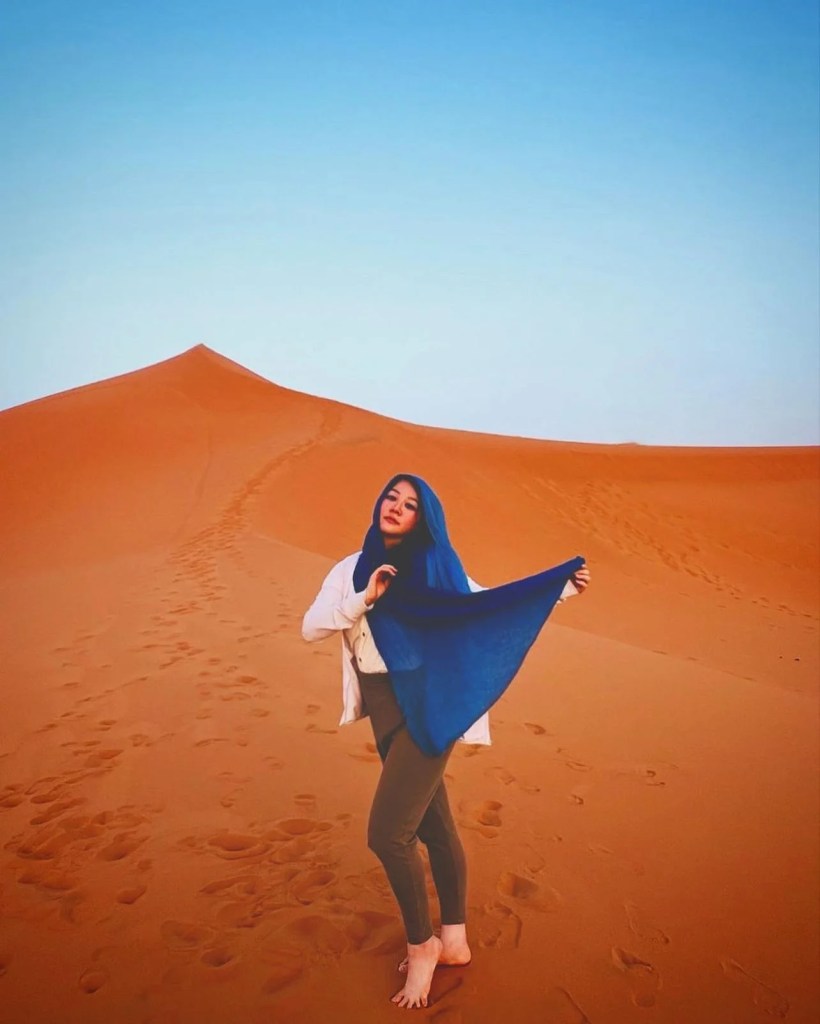
Elaine Tsai is a multi-disciplinary artist and writer based in Los Angeles and Taiwan. She received her BFA from the Rhode Island School of Design (RISD) and her MA in English (ALM) from the Harvard Extension School. Her practice spans both visual and literary arts, engaging with their distinct forms as well as the spaces in which they converge. She has exhibited internationally in Los Angeles, Providence, Boston, and Rome, and her work has appeared in The Underground and Clerestory. She has taught both K-12 students and adult learners. She is currently developing new projects that interweave material, narrative, and research. Visit her website for further information.
 Cha
Cha 