
Editor’s note: Julien Pieron’s essay examines Sophie Houdart’s Ce territoire qui, comme une pulsation… (Éditions des mondes à faire, 2026), an ethnographic study of post-Fukushima life in Tōwa that portrays a world where catastrophe persists as an unclosed present. Through its distinctive graphic design, meticulous descriptions, and chronicle-like narrative, the book rejects definitive measurement and embraces epistemic humility. It attends to everyday practices shaped by radiation, resisting cliché and abstraction. The essay raises a political and ethical question: how to live attentively within an irreparably damaged environment without normalising the disaster itself in contemporary contexts.

[ESSAY] “Life in the Persistence of Fukushima: Sophie Houdart’s Ce territoire qui, comme une pulsation…” by Julien Pieron1
Sophie Houdart. Ce territoire qui, comme une pulsation… [This Territory Which, Like a Pulse…]. Les Éditions des mondes à faire, 2026. 448 pgs.
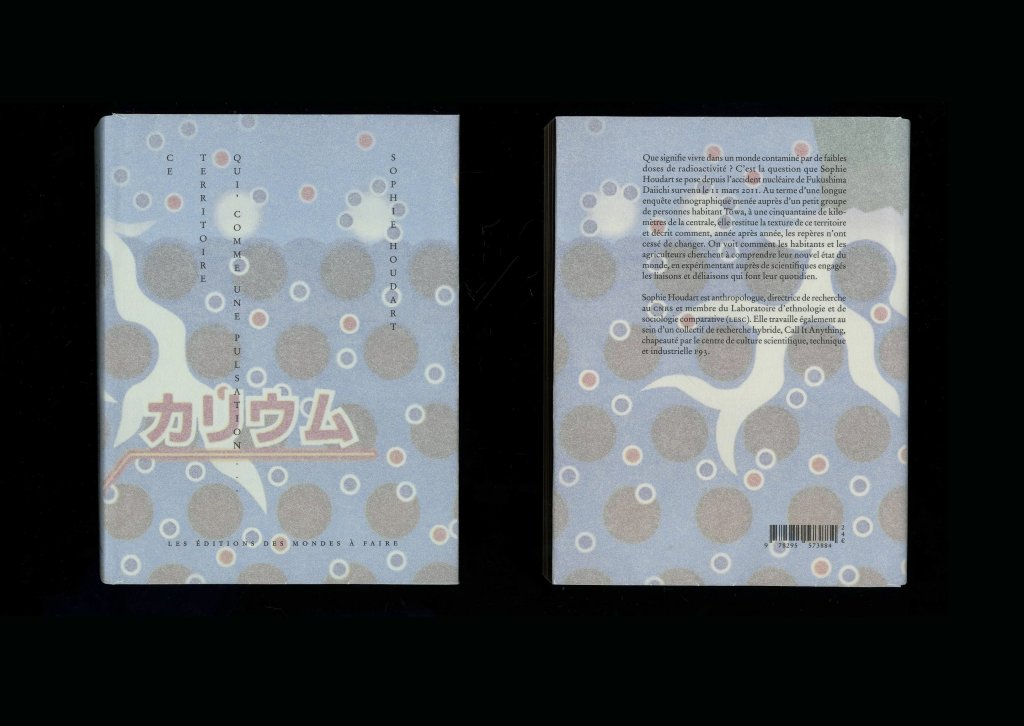
This Territory Which, Like a Pulse… (Ce territoire qui, comme une pulsation…), by the anthropologist Sophie Houdart, originally written in French, is the latest beautiful book published by Éditions des mondes à faire. It is the result of an ethnographic study spanning more than ten years in Japan, in the town of Tōwa, some fifty kilometres from the Fukushima Daiichi power station, which suffered an accident on 11 March 2011.
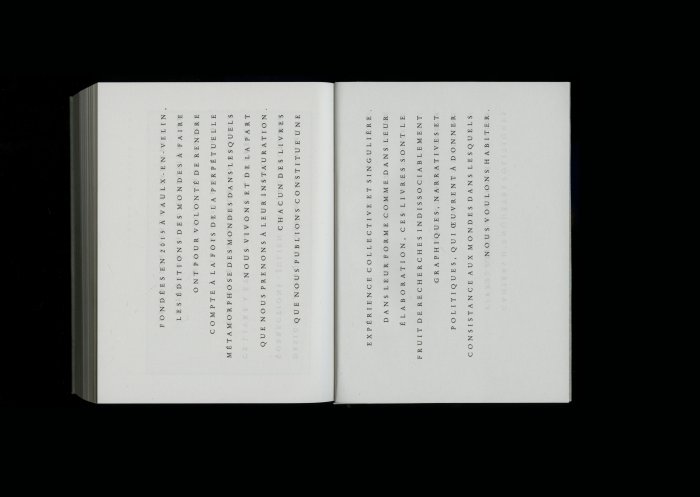
The publishers’ manifesto, printed in the final pages of the book, states: “Each of the books we publish constitutes a collective and unique experience. In both form and elaboration, these books are the result of research that is inextricably graphic, narrative and political, working to give substance to the worlds in which we wish to live.”
I propose to take this statement seriously. I shall outline the book by addressing these three dimensions, graphic, narrative and political, and by following the thread that leads from one to the other. All translations from the French are my own, and excerpts from the book, which the publishers have kindly entrusted to me, are incorporated throughout this essay.
)
Held in the hand, the book is thick and almost square in shape. Covered in translucent tracing paper, upon which the title and the author’s name are printed, the book-object immediately calls to mind the paper partitions of traditional Japanese dwellings. Yet the white halo of the tracing paper allows the pattern printed on the enclosed cover to show through, whilst softening its brilliance and blurring its contours: a white flow and a shower of beads of varying sizes, in different shades of blue and red. The graphic choice of tracing paper over the coloured cover embodies the coexistence of the visible world and that of invisible radioactive elements that come to wreak havoc upon it, and with which those who have not been displaced must now learn to live.
“In what follows, I shall speak from a certain place, and it is therefore from there that my words must be heard. And that complicates everything. That place is the small town of Tōwa, situated in a complex maze of green hills, some fifty kilometres from the Fukushima Daiichi nuclear power station. The people who matter here are not those who were displaced or those bereaved by the tsunami: they are the people who stayed behind and are learning to ‘live with’ low doses—but doses nonetheless—of radioactivity.” (p. 15)
Although it may at first appear abstract or purely decorative, the motif printed on the cover later reveals itself, an effect that becomes somewhat evident when the book is laid flat and opened in the middle, as a schematic representation of the roots of a rice plant in soil contaminated with caesium, and of attempts to bind the caesium to zeolite spread across the rice field.
‘‘May 2011. It is spring. In the neighbouring rice fields, the young shoots are just emerging from the water. On screen, a diagram shows, in the form of small blue beads, the caesium flowing from the top of the mountain down to the rice field and then seeping into the earth, beneath the rice stalks. The animation shows them gradually rising up through the field. In the following shots, we see that zeolite (represented by larger, white beads), followed by potassium (the red beads), has been spread over the rice field. The blue caesium beads attach themselves to the white zeolite beads, and it is the red potassium beads that rise into the rice plant and nourish it. A trap for radioactivity, I thought to myself, intended not to decontaminate the rice field, but to locate and fix the radioactive particles.” (p. 186)
We then realise, in hindsight, that the motif adorning the book’s cover is less a creation than a visual quotation of a document, likely drawn from the educational sequence of the documentary film of which Sophie Houdart provides a detailed description. Through this effect of delayed visual reading, the graphic choice of the cover, together with its association with the tracing-paper device, replicates a process of obstructed visibility, in which what is seen is accompanied by obstacles or screens that blur its nature and contours, and thus take time to appear as such.
In this sense, the cover functions as an emblem of the anthropologist’s approach, with the exception that, for her, in this territory, and even over the very long duration of the research, it is never possible to remove the tracing paper completely. Nothing ever settles into a definitive “as such”.
“Over time, I have come to think that these particular conditions are what give me the feeling that the fieldwork, carried out each year with the near-regularity of a metronome, is always entirely yet to be realised, that it is always preliminary; at the same time, they give me the feeling that journey V never prepares me for V+1.” (p. 221)
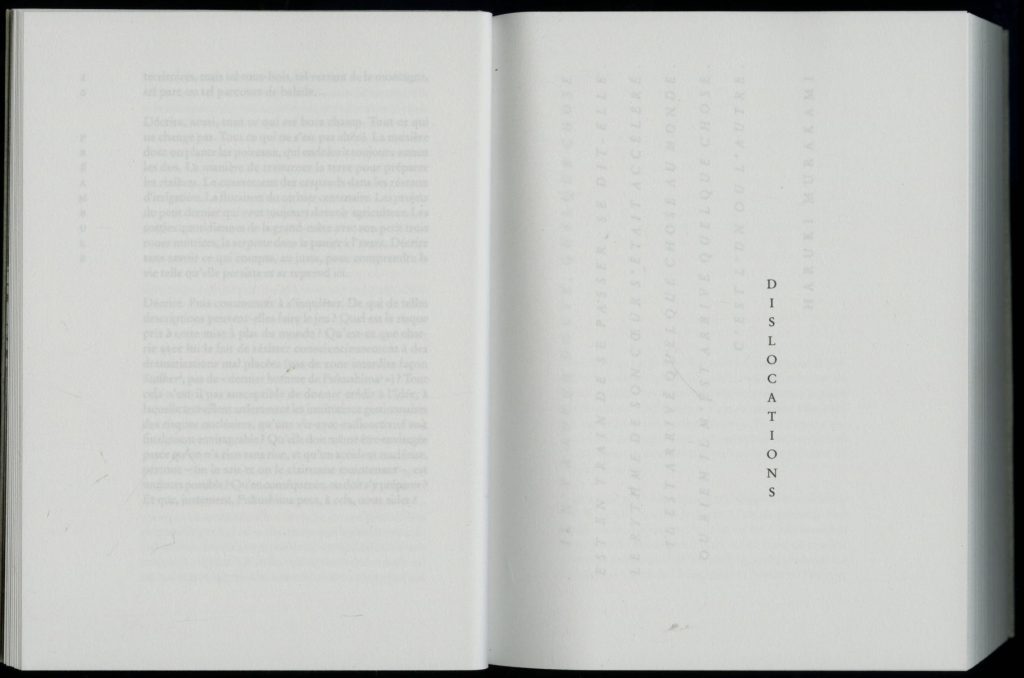
On the tracing paper wrapping the cover, the book’s title and the author’s name are printed in black and arranged in four columns; they are read from top to bottom, letter by letter, vertically. The same applies, inside the book, to the titles that open and delimit the four sections of the work: “Dislocations”, “Consistances”, “Cohabitations, Powers, Powerlessnesses”, “Reprises and Setbacks”.
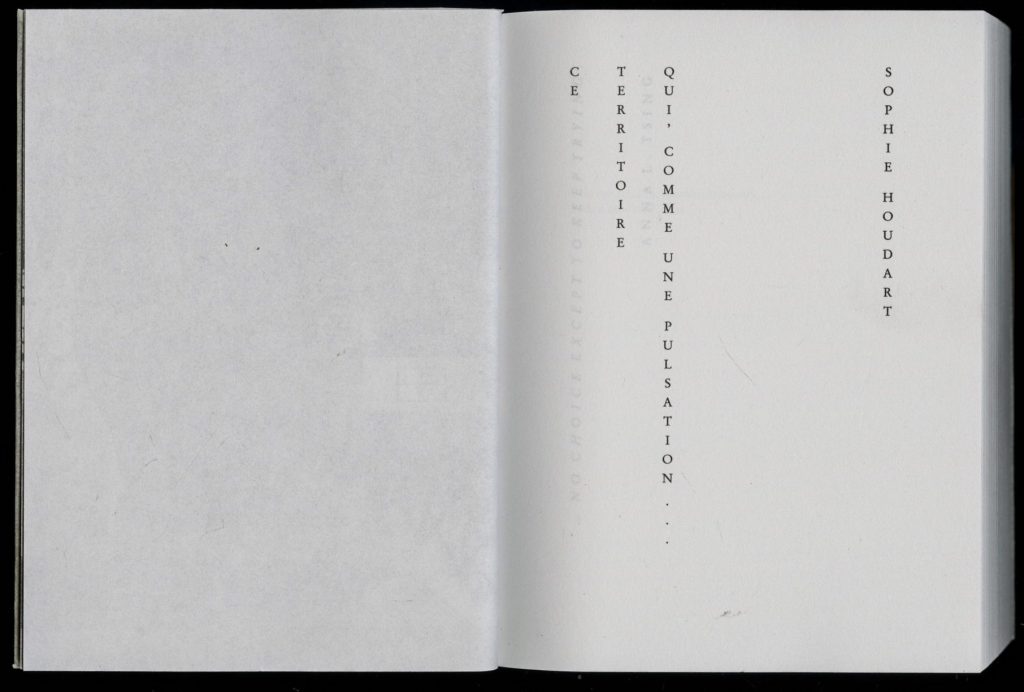
Within the book, what are usually referred to as running titles are also set vertically. Rather than appearing horizontally at the top of the pages, the section title is placed in a column in the margin of the left-hand pages, and the chapter title in the margin of the right-hand pages; both, along with the page numbers, are to be read element by element, from top to bottom. Finally, the epigraphs at the beginning of each section, which contain the keys to their enigmatic titles, are also set in columns, though to read them one must this time rotate the book 90 degrees to the right and adopt the horizontal reading mode to which we are accustomed in the West.
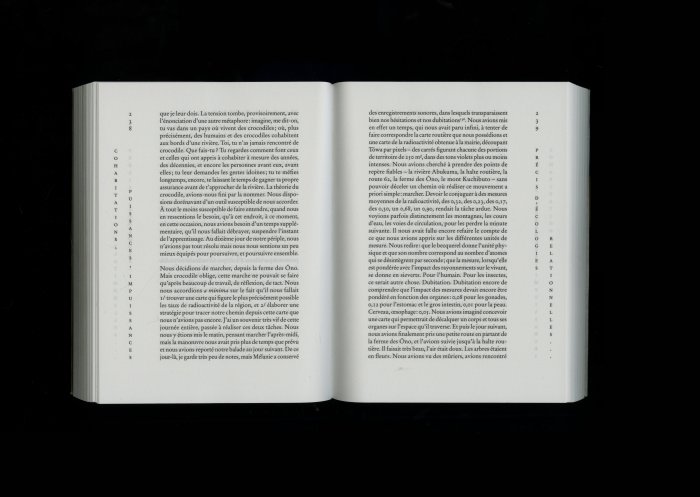
What emerges visually from these compositional choices is the sense of a frozen, almost hieratic reading landscape.
What emerges visually from these compositional choices is the sense of a frozen, almost hieratic reading landscape, as if the overall narrative, rather than sliding along a timeline or horizon, were to come to a standstill and begin to sink into the contaminated ground. Here too, the graphic discourse functions as an emblem of the ethnographic approach, in what might be called, with reference to the Latin humus, meaning soil or earth, its epistemic humility.
Whilst the first section of the book is permeated by the question of measuring radioactivity, as well as by the desire to demarcate zones, whether safe or to be avoided, and to set thresholds of the acceptable or the unacceptable, regarding what one eats, drinks or breathes, and regarding the act of being at rest or in motion in a place, we gradually come to understand that this desire, perpetually thwarted, is doomed to failure. The need to multiply measurements almost ad infinitum, because radioactivity is not the same in the open field as in the undergrowth, not the same on leaves as on a trunk, not the same on a smooth trunk that feels tsurutsuru as on a rough trunk that feels zarazara, forces us to move beyond the idea of a metric of radioactivity towards an ethology of “elementary lives” and a pragmatics of their relationships.
To do this, we must delve deep into the territory, remaining rooted in the finer details of places, times and situations. This is what the inhabitants do, whom the nuclear accident has forced to become perpetual investigators; it is also what the anthropologist does, attempting to experience and convey the texture of their world.
‘‘The ethnographic study I had begun in 2012 on programmes to measure radioactivity in the air, soil and food—a study I had envisaged as systematic—encountered one of its first stumbling blocks in this scene. I had seen people measuring endlessly, but there, for the first time, I glimpsed just how open the field of experience had to be to understand how radionuclides ‘behaved’, how they ‘expressed themselves’ or ‘emerged’. The prominence of a particular vocabulary and of postures indicated that these experiences were more about observation than measurement: the rice fields, forests, fields, were transformed into observation platforms from which to capture flows, pathways, but also frictions (between one thing and another, between the radionuclides and the root of the rice plant, which is different from that between the radionuclides and the grains of rice, etc.). It was therefore less a matter of measuring a radioactivity level than of describing the extremely varied ways in which radionuclides interacted with a specific environment, a specific entity within that specific environment, a season, a day, the weather, etc.” (pp. 157–158)
That the titles and running titles, which usually allow one to enter a book and move from one chapter to another, one section to another, are here graphically blocked, and that their layout in columns or vertically prevents them from running, is by no means insignificant. The whole point of the book, which deals obliquely with the Fukushima nuclear accident and directly with daily life in a world contaminated by low doses of radioactivity, is precisely to try to identify and describe an event that will not pass, that stubbornly refuses to pass, despite all attempts, whether from the state, industry, the media, or the weariness of the inhabitants themselves, to turn the page and move on.
In this sense, one cannot, strictly speaking, say, as one might be tempted to do at first glance, that the book deals with life, or attempts to live, after Fukushima. Rather, the book seeks to describe the way in which the Fukushima event blocks the apparent passage and continuity of time.
‘‘Far from resolving itself into a simplistic tension between a before and an after, the catastrophic event that took place in 2011 but has since dragged on lacks, despite all the symbolic manoeuvres to mark its end, a horizon of closure. Something is set to endure, and from my perspective, this persistence implies a re-examination of investigative methods.” (p. 220)
Time grinds to a halt when the present cannot be transformed into the past. A detour through largely forgotten conceptions of time would show that the present, considered as a mode of existence, is defined by at least two characteristics. The present is that which is in the making, in the process of becoming, whose meaning is not fixed or stabilised but is always unfolding; it is also that which has acquired the power to concern, to impose itself upon the agenda because it compels our attention.
These two characteristics, which make the Fukushima event a perpetual present, shine through on every page and at every turn in Sophie Houdart’s work. The book opens with a section entitled “Dislocations”, because what first emerges from the investigation is the way in which the event shatters the fabric of everyday life, so that one must constantly relearn and readjust one’s relationship with things and beings, and that, for reasons now vital to survival, one can no longer do without this learning and these perpetual adjustments.
‘‘What has become the common lot is not unconsciousness or denial, but the very impossibility of being unconscious. Of no longer being able to move, eat, drink, breathe, contemplate, work, cultivate the land, without being perfectly clear about what each of these gestures entails. And if only… if only it were possible to be perfectly clear… But no. The impossibility of unconsciousness is coupled with a lack of clarity, a confusion, which both obscures the regime of attention demanded by the situation and reinforces it.” (p. 386)
What also prevents the page from turning are the voids that the Fukushima event cuts into familiar landscapes. In the same way that the Manouches, by burning certain possessions of the deceased and forbidding themselves to utter their names, hollow out or expose habits and language, not to consign them to oblivion but to intensify the presence of the departed,2 the gaps that contamination carves into familiar places and routes paradoxically help to sustain the event’s presence and prevent it from passing.
‘‘I join Mr Nonaka’s team, which is moving quietly from one patch of land to the next, with the students or farmers taking six 30-centimetre soil samples from three points at each location. Most of the time on foot, we chat. One stops in front of a stele, beside a stone portico marking the entrance to a shrine. Engraved on the stele are the names of the donors and the sums they contributed towards the erection of the torii. Collecting samples is also an opportunity for the locals to explore and show off their territory. They are happy to tell researchers from elsewhere how they used to live there, how they inhabited it, precisely. “I used to practise kendō in that dōjō over there, once a week,” “my children used to come and play here,” “in that house, the husband worked at the post office and the wife at the town hall’’… Listening to them, I realise that whilst they are convincing themselves of a possible return, of a conceivable reclaiming, they are articulating—as much for our attention as for their own—what will not return, what will no longer be.’’ (pp. 195–196)
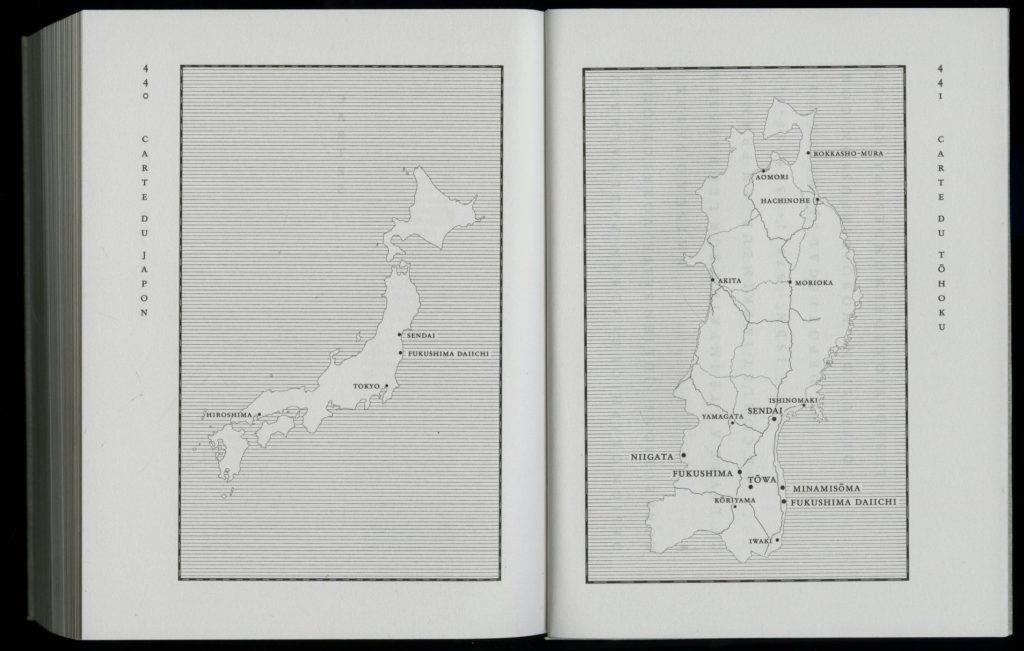
The book’s final notable stylistic choice is the total absence of illustrations or photographic material apart from its cover and title page, a fact that is, all things considered, quite rare for a contemporary ethnographic work. The only element that constitutes an image here is language, words and their inscription, in French or Japanese.
This choice seems linked to a radical descriptive imperative: everything that is shown must be conveyed through a form of description that rejects illusion, false obviousness, and the pitfalls of immediacy. Even the texts and documents, whether scientific articles, peasant manifestos, hiking guides, or expert reports, when the latter reach stratospheric heights of indecency, they become the subject of entire chapters entitled “Ritournelles”, appear as sites that the anthropologist surveys by offering a description of them.
One of the major characteristics of this descriptive work is its rejection of both the immediate and the definitive.
One of the major characteristics of this descriptive work is its rejection of both the immediate and the definitive. What we encounter is a description that is constantly searching for itself and correcting itself, that shares its hesitations and doubts, that castigates its own haste, and that tempers its eagerness to seize upon striking images and turn them into a pathetic spectacle. We are dealing with a gaze which, in its inception, its execution, and its rendering, seems constantly driven by a concern to combat the spontaneous generation of the cliché, which risks crushing a situation by reducing it to another, freezing its ambivalence, and immobilising its pulse.
“The first time I went to Mount Kuchibuto, it was by car. It was autumn 2016. Mr Ōno was driving, and we set off from behind his house, turning sharply right just before the tunnel. It was quite clear that the road was neither busy nor well-maintained. I have a vivid memory of that moment. The memory of potholes and numerous cracks in the road, through which vegetation was flourishing. The memory of an abandoned nursery school, the faded colours of the playground equipment. I even remember thinking that the scene was too easy, in a sense, that it tugged too strongly at the heartstrings and the mind precisely where one would expect it to, having been so often fostered in films and documentaries. The image had certainly come to me then, as it does whilst writing these lines, of the Ferris wheel in Pripyat (Chernobyl), which was due to be inaugurated on 1 May 1986—certain motifs are so persistent…’’ (pp. 253–254)
In its moments of condensation, this writing sometimes borders on the art of enumeration and lists à la Sei Shônagon.
Starting from this radical descriptive demand in struggle with the cliché, from this freezing of a timescape that nevertheless continues to pulse, and from this opacity, or perpetually obstructed visibility, of beings and relationships, what narrative style should be developed? Sophie Houdart’s writing engages with and explores the chronicle, the account of a day, a week, a season, a year. In its moments of condensation, this writing sometimes borders on the art of enumeration and lists à la Sei Shônagon.
“pause. Let us place ourselves in the mid-2010s, a few years after the triple disaster—an earthquake, a tsunami, a nuclear disaster—struck north-eastern Japan in March 2011.
By the mid-2010s, the debates over who owned the disaster—the nuclear experts? the Japan experts?—had dried up.
In the mid-2010s, what the hybrid collective I was working with called ‘blitz expeditions’— which had become increasingly frequent since 2012 around the Fukushima Daiichi power station (leaving Tokyo by train, hiring a car at Fukushima station, heading for the coast whilst getting as close as possible to the plant, skirting the forbidden…), had become less frequent.
By the mid-2010s, the hunt for rare Pokémon in the exclusion zone had itself just been banned.
By the mid-2010s, the process of designating certain remnants of the disaster as heritage sites had only just begun.
The Olympic Committee had then decided in favour of Japan’s bid, and rumours were circulating that the Olympic Village would be situated precisely in north-eastern Japan, from where the marathon would also start—a way, it was said, of contributing to the effort to ‘rebuild Japan’.
Most of Japan’s nuclear power stations had shut down, raising hopes among anti-nuclear campaigners of a phase-out of nuclear energy, but they were then restarted at the behest of a government keen, as in France, to work towards the country’s energy self-sufficiency.
In the mid-2010s, however, consultations and hasty decisions regarding temporary disposal sites for radioactive waste were in full swing.
But whilst the Fukushima Daiichi plant continued to leak radioactive waters, the issue of the long-lived nature of radioactive materials was not being publicly addressed.” (pp. 218–220)
The exploration of the chronicle’s register constitutes another testament to this epistemic humility, which we should begin to recognise as, in its own way, a form of radicalism. Epistemic humility is characterised by a concern to remain close to the ground (Latin humus), by an almost obstinate refusal of any ascent into generality, of all-encompassing abstraction, and sometimes even of conceptualisation.
The latter is then effectively replaced by chapter or section endings that function as points of condensation or sensitive crystallisation of everything, things seen and heard, glances caught and thwarted, ambivalent affects, that has been swept up and churned by the narrative thread.
‘‘One would thus need to be able to churn up the times in a bloated enumeration, which would set the historical sequences reeling and, in so doing, reveal recurrences, or at the very least echoes, or reminders. To describe a catastrophe, in short, whilst refraining from finding a beginning and an end to it.’’ (p. 347)
The chronicle form must also be understood within the semantic field of chronic illness, with its long duration, slow progression, and fundamentally incurable nature. The chronicle woven by Sophie Houdart is the day-to-day account, repeated year after year, of the exploration of a wounded territory that is also a blocked temporal landscape, through a wandering, in which walking is transformed into a method of inquiry, amongst the places and beings that compose or recompose it, each time in a different way.
“April 2015. I’ve come to stay for a while; the Ōno family and I are slowly getting to know one another. We chat over a cup of tea. ‘The situation isn’t easy,’ Mr Ōno begins. ‘A lot of things are still heavily contaminated—wild vegetables, mushrooms especially.’ It’s still impossible this year to grow shiitake, as he has done all these past years in the undergrowth above his home. So he’s had to think about diversifying his activities. Some have taken up viticulture; another has staked everything on apples. We must stay positive, he muses: the situation is certainly difficult, but it is also interesting; it forces us to embrace new dynamics, to try out new combinations. Faced with this adversity, the local community is united. People stick together, encourage one another, tell themselves it’s worth a try, that things will be alright.
This period is difficult to describe. It is made up of the little things which, woven into everyday life, have had to be squeezed out or displaced to make way for this one thing—radioactivity—which in turn affects them. It is sometimes subtle. Sometimes it is barely noticeable. Sometimes it seems to alter a relationship, and then ultimately does not, or not as much as that, or not for long. But certain figures are particularly drawn to it, hold onto it more than others, and thus constitute points where to focus one’s observation. Such as mushrooms. Or wild boars. But the stories here are not told in a straight line.” (pp. 228–229)
The choice of the chronicle’s narrative register, and of the mosaic of descriptions it assembles, is, ultimately, a political choice. For life in and since the Fukushima event, and the narrative or description that conveys it, is caught in the grip of what is attested to, almost everywhere today, as the “(im)possibility of repair”.3
For the residents of Tōhoku who have not been displaced, as for all those who, today and across the world, are forced to live amidst ruins, there is no choice but to try, through experimentation and trial-and-error, to carry on. But an obscene spectre looms over this continuation, that of celebrating, from a safe distance, the resilience of others, which always ends up legitimising the world as it is, heading for disaster.
It is also to sidestep this pitfall that Sophie Houdart, like most of her interviewees, has chosen epistemic humility, not to rise above ground level, so as no longer to have to wonder where to land. She and they have understood that life amidst catastrophe holds no universal lesson. She and they know, or sense, that a now nagging question hangs over every one of their actions: how can one learn to live well in an irreparably damaged world, without every meagre success of this learning process being immediately co-opted to contribute to the normalisation of the catastrophe, to the creation of expertise that can be exported as a survival kit to the sites of future devastation?
“Describe. Then start to worry. Whose interests might such descriptions serve? What is the risk involved in this laying bare of the world? What does the act of conscientiously resisting misplaced dramatisations (no ‘no-go zone’ à la Stalker, no ‘last man of Fukushima’) entail? Is all this not likely to lend credence to the idea—at which the institutions managing nuclear risks are working fervently—that a life-with-radioactivity is ultimately conceivable? That it must even be considered because you can’t have something for nothing, and that a nuclear accident, anywhere—as we now know and are now trumpeting – is always possible? That, consequently, we must prepare for it? And that, precisely, Fukushima can help us with this? (p. 20)
- An earlier version, in French, was published in Lundi Matin #512, 17 March 2026. ↩︎
- Patrick Williams. Nous, on n’en parle pas. Les vivants et les morts chez les Manouches. Éditions de la Maison des sciences de l’homme, 1993, cited in Vinciane Despret, Au bonheur des morts, Les Empêcheurs de penser en rond / La Découverte, 2015, pp. 79–80; English version: Vinciane Despret, Our Grateful Dead: Stories of Those Left Behind, translated by Stephen Muecke, University of Minnesota Press, 2019. ↩︎
- “Réparations palestiniennes”. Lundi Matin #510, 24 February 2026. ↩︎
How to cite: Pieron, Julien. “Life in the Persistence of Fukushima: Sophie Houdart’s Ce territoire qui, comme une pulsation….” Cha: An Asian Literary Journal, 24 Mar. 2026, chajournal.com/2026/03/24/fukushima.

Julien Pieron is a lecturer and researcher at the University of Liège, where he teaches metaphysics and theory of knowledge-practices. He is also co-director of the Master’s programme in Analysis and Creation of Critical Knowledge. His principal areas of interest include the metaphysics of time, film theory, feminist epistemology, and the contemporary revival of pragmatism and speculative philosophy. He is currently a Fellow at the Käte Hamburger Centre for Cultural Practices of Reparation (CURE) in Saarbrücken, Germany.
 Cha
Cha 