
茶 LEEDS
茶 FIRST IMPRESSIONS
茶 REVIEW OF BOOKS & FILMS
[LEEDS | REVIEW] “Building Shenzhen from the Ground Up: Sheng Keyi’s Northern Girls” by Todd Foley
Click HERE to read all entries in Cha
on Northern Girls.
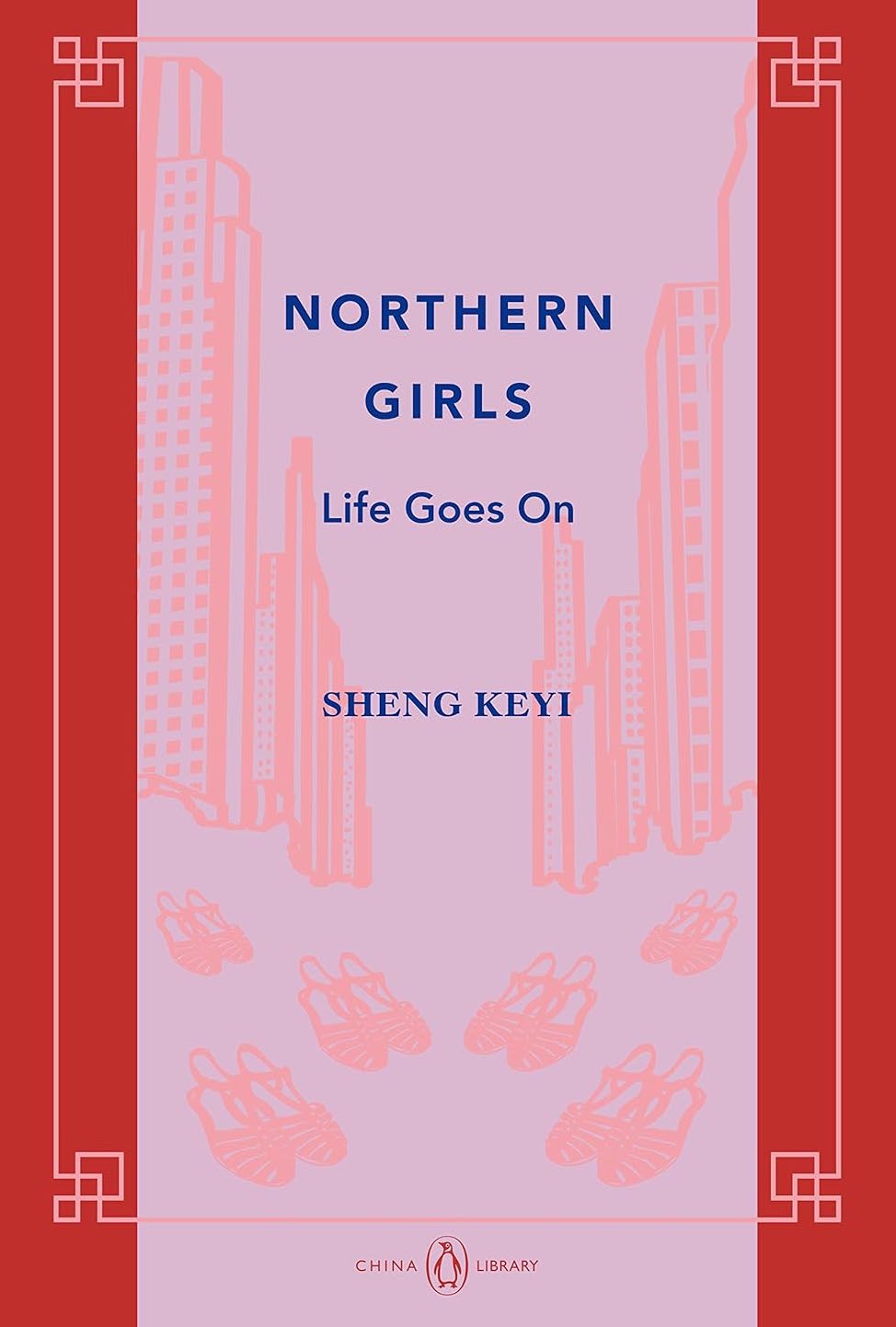
Sheng Keyi (author), Shelly Bryant (translator), Northern Girls: Life Goes On, Penguin, 2012. 320 pgs.
A rough plot outline of Sheng Keyi’s Northern Girls seems typical enough: a young woman from China’s provincial interior, unskilled and relatively uneducated, makes the bold decision to move to Shenzhen, the hedonistic southern megacity born of the post-Mao economic reforms. Here she comes face to face with the sex industry and the numerous, seemingly insuperable barriers that prevent her from establishing a respectable, comfortable, and happy life.
Yet Sheng Keyi’s treatment of this Factory Girls-type plot is poignant, nuanced, funny, and refreshing, and had it won the 2012 Man Asian Literary Prize for which it was longlisted,1 it would, in my opinion, have outshone certain previous winners like Jiang Rong’s Wolf Totem (translated by Howard Goldblatt, 2007).
Xiaohong, the protagonist of Northern Girls, exhibits an élan vital that compellingly drives her quest for personal growth and happiness. Well known in her native Hunan village for her voluptuous figure, Xiaohong has always suffered rumours about her impropriety, and the discovery of her affair with her brother-in-law precipitates her departure for the South. With her best friend Sijiang in tow, Xiaohong sets off for the big city, and the pair of young women struggle through a series of jobs that include factory work, a hair salon, and a hotel. While Xiaohong, clearly the more dynamic of the two, demonstrates a down-to-earth sensibility and laudable work ethic, she is hounded by the police because of her questionable legal status, and she is constantly propositioned by the lecherous representatives of Shenzhen’s capitalist excess.
Through it all, Xiaohong demonstrates an attitude that is neither prudish nor moralising, yet which is characterised by a refreshing truthfulness and innocence. This is the key to Sheng Keyi’s success in creating this character, which is perhaps most clearly demonstrated through Xiaohong’s relationship with her sexuality.
)
After a harrowing episode in which Xiaohong and Sijiang are taken in a van to some dark corner of the city to be raped, Xiaohong defiantly continues to make her own way in Shenzhen, and on her own sexual terms.
She indulges in a risky night of pleasure with a sexy triad boss simply because she is attracted to him, and later, when she is in need of both physical satisfaction and cash, she ends up humorously rebuffing a “big spender” at the hotel when she faces him in closer proximity: although “the thought of a romp on the pure white bed with its fluffy pillows and a night of ecstasy was certainly an interesting proposition,” Xiaohong is ultimately so repulsed by this “fifty-odd-year-old, S-shaped man” that she ends up paying him instead: “Uncle,” she says in her diplomatic parting, “I’m a virgin. I’m just curious about your body. I took off your clothes. If it’s not too much trouble, would you mind putting them back on now? This fifty yuan is a tip for your trouble” (pp. 199-200).
Although in this instance Xiaohong almost effortlessly manages to reverse the typical sexual power dynamic, the dangerous, fine line she walks is highlighted by the fate of her roommate, “a girl from Chengdu who called herself by the exotic-sounding name Julia Wilde” (p. 170). Hesitant at first, Xiaohong accepts and eventually respects Julia Wilde’s “quivering sensuality,” which she displays as she openly engages in all manner of sexual pleasure right there on her shaky dorm room bed, that is, until she disappears and is later found dead, having been raped, murdered, and discarded.
)
The balance of the dark, disturbing social underbelly of Shenzhen with a young person’s determined yet ambiguous pursuit of something better closely mirrors Mian Mian’s Candy, (translated by Andrea Lingenfelter, 2003), written just a few years before Northern Girls, and the two novels can be seen to complement one another in an interesting way.
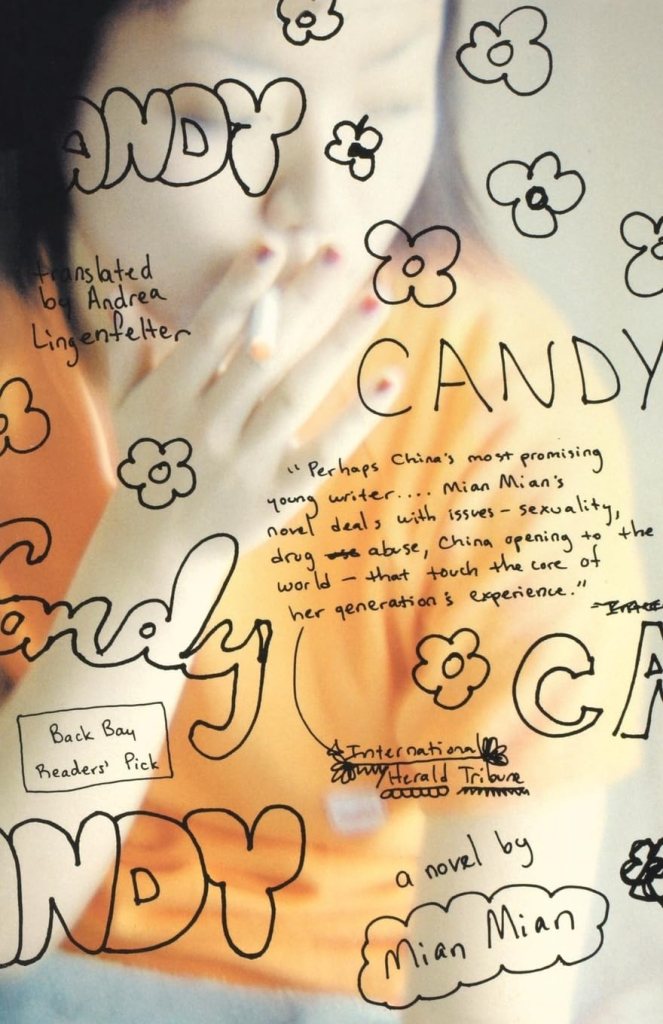
Mian Mian’s protagonist, Hong, is an enfant terrible from a family of Shanghai intellectuals who runs off to Shenzhen to indulge in the unrestricted personal freedoms of sex, drugs, and rock and roll, all the whilst vacillating between ennui and sense of purpose. For Hong, Shenzhen represents a new postsocialist imaginary where anything is possible. As a city that came into being in 1980 as China’s first Special Economic Zone, it is uniquely cut off from the historical, ideological, and cultural burdens of the past, thereby providing the perfect experimental environment for a young artistic soul from Shanghai in search of herself. Hong’s Shenzhen is abstract and amoral, frightening and exciting, and as such it serves as the perfect, monstrous backdrop for Hong’s personal journey.
Sheng Keyi’s Northern Girls approaches Shenzhen from the opposite direction. Though its atmosphere and characterisation are the same, Xiaohong shows us the city from the ground up by demonstrating the internal logic of its operation. Where Hong drifts along in Shenzhen’s irreverent youth culture, detached from the lives that have built the city and keep it operating, Xiaohong directly participates in making the city the kind of place that can enable a lifestyle like Hong’s. As a factory worker, hair-washer, receptionist, and finally hospital employee, Xiaohong’s precarious existence balances between economic necessity (though never quite desperation) and her tenuous legal status as a migrant worker on the one hand, and her own inventiveness, permissiveness, and sheer will to live on the other. Within Xiaohong, we see the basic ingredients of Shenzhen itself, yet her character is not just a simple symbol or allegory of this frightening, hopeful, dynamic place. The subtly complicated nature of the relationship between Xiaohong and Shenzhen is presented with a straightforward simplicity that makes it particularly effective.
)
The only part of Northern Girls I am not so enthusiastic about is the ending. In the final pages, Xiaohong becomes weighed down by her ever-growing breasts; they eventually cause her to topple over on the street, where she lies “like her breasts were nailed to the ground” (p. 318). For me, this seemed to exceed the bounds of the sort of realism within which the rest of the novel exists. While many contemporary Chinese authors, most notably Mo Yan, are known for their hyperbolic and grotesque style of writing, the exaggerated nature of this final plot twist seemed, to me, unnecessary and overtly symbolic.
This does not diminish the novel’s considerable achievements, however. Shelly Bryant’s accomplished translation enables a smooth and rewarding read from start to finish. The speed with which the novel can be read comes not from any lack of depth, but from the directness of the prose that mirrors Xiaohong’s simple and unhampered vitality.
- The 2012 Man Asian Literary Prize shortlist comprised: Musharraf Ali Farooqi’s Between Clay and Dust (Pakistan), Hiromi Kawakami’s The Briefcase (Japan), Orhan Pamuk’s Silent House (Turkey), Tan Twan Eng’s The Garden of Evening Mists (Malaysia), and Jeet Thayil’s Narcopolis (India). The winner was Tan Twan Eng’s The Garden of Evening Mists, announced in March 2013. ↩︎
How to cite: Foley, Todd. “Building Shenzhen from the Ground Up: Sheng Keyi’s Northern Girls.” Cha: An Asian Literary Journal, 9 Feb. 2026, chajournal.com/2026/02/09/girls-northern.



Todd Foley holds a PhD in East Asian Studies from NYU, where he teaches courses on Chinese literature, film, and translation. His recent translations include Wang Anyi’s I Love Bill and Other Stories (Cornell, 2023), Yu Hua’s City of Fiction (Europa, 2025), and Yang Qingxiang’s Chinese Millennials: What Is to Be Done? (Palgrave Macmillan, 2025). [All contributions by Todd Foley.]
 Cha
Cha 