
茶 LEEDS
茶 FIRST IMPRESSIONS
茶 REVIEW OF BOOKS & FILMS
[LEEDS | REVIEW] “Memory, Fiction, and Subjective Reality in Ge Fei’s A Flock of Brown Birds” by Todd Foley
Ge Fei (author), Poppy Toland (translator), Flock of Brown Birds, Penguin Australia, 2016. 100 pgs.
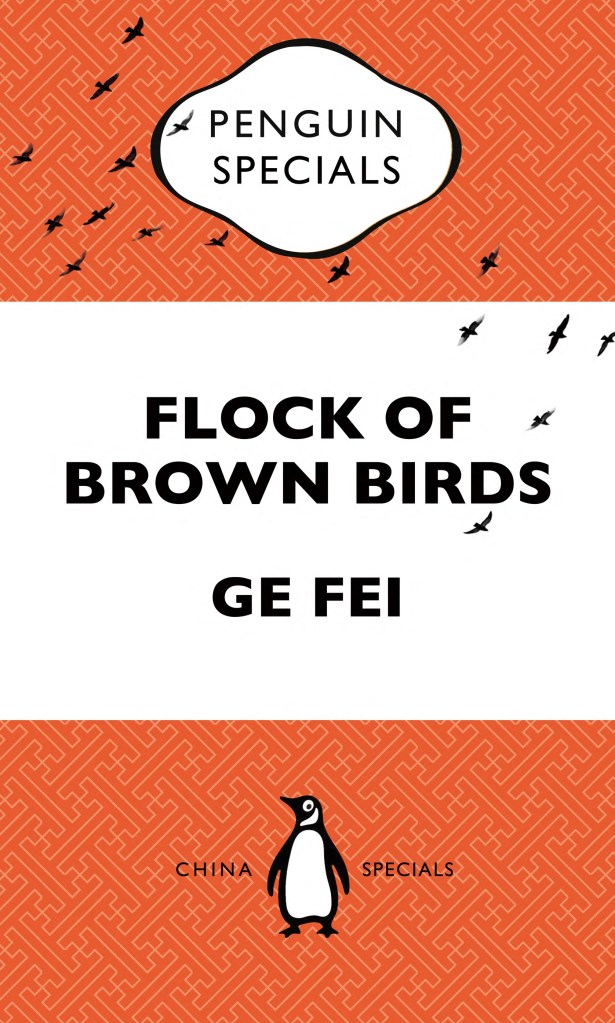
When I first read Ge Fei’s Flock of Brown Birds in the original Chinese, slowly and laboriously, many years ago, for a literature class at Peking University, it was an experience I would have to characterise as more difficult and confusing than enjoyable.
Even so, many details of this intriguing avant-garde novella have stayed with me ever since. The Penguin Inn, the wooden combs, the broken bridge, and, of course, the eponymous birds all left me with an impressionistic memory of a bizarre story that presented a scrambled perception of time, place, and reality.
I was very happy to discover that this important work had been translated into English, allowing me both to revisit it casually and to subject it to more rigorous analysis in my undergraduate literature classes.
Upon reading Poppy Toland’s fluid and straightforward translation, I discovered that the plodding pace of my first reading had likely not been entirely due to my level of Chinese. Although short, the story is demanding and not really to be fully consumed, much less digested, “in your lunch hour,” as the Penguin Specials series that publishes it suggests.
As we might expect from Ge Fei, the story has no clearly defined plot, but is instead an entanglement of hazy memories and ambiguous present encounters. The protagonist, “Ge Fei” himself, keeping in mind that Ge Fei is the author’s pen name, is in the midst of writing a novel in seclusion when he is visited by Qi, a mysterious woman who claims to know him but whom he does not recognise. He tells her the story of another mysterious woman whom he once saw in the Penguin Inn and then meets again years later. In their second meeting, he discovers that the woman is in an abusive relationship with her alcoholic husband, who eventually drinks himself to death. Ge Fei steps in to fill his place and marries the woman, who then promptly dies of a cerebral haemorrhage on their wedding day. Qi leaves after listening to this story and then returns several years later, although she has no recollection of Ge Fei or of the time she spent with him.
Part of the reason that reading this novella requires such an investment is that, on the most concrete level, it is peppered with details that seem significant, giving the sense that they are part of a puzzle that needs to be pieced together by the reader. The woman’s stroke, for example, is mentioned in the very first paragraph and then forms the final, unanticipated climax of the story Ge Fei tells Qi. In this sense, the novella harkens back to the author’s earlier short story “The Lost Boat,”1 in which the protagonist’s eventual death comes as a surprise despite its heavy foreshadowing the whole way through.
In A Flock of Brown Birds, however, most of the details never really fit together so clearly. As he follows the woman, his eventual wife, to the wooden bridge, for instance, Ge Fei passes another cyclist and hears “the sound of friction as the material of our down jackets made contact” (p. 16). Much later, the woman tells him it could not have been her, although her husband had passed by the remnants of that bridge one snowy evening and seen tracks, and the next morning “a bike and a young person’s body was fished out of the river” (p. 35). Does this mean that Ge Fei is really dead, or has he written this tragic incident into his own personal memory?
Details like this, much like the migratory brown birds that fly past his apartment every day, often cycle round in the story, although their connections and significance ultimately remain unclear. This technique effectively undermines the presence of a rational order and makes the story stand apart from similarly hallucinatory works by authors such as Can Xue, whose approach is not so overtly structured and technical.
These misfit puzzle pieces function as part of a larger effort to undermine any notion of existence outside the protagonist’s subjective reality.
More importantly, I think, these misfit puzzle pieces function as part of a larger effort to undermine any notion of existence outside the protagonist’s subjective reality. Is the story he tells Qi completely fictional? While he presents it as a recounting of facts, “thinking that any embellishment or attempt to add intrigue would destroy its purity” (p. 11), Qi responds as if it is an entirely fabricated account, complaining that he has given it “such a banal ending” (p. 21) and that it too predictably adheres to the “formula of love” (p. 14). The only connection between Ge Fei and the past he relates is his memory, which he describes as “a rusty chain, disintegrating link by link into dust” (p. 44).
The novel he is writing, furthermore, “seems to have completely destroyed [his] memory” (p. 9). This, of course, poses fundamental questions about the very idea of narrative, undermining any claim to represent truth or an objective view of history. The political implications are subtle but present. Both Ge Fei and Qi agree that “memory is power” (p. 11), and Qi’s name in Chinese means “chess,” suggesting that there may be a tactical element hidden in the discrepancies between Ge Fei’s account of events and the version she apparently already knows.
Through its experimental form and intellectual depth, A Flock of Brown Birds offers a number of productive and rewarding readings, and it is well worth the effort it demands. I think Toland’s translation is a particularly valuable contribution to contemporary Chinese literature available in English, and I found the experience of reading it quite rewarding.
- Ge Fei’s story “The Lost Boat” was originally published in Chinese in 1987 and first appeared in English in The Lost Boat: Avant-Garde Fiction from China (Wellsweep Press, 1993), a multi-author anthology of contemporary Chinese fiction edited by Henry Y. H. Zhao. The story was translated by Caroline Mason; other contributions in the volume are by different authors and translators. ↩︎
How to cite: Foley, Todd. “Memory, Fiction, and Subjective Reality in Ge Fei’s A Flock of Brown Birds.” Cha: An Asian Literary Journal, 3 Feb. 2026, chajournal.com/2026/02/03/flock.



Todd Foley holds a PhD in East Asian Studies from NYU, where he teaches courses on Chinese literature, film, and translation. His recent translations include Wang Anyi’s I Love Bill and Other Stories (Cornell, 2023), Yu Hua’s City of Fiction (Europa, 2025), and Yang Qingxiang’s Chinese Millennials: What Is to Be Done? (Palgrave Macmillan, 2025). [All contributions by Todd Foley.]
 Cha
Cha 