
Editor’s note: In this deeply personal essay, Sajita Nair recounts her first pilgrimage to Sabarimala after decades of exclusion shaped by gendered religious custom. Beginning in childhood bewilderment at ritual prohibition, it moves through family memory, mythic inheritance and disciplined preparation to a physically exacting ascent undertaken with her elderly mother. Drawing on Advaitic philosophy, particularly the injunction Tat Tvam Asi, it interrogates identity, ego and belonging.

[ESSAY] “The Eighteen Steps Home” by Sajita Nair
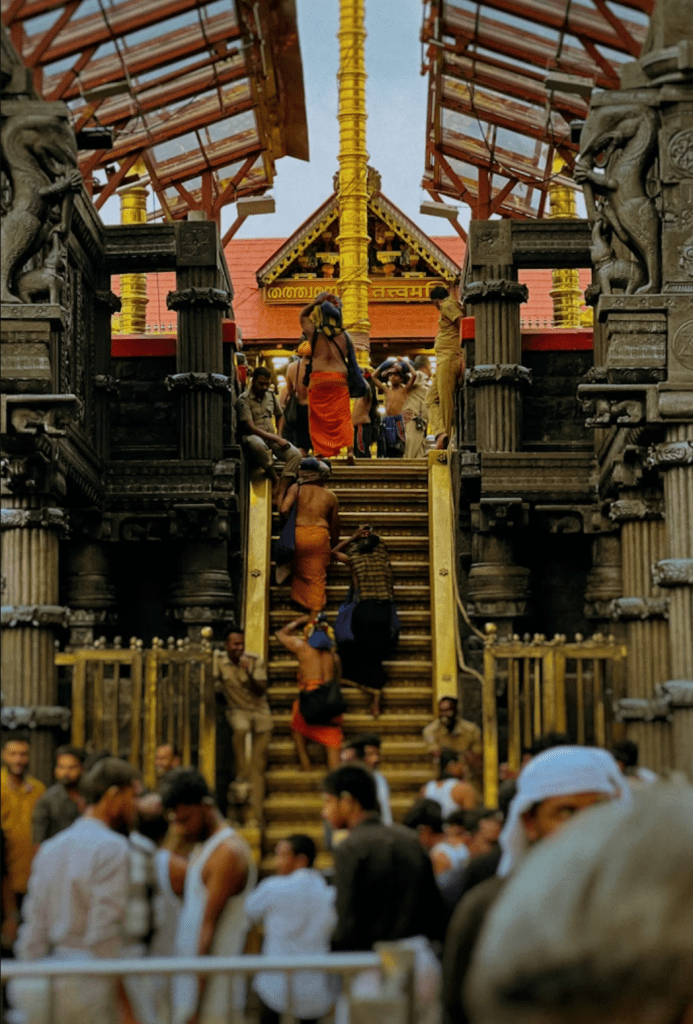
Tat Tvam Asi. You are that.
These words, inscribed in Malayalam and Hindi, held my attention as I first stood before the temple that had been forbidden to me for most of my life. For a moment, I felt cheated. If I am that, if I am part of Brahman, what was I seeking here? Why had I undertaken rigorous austerities, braved thronging crowds, heat and steep stone paths to arrive at this threshold? And if the words were true, why did I feel so distinctly separate from the lakhs of pilgrims around me?
I was thirteen when I first heard of the Sabarimala temple. My father and brother were observing the vrutham, a period of spiritual discipline, and I was instructed not to be anywhere near them, especially during my periods. According to the prevailing customs, anything I touched during menstruation was to be cleansed. In a home where discrimination never existed, I found myself suddenly excluded. To me, it defied logic.
Not one to give up easily, I rebelled with questions. Why would Ayyappan impose such a rule? Surely, it had been misunderstood. If it was about menstruation, why was the restriction not only for the specific period, as in other Hindu temples? As this was long before easy access to information, my mother explained through storybooks and hearsay. Women in their fertile years, she said, were forbidden from visiting Sabarimala because the presiding deity, Lord Ayyappan, was a Nitya Brahmachari, an eternal celibate.
In the pooja room, I peered at an image of Lord Ayyappan astride a tigress and whispered, “
“Must I wait a lifetime?”
Stories of Ayyappan reached me in fragments as I grew up. Myth and history blurred as the tales shapeshifted across centuries, presenting multiple versions. What stayed constant, however, was my mother’s fear that if the vrutham was not observed with utmost sincerity, misfortune would follow. She spoke of pilgrims who vanished into the forests, some devoured by tigers, others trampled by elephants, and still others who wandered into the dark foliage, their sanity lost.
For the safe return of my father and brother, I did as I was told. I watched them with a mix of apathy and envy as they bathed, prayed, observed their abstinences and walked barefoot on gravel to toughen their feet. I saw them flinch as the stones dug into their soles. Could it really be that difficult?
One humid afternoon, when no one was watching, I tried it myself. It hurt, but was bearable. I concluded that I could easily have undertaken the trek if not for the restriction. Until then, my brother and I had done almost everything together, but here I was left out. The grudge stung, and I did not know whom to direct it to but Ayyappan himself.
When they completed their pilgrimage and returned, I bubbled with questions. Was it tough? Were there many devotees? Did you see any tigers or elephants? What did you eat? My father answered patiently, while my brother exaggerated every detail, clearly enjoying his exalted status. He spoke of breathing the chill mountain air through the bus window, of eating pazham pori (banana fritters), parippu vada (lentil fritters) and sand roasted peanuts from paper cones, washed down with chukku kaapi (dry ginger infused black coffee). I wished I could have been there with them.
“Chants of Sharanam Ayyappa, Swamiye Ayyappo, and kallum mullum kalekku mettai saw us through,” my father said, while my mother gently tended to their blistered, bruised feet. Such pampering was reserved only for them. I watched from a distance, both curious and indignant.
My only solace was the aravana payasam prasadam, the sacred offering given to devotees. I licked the honey hued sweetness from my palm and insisted that they bring back more the next time they went. Twice more, they made the pilgrimage and returned with enough aravana payasam and appams to last for days.
Along with the prasadams came stories of pilgrims who claimed the journey had changed their lives. Some spoke of visions, miraculous appearances and sudden, inexplicable strength in moments of extreme fatigue. Drawn by Ayyappan’s inclusivity and his famed friendship with Vavar, the legendary Muslim trader, even some of my father’s Christian and Muslim friends undertook the pilgrimage with equal fervour. Through it all, I absorbed the stories, and Sabarimala remained a hallowed destination.
Years passed, but my curiosity lingered. Decades later, in my mid fifties, as I drove past an Ayyappa temple at dusk and stopped at a traffic signal, a flicker of old desire rekindled. In the subtle yellow light of the lamps stood Swamys in black mundus, sandalwood smeared on their foreheads, palms folded in prayer. Harivarasanam Vishwamohanam, in K J Yesudas’s voice, flowed hypnotically through the air, the very song my father had listened to during their vrutham period. In that dreamy, nostalgic moment, I felt a strong tug. But why did I want to go now? Was it curiosity? Faith? A challenge I finally felt ready for? Or had I grown accustomed to seeking strength and spiritual guidance from sacred spaces, regardless of the religion they belonged to?
“Ma, do you want to visit Sabarimala?” I asked my widowed mother, now in her late seventies. For a long moment, the phone line fell silent. “I have carried this desire for so long,” she said at last.
A few days later, when I called again to discuss our trip, she sounded upset. Her voice was heavy. “My pooja room has no picture of Ayyappan,” she said. The next morning, volunteers from a nearby temple came seeking donations and handed her a small gift.
When she unwrapped it, beneath the crackle of brown paper was a framed image of Ayyappan. It might just have been a coincidence, but we took it as a sign.
Paths opened up in ways I had never imagined. Reservations, virtual queues, support from family, even money flowing in, everything began to align with our purpose. My anxiety about finding a Guruswamy, an experienced guide who leads pilgrims through the forty one day austerity period, eased when we found an elderly temple priest who had made the pilgrimage over forty times. He initiated us into the rituals at an Ayyappa temple along a quiet riverbank.
I wore my rudraksha mala, a string of sacred brown beads around my neck, and draped a black cotton mundum-neriyathum around my body. With an oblong sandalwood paste neatly concealing the wound mark on my forehead, I barely recognised myself in the mirror. Who was the sannyasin staring back at me, her well oiled curly hair, sans makeup or jewellery, stripped of colour and adornment? She was not the woman who had married across faiths, who had logic and reasoning as lifelong companions. Something in me was changing.
I found myself receptive to experiences beyond my conditioning. Between the sattvic food, prayers and heightened ritual cleanliness in the home and environs, the self that once identified with position, titles and social hierarchy slowly began to dissipate. Neti, Neti. Not this, not this, echoed within. When I walked barefoot over sharp gravel or puddles, fell at the feet of pujaris and interacted with those who had meagre material possessions, surprisingly, my ego did not intervene. And when strangers greeted me with namaskarams and easy smiles, offering seats and starting polite conversations, their respect no longer inflated me as it once would have.
It was in this altered state of mind that I began my pilgrimage to Sabarimala. Following tradition, my mother and I first visited the Vavar mosque at Erumeli, and the Dharma Shastha temple just a few metres away. The overwhelming surge of devotees during the Mandala Pooja, leading up to the Makaravilakku, left me astounded.
Bare-chested men smeared with ash and turmeric danced in devotional ecstasy to the loud beats of chenda drums, holding up twigs of fresh mango leaves and colourful bamboo arrows, the sharams. Groups performing the Pettathullal passed us, their soft bellies jiggling, their loud chants rising above the percussion, bringing alive the triumph of Lord Ayyappan over the demoness Mahishi.
I turned to the driver. “If this is the scene here, do you think Sabarimala will be crowded?”
“Of course,” he replied without hesitation. “But most of these men are taking the traditional, nearly fifty kilometre long Karimala route. They will take many days to get there.”
I looked at them again with renewed awe. Men of all ages and varying levels of fitness were bound by a common resolve to trek long distances barefoot through harsh, unforgiving forest terrain.
The sight helped us mentally prepare ourselves. My mother and I decided to start early to beat the tropical sun. After a cold water shower at 3 a.m., we headed to the Pamba base camp, only to encounter a traffic jam. On the narrow, pristine road fringed by dense vegetation, buses, cars and police jeeps stretched as far as the eye could see. I had anticipated a crowd, but this was an avalanche of Ayyappan devotees, brimming with piety and fervour.
Suddenly unsure, I looked at my elderly mother, wondering what we were getting into. She, however, remained stoic. “Ayyappan has called us. He will show the way,” she said. “He has helped many devotees, appearing as an old man, a child or even a spirited lad.” Her faith was so absolute that all practical concerns seemed to vanish into the morning mist of the valley below.
When we finally reached the Pamba River bridge, each step we took carried more than mere anticipation. It bore the weight of a long suppressed desire, a longing that had stretched for decades.
Along the banks of the holy river, pilgrims immersed themselves in its waters to wash away their sins. Some discarded their old attire, their mundus, and donned new ones, symbolising a fresh beginning. Sanitation workers moved quietly along the banks, gathering the discarded clothing before it could choke the river or harm aquatic life. Belief and piety had left in their wake mounds of waste along a once quiet river flowing through a lush valley.
Jostling through the crowds, I realised we were just two more among the millions gathering for one of the largest annual pilgrimages in the world. I put an arm around my mother and carefully steered her to the dolly service counter, where dolly men waited beside the chairs mounted on bamboo poles, meant to carry pilgrims unable to undertake the steep trek. Having seen her off in a dolly, I began my trek on the traditional path of nearly five kilometres to the Sannidhanam. Family members had casually joked during our planning that two dollies would be a better idea, but I was determined to climb uphill on my own. This was how I had always imagined it. Yet I was unsure whether my mild yoga practice would help me endure the gruelling workout my body was about to undertake.
I climbed up to Appachimedu, taking adequate breaks, especially at the cardiology centre at Neelimala, which offered the solace of accessible medical help. Measured, deliberate breaths carried me uphill as my pedicured feet pressed against the craggy path with each heavy step.
Ahead of me, an elderly woman collapsed from exhaustion. The irumudi kettu, a bag of offerings to Ayyappan, could not be placed on the ground as per custom, and members of her group rushed to support her. Volunteer pilgrims fanned her with their black mundus, and as I walked by, straining forward, they fanned me too. The sudden rush of air on my drenched face brought the gentle coolness of a citrus scented mist.
As I waved goodbye and walked ahead, a stark realisation struck me. I was alone, with no one to help me if I collapsed. “Sharanam Ayyappa,” I chanted, and took the next step along the steep incline that rose to nearly sixty degrees, testing the last reserves of my stamina and resolve. My black blouse clung to my back, soaked through with sweat, and beads rolled slowly down my spine. I sipped water from my bottle and, along the path, took the medicated, herb infused water served to pilgrims.
A group leader called out, “Swamiye,” and the others responded in unison, “Sharanam Ayyappa.” I joined in the chorus even as they overtook me, their callused, weathered feet with cracked heels far more in tune with the bare earth. My heart pounded, protesting in my ribcage, and my breath shortened. An old wound on my right foot, sustained during a badminton match, throbbed, and my left knee popped with a sharp ache. Could I continue? Should I? Or turn back and take a dolly? That would be so much easier on my body. Lost in these thoughts, I sank onto a rough, protruding stone.
Behind me, a spirited call of “Swamiye, Sharanam Ayyappa” drew my attention. Turning around, I saw a physically challenged man seated on a low, movable wooden platform. The sight sent an instant surge of strength through my fatigued body. I felt deep gratitude for the feet that could still carry me. What was a little pain in comparison?
Fathers carried their children on their shoulders. Some of those still walking simply stopped, sitting in quiet protest. I reassured them, using the same comforting lie the nurse at the cardiology centre had told me. I knew it worked. The belief that we had almost reached Ayyappan had a strange power of its own.
After Sharamkuthi, as the intensity of the climb eased, the crowds, which had briefly thinned, gathered again as police cordons permitted only batches of devotees through. I found myself captive within one such section, surrounded by men of all ages, their bare bodies glistening with sweat. The air filled with mingled smells of fragrant sandalwood, musty clothing, ghee seeping from irumudi kettus, the tang of raw mangoes and the fermented odour of overripe bananas. It felt suffocating, almost nauseating. I held my breath and clutched my bag firmly between myself and the bodies that swayed closer.
When the rope cordon was lifted, young men, in devotional frenzy, surged forward like floodwaters, oblivious to anything in their path. Did they too carry the same essence of Brahman, I wondered, as I moved along the fringes to the next section. Why was I judging, I asked myself, the rudraksha beads rolling restlessly between my fingers.
When a policeman informed the group that the wait would be nearly four hours, I stepped forward after a moment’s hesitation. All pairs of eyes in the cordoned section turned towards me.
“My mother has gone by the dolly route and would be waiting for me,” I said. “May I go that way too?”
He looked at the mass of devotees and then at me. “Wait here,” he instructed, guiding me aside. The crowd rushed past, swirling like water gushing around a rocky islet in a gurgling stream, while I crouched behind a metal column. After deliberating with his senior, the policeman escorted me to an alternate route. The crowd parted to let me through, much like the waters of the Yamuna for Vasudeva as he carried the infant Krishna.
I walked almost alone, immersed in the sights and sounds of the forest. A lion tailed macaque and a Malabar squirrel watched me intently from a tree as I neared the final stretch. Perhaps they were cheering me on.
With all phone signals lost, anxiety crept in during the final ascent to the Valiya Nada Pandal. How could I possibly find my mother among the swirling mass of similarly attired devotees? After a few enquiries, I was directed to a quiet spot where my mother waited, overjoyed to see me.
“I knew Ayyappan would help,” she said, as though she had been certain all along.
I smiled. Was it her faith, my search, or mere coincidence? Whatever it was, reuniting with her was one of the most humbling moments of my pilgrimage.
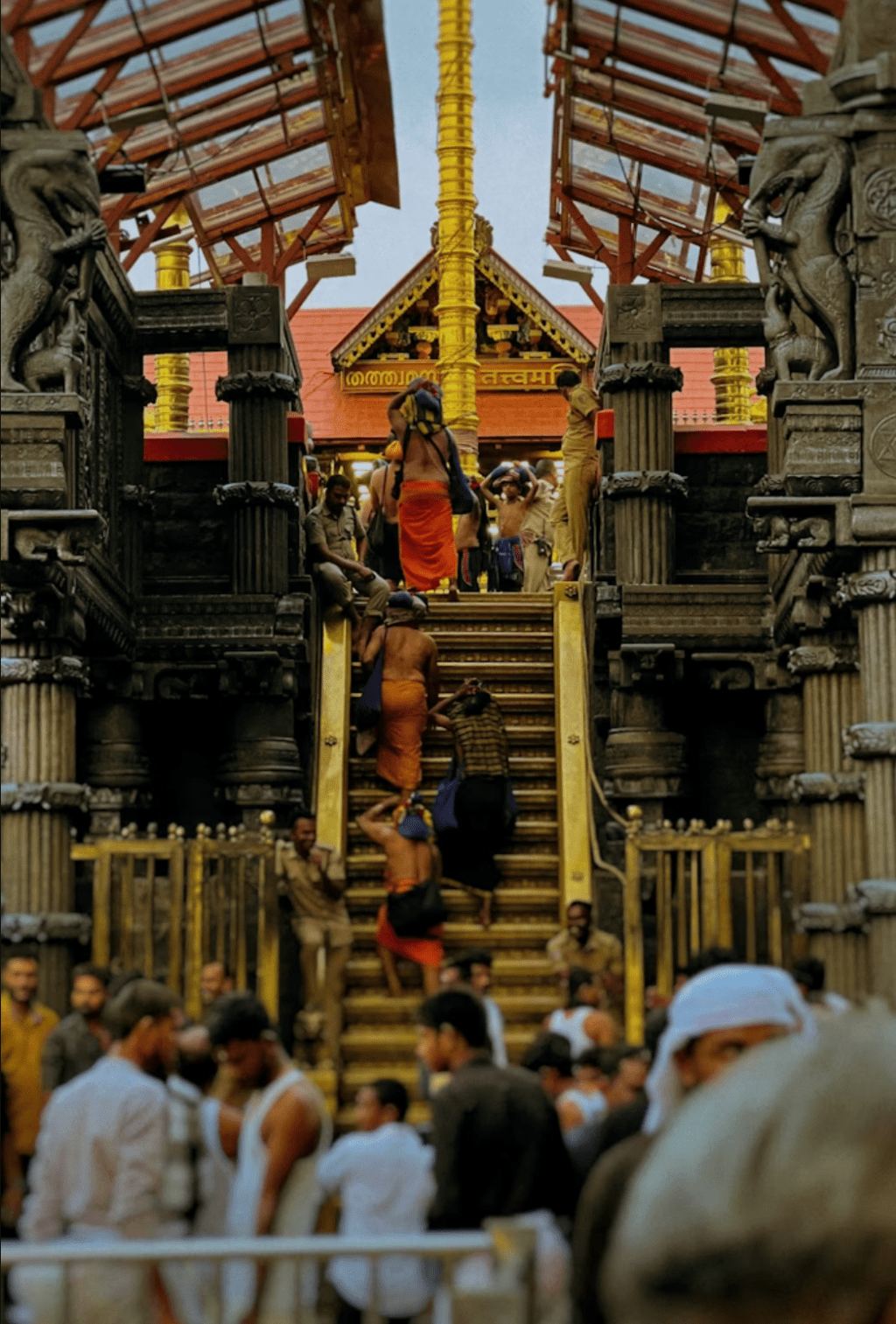
Strangers guided us towards the Padinettam Padi, the eighteen holy steps, each step symbolising the ascent to higher consciousness. Policemen lined both sides of the golden stairway as pilgrims pressed forward. My mother and I were caught in a strong, rising current of devotees, even as our irumudi kettus dug into our heads. To avoid losing her, I held the pallu of her saree, just as I had done as a child. Time dissolved as we climbed the steps and arrived at the sanctum sanctorum. Fearing a stampede, I did not pause, catching only a fleeting glimpse as I moved on.
Out of nowhere, a long arm stopped me. I looked at the tall policeman, puzzled. He positioned my mother and me at the centre and said, “You have come a long way to pray, no? Look, Ayyappan is here. Close your eyes and pray.”
In that moment, I saw Ayyappan, with a golden aura, amid the diffused light from the tall lamps. I smiled broadly, as though I had met an old friend. My mother was in tears.
From the irumudi kettu, we unpacked the ghee filled coconuts. When the shells were broken and the ghee flowed out, the thick yellow liquid merged, indistinguishable from the rest. The hollowed shells were tossed into the giant fireplace, the aazhi, where they crackled and burned.
The flowing ghee. The discarded shell.
Tat Tvam Asi.
My entire life had been about shaping a distinct identity. Now I was unlearning and relearning, realising that I was only a convenience.
Walking downhill on trembling knees and aching calves, I saw a beggar with a wizened face in ash coloured rags, jingling his coins in a misshapen aluminium bowl. Could I trade places with him, stand where he stood? I asked myself. My fingers instinctively clutched the sling bag. Then, as our eyes met, the grip loosened.
My mother, who had been reflecting on the incident at the Sannidhanam, said, “What if that was Ayyappan in the form of a policeman? People say that he appears in many forms.”
“Could have been, Ma,” I said, although I was not sure. The line between coincidence and divine intent blurred in my mind.
I held her arm as we descended the steep slope. Groups of pilgrims with their irumudi kettus walked uphill, chanting through laboured breathing, their eyes fixed on a summit they could not yet see. Distances were temporary. Every step, up or down, eventually led us home.
How to cite: Nair, Sajita. “The Eighteen Steps Home.” Cha: An Asian Literary Journal, 31 Dec. 2025, chajournal.com/2025/12/31/eighteen-steps.

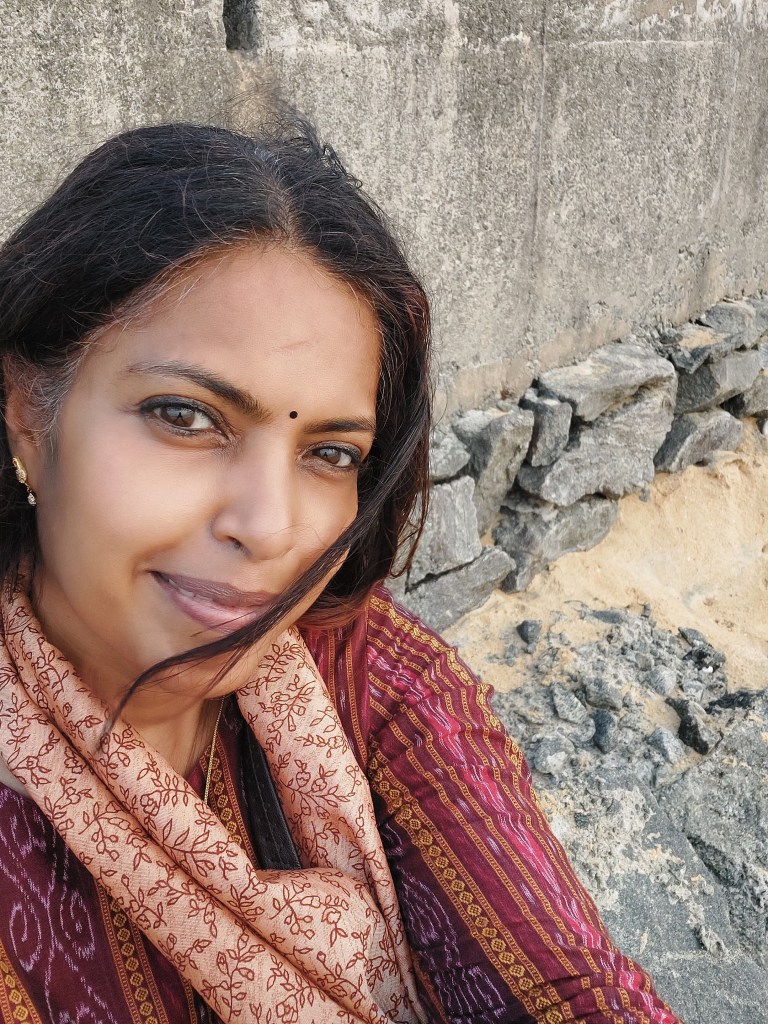

Sajita Nair is a writer based in Bangalore, India. She is the author of three novels and a collection of short stories, including She’s a Jolly Good Fellow (Hachette India, 2010), The Army Officer’s Wife (Juggernaut Books, 2018), The Search (Juggernaut Books, 2021) and The Grande Matriarch of Malabar (Readomania Publications, 2023). Two of her novels, She’s a Jolly Good Fellow and The Grande Matriarch of Malabar, were long listed for the Crossword Book Awards and the AutHer Awards. Her short story, “Bravo Zulu”, is part of the Bachelor of Arts (English) syllabus at the University of Kerala. Her work has also appeared in publications such as The New Indian Express, DNA, Mid-Day, Transitions Abroad and India Currents, among others.
 Cha
Cha 