
茶 FI茶 FIRST IMPRESSIONS
茶 REVIEW OF BOOKS & FILMS
[REVIEW] “Gigi L. Leung’s Everyday Movement and the Human Texture of Protest” by Jennifer Eagleton
Click HERE to read all entries in Cha on Everyday Movement.
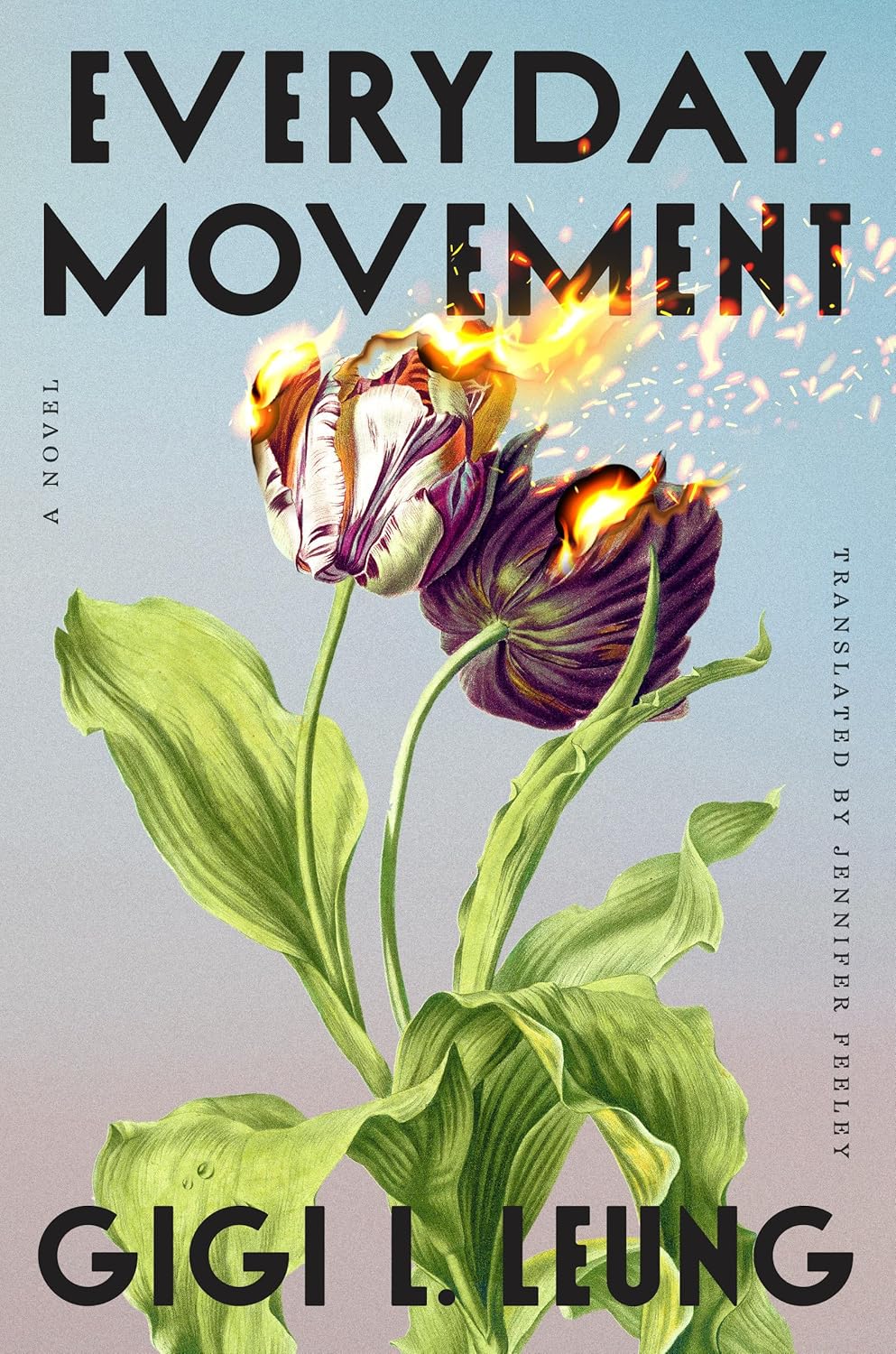
Gigi L. Leung (author), Jennifer Feeley (translator), Everyday Movement, Riverhead Books. 2026.
As soon as I started reading Gigi L. Leung’s Everyday Movement, translated by Jennifer Feeley, my immediate thought was that this was history in fictional form.
As someone who experienced the events depicted in the story, I found that the book possesses a strong aura of authenticity. Set during the 2019 anti-extradition protests, the author seeks to show how political turmoil transformed relationships, affected daily life, and raised questions of belonging and connections to mainland China. It humanises politics at a personal level. The book also engages with existential questions of patriotism, the meaning of consumerism, and the challenge of being one’s authentic self, albeit with some ambivalence about how the self can or should be represented in times of rapid change.
Told through the eyes of interconnected and relatable characters, largely young people who formed the bulk of the protest participants, the narrative focuses on what might be described as a “transitional generation”, born around the time of the 1997 handover. Unfamiliar with colonialism, less connected to the mainland, and perhaps more Western-educated than their forebears, these young people are at once idealistic and pragmatic, questioning both their reality and their capacity to change it: “On June 28, 1997, Hung Yi was born. Relatives joked that she ‘popped out’ just in time, sneaking in a few breaths of British air before the July 1 handover.”
Some students were immediately drawn into the protests, while others were initially uncertain but later came over to the cause and to debates about how the protests should be conducted, whether with less violence or more violence, both of which existed. There was significant inner conflict: “That was when Ah Mak began to realise that his willingness to endure and his inability to act could hurt the people around him. There was no turning back. He was no longer the version of himself who had believed in the popular principle of ‘Peace, Reason, and Nonviolence.’” I think many people in Hong Kong at the time experienced mixed feelings as the protests wore on about how they should proceed. It is easy to look back and criticise particular actions with the benefit of hindsight, which is why it is useful to revisit 2019 through a novel such as this one, which is largely set in the present tense.
The 2019 anti-extradition movement was also an “everyday movement” that involved nearly everyone, either passively or more actively. Activists encouraged the public to integrate resistance into everyday life, suggesting that advocacy should not be confined to the streets: “one should bring it into the workplace, and social occasions. The goal was to educate, persuade, and spread the message, breaking out of echo chambers, and building broader support.” In general, I think this was achieved, largely because people witnessed police action first-hand at the dispersed protests throughout Hong Kong.
As an everyday movement, people also coped in everyday ways: “When conflict becomes part of your daily life, it’s natural that you need some getting used to. You know, each person has their own way of coping, and not everyone can allow themselves to fall apart. Maybe maintaining order is the only way Panda knows how to survive.” This explains why people continued to go to work, attend school, visit shopping malls, and eat in restaurants, while taking part in protests at weekends.
Hong Kong’s famous shopping culture is treated with a distinctly ironic tone. As Hongkongers effectively lived in shopping malls, these spaces became small “civic squares” and temporary “battlefields”. Shops were “so quick to kick out customers and slam its shutters when things went down. It was now jam-packed with shoppers again. There was no trace of trauma.” This scenario was repeated throughout the many months of the protests.
Since consumerism is almost a secular religion for Hongkongers, shops acquired clear ideological associations. Businesses became known as “yellow”, in support of the protests, or “blue”, opposed to them: “The public scrutinised every business, the décor, the staff’s remarks, to figure out their stance on the movement, sorting them into categories for support or boycott. This raging tide swept away the practical considerations for service, quality, and price. The primary standard for evaluation became do you share my politics?”
The book does not engage in sustained political analysis of event after event, but from time to time it provides a sense of the chronology and characteristics of what unfolded in 2019. Early in the novel, it is noted that “Ah Lei hadn’t been the most political person, but even she understood it would be an infringement of civil liberties in Hong Kong [referring to the anti-extradition bill], so the night before the rally when Panda invited her to join her, she agreed to immediately.” Later, there are references to the District Council elections, including a brief observation on their traditionally pro-establishment nature, as well as oblique references to the university sieges of late November. These moments are not disruptive to the narrative and are helpful for readers who may be less familiar with the course of the protests.
The novel does not shy away from showing that there were critical voices among the protesters themselves, particularly regarding the increasing use of violence and the calls for independence voiced by some participants, which later became a major justification for the introduction of the National Security Law.
We’re losing public support. In the summer, I came out to demand accountability for police brutality. But now, at rallies, some people are wielding flags calling for Hong independence. That really puts me off. I feel like the movement has been hijacked.
“Hong Kong independence” was a trigger issue for Mainland officials, which escalated events to a certain degree. Desperation on the part of some protesters in seeking to achieve their goals likely led them to adopt this slogan. The novel’s treatment of this issue also demonstrates its fidelity to lived experience and contemporary thinking, as there was no monolithic “Hong Kong independence” bloc.
The question of the Hong Kong–Mainland relationship is handled with nuance. One student “began to think of China as full of secret sources of happiness. She had wondered why her classmates’ essays often ended on a contrived uplifting note, such as ‘I’ll grow up to be a useful Chinese citizen’ or ‘I love my great motherland!’” Yet through her interactions at school, she “had begun to understand that it wasn’t all glory to be a mainland kid. Many of them didn’t know Hong Kong well.” I recall seeing a poster at The Chinese University of Hong Kong addressed to Mainland students, explaining the reasons for the protests. In the novel, Mainland students are somewhat removed from events, as the focus remains on Hong Kong student protesters.
Towards the end of the book, the following observation is offered:
The Hong Kong she knew emphasized instrumental rationality—a “first- world” materialistic city ruled by capitalism. An elite education had drilled in her that this city ran on cool-headed speculation, analysis, and salesmanship. But none of these things explained how, on a recent outing, human blood trickled on the ground, streaming past her half dirty Nike sneakers.
For too long, we have been told that we are a particular kind of people, “rational” and “pragmatic” and politically apathetic. I have never believed this, particularly the latter claim. Hongkongers will respond to threats to society when they perceive them to be intensifying. It is a tragedy that circumstances have rendered many Hongkongers still living in the city understandably mute. The book ends in an open-ended manner, but not an overtly pessimistic one (this is not a spoiler).
I do not think that the book is really meant for me, and I am not sure that I wish to relive 2019 again, even though I am constantly writing about the aftermath of that year. Rather, it seems intended for readers who want a deeper understanding of the 2019 protests beyond sensationalist media coverage or Beijing’s official narratives. I would be particularly interested to read a review by a young person who took part in the protests. How have younger participants responded to the original Chinese version of the novel? I suspect that the author must either have been a participant herself, known some of these young people personally, or interviewed those who did take part. As noted earlier, the novel possesses a strong aura of authenticity. At times, historical fiction can convey more of the atmosphere of an event from a human perspective than a straightforward and dispassionate recounting of events.
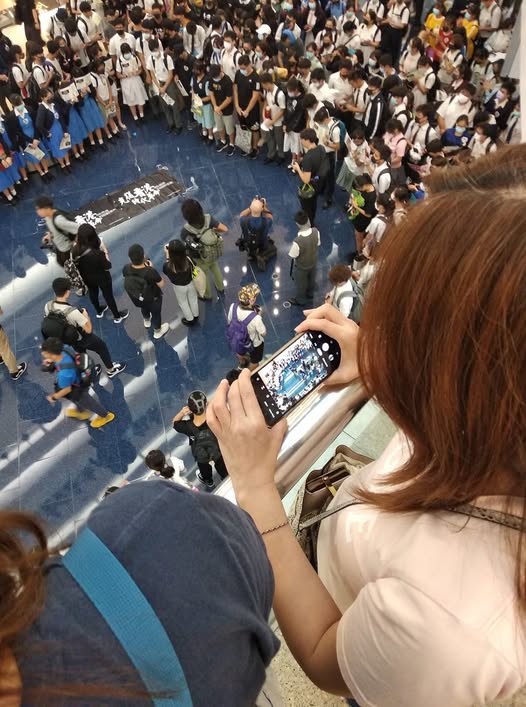
Singing the protest anthem in Festival Walk shopping mall. Photo by Jennifer Eagleton.
How to cite: Eagleton, Jennifer. “Gigi Leung’s Everyday Movement and the Human Texture of Protest.” Cha: An Asian Literary Journal, 1 Jan. 2026. chajournal.com/2026/01/01/movement-everyday.


Jennifer Eagleton, a Hong Kong resident since October 1997, is a close observer of Hong Kong society and politics. Jennifer has written for Hong Kong Free Press, Mekong Review, and Education about Asia. She has published two books on Hong Kong political discourse: Discursive Change in Hong Kong(Rowman & Littlefield, 2022) and Hong Kong’s Second Return to China, A Critical Discourse Study of the National Security Law and its Aftermath(Palgrave Macmillan, 2025). Her poetry has appeared in Voice & Verse Poetry Magazine, People, Pandemic & ####### (Verve Poetry Press, 2020), and Making Space: A Collection of Writing and Art (Cart Noodles Press, 2023). [All contributions by Jennifer Eagleton.]
 Cha
Cha 