
茶 FIRST IMPRESSIONS
茶 REVIEW OF BOOKS & FILMS
[REVIEW] “Between Adaptation and Escapism: Navigating Entrapment in Ling Ma’s Severance” by Hilda Wong
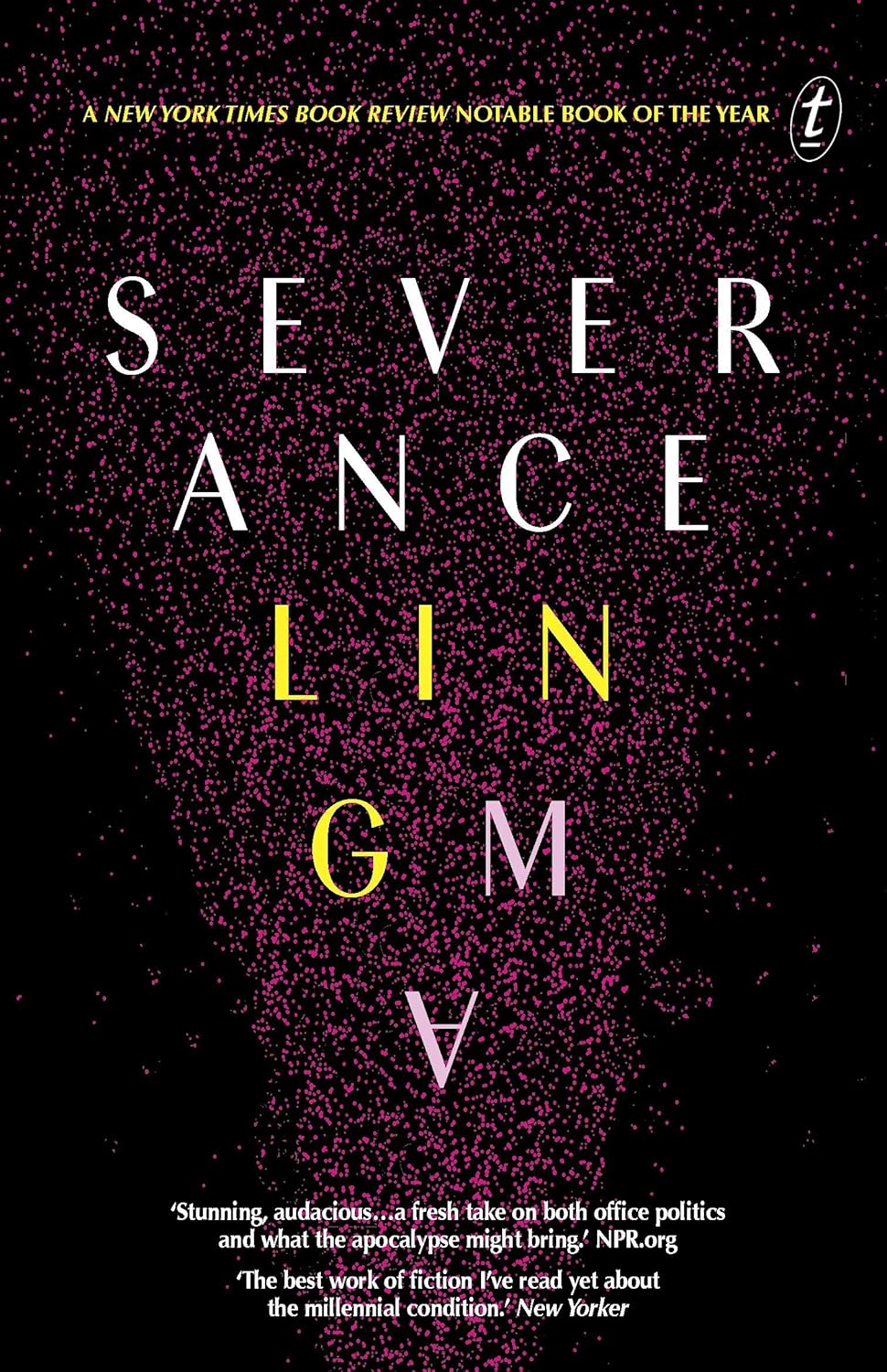
Ling Ma, Severance, Farrar, Straus and Giroux, 2018. 304 pgs.

In an era defined by burnout and quiet quitting, Ling Ma’s 2018 dystopian novel, Severance, offers a definitive metaphor for our age, a pandemic that turns routine and meaningless patterns into a lethal cycle of recurrence.
On its surface, the novel narrates the story of Candace Chen, a millennial woman navigating a global pandemic. At its core, it is a critique of capitalism, mundane routines, and the search for meaning and autonomy within systems designed to exploit labour and stifle consciousness. Severance reimagines themes from one of the classics, Franz Kafka’s The Metamorphosis, for the twenty first century. It portrays Candace as a modern version of Gregor Samsa, perpetually entrapped within cycles of systemic control.
The novel’s central metaphor, “Shen Fever”, is itself a critique. The Fever reduces the infected to mindless beings trapped in endless loops of their most familiar routines. This is a literalisation of the alienated labour and mundane consumption that define the pre apocalyptic lifestyle. The loss of consciousness symbolises the erosion of individuality under capitalism, presenting modern individuals as little different from the infected. Candace’s immunity serves not as a biological shield against the Fever, but as a representation of productive alienation. Her awareness of her own pre apocalyptic entrapment in her mundane job managing Bible production paradoxically preserves her selfhood. This blurred line between the “immune” and the “infected” raises a question: is mere awareness of our confinement sufficient to escape the loops of routine? Passion and courage may break patterns of entrapment, but the comfort and security of routine are also powerful cages, what we call “golden handcuffs”.
The narrative structurally extends patterns of entrapment beyond the corporate sphere and into social life. Candace’s departure from the decaying metropolis leads her into another oppressive system, the group under Bob’s dictatorship. The mall they call “The Facility”, where they reside, replicates a rigid and hierarchical structure that mirrors the pre apocalyptic corporate world. This repetition reinforces the novel’s critique of systemic entrapment.
Escapism may appear victorious at first, but is it merely an illusion? Candace escapes one system only to find herself trapped in another, from her Bible production job in the pre apocalyptic world to Bob’s dictatorship in the post apocalyptic state. The novel ends with her driving towards Chicago while pregnant. Although she escapes Bob’s institutional control, the unresolved ending suggests an ambiguous future. As readers, we do not know whether this constitutes true freedom for her and her child. If she encounters another group, will she ever break free from endlessly recurring systemic patterns?
The question remains: which is the solution, adaptation or escapism? Does survival require reliance on a system, or can one exist alone without systemic support? Perhaps adaptation and escapism should not be understood as opposites, but as interconnected failures.
This dilemma exposes the false dichotomy between adaptation and escapism. As Karl Marx’s concept of “relations of production” elucidates, individuals must enter social and economic relationships in order to survive. In the novel, Bob’s group engages in collective “stalking” of houses to gather food and utilities, demonstrating that communal systems provide tangible protection and mutual benefit that are absent in solitary survival.
As condemning as the novel appears in its treatment of mundane routines and systems, a more optimistic reading suggests that the choice is not about achieving freedom from all systems, but about consciously navigating and selecting which ones to participate in. Reliance on systems seems inevitable, as social animals we are meant to live as part of a collective. However, we retain the capacity to leave hostile environments and to walk away from spaces that no longer serve us.
Severance is not merely a critique of how modern capitalism commodifies time and erodes identity, but also gestures towards a subtle form of resistance and navigation within systemic entrapment. Candace is not a conventional gun wielding apocalypse heroine; her power lies in quiet observation, adaptability, and passive resistance. Her subversive act of secretly documenting the deserted city on her blog, “NY Ghost”, becomes a means of articulating her thoughts and asserting agency.
Beyond its systemic critique, the novel offers a compelling lens on the immigrant experience. Through an Asian American perspective, Severance presents Candace’s experience not as a simple binary of belonging, but as an ongoing struggle to connect with distant roots. As the daughter of Chinese immigrants, Candace constructs her cultural identity largely from scratch. This disconnection is illustrated through her failure to recreate an authentic shark fin soup from her mother’s recipe. Her cultural identity is shaped not through rich communal traditions, but through an inherited immigrant work ethic and a critical outsider perspective. During her business trip to Shenzhen, she embodies her status as a foreigner. This position affords her a critical distance from which to observe the exploitative mechanisms of global capitalism. She directly links consumerism in New York to the exploited factory workers in China who produce the Bibles she manages. In witnessing their alienated labour, she recognises a shared monotony with her own routine. Despite their differing positions within the global supply chain, she realises that both she and the workers function as indispensable cogs in the same machine. Rather than a deep rooted cultural bond, her relationship to her ancestry is mediated through the harsh material realities of her homeland.
Severance dismantles blind optimism and foregrounds the central challenge of the modern world, the construction of purpose and identity within systems of entrapment without being consumed by them. The solution lies neither in total escapism nor passive adaptation, but in conscious navigation between compliance and resistance. The practice of critically choosing and strategically inhabiting systems therefore becomes essential. Through an Asian American lens, Candace’s internal negotiation is further complicated by cultural severance. Caught between the absence of ancestral connection and the weight of inherited expectations, she occupies a space of cultural loss and reconstruction. Ultimately, agency emerges not from freedom outside systems, but from awareness and deliberate action exercised while shaping identity and future within the very structures designed to contain them.
How to cite: Wong, Hilda. “Between Adaptation and Escapism: Navigating Entrapment in Ling Ma’s Severance.” Cha: An Asian Literary Journal, 18 Dec. 2025, chajournal.com/2025/12/18/severance.


Hilda Wong is an undergraduate student in the Department of English Language and Literature at Hong Kong Baptist University, with wide-ranging interests in multicultural writing, speculative fiction, Modernist literature, and postmodern and postcolonial studies. [All contributions by Hilda Wong.]
 Cha
Cha 