
茶 FIRST IMPRESSIONS
茶 REVIEW OF BOOKS & FILMS
[REVIEW] “James Shea’s Last Day of My Face and the Practice of Not Knowing” by Jennifer Eagleton
Click HERE to read all entries in Cha
on Last Day of My Face.
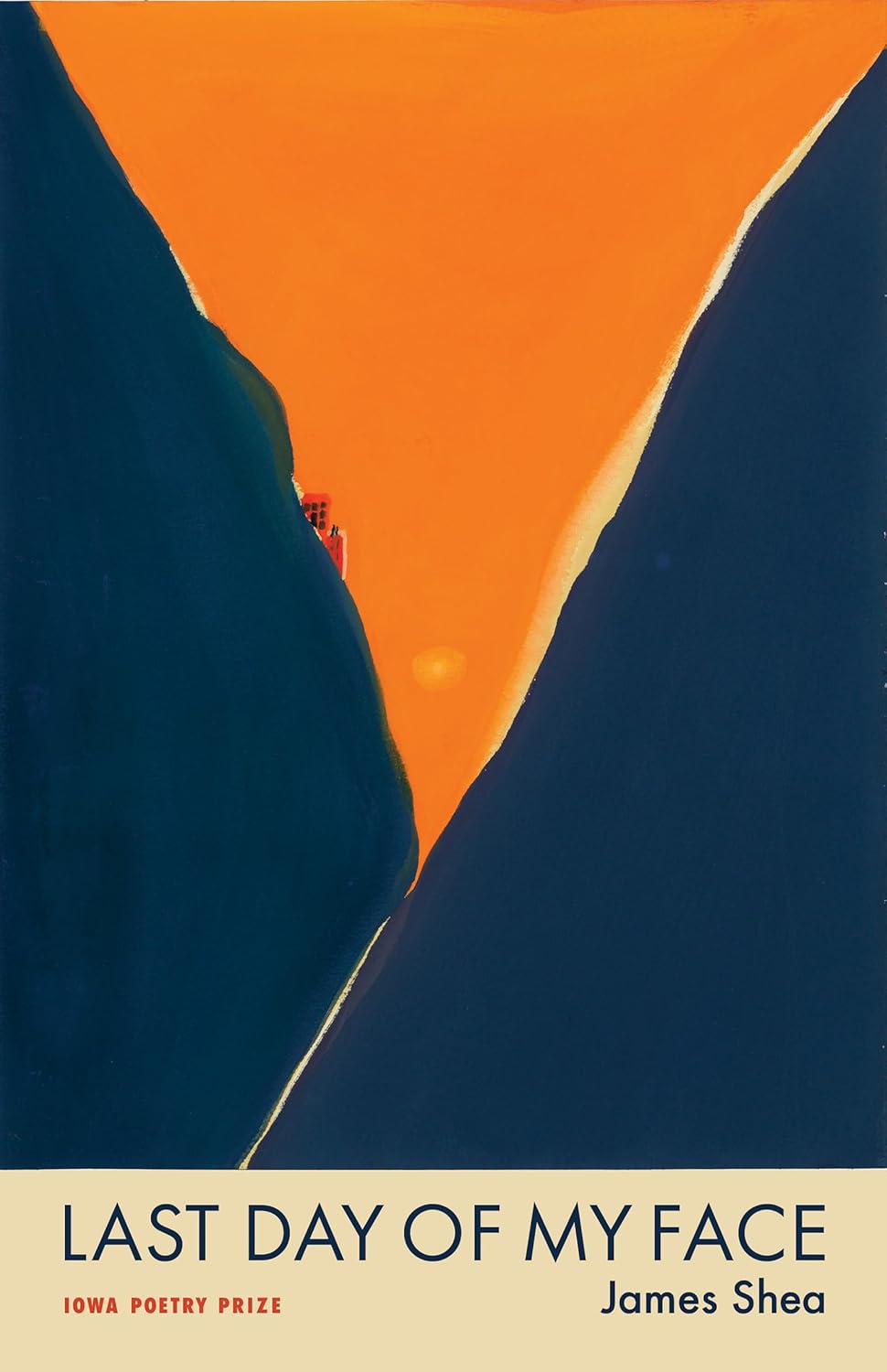
James Shea, The Last Day of My Face, University of Iowa Press, 2025. 76 pgs.
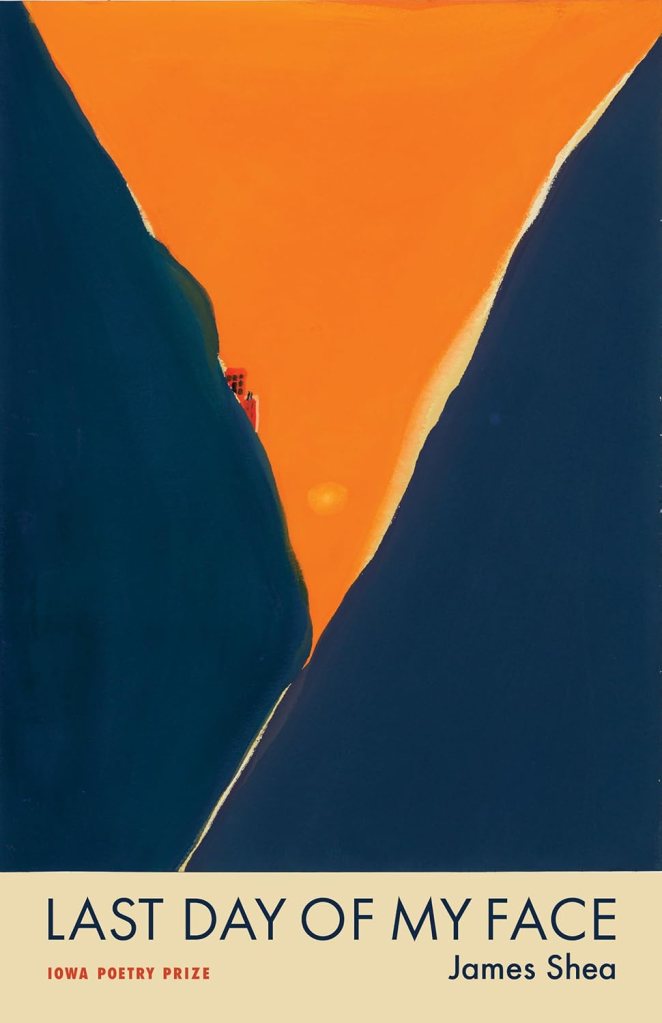
James Shea’s prize-winning collection centres on themes of loss, mourning, nostalgia, and the contemplation of mortality, with the occasional glimmer of humour and a sense of profound solitariness. The following poem encapsulates the spirit of this work and the contradictions inherent in attempting to know oneself. The more one tries, the more one realises how difficult this is, for consciousness erects boundaries that prevent it from fully emerging, yet mischievously entices us to make the attempt.
Equipoise
Begin with the formal properties of a ghost:
you seem bound in mystery and loneliness.
I mean bound in mystery and openness,
for loneliness is a kind of openness.
No one’s as simple as one would like to be.
This might be the tipping point into happiness,
riding softly into the numinous landscape.
So much for private swallows of water.
We jumped at the first blush between us.
The poem above also reflects an Asian sensibility that flows through this collection. The following poem reminds me of the Zen verse of Cold Mountain. In “Poor Memorial”, time moves on without the poet, “seasons outgrow themselves”, and “I cannot see myself without / conjuring the vision of no other person: / an empty flat, negative / of where we once lived, / as if even our ghosts were gone”. Even in the midst of others, the poet remains alone.
In “Times”, as in several poems throughout the book, the poet gazes out of a window, observing nature yet feeling apart from it and from other human beings: “like the sky in Magritte’s painting of men falling anonymously, / two streaks of cloud masking part of the air, / twin lights twitched on silently, not overly / noticed, but I observed them in my quietness”. This calls to mind the Tang poet Li Bai’s poem of drinking alone beneath the moon on a quiet night.
“Skidding Meditations” comprises a series of haiku-like gems that evoke the Daoist concept of wuwei, translated as “non-action” or “effortless action”, a state of acting in harmony with the natural circular flow of the world. I note the circularity of many of Shea’s poems throughout this collection. One of the meditations states that “Everything, therefore, / nothing, arouses me”; in another, each word is granted its full weight by being placed on its own line, forming a column.
Why,
the
sky’s
right
here,
next
to
our
faces.
At the end of this meditation, the horizons of “Sea, sky” open into unknown possibilities through the absence of a full stop. Several poems are arranged in a vertical, column-like form, consisting of a single word or a small cluster of words “running” ahead with or without commas, suggesting a kind of semi-conscious stream that captures thoughts on the page before they flee the poet’s mind. In “Saccade”, a term denoting the rapid movement of the eye between points of fixation and thus implying disconnection, the poet ensures that form reflects content: “My signature is a zigzag. / A few new circumstances can change the future. / The future can change the past. / Something inherently elegiac about reversals.” The poet is disarticulating himself into component parts. In the following, Shea questions whether the attempt to communicate his ideas is worthwhile because certain details are “withheld”.
“The Withheld Detail of the Dream” consists of only two lines: “A pause on my lips— / you fill in what you feel.” This, to me, expresses the essence of poetry, for no poem has a singular meaning. The “withheld detail” is the space into which the reader inserts meaning. I once wrote a similar postmodern poem that read, “This poem has been left intentionally blank, insert imagination.” At times, the poet appears to set his thoughts aside and direct his attention towards nature, although he remains apart from it. In “Setting My Worry Against These Trees”, he casts his worry upon the natural world that nevertheless keeps its distance from him.
The poet also addresses the physicality of the body, perhaps the one entity capable of knowing him, and does so with humour. “Two-Body Problem” considers bodily parts, noting that “Toes are the last to go / when you’re dead-dead, / so far from the central / nervous system”, while “Wake” reflects on clothing, the items closest to his nakedness: “…Underwear came and cried at the casket. / Underwear, who knew me best.” These objects become the ultimate mourners of his demise, unseen by anyone else. In “Bicycles”, another column poem, the poet repeatedly “confirms” that he is “not a bot”, such is his sense of disconnection from society. He does this “many times a day”, yet by the end the repetition is unpersuasive, for he ultimately confesses, “I’m a bot / that I can / confirm.” In this regard, one might think of the award-winning short film I Am Not a Robot, in which a music producer becomes increasingly unsettled after repeatedly failing online captcha tests, only to be told she might in fact be a robot. It is not merely an annoyance but a humorous and surreal reflection on identity, autonomy, and humanity in the digital age.
There is a shift in focus in the last third of the book. “Failed Self-portrait”, a fourteen-page, nine-section poem, reflects the collection’s title Last Day of My Face in that the poet acknowledges not only that he cannot truly know himself, but also that he may have stepped aside from self-enclosed expression and recognised that he cannot offer his readers a definitive portrait of who he is. This constitutes another “failure”, yet perhaps it is an acceptable state of being, or at least a gesture towards acceptance.
At the beginning of this long poem, the poet admits that “I’ve made a sort of makeshift / sense of ourselves, // cohabiting with the cranes / on the windward side of the river”, though whether he truly has is open to question. He foregrounds the wider world around him, yet midway through, in section four, he inserts a vertical column of single words that form the sentence:

The poet longs for connection with others. He may be making some progress towards this, but he still has far to go. The poem concludes with the lines: “I drive near trucks and curbs. I’m there. / I belong everywhere in general. I’d rather not // respond right now. / When I need to speak, / I will. Succinctly, and full of sincerity. // I’d rather ramble into the fictions. / People are dying before I can even get to them.”
In acknowledging his inability to render a complete “self-portrait” through poetry, the poet points indirectly to the title Last Day of My Face, which seems to gesture towards the last day of a particular face at a particular moment. Our faces have many last days. The face of tomorrow will be another entirely.
How to cite: Eagleton, Jennifer. “James Shea’s Last Day of My Face and the Practice of Not Knowing.” Cha: An Asian Literary Journal, 8 Dec. 2025. chajournal.com/2025/12/08/my-face.


Jennifer Eagleton, a Hong Kong resident since October 1997, is a close observer of Hong Kong society and politics. Jennifer has written for Hong Kong Free Press, Mekong Review, and Education about Asia. She has published two books on Hong Kong political discourse: Discursive Change in Hong Kong (Rowman & Littlefield, 2022) and Hong Kong’s Second Return to China, A Critical Discourse Study of the National Security Law and its Aftermath (Palgrave Macmillan, 2025). Her poetry has appeared in Voice & Verse Poetry Magazine, People, Pandemic & ####### (Verve Poetry Press, 2020), and Making Space: A Collection of Writing and Art (Cart Noodles Press, 2023). [All contributions by Jennifer Eagleton.]
 Cha
Cha 