
茶 FIRST IMPRESSIONS
茶 REVIEW OF BOOKS & FILMS
[REVIEW] “Mariko Nagai’s Imaginary Death: The Genre-Bending Architecture of Wartime Testimony” by James Au Kin-Pong
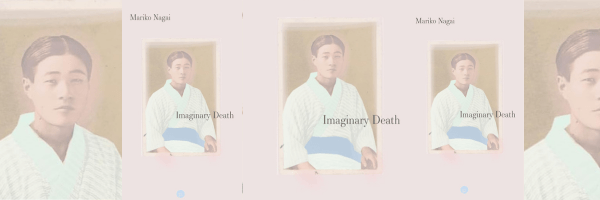
Mariko Nagai, Imaginary Death, Punctum Books, 2025. 297 pgs.

It is difficult to determine the genre to which Mariko Nagai’s Imaginary Death belongs. Some might regard it as creative nonfiction, for it depicts the writer’s own family, her uncle Tsutomu and his two deceased brothers, drawing on her grandfather’s journal. Others might consider the work a family biography, given the narrator’s attempt to trace how the experiences of the three brothers are interwoven with wider historical events. To cite one example, Shirō, the eldest brother, was ordered by the emperor to go to China on 12 October 1937, and two months later the Japanese imperial army marched into Nanjing. However, when read from a Japanese perspective, the book can also be seen as a kind of historical narrative, or rekishi shōsetsu, a genre prominent in Japan in the 1960s and 1970s, because of the narrator’s historiographic approach, including the long list of references composed of important primary and secondary sources on the Second World War from the Japanese side.
In terms of narrative style, the story proceeds chronologically from the birth of Shirō on 26 June 1916 until seven years after the war, when Kōkichi, the only surviving brother, works on the farm. Yet the narrator frequently appears in the form of prophecy, or may be seen as an omniscient voice, telling the reader what will occur beyond the moment she is describing. In the section “July 13, 1944: One Life Is Gone, and Now, Another Takes Over,” for instance, when the narrator summarises the circumstances of Saburō’s three sons, she simultaneously points to the future, noting that in August 1945 America “will drop two bombs, one in Hiroshima and another in Nagasaki.” In another section, “January 8, 1941: Duty Is Heavier Than a Mountain; Death Is Lighter Than a Feather,” while the narrator explains how soldiers were compelled to continue their mission in the East Asian War and how General Tōjō issued a new Imperial Rescript on behalf of the emperor, she remarks that officers continue to defend their positions “ten years after the surrender,” implying that Japanese holdouts, though aware that the war had ended, persisted in their fight. In another scene, when Susumu is drafted and Shirō, the elder brother, bids him farewell, the narrator concludes that “[t]hey do not know that this is the last time they will see each other alive.”
This expansion of the timeline and adoption of an omniscient perspective recalls Shiba Ryōtarō’s celebrated works Ryōma ga yuku and Saka no ue no kumo, which portray historical figures such as Sakamoto Ryōma and the Akiyama brothers. There, too, the narrator often moves beyond the principal timeline to inform readers of events that occur, for instance, after the protagonists’ deaths.
Nevertheless, despite the inclusion of photographs, documents, and letters, it is significant that the story is not a historical record of a family or of the war. It is instead a testimony to a man who once lived, a man, like many others, who has been overlooked, a man who spent his entire life sustaining the myth, namely the new myth of Japan, a word emphasised throughout the narrative. The dead soldiers become gods when they die for the country and are venerated in the Yasukuni Shrine, and as the emperor is believed to be the descendant of the gods, Shirō’s drafting, too, is perceived as a form of divine selection. The victory of the war itself becomes a belief system, as the narrator illustrates through a newsflash. The war becomes mythology, and everyone believes that the Yamato spirit will prevail and preserve the myth.
Apparently, this myth, as the narrator presents it, is satirical, for the end of the story shows how Japan loses the war and how two out of Saburō’s three sons die in it. Aside from that, the illness of the emperor also introduces a note of humour, an inversion of the usual image of a god’s indestructibility. The narrator deliberately uses short sentences, “A God.” “Sick.” “We tremble.”, to suggest, on the surface, the absurdity of Emperor Taishō’s suffering from diabetes and sciatica, but more deeply the people’s belief in the emperor as a god and their willingness to fight for that god in disguise.
The three brothers are among those who, willing or not, are compelled to believe in the emperor as well as in the national myth. For instance, Shirō feels that Japan is like an orphan, with no nations recognising Manchukuo as a legitimate state; rather, it is seen as a puppet regime of imperial Japan. The reader senses sadness in seeing how Shirō, like many others, sacrifices his time with his family to serve the emperor as part of the army, even as he longs to earn the honour that will make his first son and his wife Masa proud of him. It is precisely this unusual sentiment, almost equivalent to a religious belief, that brings soldiers like Shirō to the battlefield and ultimately to their unimaginable loss.
The title Imaginary Death suggests the impossibility of determining the cause of death because of the lack of documentation. The corpses are never found, so a soldier may have died from disease or may have been killed on the battlefield. But the word “imaginary” also signifies the narrator-writer’s attempt to reconstruct the lives of the soldiers through her imagination, supported by the historical materials and documents at hand. By penetrating the thoughts of characters such as Shirō, it becomes easier for the reader to grasp the cruelty of life during wartime.

War appears to be a source of inspiration, or at least an important theme, for Nagai Mariko, for apart from Imaginary Death, she has also written several works shaped by wartime experience. Under the Broken Sky (2023) is an epic that follows a girl named Natsu’s life in Manchuria from the 1930s until the end of the Second World War. When the war ends, countless Japanese children whose families once settled in the region are forced to remain there for survival, working as maids or marrying locals. In Irradiated Cities (2023), as the title suggests, Nagai turns to cities affected by man-made disasters, including Hiroshima and Nagasaki, where the United States dropped atomic bombs to end the war.
Among the various aspects she describes about the city, it is particularly striking how the different writings of the same place, ヒロシマ, 広島, and 廣島, all read as Hiroshima, carry different meanings, and how rendering the name in Katakana suggests a city shattered and victimised. Such detailed attentiveness also appears in Imaginary Death, including the list of items the emperor bestows upon Shirō and the specifics of Japan’s attack on Pearl Harbourr, where the war narrative becomes no less real than a historical document.
Bibliography
▚ Nagai Mariko (2024). Under the Broken Sky. Henry Holt and Company.
▚ —- (2023 [2017]). Irradiated Cities. Punctum books.
How to cite: Au, James Kin-Pong. “Mariko Nagai’s Imaginary Death: The Genre-Bending Architecture of Wartime Testimony.” Cha: An Asian Literary Journal, 1 Dec. 2025, chajournal.com/2025/12/01/imaginary-death.


James Kin-Pong Au is a Master’s graduate of both Hong Kong Baptist University and the School of Oriental and African Studies (SOAS) in London. He is currently a PhD candidate at the University of Tokyo, writing his dissertation about the relation between history and literature through close readings of East Asian historical narratives in the 1960s. His research interests include Asian literatures, comparative literature, historical narratives and modern poetry. During his leisure time, he writes poetry and learns Spanish, Korean and Polish. He teaches English at Salesio Polytechnic College and literature in English at Tama Art University. [All contributions by James Kin-Pong Au.]
 Cha
Cha 