

📁 RETURN TO FIRST IMPRESSIONS
📁 RETURN TO CHA REVIEW OF BOOKS AND FILMS
Hisham Matar, The Return: Fathers, Sons and the Land In Between, Alfred A. Knopf Canada, 2016, 256 pgs.
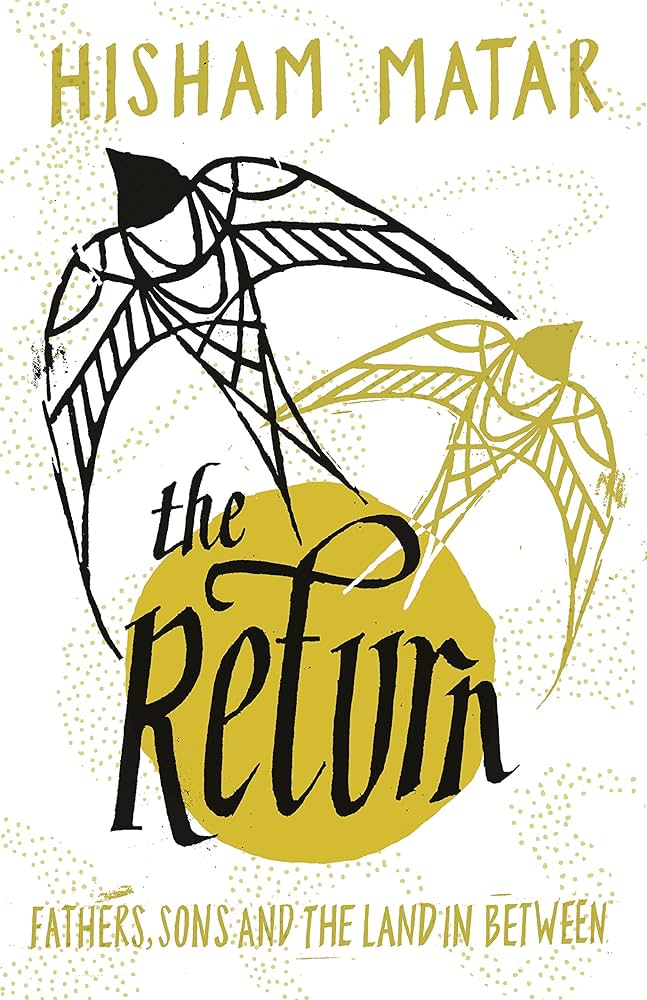
You walk into a memoir anticipating something deeply personal. You expect to encounter memories of the author, to catch glimpses of their life events, relationships, and experiences. Memoirs promise you an insight into the author’s world. So why did reading Hisham Matar’s memoir, The Return, surprise me in the way it left me unsettled?
Unexpectedly, I was left with a feeling akin to walking in on someone engaged in an unmistakable internal monologue. Do not misunderstand me. You do not feel uninvited for a moment, yet the intensity of his personal astounds you. You lose your footing. You wish to hold Matar’s hand, both to steady yourself and to comfort him.
In The Return, Matar does not merely share his memories, which in themselves carry the weight of his life and living. With extraordinary tenderness, he gathers for us a lifetime of thoughts, perceptions, and feelings. As he painstakingly retraces the events of his life, his memories unfold, and through them we are granted the bareness of his emotions. We journey with him: as a son learns about his father, as a young man discovers his nation’s history, and as a writer finds his words.
The kidnapping and subsequent disappearance of Matar’s father, Jaballa Matar, by the Qaddafi regime is the premise of The Return. Yet, like most memoirs, it is not only about this. It becomes the horizon from which Matar departs and to which he returns.
Eventually, the original loss, the point of departure, the point from which life changed irrevocably, comes to resemble a living presence, having its own force and temperament. Like desire, its vitality is in what it withholds, until attachment and resentment are so closely intertwined that it is difficult at times to distinguish one from the other.
In many ways, Matar’s memoir is a meditation on life and death, what does it mean to live and to die. And about living despite death. How does one speak of loss beyond the language of living and dying? Is it possible? Is it worth attempting? Matar makes us feel that it is:
My father is both dead and alive. I do not have a grammar for him. He is in the past, present and future. Even if I had held his hand, and felt it slacken, as he exhaled his last breath, I would still, I believe, every time I refer to him, pause to search for the right tense. I suspect many men who have buried their fathers feel the same. I am no different. I live, as we all live, in the aftermath.
When the older Matar first encounters his eighteen-year-old father through his prose fiction, the father takes on new life for the son. The joy Matar experiences in discovering his father’s short stories after his disappearance is not a simple joy. Here was the mind “of the young man who was to become my father.” Matar confides in us a tender fantasy of meeting this young man, complimenting him, advising him on possible improvements to his writing, recommending books, and, like all good teachers, pursuing the student with gentle persistence to ensure he develops his skills further.
There is loss, but there is also life here. His father’s disappearance resists any attempt to be read as death, as something final or conclusive.
When Matar learns how his father’s letters to his family were smuggled out of prison, he discovers yet another man, one who meant so much to so many others who knew him at a time when Matar scarcely did. This period of Matar’s life, marked by his father’s absence, becomes alive through the memories of people who saw him, heard him, and loved him in a parallel world where he was found, no longer disappeared. The wounded memory of his father is nourished now by these small anecdotes about the strength of his moral character.
“I didn’t know your father before prison,” Ehlayyel said. “I came to know him first by his voice. When one of us young prisoners was being taken to the interrogation room, your father would call out, ‘Boys, if you get stuck, say Jaballa Matar told you to do it.’ I loved him for that, because you have no idea what hearing that did for my heart. Strength at the weakest hour. Gradually he and I started exchanging letters. He wrote me many beautiful letters that I had to destroy.”
Ehlayyel Bejo and Nasser al-Tashani risked their lives to bring us the letter that shattered the myth the Egyptian authorities had constructed. And once Father was sent down into the bottomless abyss, he did not give up their names.
So what, then, does dealing with the possibility of death look like when the exact image of death itself does not exist? What becomes the architecture of remembrance in the absence of the where, when, and how of dying? In that magnificent chapter, Maximilian, Matar constructs for us a blueprint of possibility.
The body of my father is gone, but his place is here and occupied by something that cannot just be called memory. It is alive and current. How could the complexities of being, the mechanics of our anatomy, the intelligence of our biology, and the endless firmament of our interiority—the thoughts and questions and yearnings and hopes and hunger and desire and the thousand and one contradictions that inhabit us at any given moment—ever have an ending that could be marked by a date on a calendar?
In Maximilian, death is framed through the juxtaposition of three details: a meticulous examination of Édouard Manet’s The Execution of Maximilian, a careful breakdown of Qaddafi’s notorious prison, Abu Salim, and the arrival at the likely day Jaballa Matar was murdered by the Libyan regime. Death becomes a painting, so exquisite, so grand, so heartbreaking, not to be remembered by a date, but as an ever-expanding canvas of what absence leaves behind. It is in this moment of exquisite construction that Matar begins to worry:
I have always wondered if it is possible to lose your father without sensing the particular moment of his death…Of course, I told myself, it would be impossible that I should fail to detect the moment when someone I love dies. And this thought often comforted me, particularly when hope was thin. And now that it is unimaginable that my father is alive, I am unsettled by the failure. So much happens in this world without us blinking.
As the chapter closes, it would not be wrong to say that Manet answers Matar.
Through all this, the question remains: why make a man disappear? What does Power gain in withholding? Why does it stubbornly cling to fragments of people’s memories, refusing and rejecting any attempt at closure, with death remaining an unfinished puzzle?
Amidst all the back and forth between life and death, it is easy to lose sight of the fact that Matar has grown with us, or we with him. Matar is eleven in one instant and a tense thirty-year-old in another. At one moment, he is a young boy with a secret identity in an English boarding school, finding his lost Libyan home in a chance friendship with an Arab classmate. Their final goodbye, when Matar reveals his identity, is beyond cinematic in the way that only life can be.
“Hamza, I am Libyan. My name is Hisham Matar. I’m the son of Jaballa Matar.”
He didn’t let go. I felt his body become rigid.
“I am sorry,” I said. I was not sure what exactly I was apologizing for.
When we looked at each other we had tears running down our faces.
In another moment, we accompany an older Matar, perhaps in his thirties, at a reading in Benghazi held in remembrance of his father. In that gathering of men and women sharing stories of Jaballa Matar, we meet a man who chooses to recall “the silent sacrifices of Hisham’s mother, Fawzia Tarbah.” The narration that follows leaves Matar perplexed by this “other life” his mother had, a life he seems never to have known or sensed.
Strangely, this book about fathers, sons, and the land in between stirred in me a fragile sense of wanting a child. Somewhere along the way, The Return offers us lessons in bringing up a child and nurturing a young mind. In one of his interviews, Matar recalls exchanging letters with his father while living in the same house—one of many ways, he suggests, that his father made him feel he had an interesting mind. What a wonderful way of befriending your child. The memoir is sprinkled with fragments of such beautiful moments between parent and child. These fragments play hide and seek with the reader, there one moment and gone the next. Like when Matar tells us about Uncle Mahmoud, Aunt Zaynab, Izzo, and Amal’s visit. And in the next instant, we find ourselves taking a detour with him, guiding his father through the alleyways of Cairo in search of that one tiny restaurant serving grilled goat chops. The excitement of a son eager to impress his father with his discovery is hard to miss, as is a father’s almost intuitive recognition of his son’s ability to find his own way. The comforting realisation is apparent in Jaballa Matar’s words:
“I’ll never find this place again,” he said as we were leaving. I stood him in the middle of the alleyway and pointed out the silver shop on the corner, the large brass lantern blackened with age on the opposite side, the old man selling pickled lupins and the sign above him that read: MERCIFUL. Father took note of all of these markers, but then repeated, “I’ll never find it.”
It was his son’s way. He was merely a companion.
This book was particularly personal to me, in the way Matar’s language flows and how his words take shape. This is how I wish to write and how I wish to be read: quiet words, writing that is capable of holding stillness, the kind that makes the reader believe they have stopped reading, that they are simply reflecting. Somewhere, the author’s words become the reader’s thoughts.
What other combination of words could sound more like restful grief than those Matar chooses to describe an imaginary reunion with his father, a lifetime of pain wrapped within the peace of a mid-afternoon sleep:
When I used to imagine being reunited with him, I had always pictured it happening not in our home in Cairo, the place from which he was taken, not in London, where I lived and wondered at times, given Egypt’s betrayal, if he might choose to live after his release, but in my grandfather’s house in Ajdabiya. It was as though I was returning him, in my imagination, to his father’s house. I imagined it taking place not in secret, not in the night hours, as when he made those perilous visits, sneaking across the Egyptian-Libyan border in order to visit Grandfather Hameed, but in a day full of light.
At times, I found myself simply admiring the beauty of his descriptions:
Unlike the austerity of Ajdabiya, where idle talk is suspect, my mother’s landscape, the Green Mountains, is verdant with vegetation and talk.
And at other times, he makes you forget that sentences do not come fully formed, that the words which compose them can be taken apart:
I think this because absence has never seemed empty or passive but rather a busy place, vocal and insistent.
As a reader, it feels impossible to speak of Jaballa Matar as if he is no more. Now that I have read the book, I am Hisham’s friend, or so it feels. As the memoir draws to a close, we know that Hisham has not received an answer to the question of where, when, and how his father died. Even as the reality of his father’s death feels imminent, we remain with Hisham. And as his friend, I cannot accept a truth he does not know.
My ambitions, when it came to my father, were ordinary. Like that famous son in The Odyssey—like most sons, I suspect—I wished that “at least I had some happy man / as father, growing old in his own house.”
How to cite: Nair, Varsha. “A Memory of Absence: Hisham Matar’s The Return.” Cha: An Asian Literary Journal, 1 Nov. 2025, chajournal.blog/2025/11/01/the-return.


Varsha Nair is a researcher and writer who moves between the worlds of evidence and imagination. She studied political science at Lady Shri Ram College, Jawaharlal Nehru University, and the University of Hyderabad, and now works with Campbell South Asia, where she focuses on evidence synthesis and knowledge translation. Beyond her professional work, she writes essays and reflections on books, cinema, and the quieter aspects of life. She is currently based in Puducherry, India.
 Cha
Cha 