

📁 RETURN TO FIRST IMPRESSIONS
📁 RETURN TO CHA REVIEW OF BOOKS AND FILMS
Sean Wang (director), Didi, 2024. 96 min.
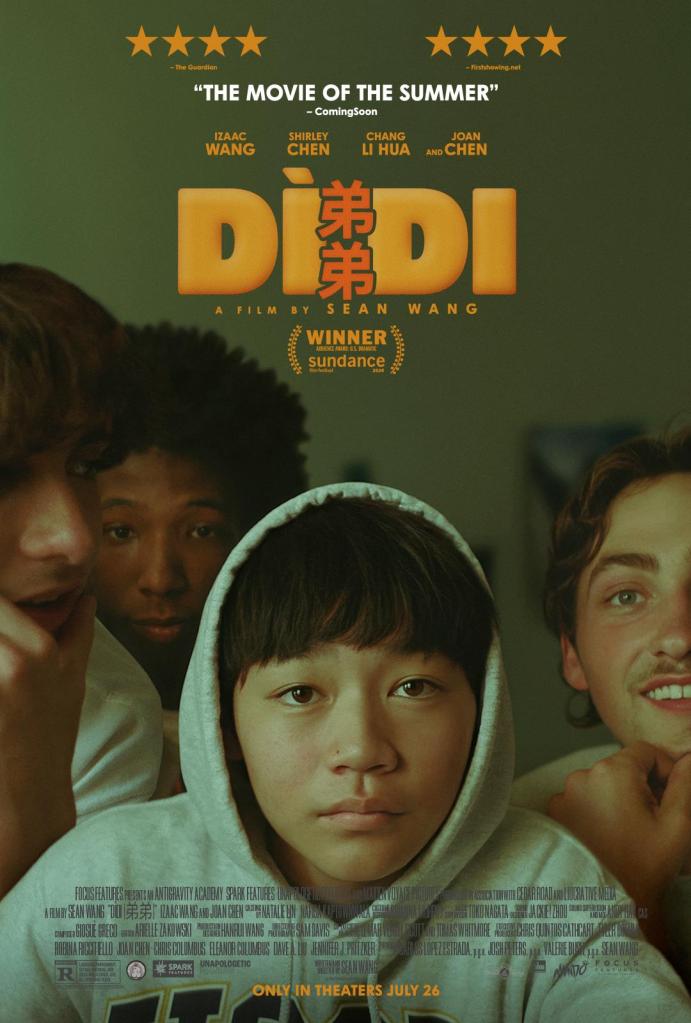
In Chinese culture, parents often address their children by their familial roles, a gesture of affection and intimacy. My mother calls me “elder sister” (ga jeh 「家姐」in Cantonese), while my father was referred to as “younger brother” (sai lo 「細佬」in Cantonese or didi「弟弟」in Mandarin) by his parents. Didi (2024) opens with an echo of this tradition: the mother of teenage protagonist Chris Wang calls him “didi” as she asks him to join the dinner table.
Director Sean Wang’s acute sensitivity to his own cultural upbringing in suburban California sets the tone for this coming-of-age story. It was funny, poignant and bittersweet, and I left the cinema with a heavy heart.
The film revolves around Chris Wang, a 13-year-old Taiwanese American born and raised in Fremont, California. He lives with his mother, Chungsing; his elder sister, Vivian; and his paternal grandmother, known as Nai Nai (奶奶) in Chinese. His family reflects an “astronaut family structure”, a common arrangement in which the father remains in Asia to earn a higher income while the mother accompanies the children abroad, overseeing their education and wellbeing. Chungsing Wang, portrayed by Joan Chen, is a middle-aged immigrant housewife who cares for her family and paints in her free time. Although her husband is perpetually away on business trips in Taiwan, his presence lingers in the house, surfacing in conversations where Nai Nai berates Chungsing for her perceived inadequacies as a mother, or in emotionally charged arguments provoked by Chris.
Sean Wang stated in an interview that his goal was not to make a Chinese American film, but rather to create something deeply personal, a work that explores the layered memories of growing up in his hyperlocal community. He invited his own grandmother, Chang Li Hua, to portray Nai Nai.
Through a microscopic lens that captures subtle cues such as fleeting glances, blank expressions and moments of silence, Sean Wang masterfully weaves together the complexities of family dynamics, identity and the immigrant experience in America. Chris’s everyday life unfolds through all-too-familiar sibling fights, dinner table tensions, supplementary maths classes, attempts to impress cool friends and texting a crush on MySpace. Growing up in Hong Kong, I too resonate with the weight of traditional views and gender roles that are subconsciously passed down through the Chinese family hierarchy.
One of the film’s most poignant elements is its portrayal of the invisible yet heavy labour a mother performs for her family, which so often goes unrecognised. Chungsing once dreamt of moving to New York City to pursue a career as a painter, but ended up abandoning her dream to build a family instead. In one scene, Chungsing explains her painting, a labour of love that depicts a nostalgic moment where a young Chris and Vivian swam in the sea, but receives a lukewarm, dismissive comment from Chris, who is far too absorbed in his own teenage troubles. By contrast, Chris’s friends appreciate her painting and offer compliments, while Chris pushes her out of his bedroom in embarrassment. She must have felt the brunt of her husband’s absence more than anyone else, yet she is constantly reminded by Nai Nai of her perceived shortcomings, and later by her son, who unconsciously mimics Nai Nai’s words in a hot-headed attempt to provoke her.
Dinners filled with finger-pointing and passive aggressive comments felt painfully real. But in the end, love and forgiveness prevail, bridged by communication and mutual understanding, reminding me of the Cantonese saying that “family members do not hold grudges overnight”.
A sense of displacement and alienation permeates the film, both in the interactions between characters and through the lens of Chris’s video camera as he makes films. By seeing the world through his eyes, the audience is able to share his insecurity as he grapples with his identity, the desire to fit in and the challenges of growing up amid family chaos. Ashamed of his actions, he isolates himself from friends and loved ones as a means of self-protection.
Cross-generational trauma unfolds at the dinner table, where the audience witnesses the different treatment between Didi and Vivian. Nai Nai is either laser-focused on ensuring Didi is well-fed or reproaching Chungsing for her supposed negligence. She never addresses Vivian or looks at her. Chungsing bites her tongue, and the children remain silent, sharing only a knowing look. When Vivian is about to leave for college, she softens towards Chris, understanding what it takes to survive adolescence in their family, though Chris fails to grasp her sympathy. That sense of suffocation reminds me of moments in my own childhood, the shame and invisibility I once felt that made me want to escape.
Yet Wang reminds us that every character has their own blind spots, shaped by different upbringings and times, and urges the audience to examine each with compassion. In another scene, when Didi films Nai Nai in the backyard, she sheds her toughness and reveals her vulnerability to her grandson. Despite her harsh and misplaced words towards Chungsing, Nai Nai’s actions stem from a place of love. The lyrics excerpt sheds some truth: “You always hurt the one you love, the one you shouldn’t hurt at all” (“You Always Hurt The One You Love” – The Mills Brothers)
By embracing his family, Chris comes to accept himself fully and finds freedom in that acceptance. With nuance and tenderness, Didi is a fearless portrayal of the raw, unfiltered moments of growing up in a Chinese family, not only the bitter ones, but also the sweet and soft-hearted.
How to cite: Yu, Theodora. “The Weight of Love: Sean Wang’s Didi and the Chinese American Family.” Cha: An Asian Literary Journal, 15 Oct. 2025, chajournal.blog/2025/10/15/didi.

Theodora Yu is a Hong Kong–based freelance journalist, writer, and translator. Her creative writing has appeared in Canto Cutie and Voice & Verse Poetry Magazine. She enjoys walks, films, writing reviews, and the sounds of the double bass.
 Cha
Cha 