

TIFF 2025
▞ 10. The Archivist’s Film: A Conversation on Kunsang Kyirong’s 100 Sunset
▞ 9. She Was Screaming into Silence: A Conversation on Cai Shangjun’s The Sun Rises On Us All
▞ 8. You Don’t Belong to Anyone: A Conversation on Kalainithan Kalaichelvan’s Karupy
▞ 7. The Paper Boy: On Park Chan-wook’s No Other Choice
▞ 6. Saigon Does Not Believe In Tears: On Leon Le’s Ky Nam Inn
▞ 5. The Need for Change: On Kei Ishikawa’s A Pale View of Hills
▞ 4. The Angel of Death: On Jafar Panahi’s It Was Just An Accident
▞ 3. Of Eros & Of Dust: On Ratchapoom Boonbunchachoke’s A Useful Ghost
▞ 2. Light At The End of the Labyrinth: On Genki Kawamura’s Exit 8
▞ 1. Affairs of the Heart: On Cai Shangjun’s The Sun Rises On Us All

Editor’s note: At TIFF 2025, our resident film critic Nirris Nagendrarajah spoke with director Cai Shangjun and screenwriter Han Nianjin about The Sun Rises On Us All (2025), a haunting film on love, guilt, and forgiveness. They discussed the symbolism of silence, rejecting flashbacks, emotional restraint, and the cathartic final scream symbolising redemption and human connection.

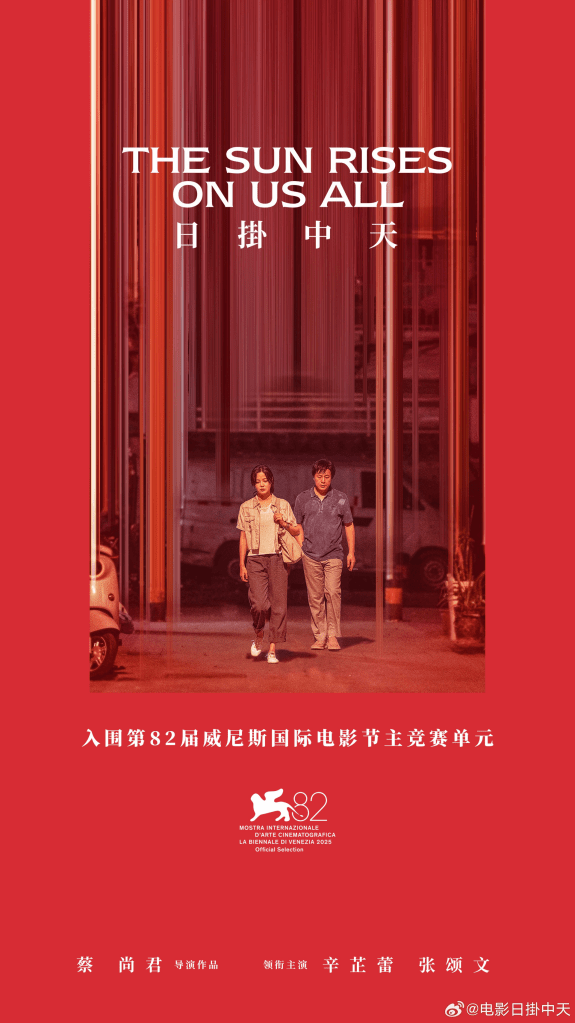
Cai Shangjun’s The Sun Rises On Us All, 2025. 131 min.
INTRODUCTION
Nirris Nagendrarajah
In the middle of The Sun Rises on Us All, reviewed in Cha, directed by Cai Shangjun, the two protagonists find themselves trapped in the lift of a housing complex. There is Meiyun—a pregnant shop owner played by Xin Zhilei, who won the Voli Cup for Best Actress at this year’s Venice Film Festival—and Baoshu, an ex-convict undergoing cancer treatment, portrayed by Zhang Songwen. They press every button, but nothing responds. They cry for help, yet there are no signs of assistance. When the doors open slightly, they grasp each side and attempt to force them apart with all their strength. He tells her to go first, and she escapes; but when his turn comes, the inward pressure becomes unbearable, and he gives up the struggle. The doors close on him while she remains outside the enclosure. This scene, archetypal and metaphorical, reflects the pair’s complex relationship, which unfolds in the film’s screenplay, co-written by Han Nianjin, gradually evolving into a heart-rending meditation on forgiveness.
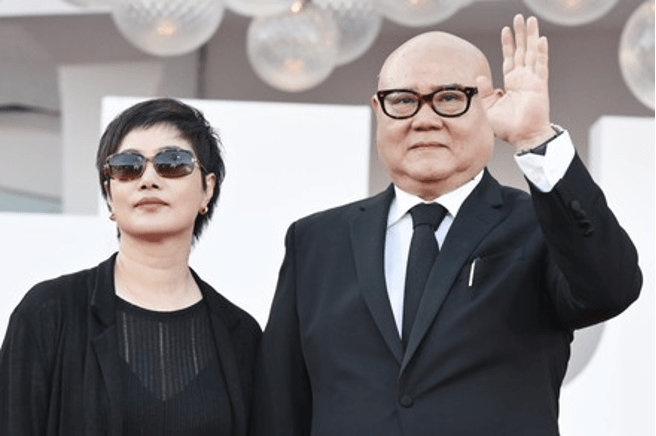
A graduate of the China Central Academy of Drama, Cai has steadily built a career exploring the moral and social dimensions of modern China through films such as The Red Awn (2007), which won the FIPRESCI Prize at the Busan International Film Festival, and People Mountain People Sea (2011), which earned him the Silver Lion for Best Director at Venice. Han, who studied at the University of Munich, is a freelance writer and cinematographer; The Sun Rises on Us All marks her first screenplay.
I met Cai and Han in a quiet meeting room at the InterContinental Hotel during the Toronto International Film Festival to discuss the film’s title, the writing and editing process, and the meaning of its final moments—a conversation that revealed as much about their artistic partnership as about the film’s enduring faith in redemption.
This conversation was translated from Mandarin into English by Erika Li.
A Conversation
on The Sun Rises On Us All
Nirris Nagendrarajah, Cai Shangjun & Han Nianjin
Han Nianjin & Cai Shangjun
Nirris Nagendararjah (NN): You are partners in real life, and the film explores fate and the ways in which people meet and drift apart. What inspired your decision to collaborate on this project?
Han Nianjin: We started to create this film during the pandemic, as we could not go out at that time. So we began to discuss what the director wanted to develop.
NN: The title of the film comes from the Cantonese opera The Legend of the Purple Hairpin 紫釵記 (1959). In English, the line reads: “The sun is hanging in the middle of the sky / It looks particularly red / The broken moon eventually needs to have unifying threads.” And then the final line: “A thousand sins originated from the poem I composed.” I think that the last line about the thousand sins and the poem, in the middle of the film, represents this violent act—this accident—from which everything unfolds. I wanted to know about your relationship with this opera, and why it influenced you to use it as the title of the film.
[Editor’s note: The lines in Chinese are “The sun is hanging in the middle of the sky / It looks particularly red 日掛中天格外紅 / The broken moon eventually needs to have unifying threads 月缺終須有彌縫” and “A thousand sins originated from the poem I composed. 千差萬錯,錯在我吹台賦詩一首!” ]
Han Nianjin: We wanted to use this name because, when we were writing the script, we hoped it would be filmed in Guangdong, so we looked it up. When considering the title, we wanted to draw inspiration from Cantonese music. The two lines, “The sun is hanging in the middle of the sky, the broken moon needs eventually to have unifying threads,” fit very well with the theme and plot of the story, as it is about the separation of two lovers, but also about redemption and their desire to make amends.
NN: From a script perspective, I thought the decision not to include flashbacks was really interesting. It was frustrating, in a productive way, to foreground the narrative within the dialogue itself, and then to allow the performers to embody that instead. I wanted to understand your approach to creating cinema in the present tense—to keeping us in the moment.
Cai Shangjun: First of all, when we were writing the script, we were clear from the very beginning that we did not want to use flashbacks. Personally, I do not like flashbacks; I think they are too easy to rely on. In this film, using flashbacks to show the characters’ pasts would certainly allow the audience to understand them more directly, but I believe that is a simplified approach. It becomes an explanation—a straightforward one—which I wanted to avoid.
In this film, we therefore designed three very important scenes in which the two characters speak to each other. The dialogue is dense and crucial to the plot; this was a deliberate creative choice. When words are spoken aloud, they become subjective—listeners may not hear the truth, and ambiguity emerges. I think this creates a layered effect, allowing space for imagination and reflection on what might have happened in the past. It leaves room for the audience to enter.
NN: Were there films or books that influenced this approach, or aspects of your educational background where you feel you learnt this technique—to be ambiguous rather than explicit? Or were there films from which you felt others had learnt this way of being ambiguous instead of explicit?
Cai Shangjun: Of course, it is based on what one has encountered in the past—whether a book, a film, or one’s education. I believe it is the result of every creator’s aesthetic foundation. Choosing such an approach is undoubtedly connected to our backgrounds, to what we have seen, experienced, and learned. Yet, as creators, it is also shaped by what we accumulate in life—the values and aesthetics we cultivate over time.
NN: In your director’s note for the film, you write that you see sacrifice as “an act of goodness.” You mentioned that there were forty-seven versions of the film when you worked with Matthew Laclau. Script-wise, what were the elements you had to sacrifice—both at the level of the script and in the edit? And what were the things you missed, or later felt were no longer necessary?
Cai Shangjun: Yes, the script is quite long, with more than 130 scenes. This was the very first script we wrote together. Usually, there are about 90 to 100 scenes. When we finished filming, the earliest and roughest cut ran for over three hours. In the early stages of production, when we were shooting the script, I felt it was another process of creation. At that time, we simply followed all the scenes and shot materials to consider the progression of the story.
During the editing stage, we already had all the material, and from that, we began to weave and thread the narrative, exploring new possibilities within what we had. We reflected on how to structure it more effectively, how to create stronger connections. Sometimes, it was about solving problems from different angles, which led to various versions and changes. Of course, duration was an important factor, but above all, the key concern was whether the story felt complete and whether the characters’ emotional development was coherent and compelling.
NN: Something I’ve been thinking about this year is that love is something one gives without expecting anything in return. I think the film powerfully explores the tension between nihilism and optimism. In the times we live in, forgiveness may not be foremost in people’s minds, but why did you choose to explore forgiveness?
Han Nianjin: We hear all kinds of different voices every day. The world is becoming smaller, and sometimes it might divide. So, beginning with us as creators, I personally think that what we care about is the connection between people. The common emotions that we humans share, such as fear, love, sympathy, and joy, and our ability to feel and perceive these emotions. I think that in this era, at this time, we are surrounded by different concepts and ideas. We have different camps here and there. We are filled with different voices on a daily basis, and the world, at a certain point, is becoming so complex that it may eventually break down. I think this film involves many concepts and topics that can be discussed, such as love, forgiveness, and sin. For example, when and how people face their guilt, how they ask for forgiveness and repentance. But in the end, our film concludes with a scene where the hero and heroine abandon each other. That is why we wanted to focus on the mutual feelings we all share. When everybody experiences the same emotions, we can be compassionate and feel for others. And that, I believe, is what we need in the world today.
NN: Speaking of the end of the film, the primal scream that concludes it, and Xin Zhilei’s award-winning performance, what were the conversations surrounding the decision to end on this note? That scream still lingers vividly in my mind.
Cai Shangjun: What we imagined at the time was that she was kneeling down in the position of a confessor. She was seeking forgiveness. Although her action was also an action of seeking forgiveness, an extreme action. That expression, I think, we only know very clearly what she wanted. That’s how it was. From her posture, you can definitely see that. This is definitely to the extreme. So what we know for the scene is that we know we’re going to have the ending point, and that’s the emotions or the expressions that we wanted to convey. But performance-wise, it’s definitely improvised. Because with so many emotions, there’s no way that we can do it repetitively. And this ending point that we have right now is what I like the most. I am most satisfied with this. Because it’s really just about the build-up of emotions. And, you know, with people, we surprise our emotions too much to a point, eventually, we’re going to have an outburst. But at the very beginning, it’s silent. That’s sometimes what we say, that the biggest thing comes to null, comes to silence, because it takes time and because we have so much suppression in our body. And because of the build-up of emotions, it will surpass your nerves, on everything. So she was screaming into silence, and eventually it was a long, long scream. The two characters were eventually in tears. They had the outcry. So it was all about the intensity of the emotions that eventually built up to this point. It’s just simply amazing and heart-wrenching performances that they both give.

How to cite: Nagendrarajah, Nirris, Cai Shangjun, & Han Nianjin. “She Was Screaming into Silence: A Conversation on Cai Shangjun’s The Sun Rises On Us All.” Cha: An Asian Literary Journal, 14 Oct. 2025, chajournal.blog/2025/10/14/the-sun.


Nirris Nagendrarajah (he/him) is a Toronto-based writer whose work has appeared in paloma, Polyester, Fête Chinoise, In the Mood Magazine, Tamil Culture, in addition to Substack. He is currently at work on a novel about waiting. [All contributions by Nirris Nagendrarajah.]

Cai Shangjun graduated from China Central Academy of Drama in 1992. Cai’s screenplays include Spicy Love Soup (1997), Shower (1999) and Sunflower (2005). He wrote and directed The Red Awn (2007), People Mountain People Sea (2011) and The Conformist (2017). The Red Awn won the FIPRESCI Prize at the 12th Busan International Film Festival, the Golden Alexander Award for Best Film at the 48th Thessaloniki International Film Festival and the Jury Grand Prize at the 2nd Asia Pacific Screen Award. People Mountain People Sea won the Silver Lion Award for Best Director at the 68th Venice International Film Festival, the Silver Montgolfiere D’Argent Award at the Nantes Three Continents Festival, the Critics Prize at the Black Movie Film Festival, and the Grand Prix Award at the 10th Pacific Meridian International Film Festival of Asia Pacific Countries. The Conformist won Best Actor Award at the 20th Shanghai International Film Festival and was screened in competition at TOKYO FILMex and as a Special Screening at the 42nd Toronto International Film Festival.
Han Nianjin (screenwriter) graduated from the University of Munich and is a freelance writer and cinematographer. The Sun Rises on Us All is her first screenplay.
 Cha
Cha 