

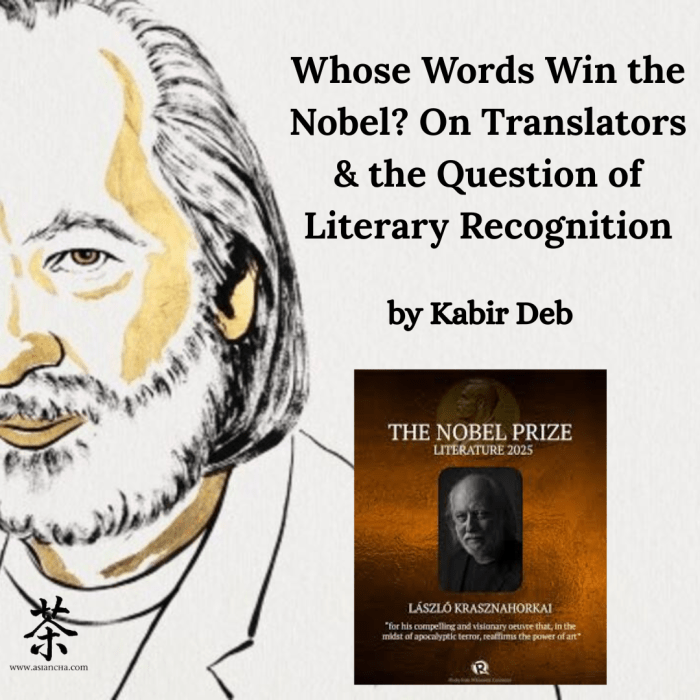
Earlier this week, the Nobel Prize in Literature for 2025 was awarded to the Hungarian novelist László Krasznahorkai “for his compelling and visionary oeuvre that, in the midst of apocalyptic terror, reaffirms the power of art.” Coverage in outlets such as The Guardian, Reuters, and Associated Press praised his distinctive prose and philosophical depth, yet few mentioned the translators into English, French, German, and other languages through whose work his novels have reached global readers. In the English-speaking press in particular, the omission of Ottilie Mulzet (Seiobo There Below, New Directions, 2013; Destruction and Sorrow Beneath the Heavens, Seagull Books, 2016; Baron Wenckheim’s Homecoming, New Directions, 2019), George Szirtes (The Melancholy of Resistance, 1998; War and War, 2006; Satantango, 2012; all New Directions), and John Batki (The Last Wolf and Herman, New Directions, 2017)1 has sparked discussion across literary venues and social media about translators’ visibility and the imbalance of recognition in world literature. Pieces such as Sandra Knispel’s “On Nobelist László Krasznahorkai, the Apocalypse, and the Art of Literary Translation”, Hungarian Literature Online’s responses from his translators,2 and the article “László Krasznahorkai and the Translators Behind His Nobel Moment” have drawn attention to the essential yet overlooked role of translators in shaping an author’s global reputation.
If we visit the Nobel Prize website and browse the literature section, it’s clear that many laureates have reached global audiences through translation.3 Among them are: from Latin America comes Gabriel García Márquez (Colombia);4 from Southern Europe, José Saramago (Portugal) and Camilo José Cela (Spain);5 from Central and Eastern Europe, Czesław Miłosz (Poland),6 Svetlana Alexievich (Belarus),7 Wisława Szymborska (Poland), and Olga Tokarczuk (Poland);8 from Turkey, bridging Eruope and Asia, Orhan Pamuk; and from Asia Yasunari Kawabata (Japan), Kenzaburō Ōe (Japan),9 Han Kang (South Korea), Gao Xingjian (China/France), and Mo Yan (China).10 These are only a few examples of authors whose work has travelled far beyond its linguistic origins. Now László Krasznahorkai joins this long continuum of writers whose international resonance owes much to the creative labour of their translators. Without translation, their words might never have crossed borders at all.
Yet translators often reside as ghosts, their names hidden within the pages rather than on the covers, as readers celebrate the writers whose work they have made visible, relevant, and award-worthy. This is not to deny the power of the original language, for the source remains magical and deserves our deepest respect, but to remind us that without the act of translation these voices would have remained unheard by much of the world. Crucially, this invisibility extends beyond English, for whether a writer’s work is translated into Chinese, Arabic, Spanish, or any other language, translators everywhere face the same quiet erasure.
Han Kang, in her “Banquet Speech,” spoke beautifully about literature, its impact, and how we should collectively stand against violence. The speech was inspiring and revealed much about what she considers when she writes. However, it was surprising that Kang did not acknowledge her translator, Deborah Smith, from a platform that represents world literature and could change lives for many aspiring writers and translators. Similarly, after László Krasznahorkai was awarded the Nobel Prize in Literature in 2025, newspapers around the world failed to acknowledge his translators Ottilie Mulzet, John Batki, and George Szirtes. Many people assume that translators are adequately compensated through book sales and that further recognition is unnecessary. Yet recognition is far more valuable than remuneration.
None of Krasznahorkai’s books feature the translators’ names on the front cover (except Destruction and Sorrow beneath the Heavens: Reportage, published by Seagull Books, and The Melancholy of Resistance, published by New Directions). The same is true of most of the writers mentioned above. This omission is not accidental but the result of long-standing publishing conventions that privilege the author’s name as a marketable brand while relegating translators to the margins. Readers often encounter translated works without being encouraged to notice the translator’s contribution, a consequence of how books are packaged and promoted rather than of conscious neglect. The responsibility, therefore, lies primarily with publishers and cultural institutions that continue to render translators invisible. Is it disrespect? The word may seem strong, yet if we think rationally it does not feel misplaced.
Although the deliberations of the Nobel Committee remain confidential, it is reasonable to assume that many of the works considered are read in translation, given the linguistic diversity of the laureates. Yet translators are rarely acknowledged in the main announcement or press release. While the Nobel website does include translators’ names on individual laureate pages, they appear only in bibliographical sections rather than as integral collaborators in the laureate’s international reputation. The issue is not that every translator across all languages should be named in the announcement, which would be impractical, but that the key translators whose versions have shaped the author’s global reception could be mentioned explicitly. Such recognition would signal the committee’s awareness of translation as a creative act and set an important precedent for other literary institutions to follow.
The dynamics of recognition and invisibility are not confined to Western literary institutions or global prizes. They resonate across regions where literature in multiple languages coexists and translation sustains the very idea of a shared literary culture. Nowhere is this more evident than in South Asia, where linguistic diversity is immense and translation has long been essential to both literary exchange and national discourse. Yet even here, the translator’s labour is too often undervalued, their creative agency reduced to mere service.
Jayasree Kalathil, an Indian writer and translator from Kerala, in an article on her Substack later published by Scroll, titled “Literary translation and its discontents,” writes that translators are often regarded as providers of a service, like ploughing a field, for which they receive “kooli”, a daily wage. After that, they have no claim to the harvest.11 This perception stems from capitalism, and over time the literary market has become a hub of capitalists in which translators retain nothing from their labour. Awards in South Asia, even after so many years, still offer unequal monetary recognition to writers and their translators, as the two are rarely regarded as creative equals. Kalathil also observes that the devaluation of translators arises partly because few people understand the additional affective and physical labour that translators perform alongside their creative work. A work of translation should read as an original piece, drawing readers into its world, yet the prizes that honour such works rarely acknowledge this artistry, as translation is still seen as mere mirroring, a craft requiring little imagination or skill. This misconception continues to vilify the art of translation.
Translators from various regions of India are striving to find a place in the mainstream with works that would never see the light of day without their dedication. Yet they also encounter a universal indifference from many leading literary platforms. They are treated as separate entities, without any claim to the recognition their texts receive. The line between writers and translators is widening with time, encouraged by a capitalist market that profits from imbalance. Fortunately, many books published in India now feature the translators’ names on the cover, a small but significant glimmer of hope. Nevertheless, internal politics within publishing remains discriminatory. A stream of art that is meant to unite people but instead perpetuates division risks hypocrisy. Even so, translators continue their work, for their struggle is not against writers but against the system. As long as writers fail to see translators as equals, this inequity will persist. Yet hope remains the current that keeps us moving forward, even amidst the most oppressive forces.
- English translations of László Krasznahorkai’s works include:
— The Melancholy of Resistance, trans. George Szirtes (New Directions, 2000);
— War and War, trans. George Szirtes (New Directions, 2006);
— Animalinside, trans. Ottilie Mulzet (New Directions, 2011);
— Satantango, trans. George Szirtes (New Directions, 2012);
— Seiobo There Below, trans. Ottilie Mulzet (New Directions, 2013);
— The Bill: For Palma Vecchio, at Venice, trans. George Szirtes (Sylph Editions, 2013);
— Destruction and Sorrow beneath the Heavens, trans. Ottilie Mulzet (Seagull Books, 2016);
— The Last Wolf and Herman, The Last Wolf trans. George Szirtes, Herman trans. John Batki (New Directions, 2016);
— The World Goes On, trans. John Batki, Ottilie Mulzet and George Szirtes (New Directions, 2017);
— The Manhattan Project: A Literary Diary Presented as Twelve Chance Encounters or Coincidences, trans. John Batki (Sylph Editions, 2017);
— Baron Wenckheim’s Homecoming, trans. Ottilie Mulzet (New Directions, 2019);
— Chasing Homer, trans. John Batki (New Directions, 2021);
— Spadework for a Palace, trans. John Batki (New Directions, 2022);
— A Mountain to the North, a Lake to the South, Paths to the West, a River to the East, trans. Ottilie Mulzet (New Directions, 2022);
— Herscht 07769, trans. Ottilie Mulzet (New Directions, 2024). ↩︎ - Ottilie Mulzet: “In an oeuvre reaching from the muddy planes of Hungary to the temples of Kyoto, László Krasznahorkai has depicted timeless archetypes … the fraught carnival of life in that world for which history has never ended.” George Szirtes noted that Satantango was the turning point for Krasznahorkai’s international appeal, and said: “László very kindly says the translator is also the author of the book … The translator’s task is to render it into a credible, moving and exciting work in the second language … But it’s great to have been able to do it.” John Batki expressed pride at being able to translate Krasznahorkai, commented on the difficulty and rewards of disentangling his long sentences, and revealed he hopes to translate The Prisoner of Urga next. ↩︎
- The Nobel Prize in Literature, first awarded in 1901, has historically recognised writers working in more than forty languages. According to data compiled from the Nobel Foundation’s official website, a clear majority of laureates have written primarily in languages other than English, including French, German, Spanish, Russian, Polish, and Japanese. This linguistic breadth underscores the extent to which the prize’s international reception depends on translation. ↩︎
- García Márquez’s 1982 Nobel citation praised his “novels and short stories, in which the fantastic and the realistic are combined in a richly composed world of imagination, reflecting a continent’s life and conflicts.” The English translation of Cien años de soledad (One Hundred Years of Solitude, trans. Gregory Rabassa, Harper & Row, 1970) had already made the Colombian novelist a household name across the Anglophone world. Rabassa’s version, which García Márquez famously described as “better than the original,” is widely credited with popularising “magical realism” as a global literary idiom and thus shaping his Nobel-era reputation. ↩︎
- Camilo José Cela (Nobel 1989) and José Saramago (Nobel 1998) both achieved international stature through English and French translations that circulated under the aegis of the European publishing networks of Seix Barral and Harvill Press. Margaret Jull Costa’s English translations of Saramago’s novels, notably Blindness (Harcourt, 1997), were instrumental in bringing his post-dictatorship allegories to global readers. ↩︎
- Miłosz, who received the Nobel Prize in Literature in 1980, wrote in Polish but spent much of his life in exile. His reputation in English was established above all through Selected Poems (trans. Czesław Miłosz and Peter Dale Scott, 1973) and The Separate Notebooks (trans. Czesław Miłosz, Robert Hass, Robert Pinsky, and Renata Gorczyński, 1984). These collaborative translations rendered his political and metaphysical verse into the shared idiom of Cold War moral witness. ↩︎
- Svetlana Alexievich’s Voices from Chernobyl (trans. Keith Gessen, 2005) and Secondhand Time (trans. Bela Shayevich, 2016) exemplify oral history rendered as polyphonic literature through translation. Han Kang’s The Vegetarian (trans. Deborah Smith, Portobello Books, 2015) won the Man Booker International and set a precedent for the global circulation of Korean fiction. ↩︎
- Both Wisława Szymborska and Olga Tokarczuk relied on translators such as Stanisław Barańczak and Clare Cavanagh (for Szymborska) and Jennifer Croft and Antonia Lloyd-Jones (for Tokarczuk). These translators did more than render texts; they positioned the authors within international feminist and philosophical discourses, bridging the Polish lyric and prose traditions with Anglophone literary markets. ↩︎
- Both Kawabata Yasunari (Nobel 1968) and Ōe Kenzaburō (Nobel 1994) gained international recognition mainly through English translations. Edward G. Seidensticker’s Snow Country (Knopf, 1956) presented Kawabata’s lyrical style as embodying a refined “Japanese aesthetic,” while Donald Keene’s versions of Thousand Cranes (1958) and The Sound of the Mountain (1970) deepened this image. In contrast, John Nathan’s translations of Ōe’s A Personal Matter (Grove Press, 1969) and The Silent Cry (1974) brought his explorations of postwar identity and moral conflict to a global audience. ↩︎
- Gao Xingjian (Nobel 2000) and Mo Yan (Nobel 2012) illustrate the pivotal role that translation plays in the international reception of contemporary Chinese literature. Gao, who became a French citizen in 1997, has worked across Chinese and French linguistic and cultural spheres, and at least one of his major poetic works (Ballade nocturne) was composed in French and later translated. His novel Soul Mountain (trans. Mabel Lee, HarperCollins, 2000) appeared in English shortly before his Nobel recognition. Mo Yan’s works reached international audiences largely through Howard Goldblatt’s English translations, including Red Sorghum (1993) and Big Breasts and Wide Hips (2005). Goldblatt’s renditions have been credited as central to Mo Yan’s reputation outside China. Goldblatt: “I take pride in the fact that the head of the Nobel Literature Committee told me in Stockholm how critical my English translations were in selecting Mo Yan as the 2012 laureate; I assume he said something similar to the French or Italian or Swedish translators, since the committee members read several languages, but, with one exception, not Chinese.” ↩︎
- “Disparities in advances, royalties, and prize money institutionalise the misconception that literary translation and translators as inferior to original texts and authors.” and “The devaluing of translators is also because … not many people are aware of the additional — affective and physical — labour that translators do alongside our creative work.” ↩︎
How to cite: Deb, Kabir. “Whose Words Win the Nobel? On Translators and the Question of Literary Recognition.” Cha: An Asian Literary Journal, 12 Oct. 2025, chajournal.blog/2025/10/12/nobel.



Kabir Deb is a writer based in Karimganj, Assam. He is the recipient of the Social Journalism Award (2017), the Reuel International Award for Best Upcoming Poet (2019), and the Nissim International Award (2021) for Excellence in Literature for his book Irrfan: His Life, Philosophy and Shades. He reviews books, many of which have appeared in national and international magazines. His most recent book, The Biography of the Bloodless Battles, has been shortlisted for the Sahitya Akademi Yuva Puraskar (2025) and the Muse India Young Writer’s Award (2024). He currently serves as the Interview Editor for the Usawa Literary Review. Instagram: @the_bare_buddha [All contributions by Kabir Deb.]
 Cha
Cha 