

📁 RETURN TO FIRST IMPRESSIONS
📁 RETURN TO CHA REVIEW OF BOOKS AND FILMS
Click HERE to read all entries in Cha on Kiriti Sengupta.
Kiriti Sengupta, Selected Poems, Transcendent Zero Press, 2025. 228 pgs.
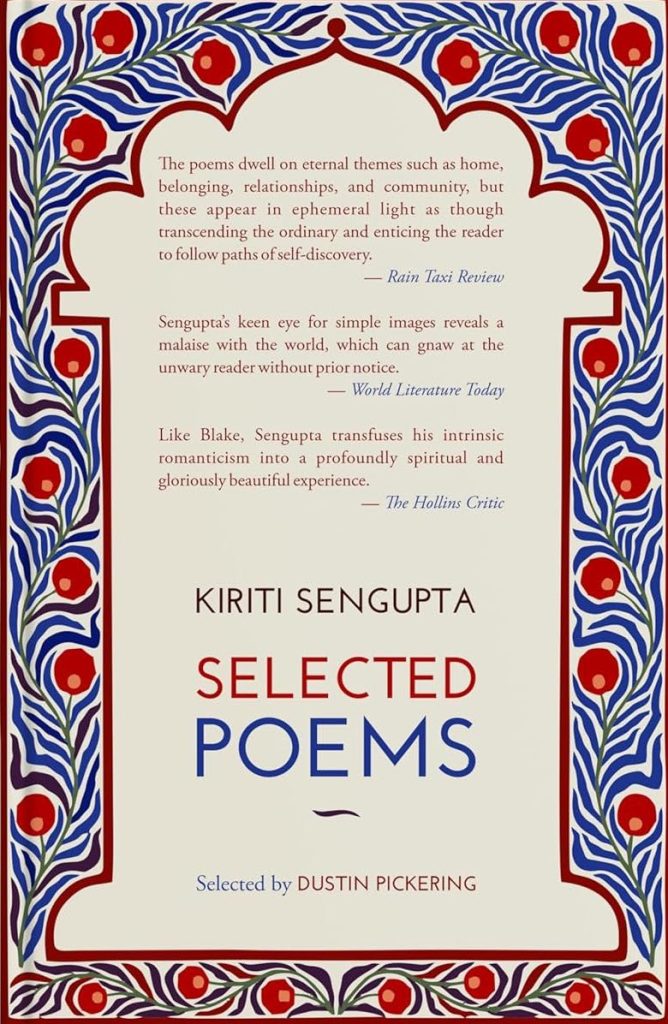
It has been more than a decade since the medical practitioner turned poet, Kiriti Sengupta, began writing poetry. A recipient of the 2018 Rabindranath Tagore Literary Prize and the 2024 Nilim Kumar National Honour, his latest publication, Selected Poems, serves not only as a retrospective of his career but also as a map of the poet’s evolving consciousness. The book features works from his early collections, including My Glass of Wine (2015) and The Reverse Tree (2014), through the spiritually charged Healing Waters Floating Lamps (2015) and The Earthen Flute (2018), and into later volumes such as Reflections on Salvation (2016), Solitary Stillness (2018), Rituals (2019), Water Has Many Colors (2022), Oneness (2024), and the recent ones under the chapter title “New Poems” (2024–2025).
The selection traces the career of a polyglot Indian Bengali poet and the quiet arc of sensibility that binds Vedāntic and Tantric spiritual influences, the inheritance of Bengali cultural memory, and the poet’s contemporary socio-political anxieties within the South Asian context. Sengupta’s verse is characterised by sparse language and spiritual resonance. The frontispiece poem in this collection, “Twice-born,” captures this quality with simplicity: “Guru initiates the lessons. / The disciple pursues the source.” The clarity of initiation is enacted through the pared-down lines, and the stillness of the moment is reflected in the poem’s brevity. Similarly, a haiku-like sensitivity emerges in “The Source,” where the poet turns to the question of life and death: “For years, I’ve been searching / for the flavours / of birth and death.”
Death becomes a flavour, a rasa, that must be discerned. Sengupta’s earlier poetry embraces syncretism. In “Blood Related,” a convergence of Hindu Tantric and Islamic practices takes place: “The Hindu Tantrics prefer the sight of red light. / Be it of the attire, / or the holy sacrifice.” The poem then undergoes a shift in register: “In the conventional practice of Islam / Qurbani is a popular station.” The effect is suggestive rather than polemical, recalling the saying “as many faiths, so many paths,” attributed to the nineteenth-century Hindu sage Sri Ramakrishna Paramhamsa, a central figure of the Bengal Renaissance. Sengupta, as an inheritor of that tradition, honours it through his craft. “Eyes of a Yogi” invokes Sri Ramakrishna, beginning with a delicate image of a mother bird on her eggs before concluding that Śakti (divine feminine) and Brahman (ultimate reality) are one and the same.
Minimalist language remains his strength, evident perhaps most clearly in “I.” He writes, “As identical a ‘I’ / through the slice / of my sigh,” and continues, “like the sky, / where the stars shine / and the Sun ‘I.’” The poem is an achievement in fusing the personal with the universal, a distillation of Vedāntic thought rendered in profoundly economical lines. The poems in this book not only sustain these themes but also extend into the realm of everyday life. Spirituality persists as an undercurrent in Healing Waters Floating Lamps. Ritual stillness is depicted in “After Bath.” “Evening Varanasi” captures the ordinariness of the sacred city with lines such as “The water here is not / a fire extinguisher, / Flames rise through the water.”
Paradox leads to revelation as Varanasi becomes the city where fire and water coexist, much like life and death. “River of Tears” demonstrates the poet’s skill in humanising sorrow, which, despite its universality, is expressed through gentleness: “They have flowed over our eyes. / Afraid of being seen, / they are shy.” Sengupta can also be incisive in satire, as seen in “Unravel.” The poem critiques the culture of seekers who desire nirvāṇa (enlightenment) with the impatience of fast food: “Healers worry about the front. / It is dusty, empty but advocates / spiritual pursuits.” The poem methodically deconstructs hollow spiritual posturing while acknowledging the poet’s own Master, who challenges him to look beyond the cages of material longing.
Memory recurs throughout Sengupta’s oeuvre. The simple act of preparing ghee (clarified butter) by his mother becomes spectrally alive in “Clarity”: “So organic is my memory— / the granular residue lifted us to heaven.” Past and present collapse into one another as cooking itself transcends into something more. Similarly, another piece, “Masala Muri” (from Rituals), uses food as an object of reminiscence, where muri (puffed rice) also takes on the function of haunting. Sengupta’s poetry increasingly engages with social critique and cultural inheritance as the selection moves into The Earthen Flute and beyond. “Womb” is an environmental meditation on earthquakes: “World, you may comment on material loss, / only the mother understands her rupture pain.” The earth becomes a mother, and maternal suffering is recast as ecological violence.
“Kajal Deeghi” recalls Jibanananda Das’s “Banalata Sen,” and “Moon—The Other Side” invokes Sukanta Bhattacharya. These homages reveal Sengupta’s embodiment of Bengali cultural memory in his verse. However, his voice is not confined to inheritance alone. “Cryptic Idioms” mocks the commercialisation of yoga: “Not a gimmick, but Yoga is now / at its creative best. // Patanjali must be happier, / I bet.”
In the Reflections on Salvation collection, the piece “Stagecraft” draws, perhaps unknowingly, from Trika Śaiva thought, recalling the Kaśmīri polymath Abhinavagupta’s Dehasthadevata-chakrastotram, which likewise holds that the body and its organs can serve as means to enlightenment. Yet in “Krishna,” Sengupta transforms Vedāntic invocation into an act of political defiance: “You might call me ignorant, but I am neither / Krishna nor your beloved political servant.” The later collections reveal a broadening range, as Solitary Stillness includes pieces such as “Manhattan Skyline,” showing his affinity, like other postmodern Bengali poets, with a lineage of bohemian writers such as Allen Ginsberg and Bob Dylan. Much like other countercultural voices who reimagined those influences through their own idioms, Sengupta refracts rather than imitates them, grounding his poetics in a distinctly local postmodern register.
From the collection Rituals, “When God is a Woman” situates divinity within the body of a sex worker: “In her sinews, / hides a hint of soil / from the yard of courtesans.” “The Untold Saga” shows Sengupta at his most confrontational, blending devotional language with depictions of sexual violence against women as he recalls the Nirbhaya rape case of 2012 that shook the nation’s conscience: “That you are worshipped on earth / gave no relief to gasping Nirbhaya.” In Water Has Many Colors, the neglect of the authorities is sharply criticised. “Santiniketan” mocks the hollow bureaucratic pomp surrounding Tagore’s Nobel Prize replica: “Aesthetes preach Tagore, / Officials display replica of / the Nobel Prize.” “Sepia” challenges the monarchs who chew and “don’t even spare the creators.” There is a flash of humour in “Colonial,” with its irreverent treatment of debates and biases.
In Oneness, “On Exit” grieves a son’s loss of his father, while in “Equipoise,” imagery is explored through “Pictures register sonic / waves, stemming from / the surface and beneath, / otherwise unheard of.” Finally, in New Poems, Sengupta is grounded in the present, with an awakened socio-political conscience that was less visible in his earlier work. This is evident in his support for Salman Rushdie following the knife attack, in the piece “Violence.” Similarly, “Demonstration” protests against the Bengal government’s apathy concerning the rape of a doctor at RG Kar Medical College, while “Her Sacred Mist” envisions Goddess Parvati as Mother Nature. The concluding pieces, “Consciousness” and “Eulogy,” meditate on mourning and the transience of life. They are remarkably spare in form yet powerful in understatement.
Selected Poems displays a remarkable range, moving from mystical lyricism in Sengupta’s early work to personal reminiscence in the middle period, and finally to political defiance in his current phase. His strengths lie in his minimalist language and his ability to compress vast philosophical and spiritual ideas into a few charged lines. He deftly weaves Bengali metaphors and cultural idioms into a broader global postmodern sensibility. Yet, if there is a limitation to Sengupta’s poetry, it lies in its austerity, which at times borders on opacity. His skeletal diction, laden with rich Indic cultural and philosophical allusions, risks alienating the casual reader who may not be familiar with South Asian traditions. However, this resistance is integral to his postmodern inheritance.
Sengupta seems to distrust transparency, embracing registers that are fractured, intertextual, and polyphonic. His poems are not to be consumed in a single sitting but revisited, reread, and lived with. He has forged an idiom of poetics that is austere yet resonant, rooted yet elliptical, and above all, singularly his own.
How to cite: Ganguly, Abhik. “The Stillness Between Fire and Water: On Kiriti Sengupta’s Selected Poems.” Cha: An Asian Literary Journal, 9 Oct. 2025, chajournal.blog/2025/10/09/Kiriti-Sengupta-selected.



Abhik Ganguly is a poet, writer, and scholar-practitioner. He traces his roots to Tagore’s Shantiniketan, West Bengal. He completed his Master’s in English Literature at Jamia Millia Islamia and is currently a Junior Research Fellow pursuing his PhD in the Department of English at the University of Delhi. His works have appeared in various publications, including Gulmohur Quarterly, Monograph, Indian Review, Setu Magazine, and others. He can be reached on Instagram (@abhik_ganguly_) and X (@GangulyRicky).
 Cha
Cha 