

📁 RETURN TO FIRST IMPRESSIONS
📁 RETURN TO CHA REVIEW OF BOOKS AND FILMS
Mallika Bhaumik, When Time is a Magic Jar, Red River Press, 2025. 108 pgs.
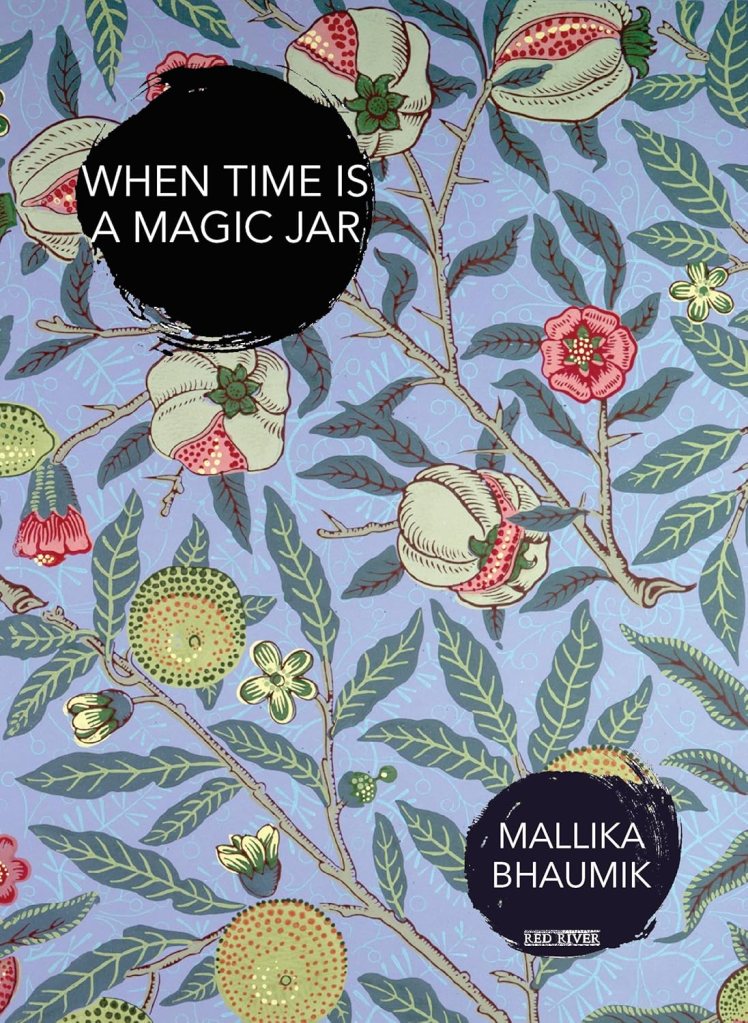
When Time is a Magic Jar by Mallika Bhaumik is like finding an old, dusty jar in your pantry. You can feel its warmth and almost smell what it once held, even though it is neither glossy nor well organised. The book is like that: a simple, curious object designed to contain things and release them. When you open it, you find a ray of sunlight, a cracked mirror. What strikes you most is how deeply the author wants you to linger over these minor details.
It does not try to be neat and new, as many creative works do. Instead, it teaches you how to savour what remains. These poems are caught in a loop. Consider the first image that stayed with me: “The sun ripens, / the sky turns opaque, / amber, / losing its innocence, / its blueness, / its transparency.” Ripening is usually a gentle process, something pleasant. But here it appears more like a bruise. The blue of the sky, which evokes infancy and hope, turns yellowish-brown. It reminded me of how Keats sought to preserve beauty and keep it safe. Bhaumik, however, allows that protection to harden, like a fossil. It is like amber, which both preserves and suffocates. This is not about making things new and exciting; it is about remaining with what is left behind. Life, in this book, is the residue at the bottom rather than something vast and grand.
Her poetry about cities conveys the same sense. “The city, a prostitute past her prime, / her jaded beauty no longer luring young men.” It is a difficult comparison because the two are so closely aligned. The poem does not attempt to romanticise the city as many poets do. Imagine Hart Crane transforming the city into an electric chapel, or Neruda describing streets and markets as though they were brimming with desire. Bhaumik reverses that tendency. She notices exhaustion instead. The city is not a place for dreaming; it is a place that has been consumed. It brought to mind the urban scenes in Eliot’s The Waste Land. They are not glamorous or enchanted but barren. Both poets use that emptiness in public to express private sorrow.
Bhaumik does not employ ornate imagery to redeem what is broken. She remains faithful to the worn and the old. That weariness quickly becomes contagious. “Life dwindles to the last swig / in a wine glass, / And I realise: / I hate newness in any form.” For anyone who wishes to challenge the old writers who adored novelty, or the younger ones obsessed with beginnings, Bhaumik’s line is the perfect rebuttal. It is peculiar to dislike newness when so much writing worships it. Her perspective recalls poets who return repeatedly to the same sorrow because it feels truer than anything fresh and fleeting.
This book makes time tangible. “Time has left its ripple on your skin … and fragile years press upon me.” What is intimate becomes cartographic: skin as a map, years as weight. One is reminded of Sylvia Plath’s raw reflections on bodies and mirrors, the mirror that tells the truth and the self one sees but cannot love. Bhaumik’s mirror fractures slowly, like frost.
There is a kind of silence that fills her rooms. “The geometry of the space bears / the quiet weight of the void.” Geometry usually implies order, yet here it encloses nothingness. Eliot’s emptiness feels distant, whereas Bhaumik’s emptiness inhabits the house itself, like dust on a window. It feels near, like two people in the same room who are somehow far apart. “We retire to bed / sleep like two continents.” The image is plain and sorrowful, close but not touching, together yet not together.
Even language itself seems to fade. “A vowel sinks into the quicksand of time.” Saying it aloud makes you hear the sound vanish. As language is lost, so too is the possibility of telling a story. The way vowels and syllables disappear reminded me of Octavio Paz and his sensual meditation on language and time. Paz often writes of time as circular and of words as both shaping and destroying us. Bhaumik’s sinking vowel achieves something similar, making us wonder whether words can ever truly sustain movement.
These intimate moments carry political undertones that lend the poems their authenticity. “You hold no papers to tether you to history. / The earth beneath your feet disowns you.” The harshness of bureaucracy and the arbitrariness of belonging evoke Mahmoud Darwish and his poetry of displacement. Darwish’s exile speaks for a nation, a collective grief. Bhaumik narrows the focus to the solitude of an individual. One does not need to read the word “refugee” to feel its echo. The absence of home becomes a personal torment, a quiet disgrace in a world that refuses to claim you. It is a geography of shame, a reflection of how belonging feels in our time.
The love in this collection is not simply tender verse. “Her hands trace the swell of her breasts” is stark and unadorned, and that directness is itself a form of love. It does not turn the body into something idealised but presents touch as a means of understanding how life persists in a world that resists it. “I gift you the memory / of stolen crimson kisses in high school.” Memory here is a kind of currency. To give someone a memory is both generous and burdensome. You offer your past and expect another to carry it. This gesture may be tender, or it may feel like surrender. The word “crimson” evokes a wound that endures. Colour does not ease the loss; it makes it eternal.
Lines such as “A museum of moments opens, / slow dances in my eyes” evoke the act of exhibiting memory. Woolf’s fascination with light within rooms, how a strip of sunlight might spark an idea, recalls Bhaumik’s “A strip of sunlight on the red floors adds a little drama.” Woolf transformed domestic interiors into spaces of thought; Bhaumik turns them into archives of memory. Memory becomes an exhibition, and we are its curators, wandering among relics, noting scents and corrosion. Yet the poet reminds us of the dirt behind the glass: “Between livelihood and living, / birthing wishes and recycling them, / a lifetime has elapsed.” This is not the glamorous season of stories but the quiet arithmetic of existence, where seconds silently become years.
When the mirror finally breaks, “Finally… / the mirror cracks, / the scattered eyes stare back / mercilessly,” the fractured self invites reflection on old notions of identity. Plath’s mirror was uncompromisingly honest. Bhaumik’s work expands the ways in which we might confront our own voices. It recalls the fragmented figures of postcolonial writing, characters made not of a single history but of many, layered upon one another.
You can still put things back together, but not in a way that makes them whole again. Yet she remains humble: “So, this is a postcard to tell you, / I believe in the remains / of dreams.” The postcard is compact and easy to carry. It shortens the distance. It does not declare “I believe in your dreams” in any grand way; instead, it says, I believe in what is left, in the torn postcards and damaged photographs. This book is most akin to the writing of Ocean Vuong and other authors who explore memory, where love and anguish are closely entwined. Much of Vuong’s poetry turns confession into a form of preservation. Bhaumik’s poems do the same, though they are more intimate, less ostentatious, and more restrained.
“Sorrow, like succulents, has propagated.” That line deserves to be remembered because it is both striking and wise. Succulents can take root almost anywhere, and sadness behaves in much the same way throughout this collection. Bhaumik’s succulents do not instruct or perform. They simply exist. They grow because they live. Survival is arduous, neither glamorous nor heroic, but constant and resilient. Bhaumik does not merely imitate or reject her literary predecessors; she converses with them. Eliot lingers in her work, yet she never writes as though she stands above him. She takes Plath’s mirror and complicates it, shattering it into fragments that must be reassembled with care. The energy remains, but Bhaumik chooses what is left behind rather than the moment of destruction.
There is also a quiet kinship between her portrayal of light and the city and the way poets like Paz and Neruda write about them. Yet Bhaumik’s sun becomes amber, and her city resembles a body that has been spent rather than a lover. That is what makes this collection resonate today. It does not seek novelty; instead, it strives to sustain. She writes poems that preserve, that hold things safe in an age obsessed with beginnings. They urge us to attend to the patterns of our lives and to discern their meaning. They ask us to consider who leaves a trace, who is remembered in books, and who lingers, unseen, in corners. And even that thought, the poet suggests, is not entirely right.
At times I find myself tempted to say that there are limits. Some poems are more about emotion than narrative, so readers seeking a story may find less to hold on to. The language can verge on the ornate, and some images do not always resolve. Yet perhaps that is precisely the point. Perfection is not the goal. Some critics demand harmony, but Bhaumik values multiplicity. She wants to show a face from several perspectives so that it is never seen in full. Her work celebrates complexity instead of convenience. If one must praise it, let it be for its courage in remaining small. It is brave to say that what is left behind still matters and that significance does not need to be grand.
A life worth writing about need not be perfect or prosperous. Bhaumik’s poems are not lesser because they are brief; they are brief because they dwell at the edges of existence, where most of life truly happens. She aligns herself with poets who believe that politics begins with the body and that history is made in domestic spaces and intimate relationships. She stands with them, yet she does not merely echo their voices.
To end where the collection often ends: “We wait for a beginning.” Bhaumik does not treat waiting as futility. It is an act of attention. Simone Weil might have called it prayer, Beckett might have named it fate, and Woolf might have seen it as the way a room feels at dusk. Bhaumik transforms waiting into faith in small things—a postcard, a beam of sunlight, the quiet persistence of succulents. She asks us to judge a life not by what it achieves, but by how tenderly it tends to its fragments. The jar spills, and the light rests upon the table. One must choose whether to clear it away or to sit with it, gathering what remains, and seeing what still matters.
Bhaumik’s poems teach us to be kind, not towards what is perfect, but towards what is too fragile to ignore. In a world that cannot stop looking forward, that lesson is something worth holding on to.
How to cite: Wani, Nazir. “When the Jar Spills Time: Reading Mallika Bhaumik’s When Time is a Magic Jar.” Cha: An Asian Literary Journal, 8 Oct. 2025, chajournal.blog/2025/10/08/magic-jar.



A postgraduate Gold Medallist in English Literature from the University of Kashmir, Wani Nazir, hailing from Pulwama, J&K, India, is an alumnus of the University of Kashmir, Srinagar. He is the author of the poetry collections …and the Silence Whispered and The Chill in the Bones. Presently working as a Senior Lecturer in the Department of Education, J&K, he writes both prose and poetry in English, Urdu, and his mother tongue, Kashmiri. A voracious and eclectic reader as well as a reviewer, he contributes his creative works, his “brain-children”, to Kashur Qalam, The Significant League, Muse India, Setu (a bilingual e-journal published from Pittsburgh, USA), Langlit and Literary Herald, Café Dissensus, Learning and Creativity, and The Dialogue Times, a journal published in London. He has received much acclaim for the beauty and depth of his writing. [All contributions by Wani Nazir.]
 Cha
Cha 