

📁 RETURN TO FIRST IMPRESSIONS
📁 RETURN TO CHA REVIEW OF BOOKS AND FILMS
Thuận (author), Nguyễn An Lý (translator), Elevator in Sài Gòn, New Directions, 2024. 192 pgs.

Nobel laureate Patrick Modiano once wrote that “it is not the future which counts, but the past.” Specialising in atmospheric reflections on consciousness, identity, and geography, Modiano’s novels are filled with haunted detectives obsessed with history and memory. Desperate to uncover some important lost truth hidden in the murky past, the existential investigations in his fictions usually end in frustration. Indeed, Modiano’s narratives are structured around a nameless void that can never be fully understood or resolved, sharing this philosophical sensibility with authors such as Jean-Paul Sartre and Kazuo Ishiguro, among others. Interestingly, all three were translated into Vietnamese by award-winning novelist Thuận. It should come as no surprise that the same metaphysical ambiguities infusing the work of those writers reverberate throughout Elevator in Sài Gòn (translated by Nguyễn An Lỳ), Thuận’s latest novel to appear in English.
The prominence of the signifier “elevator” in her title foretells that this everyday transportation device will serve as a metaphor for multidimensional travel, moving not merely vertically from floor to floor, but also horizontally across swathes of terrestrial space, and even backwards and forwards in time. Thuận’s narrative is ambitious. Her short chapters fit together like nodes in a temporal chain obeying the laws of the imagination, where each point along the continuum is variable. At any moment the novel may be anchored in 2004 Paris, then suddenly whisked back to Vietnam in 1954. The elevator of memory can jolt into action without warning, speeding anywhere. The results are traumatic or revelatory, or both, but never neutral.
Beginning with an unnamed thirty-something narrator returning to her homeland of Vietnam to attend her mother’s funeral after fifteen years abroad in Paris, the novel opens with a chilling image: the pulverised dead woman lying on her back at the bottom of an elevator shaft with her face untouched. Supposedly this was the first elevator in a private home in Vietnam, built by the narrator’s wealthy brother, a real estate magnate who had installed it to great public fanfare. The mother’s housekeeper explains the accident’s shocking outcome: “Madame fell from the top floor to the ground floor, the body was a wreck, only her face was intact.”
Perplexed as to why her mother chose to twist and turn her body in order to protect her face while dying, the narrator becomes convinced that her enigmatic mother’s past conceals a secret that will explain why. Digging through her effects for clues, she unearths a notebook stashed inside a sealed pillowcase. Within it is a photograph of a young French colonialist. A strange name is scrawled on the back, Paul Polotsky, along with the year 1954, and an address in Paris. Surely, if she locates this Polotsky, she will at last grasp the elusive key required to decode her mother’s lifelong inscrutability. However, the image proves only to be the catalyst for more and more vexing questions. Outwardly, her mother was “Mrs. Deputy Secretary of the Party Committee.” Why would an impeccable revolutionary cherish a snapshot of her oppressor?
Pursuing leads, shadowing suspects, and eavesdropping on conversations, while also raising her young son, she seeks out Mr Linh, a former collaborator (“I was not a comrade. I was an interpreter.”). Familiar with her mother and Polotsky, he discloses how they met. Nineteen when arrested by the French occupiers, she was ominously confined within the walls of Hỏa Lò prison, a notorious detention centre that “means misfortune, whatever the reason” for anyone remanded there. She was “tied at the crooks of her arms behind her back” and tortured, ending up with “one side of her face…swollen.” Mr Linh intimates that they “fell in love” during the interrogation process. This recollection sparks the narrator to recall a searing argument between her parents. Her father was livid that his wife could not convincingly explain why she had been released earlier than other prisoners under the same circumstances: “Woman, what did you do those three days in Hỏa Lò?” Did she shame her family and her nation? Eventually, his doubt compels him to divorce her, seeking to avoid guilt by association: “it wasn’t so much my mother he’d divorced though, but a danger, a nebulous unknown in the personal history.”
Driven by her obsession with Polotsky, the narrator calls every individual with his name in the Paris phonebook. Each attempt ends in failure, save for one voice that falsely accuses her of involvement in a convoluted property scheme. Suddenly a man named Bill reaches out: “there was only one way this Bill could’ve discovered that I’d been stalking Polotsky, if he and I were following the same target.” He claims to be Paul Polotsky’s offspring. Is this credible? Even he is uncertain. Bill has been conducting his own investigations, and it is through him that the narrator learns that Polotsky “died in a traffic accident in the 1960s.” Nothing independent of Bill’s testimony emerges to verify or disprove this startling revelation. Despite diligent sleuthing, there are only tantalising hints. No definitive answers, merely the futility of inconclusive happenstance: “coincidences, were, it turned out, not that hard to come by.”
A Vietnamese language instructor, the narrator regularly interacts with her students (sometimes comically), and moonlights as a translator for her brother while he negotiates a commercial deal during a business trip to the City of Light. It is in these scenes that the novel shifts from policier to satire. Thuận thoughtfully dissects the vicissitudes of immigrant life. As Jane Austen before her, Thuận is both literary artist and cultural critic, with philosophical rumination and biting ironic commentary moving in tandem. In particular, Elevator in Sài Gòn explores how linguistic nuance governs the way people interpret reality. The narrator explains that the Vietnamese language possesses only one form of verb conjugation, the present tense, and this facet allows speakers to conceive of past and present as existing in eternal simultaneity, a notion that lends justification to the novel’s cycling from Hà Nội to Paris to Sài Gòn, and back again.
Likewise, Thuận reflects dynamically on Vietnamese history. Riffing on over five decades of political events, the past for these characters is never far behind. Thuận shares this perspective with William Faulkner, another poetic writer who understood the interlocking connection between historical and personal trauma. The ennui of meaningless capitalist consumption has replaced socialist disillusionment. As long as the surface gleams, what festers beneath is of no concern. Elevator in Sài Gòn views capitalism and communism with the same bitter gaze. Presenting the hypocrisy of the mother’s ascent through communist party ranks, Thuận draws parallels with the corruption and despair of the narrator’s Western lifestyle. Neither is superior to the other. Both represent malfunctioning ideologies that demoralise while seeking to control dissent and desire.
Despite the evident intellectual depth on display, Elevator in Sài Gòn is not really a novel of ideas. It is primarily an inventive aesthetic experience. Nguyễn An Lỳ’s fluent English translation renders Thuận’s prose in refined sentences that sparkle with wit and memorable turns of phrase, such as this reflection on unification: “the beauty…[was that] the Southerners got their long lost brotherhood and the Northerners, their long sought brothers’ goods.” Or here, parsing the subtleties of a particular kind of vocal tone: “[it was] a Hanoian voice of the kind that could now rarely be heard, and only in Sài Gòn or in Paris, a Hanoian voice that belongs to a Hanoian who has been away from Hà Nội at least half a century.” Echoing the famous first sentence of Austen’s Pride and Prejudice, Thuận balances acerbity and lyricism: “It is a truth universally acknowledged that in Vietnam your local police have better and more detailed knowledge about your life than you do yourself.”
Without doubt, for Thuận, truth is the lie we choose to believe. Even then, we cannot tell anyone what we secretly think. The prudent course is to avoid becoming a “loose bike chain” and giving the regime cause to target you. Freedom under these conditions entails choosing the mask you will wear. On this point, Thuận returns the detective genre to its spiritual roots in classical Greek tragedy, where actors wore masks, and the dramatic conflicts and dilemmas depicted on stage revolved around ethical flashpoints between individuals and the collective. Elevator in Sài Gòn is reminiscent of this formally classical mode, despite its contemporary moods and modern attitude. Thuận questions how we live and how we die, with or without our faces. There is no deeper meaning beneath the mask. Still, we remain responsible for our choices. Sartre, Modiano, and Ishiguro would concur. Every road of discovery journeys straight into a dead end: “my mother’s life resembled a treasure trove of questions that led to nowhere.” It is a tribute to Thuận’s artistry that this central revelation in Elevator in Sài Gòn is not a source of sadness, but of wonder, even joy.
How to cite: Londra, Michael. “Truth, Lies, and the Mask We Choose: On Thuận’s Elevator in Sài Gòn.” Cha: An Asian Literary Journal, 3 Oct. 2025, chajournal.blog/2025/10/03/elevator.

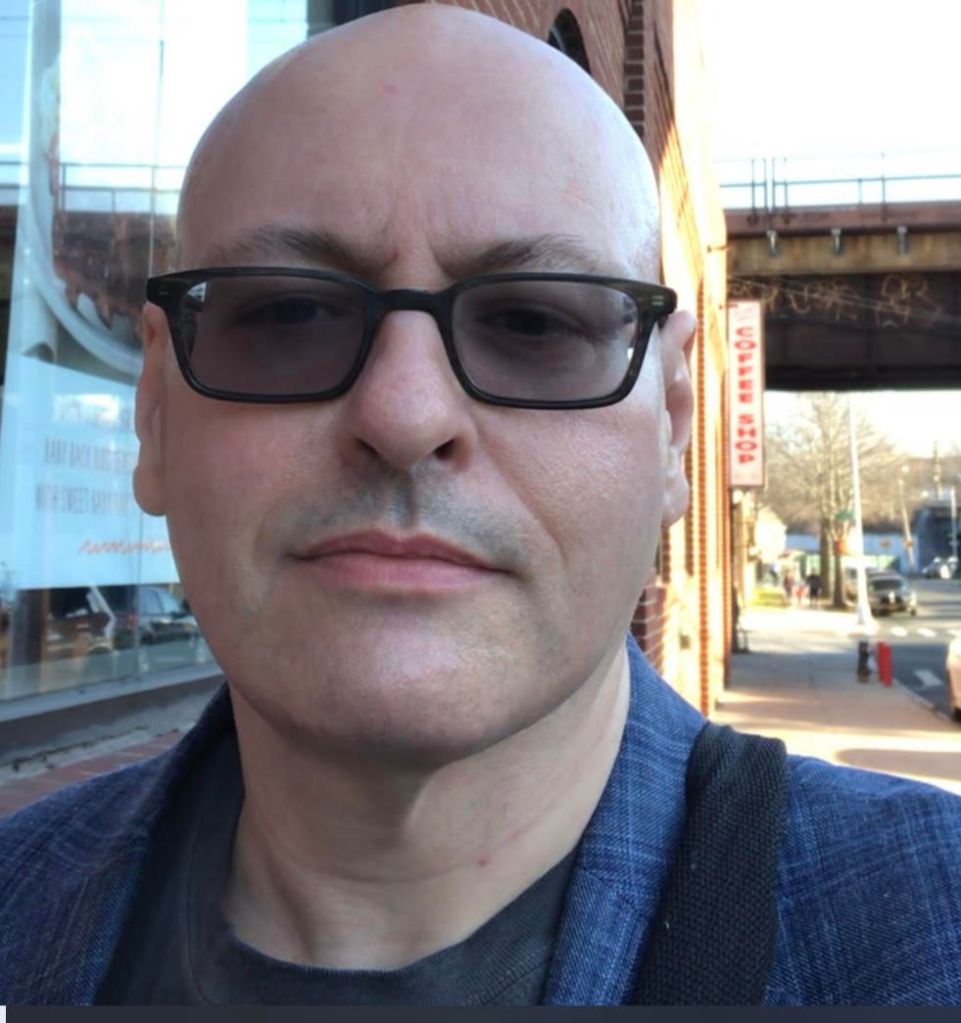
Michael Londra talks New York writers in the independent YouTube documentary Only the Dead Know Brooklyn (dir. Barbara Glasser, 2022). ‘Time is the Fire’, the prologue to his forthcoming novel, Delmore & Lou: A Novel of Delmore Schwartz and Lou Reed, appears in DarkWinter Literary Magazine. His other poetry, fiction and reviews have appeared in The Arts Fuse, Restless Messengers, Asian Review of Books, spoKe and The Blue Mountain Review, among others. He contributed six essays and the introduction to New Studies in Delmore Schwartz, due next year from MadHat Press. Born in New York City, he lives in Manhattan.
 Cha
Cha 