

📁 RETURN TO FIRST IMPRESSIONS
📁 RETURN TO CHA REVIEW OF BOOKS AND FILMS
Click HERE to read all entries in Cha on So That You Know.
Mani Rao, So That You Know, HarperCollins India, 2025. 312 pgs.
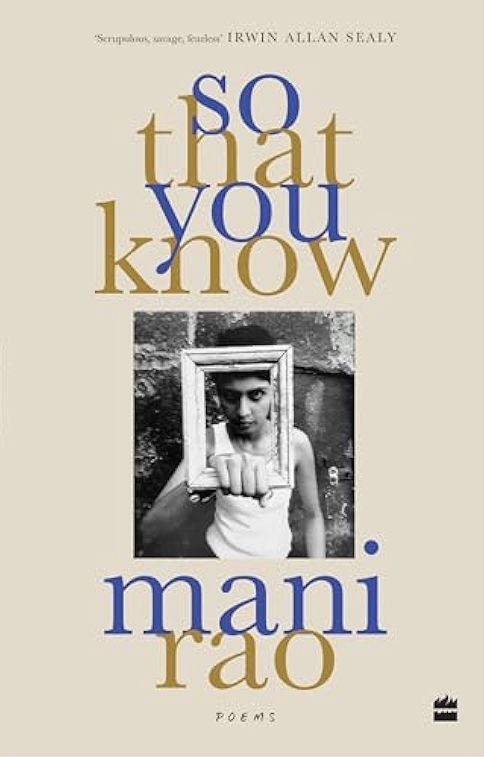
Referring to notes I made on Mani Rao’s newest poetry collection, one word I had written down was “eye wrench” (it should have been “age wrench”, such was my bad handwriting) to describe her poems. But it was a perfect choice, since the jolt we get on reading her enigmatic, spare, and wryly sardonic word worms nestled in her fractured line forms abruptly screeches us to a visual and mental halt. We need to chew over these words several times to fully appreciate them. This is how poetry should be—we try to ascertain the poet’s experience and relate it to our own backgrounds and histories, with meaning changing the more we read. As Gertrude Stein once said of poetry, it “is saying the word without saying the word”, which leaves room for multiple interpretations because of the ambiguity that is the defining characteristic of language (and memory).
Rao says in her preface, “One day, someone goes in search of the fictitious place in my story and finds it”—she seems to answer critics on the reality allegedly depicted in her poems. But isn’t this the natural question that we cannot help asking when we read poetry? Poetry can be about anything: personal experiences, observations of others, happenings in the news, or tangents of thought. I think what Rao is trying to say is that the reader will take and get out whatever they want from any one of her poems. Her poems, being minimally punctuated and containing strategically placed empty spaces, prove what I have just been saying.
This is a collection of new poems and old works over the years. Has her poetry changed in style? I don’t think so, but perhaps Rao’s ironic humour occupies a slightly more prominent place in the pages. It’s hard to discuss all that she does with her poems and the topics they deal with; I will discuss a few that particularly spoke to me.
“Invoice” (p. 15) is one of several poems that deal with either poetry-writing or poetry reception: Doesn’t stop. Is he/ getting paid by / the word? Where / do I send the bill for my y ears? / Borrows from his/deficit/ I’m his World-/Bank. The clever use of deliberate space between the “y” and “ears” refers to the protagonist’s experience being used by a poet, perhaps in prettier or uglier words. Poets use the lives of others as inspiration for their work. We might feel that the pain of recollection, of finding ourselves in poems, should be assigned some kind of payment for the pain and suffering caused.
Like many poets, Rao deals with memory and remembrance. “Retrospective” (p. 19), a short poem concluding that “memory is without gravity”, concerns letting memories fall where they will, not necessarily holding on to regrets with bitterness, but simply allowing them to occupy some neutral space.
“If Only” (p. 26) concerns relationships that you cannot easily change, but only if we could, life would be so much easier: “A big inconvenient to die /just drop that sticky lover/that loveless parent/of only one could just get plastic surgery/change lives behind the shrubbery.” Unfortunately, this seems impossible.
We cannot know how things will work out in our lives, so we often live with regrets about things previously said or unsaid. The addressee in “If There Is Any Consolation” (p. 42), “To you who” (that is, all of us), has certain regrets, but we are told at the end that all we can do is to give “two-minute silence” to these regrets, and then move on.
The title of the poem “Not Fair” (p. 27) tells it all. Things are definitely not fair. We age, but do we have significance in our living to either ourselves or to others? “remind me what/I gain by being here /Love me in a hurry.” Perhaps time is running out and we must do as much as we can in the time we have.
In “Love Poem at 3.33 am” (p. 34): “I’m leaving you /Even in my dreams I’m leaving you /You don’t believe me/Even in my dreams you don’t believe me.” Our unconscious does not leave us alone, even appearing to back up the conscious selves.
In the whimsical “Were I A Wizard There Would Be” (p. 46), the so-called small things that would make everyday life more enjoyable are held up: Grilled cheese sandwiches ready-to-eat on trees. /Crisp French fries /instead of beans. /All dentists in jail, teeth /made of steel / We’ll keep our moms, just wave/wands to make them nicer. Don’t we wish.
The following pair of very short poems deal with ageing: “Pathetic Fallacy” (p. 72) and “Law of Physics” (p. 73). In the former, there is a “Sunset sky” / / Youth gone / Passion lingers.” The space between “sunset sky” and “youth gone” shows the passage of years more vividly than any number of words could, since we can fill in the space with decades of living. The latter poem asks the question: do we still have passion as we age? Is it pathetic if we are still passionate with our ageing bodies? “Entering the prism of time/black hair emerges /on the other side / as a palette of gray / then vanishes /in white light.” I do not think so. It is just that the passion may take a different form.
How can I sum up the poetic oeuvre of Mani Rao? It is impossible. I simply suggest taking a look at her work, something I will continue dipping into from time to time in the future, to gain even more meaning than I have from my first reading of this collection of poems.

Mani Rao was a contributor to the inaugural issue of Cha, 2007.
How to cite: Eagleton, Jennifer. “A Prism of Time: The Shifting Passions of Mani Rao’s Poetry in So That You Know.” Cha: An Asian Literary Journal, 17 Aug. 2025, chajournal.blog/2025/09/26/so-that.


Jennifer Eagleton, a Hong Kong resident since October 1997, is a close observer of Hong Kong society and politics. Jennifer has written for Hong Kong Free Press, Mekong Review, and Education about Asia. She has published two books on Hong Kong political discourse: Discursive Change in Hong Kong (Rowman & Littlefield, 2022) and Hong Kong’s Second Return to China, A Critical Discourse Study of the National Security Law and its Aftermath (Palgrave Macmillan, 2025). Her poetry has appeared in Voice & Verse Poetry Magazine, People, Pandemic & ####### (Verve Poetry Press, 2020), and Making Space: A Collection of Writing and Art (Cart Noodles Press, 2023). [All contributions by Jennifer Eagleton.]
 Cha
Cha 