

茶 FIRST IMPRESSIONS
茶 REVIEW OF BOOKS & FILMS
[REVIEW] “History as Painting: Lav Diaz’s Magellan” by Alicia Izharuddin
Click HERE to read all entries in Cha
on Magellan.
Lav Diaz (director), Magellan, 2025. 165 min.
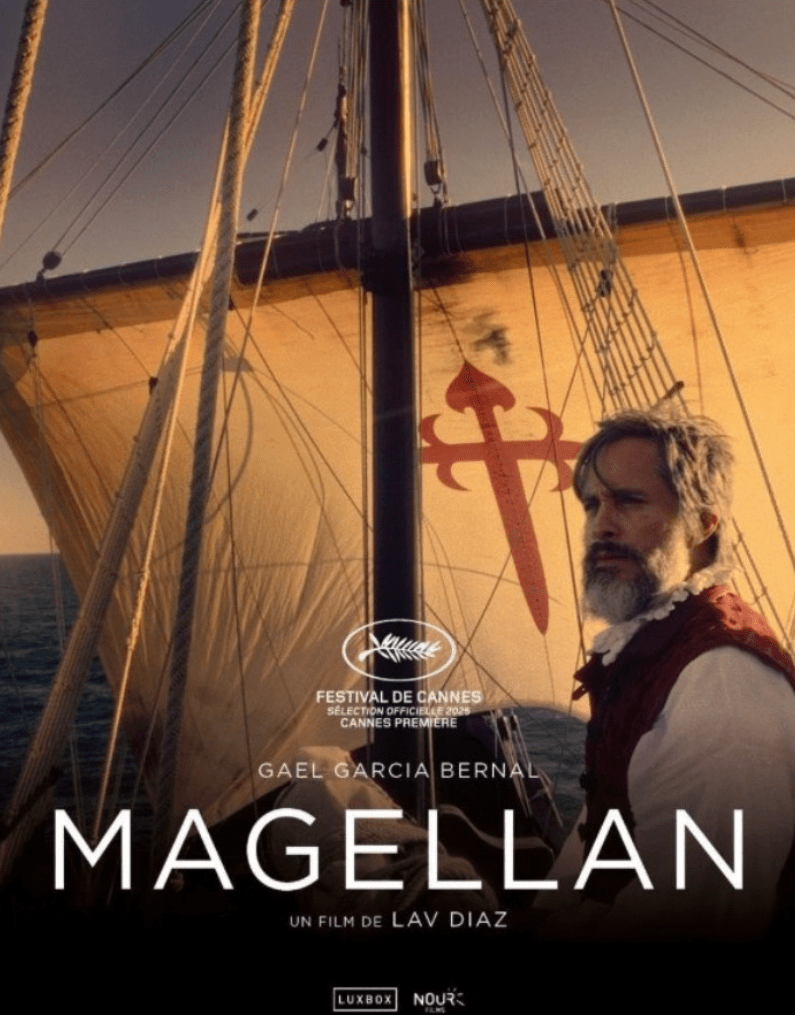
The most striking aspect of Lav Diaz’s Magellan is the deep, saturated blue of sea and sky. There is something at once hyperreal and unreal about them. These are reimagined landscapes drawn from the distant mists of the early sixteenth century, in particular the uncharted oceans that first brought European colonialism into contact with Southeast Asia. The effect is akin to viewing a painting of Western provenance from the same era. One feels several steps removed from the scene, distant yet close enough to experience the gravitational pull of the crashing waves. By contrast, scenes on land and on the ship’s deck are rendered in a dark tableau of browns and blood.
The venue in which I watched this film-as-painting, the hallowed halls of Singapore’s National Gallery, as part of the ten-day art film festival Painting with Light in September 2025, was entirely apt. I had expected the attrition of audiences so often associated with Diaz’s screenings. Falling asleep or walking out halfway through his films has become part of the lore. Yet the screening I attended on a Saturday afternoon was nearly full and, remarkably, attentive: every spectator remained in their seat until the closing credits had finished rolling.
At just under three hours, this is one of Diaz’s shorter works, though it bears his signature slowness: the static mid-range camera, the scenes allowed to breathe in long takes, and the characters conversing in lingering two-shots. We accompany Ferdinand Magellan, the titular Portuguese explorer, embodied with fitting severity by Gael García Bernal, who will stop at nothing to spread Christianity and bring glory to his crown.
Diaz avoids the familiar trope of the colonial explorer’s descent into madness on entering the riverine heart of darkness. Instead, we are asked to reflect on the uncertainty and ambiguity that haunted a mission incapable of tolerating religious doubt. He even inverts the trope of the colonial madman. During the intervening years in Portugal, as he gathers resources for his next voyage to the Philippines, Magellan’s body appears increasingly ravaged, briefly restored by his marriage to a much younger noblewoman. At sea, his vigour returns, but he is haunted by dreams and the ghost of the wife he has left behind.
Death is a recurring motif in Diaz’s films, whether in the notion of “dead time”, those extended takes that provoke restlessness and discomfort in audiences, or “death time”: long, excruciating scenes of characters waiting to die. Diaz has also spoken of the Philippines as a “force of death” (Ingawanij 2015, p. 102). Mercifully, graphic violence is treated with restraint in Magellan. Scenes of mass death unfold after the killing, with dead and dying bodies strewn across the ground, bloodied yet mostly intact. Here we are reminded that modern warfare leaves corpses dismembered and scattered, unsuitable for cinematic contemplation.
There is something tidy, even pat, about Diaz’s retelling of Magellan. Although the story contains no surprises, it is nonetheless a reckoning with how and why the Philippines endured centuries of colonial domination. In a post-screening discussion in Singapore, Diaz revealed that his original director’s cut was some nine hours long. Such length would have been more fitting, allowing viewers, through sheer durational endurance, to absorb the full extent and complexity of Philippine colonialism. In the fictional figure of Enrique, a slave Magellan acquires during his earlier exploits in Melaka, we encounter the embodiment of transformation and awakening. Early in the film, still awaiting purchase, Enrique, whose original name is lost, calls out to the spirits of the skies for mercy and the restitution of dignity. Once in Portugal, he reaches out again to foreign skies, this time in gratitude. By the film’s end, he has undergone religious conversion, speaking reverently of Jesus and Mary.
The film’s centrepiece is Magellan’s epic voyage to Cebu in the Philippines. It is a journey both slow and violent. During the crossing, Enrique clings to the ship like a barnacle against the forbidding waves, while those of higher rank and race perish of disease or are executed for sodomy. Upon arrival, Cebu is depicted as already rich in culture and civilisation. Magellan and Enrique persuade, then coerce, the inhabitants into converting to Catholicism. Unfamiliar with monotheistic adherence to a jealous Christian God and Virgin Mother, the coastal residents are horrified when their wooden idols are destroyed by Magellan’s men. In resistance, the fearsome figure of Lapulapu is invoked to avenge them. Yet for the invaders, and within the narrative structure of the film, Lapulapu is only a name, a mere “phantom”, as Magellan dismissively remarks. It quickly becomes, however, the rallying cry of fierce opposition, culminating in the bloody clash that finally claims Magellan’s life. The force of death begins henceforth.
Bibliography
Ingawanij, May Adadol. 2015. Long Walk to Life: The Films of Lav Diaz. Afterall 40: 102–115.
How to cite: Izharuddin, Alicia. “History as Painting: Lav Diaz’s Magellan.” Cha: An Asian Literary Journal, 16 Sept. 2025, chajournal.com/2025/09/16/magellan.



Alicia Izharuddin is Senior Visiting Fellow at the National University of Singapore. She is the author of Gender and Islam in Indonesian Cinema (2017) and co-editor of the forthcoming Routledge Handbook of Southeast Asian Cinemas.
 Cha
Cha 