
📁 RETURN TO FIRST IMPRESSIONS
📁 RETURN TO CHA REVIEW OF BOOKS AND FILMS
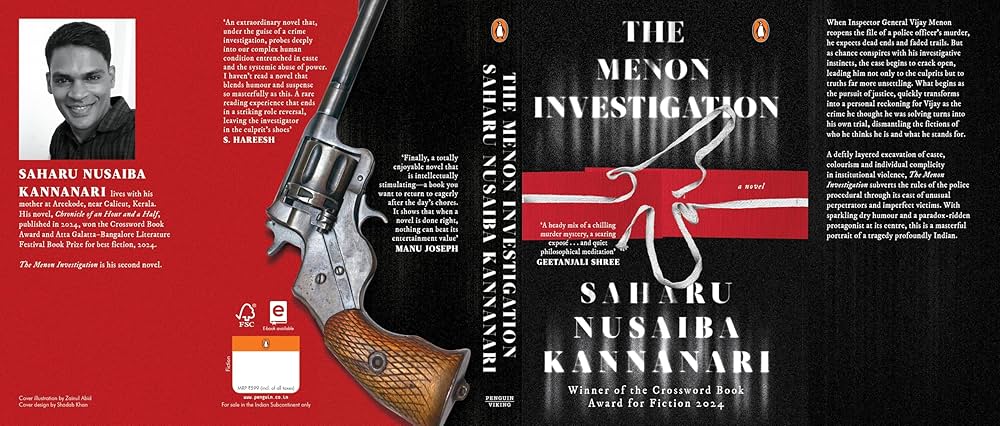
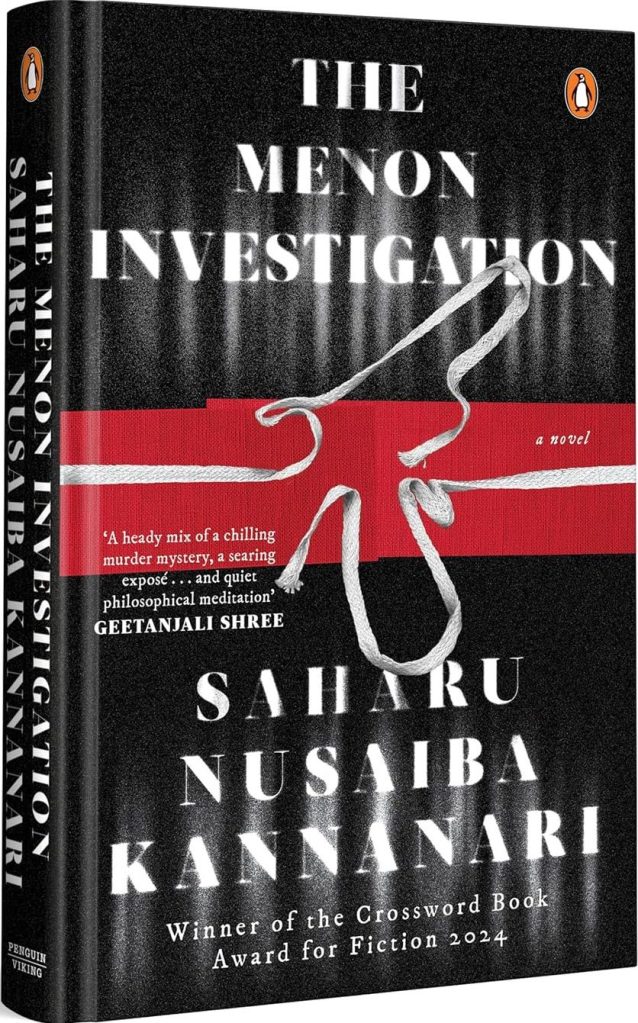
Saharu Nusaiba Kannanari, The Menon Investigation, Penguin Random House India, 2025. 246 pgs.
In the world of crime cinema, the Austrian film director and screenwriter Fritz Lang is considered the guiding hand. The question that many people forget to ask is: what makes him so great and monumental in creating a cinema that revolves around crime? In an essay for the London Review of Books, Michael Wood notes that Lang believed crime has a life of its own, and that every crime carries its own history. If one does not attempt to touch and explore these two primary traits of crime, the act remains in the shadows. Saharu Nusaiba Kannanari’s novel The Menon Investigation is a text in which crime acquires its own body. We are not observing characters organising and committing a particular criminal act; rather, crime becomes a singular theory, and every character is led by its temptation. The plot of this novel is simple, but the life and history of the act itself tie several knots for us to unpick through reading, assumption, and finally a climactic consequence. In short, the novel is crime’s cockpit.
The story of Kannanari’s novel concerns the fallacious, complex, and internally insecure Inspector General Vijay Menon’s investigation into a sub-inspector’s heinous murder. The novelist builds the atmosphere of the crime and of the protagonist’s life in the first three chapters, then gathers pace from the fourth onwards. While we are drawn into the language, anatomy, and psychology of the crime, the story also gives rise to several tributaries that address the lives of characters who grow across this novel like sturdy trees and resistant creepers. The striking quality of Kannanari’s work lies in how its narrative is not merely a progression towards society’s grim realities; it also approaches the figments that coalesce around everything realistic. This quality can be found in Quentin Tarantino’s films, where the main perpetrators or antagonists are exposed to their own imaginations. This technique allows the audience to break their preconceived notions.
o
In the German crime thriller The Testament of Dr Mabuse (1933), Fritz Lang shows us how criminals operate while waiting to commit a crime. The screenplay, co-written by Lang and Thea von Harbou, was adapted from Norbert Jacques’s novel featuring Dr Mabuse, the criminal mastermind. Lang, however, reshaped the material into an allegory that critiqued the rise of totalitarianism in Germany, which led to the film being banned by Joseph Goebbels. In the story, Mabuse’s writings influence criminals who terrorise the city with their activities. In one particular scene, Lang depicts the chaos among these criminals as they gossip and dissent against Mabuse’s words, giving the audience a sense of how every negative act is preceded by ideas that question its very motive. In the prologue of Kannanari’s The Menon Investigation, we find a similar chaos stirring in the minds of characters who are on the verge of igniting a monstrous act. We live in a time when a decision handed down by the upper crust of society is treated as gospel and expected to be obeyed. Kannanari writes of a situation in which the characters hesitate to place themselves in positions open to questioning, for their answers would carry no meaning. Like Lang, his art lies in drawing a grey image of the characters. Yet, unlike the director, the novelist directs his readers towards a bigger picture without any overarching purpose.
The absence of an overarching purpose was evident in crime thrillers such as City of God (2002), Nobody (2021), and even Gangs of Wasseypur (2012). At the Jaipur Literature Festival, Kannanari remarked that art cannot change society and should not be considered a tool of activism. There is a certain truth in this, yet to accept it entirely would be to embrace a privileged detachment. A special screening of Rang de Basanti (2006), directed by Rakesh Om Prakash Mehra, was organised in Delhi and ultimately inspired the anti-corruption movement led by Anna Hazare. Similarly, Denis Villeneuve’s Sicario (2015) spurred investigations into drug and human trafficking throughout South America. This latter impact was strengthened by the inclusion of Benicio del Toro, which allowed Puerto Rican and Mexican audiences to relate directly to Villeneuve’s message. Art has always been a primary agent in activating the sensory system of society and its thinking beings. Kannanari, as a literary speaker, contradicts his dominant identity—a writer—and this is not unusual. A knight may speak of peace; a smuggler may lecture on order; a politician may preach equality; a teacher may advocate autonomy. The contradiction may appear strange, but the novelist is in search of truth, and he pursues it in his own comfortable space.
o
Crime, serving as the manure of the book, functions in various ways to expose conditions already familiar to us yet still in need of articulation. The novel’s treatment of caste is both unusual and compelling. The privileged and dominant castes have long oppressed those of lower status. Kannanari identifies caste as a product of colourism as well as a conditioned interface. In a 1997 WCW promo, Booker T (Booker T. Huffman Jr.) accidentally referred to Terry Gene Bollea (Hulk Hogan) as a “nigga.” He immediately regretted the slip, which later resurfaced as an infamous blooper. Booker T, himself a Black American, had been conditioned by society to use a word that is banned and regarded as a slur against Black Americans and Africans. In this book, Kannanari describes how both upper and lower castes have, through decades of conditioning, associated dark skin with the latter. The complexity of the upper-caste protagonist stems from the thought that binds caste with flesh, caste with death, and caste with crime.
o
In Sofia Coppola’s Lost in Translation (2003), desire is conveyed through the claustrophobia of habit and surveillance, both overt and covert. The protagonists meet through the monotony of their lives, and we observe desire’s by-products accumulating around them: a faint smile, a minimal touch, and a conversing silence. Vijay Menon, the protagonist of The Menon Investigation, becomes the medium through which Kannanari questions the monogamous ideal of a relationship. The concept is noble but collapses when it rests upon a fictional tale created by powerful humans to curtail freedom. Padmini, the protagonist’s partner, could have been portrayed with greater tenderness, yet the writer succeeds in uncovering the massacred root of marriage and the exhausted body of expectation. Libertines have often claimed desire without reference to any socially constructed institution. Here, both Padmini and Menon are victims of expectation, bound together by a single, withered string.
o
During the screening of Viduthalai Part 1 (2023), V. Chitravel Vetrimaaran was asked about a particular shot in which the director focused on the perspiring neck of a policeman to indicate the tension of the situation. Vetrimaaran explained that the shot occurred because the tripod could not find a stable spot; the moment was entirely accidental. A similar instance was recalled by Irrfan Khan in the film Maqbool (2003), where a drop of sweat falls on a glass pane, revealing inner turmoil more powerfully than dialogue. The actor explained that it occurred because he could not look directly at the characters inside the hospital room. These are moments where atmosphere performs the work, and the actor merely becomes the medium. Kannanari’s detailing is similarly visual, painted as vivid pictures that overshadow the effort of the mind and the psychology of the characters. While a degree of detailing helps readers to visualise a situation, it can also render the story overly easy and fluid. The writer manages to keep readers hooked with his raw and fresh imagery, but like every point of fascination, it leaves little room for imagination and greater clarity than necessary. In literature, shadows are essential, guiding readers gently into the story.
The Menon Investigation is a gritty crime novel that does not shy away from being raw, brutal, and unsettling. Yet it also offers moments of solace, for it articulates our silent screams. It is not an investigative thriller but a social drama that thrives upon thrill, morbidity, and mystery. Saharu Nusaiba Kannanari is an important voice, one who weaves storytelling with a chaotic package. His chaos is necessary in a world where people are repeatedly urged to calm down, for the time is said to be inappropriate.
How to cite: Deb, Kabir. “Silent Screams and Chaotic Truths: Saharu Nusaiba Kannanari’s The Menon Investigation.” Cha: An Asian Literary Journal, 12 Sept. 2025, chajournal.blog/2025/09/12/investigation.



Kabir Deb is a writer based in Karimganj, Assam. He is the recipient of the Social Journalism Award (2017), the Reuel International Award for Best Upcoming Poet (2019), and the Nissim International Award (2021) for Excellence in Literature for his book Irrfan: His Life, Philosophy and Shades. He reviews books, many of which have appeared in national and international magazines. His most recent book, The Biography of the Bloodless Battles, has been shortlisted for the Sahitya Akademi Yuva Puraskar (2025) and the Muse India Young Writer’s Award (2024). He currently serves as the Interview Editor for the Usawa Literary Review. Instagram: @the_bare_buddha [All contributions by Kabir Deb.]
 Cha
Cha 