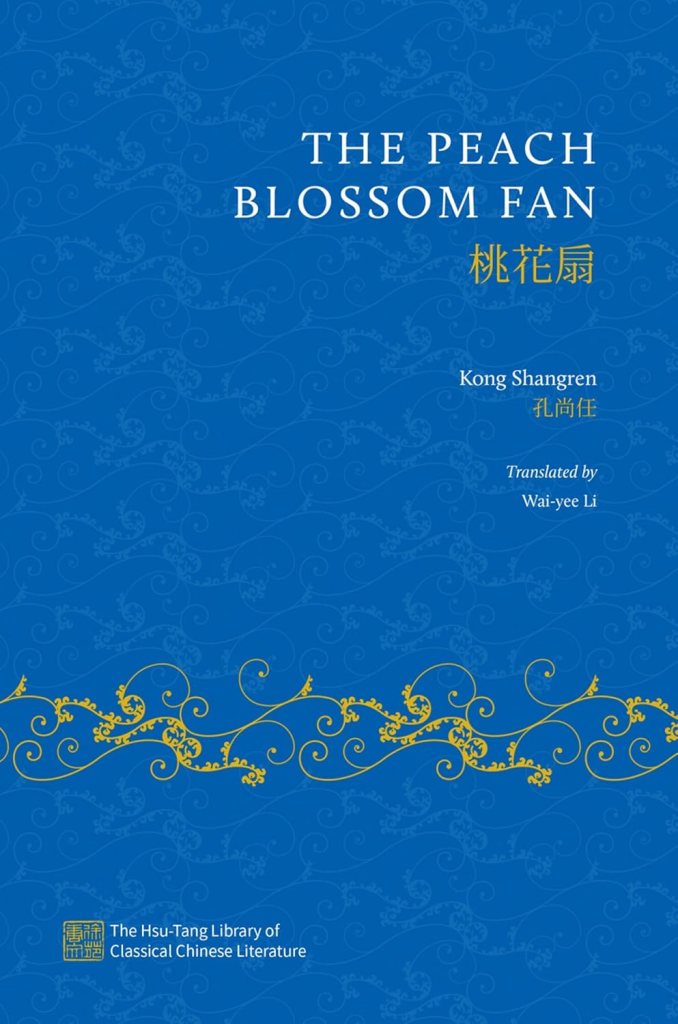
Kong Shangren (author), Wai-yee Li (translator), The Peach Blossom Fan, Oxford University Press, 2024. 816 pgs.
Wai-yee Li is one translator who knows how to hook a reader. This is how she begins the introduction to her new version of Kong Shangren’s epic 1699 play The Peach Blossom Fan:
A big book promises a world. With this book, that promise is fulfilled through the destruction of a world.
The Peach Blossom Fan is certainly a big book. Eight hundred pages plus in this new bilingual edition, it dramatises, in 44 scenes, the death throes of the Ming Dynasty, the “destruction of a world” signalled above, in the mid-1640s, through the exploits of dozens of characters whose ranks include writers and woodcutters, generals and common soldiers, courtesans and priests. A handful of framing episodes set 40 years later extend the perspective on the action we are witnessing, and that is not even to get into the elaborate editorial apparatus accompanying the main text, which includes not only Kong Shangren’s own commentary but also Li’s formidably erudite annotations explaining the historical and literary allusions that permeate the work.
This teeming canvas becomes more approachable when you realise it centres on an ill-starred romance. In the “pleasure quarters” of Nanjing, the dashing young scholar Hou Fangyu is introduced to the beautiful teenaged courtesan Li Xiangjun, whose skill as a singer would seem to make her a natural fit for Hou, already recognised as a writer of promise. A handful of secondary characters, among them a conniving madam who also happens to be Xiangjun’s foster mother, contrive to bring the young couple together, and their courtship unfolds as something of an idyll, with picnics and music and recitals. But Kong gives us a sign of what is to come: the scene in which Hou and Xiangjun meet concludes with a reference to warships moored in the harbour.
Sure enough, real life soon clouds the lovers’ sunny scenario. As Hou and Xiangjun are about to marry, she receives an extravagant wedding present of 300 taels of silver from Ruan Dacheng, a local government official who is also a playwright and a bit of an aesthete himself. Ruan is in disgrace for having allied himself with a corrupt and brutal ruling faction decades earlier, and he clearly wants to curry favour with the rising clique Hou represents. Already showing herself to be more principled than her lover, Xiangjun declines the 300 taels and excoriates Ruan for his past misdeeds.
Stung by their snub, Ruan abuses his authority to frame Hou on trumped-up charges of sedition. In order to save his skin, Hou flees Nanjing, abandoning his new bride after they have barely got to know each other. Ruan’s insistence on respect from the bright young things, and the dire consequences of his wounded hauteur after they reject his overtures (shrewdly intermingled with a hint of literary rivalry between an older and a younger writer), exemplify Kong’s ability to create motivations that feel psychologically true and entirely modern for a 21st-century reader.
The relative ease with which Ruan places Hou in jeopardy partly reflects a wider public disorder. After a reign of 300 years, the Ming Dynasty is on the verge of collapse. As a rebel army threatens and then takes Beijing, and the Manchus are invading from the north, the various generals charged with protecting the realm abandon their responsibilities in a welter of infighting and naked self-interest. The fall of Beijing prompts the sitting emperor to commit suicide, at which point Ruan and a coterie of corrupt officials throw in with the no-account Prince Fu and install him as the Hongguang Emperor in Nanjing. This begins the short-lived Southern Ming regime, which (as students of history know) will prove no match for the Manchus.
Amid all this turmoil, Hou and Xiangjun temporarily recede from view as we take in a series of vivid tableaux depicting a society in chaos. Good men sacrifice themselves in the name of vanished ideals, while bad ones exploit the deteriorating political situation for personal gain. Of those who are lucky enough to survive, a few come to understand, in the words of Pockmarked Liu, the roguish storyteller who functions as an author surrogate, that “the battle for fame and gain is but momentary clatter.”
A remarkable number of bit players scurry around the margins of the main drama, granting us virtually a top-to-bottom overview of the late Ming world. The vivid cameos begin in Scene 3, when two temple functionaries engage in a rhyme duel that undercuts the air of solemn ritual:
SECOND ASSISTANT: For firewood, we rely only on the saw. FIRST ASSISTANT: Steal a tree, break the law. SECOND ASSISTANT: All year long, vegetarian fare doesn’t suffice. FIRST ASSISTANT: Meat from the sacrifice.
In Scene 7, we meet Bao’er, a servant in the brothel where Hou has been wooing Xiangjun. Scrubbing the chamber pots early in the morning, she whiles away the time by singing a bit of eye-opening doggerel:
Turtle piss, turtle piss Out comes a little turtle miss Tortoise blood, tortoise blood Out comes a little tortoise stud Turtle piss, tortoise blood Can’t tell a stud from a dud.
A few lines later, Bao’er’s jaundiced commentary on the young lovers (“all that nuzzling”) underscores the sense that Hou and Xiangjun inhabit a cocoon of privilege. But my favourite walk-on, and perhaps even my new favourite supporting character in all of Chinese drama, is the ageing bookseller Cai Yisuo, who appears in Scene 29. After cataloguing the breadth and depth of his wares (you will wish you could browse his shelves), he declares, “How glorious and gratifying it is!”
As some of these quotations suggest, Li has a gift for rendering colloquial speech as well as for a certain cheekiness. (Respect to any translator with the confidence to rhyme “tea” with “hegemony,” as she does in Scene 31.) At times she achieves an effect of utter directness, such as the moment in Scene 9 when one soldier berates an obtuse comrade: “You don’t get it.” But she can also move from an earthier, everyday register into a more exalted mode. Every chapter in The Peach Blossom Fan ends with a four-line stanza in which one character sums up or renders a judgment on what has just transpired; if you respond at all to the tradition of classical Chinese poetry rendered in modern American English, some of these quatrains will surely stir you. Here, for instance, is the four-line closing poem from Scene 31:
In the vast distance over mist and waves, night darkens. Draining a cup of wine, a traveler’s soul is crushed as duty beckons. From time immemorial, a hero can have no return date. We see the Yangzi River roll on, heading to the ocean’s gate.
And, from the fadeout of Scene 39:
Under silent pines, an old man cultivates the Way. The boat turns a thousand times in the stream by the bay.
In her introduction, Li explains that because The Peach Blossom Fan is so long, taking several consecutive days to perform in its entirety, within a few years of its publication audiences were more likely to see performances of a selection of scenes, or even individual scenes (several of which became canonical in their own right), rather than sit through the whole work. With that in mind, it becomes possible to envision how these closing poems would have functioned as part of an overall theatrical experience, satisfyingly rounding off the segment that had just unfolded.1
o
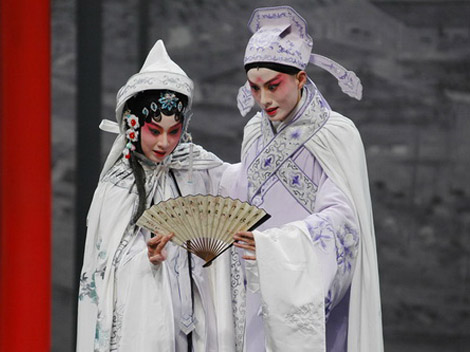
The object that gives this play its title is a gift Hou offers Xiangjun early in their romance: a palace fan on which he writes a poem testifying to his ardour, and which she then clings to all through their long separation. Xiangjun falls into the clutches of a devious Southern Ming coterie who want to force her into concubinage; rather than submit, she dashes her head against a pillar in a failed suicide attempt, spattering the fan with her blood (possibly the most upsetting moment in a play with no shortage of onstage deaths). A sympathetic painter friend reworks the bloodstains into peach blossoms, and in this form, as the bruised emblem of Xiangjun’s fidelity, the fan is eventually delivered into Hou’s hands, letting him know his beloved is both alive and steadfast.
Hou has to endure a spell in prison, and Xiangjun captivity in the Southern Ming court, before they each find their way to a rural retreat in the hills outside Nanjing. Several officials from the fallen dynasty have also found refuge in the same hilly sanctuary, and it is here, at a ritual commemoration honouring the late emperor and his court, that the two lovers are finally reunited. But Kong Shangren has something other than happily-ever-after in store for his hero and heroine, and for his audience.
Zhang, the Daoist priest presiding over the memorial ceremony, rips up the peach blossom fan and then has some rude words for Hou and Xiangjun. Amid mass slaughter and the fall of a dynasty, he tells them, the love between two little people does not amount to a hill of beans:
ZHANG: What are you babbling on about? What are you saying? At a time when earth crumbles and heaven is overturned, you still cling to the roots of love and the seeds of desire. Isn’t this ludicrous! HOU: You’re wrong there. From time immemorial, marriage and family have been fundamental in human relationships. The joys and sorrows of union and separation are the dictates of passion. How can you try to interfere, sir? ZHANG: Alas! You two deluded worms! Just look! Where is the country? Where are our homes? Where is our ruler? Where are our fathers? How can this romance not be severed? [Scene 40]
Zhang bats aside Hou’s defence of the sanctity of marriage and its role in maintaining social order. Love, marriage, even “society” itself are ultimately all just illusions that the enlightened individual learns to see beyond and do without. The priest convinces the young couple that only by converting to Daoism will they ever attain peace of mind, which they promptly do, with Hou setting off to enter the temple and Xiangjun committing herself to a nunnery.
By the time a reader reaches Scene 40, Kong has so thoroughly promulgated his bleak worldview that probably no one will still be anticipating an untroubled reunion for his two lovers. I was expecting something along the lines of a conventional romantic tragedy, one person dies, one person cries, but the denouement we get is more disconcerting than that. The abruptness with which Hou and Xiangjun renounce their bond implies that the love that kept them each going through months of separation and loss was a sustaining illusion, necessary in the moment but no less a mirage for all that.
That is not the only harsh medicine Kong dispenses at the end of his long chronicle. The Peach Blossom Fan’s title alludes to a resonant work of Chinese literature that the poet Tao Yuanming (also known as Tao Qing, 365–427 CE) wrote more than a thousand years earlier: the short prose narrative that precedes his poem “Peach Blossom Spring.” In it, an anonymous fisherman, after venturing far upstream and passing through a grove of blossoming peach trees and then a tunnel in a mountain, discovers a peaceful rural community serenely detached from the larger world outside. Surprised by their visitor’s sudden appearance, the “happy and carefree” inhabitants explain that
in the past, while their ancestors were fleeing the chaos of the Qin Dynasty [i.e., a few hundred years earlier], they led their families and fellow villagers to this remote place. As they hadn’t left it since then, they had been cut off from outsiders.2
The locals treat their guest hospitably for several days, but as he is preparing to leave, they deliver an injunction: “The villagers told him not to tell outsiders.” But of course he does, blabbing straightaway to the governor in his hometown, and an expedition is sent to confirm the mysterious community’s existence (and, we cannot help but surmise, bring it under official control). Although the fisherman carefully marked his way home from Peach Blossom Spring, neither he nor anyone else can locate it again. It remains forever out of reach, an unattainable utopian ideal.
This eerie anecdote, which can strike a contemporary Western reader as a forerunner to Brigadoon and to any number of old Twilight Zone episodes, undergoes a bleak reversal at the close of The Peach Blossom Fan. In a coda following the priest Zhang’s excoriation of worldly illusion and the two lovers’ grand act of renunciation, we reunite with the three survivors in the woods: the Ritual Master, Pockmarked Liu and Su Kunsheng. All former scholar-officials and literati, they now eke out hardscrabble countrified existences, the latter two as a woodcutter and a fisherman respectively.
At first the scene unfolds like a validation of the simple life and of Zhang’s pronouncement in Scene 30 that “leaving the dust and clamour is easy.” But not so fast. The men’s peaceful reclusion is interrupted when a local official bursts into their retreat and announces that all recluses must be rounded up for government service. This herald of the new state authority (significantly, he is indicated as wearing Qing costume) brandishes a warrant for their arrest and tells them: “Right now, it’s people like you that have to be found out and apprehended.” Liu, Su and the Ritual Master, the trio who have proved themselves to be the shrewdest operators in the whole play, take their leave with the stage direction “Exit, running in three directions.” There is nowhere to hide, for them or for us.
You have a talent for literary ornamentation and embellishment, but you lack the workings of the dark and blurry.
Good luck getting anyone to tell you that in your MFA class.
But there cannot be a better point of entry into the Hsu-Tang series than The Peach Blossom Fan. That may seem like an extravagant claim for a tome that weighs in at more than 800 pages, and a play that is more than 300 years old, but for me the combination of Kong’s narrative momentum, the variety of his characters and the felicity of Li’s translation all combined to make this initially daunting work as accessible as a good historical novel. Do not be deterred by the scholarly apparatus. The notes running alongside the text are comparable to most standard paperback editions of Shakespeare, for instance, and the side-by-side bilingual text should not faze anyone who regularly reads poetry in translation.
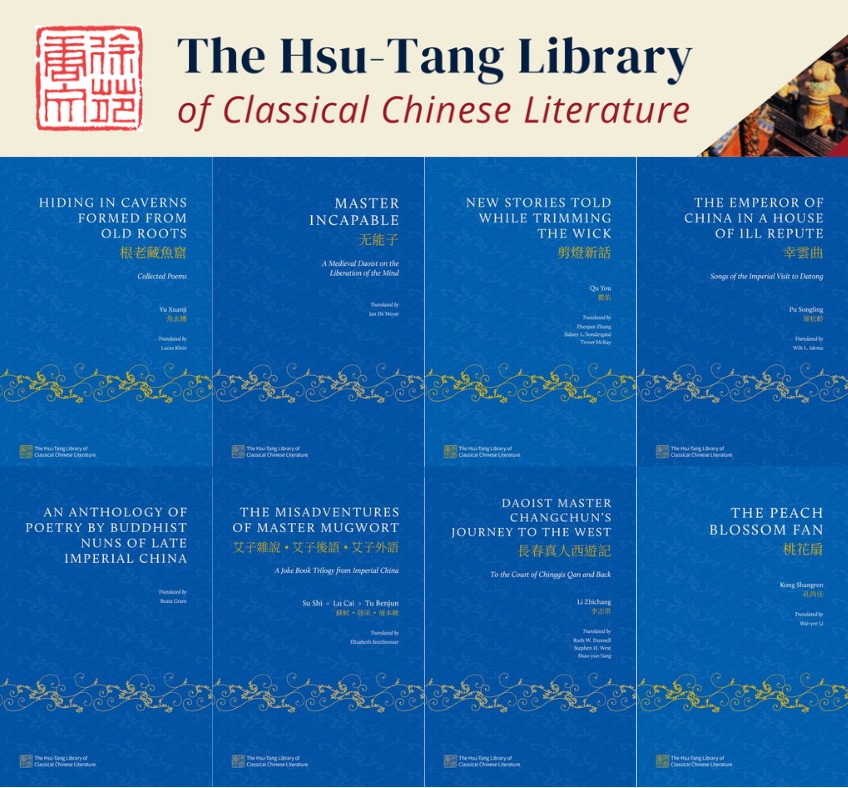
And not only that. The Hsu-Tang Library should also be acknowledged as a rare instance in contemporary publishing where the evident care that goes into the contents is matched by the care taken with the presentation. Li’s Peach Blossom Fan offers an opportunity for a reviewer to extol the book at hand as a physical object: in this case, a triple-decker hardcover that is so well constructed you can read it standing up on mass transit, and one graced moreover with an elegant typeface and layout and, like all the other titles in the series, a beautiful cobalt blue dust jacket. (The aesthetic appeal of those blue dust jackets sitting side by side should not be underestimated. Bookstagrammers who collect this series will rout the competition.)
Most of all, an endeavour like the Hsu-Tang Library feels like a bastion of sanity in dark times. Not long before I started reading The Peach Blossom Fan, the American Secretary of State publicly exulted in how the United States was going to start “aggressively” revoking Chinese student visas; as if in response, a few weeks later news broke that in China the authorities are confiscating the passports of even low-level and retired civil servants to prevent them from travelling abroad. These books are the real Peach Blossom Spring.
The University of California Press published a translation of The Peach Blossom Fan by Chen Shih-hsiang, Harold Acton and Cyril Birch in 1976, which was reissued by New York Review Books in 2015. The reissue was thoughtfully reviewed in Cha by William B. Noseworthy. Having sampled the earlier version for purposes of comparison, I do not hear in it the same polyphonic music Li elicits in her rendering, and the Wade-Giles romanisation imparts a slightly antique air to the text. ↩︎
How to cite: Tompkins, Jeff. “Things Fall Apart: Kong Shangren’s The Peach Blossom Fan.” Cha: An Asian Literary Journal, 12 Sept. 2025,chajournal.blog/2025/09/12/fan.
Jeff Tompkins is a writer and zine artist in New York City. His essays and reviews have appeared in the Brooklyn Rail, IMPULSE, and Words Without Borders, among other outlets. In previous incarnations he was a Senior Producer for Asia Society New York and the Online Content and Community Manager for Library of America, the non-profit publisher. [All contributions by Jeff Tompkins.]





 Cha
Cha 