

◉ Afterword: Living Between Languages
◉ Three Poems
◉ Anything but Human 大重啟
@ TrendLit Publishing

Living between languages
by Daryl Lim Wei Jie

My poetry was brewed in the multilingual kitchen that is Singapore. The translational and the interlingual—that is, existing between languages—seem to me utterly natural states of being. I am not just thinking of Singlish, our national creole. Some of you reading this might well be Taiwanese Hokkien speakers. Imagine my astonishment when I realised, in my first trip to Taiwan years ago, that the word for recently or just in Taiwanese Hokkien was not ba lu, as it is in Singaporean Hokkien. In Singaporean Hokkien, this fundamental concept is expressed by a Malay loanword: ba lu is derived from the Malay baru, meaning new. In that same trip, I learnt that the Taiwanese Indigenous languages are part of the same Austronesian language family as Malay. Our Taiwanese Indigenous guide told us that in her language, to eat was also makan. Coming back from the trip, my view of languages was totally transformed. The prescribed connections between ethnicity and language were becoming undone, and the guardrails that had demarcated seemingly different languages were quickly loosening. Although I did not know it then, this was part of my formation as a poet.
I do not believe that the English language is a single language, just as I do not believe the Chinese language is a single language. (By this, I am not even referring to the absurdity of grouping the vast number of so-called Chinese “dialects” as a single language.) Some sources allege that nearly eighty percent of the English language consists of loanwords from other languages. The figure for Chinese is much less, but it is significant and sometimes surprising. For example, the Chinese word for honey, 蜜, is believed to have come from a now-extinct Indo-European language, Tocharian, once spoken in the area which is now Xinjiang. This means, despite the vast distance, mì is related to the English mead (the alcoholic drink made from fermenting honey and water). Even a seemingly ordinary expression like 毕竟 (one of my favourite Chinese phrases: I just love how it conveys an unarguable and somewhat reluctant finality) has its origins in Sanskrit. My prize linguistic tidbit is the fact that the words for jasmine in Chinese, Malay and Tamil (the three so-called official mother tongues of Singapore) are all derived from the same Sanskrit root. I say mòlì, you say malli, she says melati. In this way, I think of languages not as separate streams of clear water, but as systems of wildly interconnected fibres. The image of different language family trees which we are familiar with then seems to be inadequate and perhaps utterly misleading. Languages themselves are what Deleuze and Guattari termed rhizomes: “unlike trees or their roots, the rhizome connects any point to any other point”. Take any word in any language, and it can be a key to another language, unlocking centuries of history—some of it secret, some of it lost.
I am muddying the waters not to devalue the work of the translator (especially not one as talented as Andy, the terrific translator of this book) but to disturb some of the heroic metaphors that are sometimes used in describing the work of translation. As a translator myself, I do not think that we are building bridges between cultures nor ferrying precious cargo between two shores. These ways of speaking seem to me to only exaggerate the differences between cultures and languages, which are so often hardened by official categories and national politics. The calcification of these boundaries plays right into the hands of ethnonationalists and other retrograde fantasists. Enough of that, I say. We are able to translate because languages naturally have so much affinity with each other, not because they are so different.
A parallel situation exists in food, my other great passion. Most cuisines in the world are by nature already fusion cuisines. Italian food would be unimaginable without tomatoes. Indian and Chinese food, without chilli peppers. British food, without the potato. (The weakest member of this triad, I know.) All these ingredients came from the Americas. In my native Singapore, many supposed “Indian” and “Chinese” dishes would be foreign in India and China. The dish I always crave when away from Singapore is bak chor mee. In its platonic form, it is yellow egg noodles, minced pork, stewed mushrooms, crunchy nuggets of lard, deep fried shards of dried sole fish and a dressing made from punchy black vinegar, fish sauce and chilli sauce. I think of it acquiring new layers of flavour as some ancestral version made its way from Chaozhou in China—crucially, it picked up the fermented shrimp chilli, or sambal, of the Malay Peninsula, dramatically altering its taste profile. Ancient patterns of trade and the movement of people, animals, plants and produce have long shaped our foodways. In gastronomy, it is the undue focus on cuisines deemed more fusion (and by implication, more exotic, and by further implication, more prestigious) that blinds us to the mélange of the everyday.
Languages and cuisines are positively promiscuous. They are often in bed with each other (much like poets). They pollute and impregnate each other.
To write poetry is to be open to this pollution, and corruption. This is why Anything but Human (in English) has several Bai Juyi poems translated from the Chinese (though we have made the decision to omit them in the Chinese edition). Translating Bai Juyi’s radically simple and elegant poems showed me a way out of a rut I had got myself into, that of increasing sophistry and obscurity. Since then, I have believed in the salvific value of translation as a way of opening up one’s poetic meridians, to use an analogy from Chinese medicine. When we translate, we are unmoored from the rigid fixities of the tongue we grew up speaking. We learn to bend and break the rules. That state is perfect for poetry, which demands of us an unnatural, sometimes perverse, relationship with language.
Having said all that, I have long viewed my poems as always already translated (just as I think of most food as always already fusion), because I was never speaking to a monolingual audience. I had never intended them to be some inert and stable compound, aspiring for a niche in some columbarium canon. I want them to react unstably, dangerously with the reader and the world. I want my poems to be seeds of many gorgeous, new languages. (I will contradict myself here and say that poetry is ultimately a language of one. Be your own idiolect.)
Now that they exist in this fantastic Chinese translation by Andy, I find myself wondering, like a Borgesian protagonist, which is the original and which the translation. The answer is, of course, it does not matter.
How to cite: Lim, Daryl Wei Jie. “Anything but Human: Living between Languages.” Cha: An Asian Literary Journal, 10 Sept. 2025, chajournal.blog/2025/09/10/human-afterword.

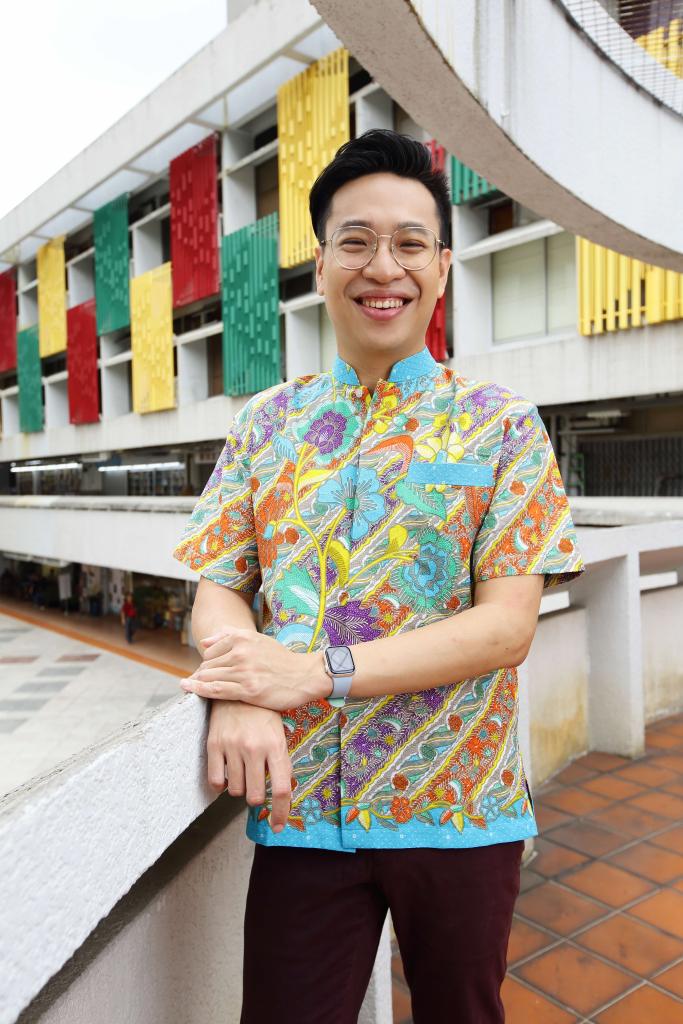
Daryl Lim Wei Jie 林伟杰 is a poet, translator and editor from Singapore. His latest collection, Anything but Human, was a finalist for the Singapore Literature Prize. He conceptualised two anthologies: Food Republic: A Singapore Literary Banquet, which received a Special Award at the Gourmand World Cookbook Awards;and The Second Link, a collection of Singapore and Malaysian writing about the unique relationship between the two countries, shortlisted for Best Literary Work at the Singapore Book Awards. In 2023, he was awarded the Young Artist Award, Singapore’s highest honour for young art practitioners. He is currently working on the video gaming anthology, Free to Play. www.darylwjlim.com (Photo credit: The National Arts Council, Singapore) [Daryl Lim Wei Jie & chajournal.blog.]
 Cha
Cha 