

📁 RETURN TO FIRST IMPRESSIONS
📁 RETURN TO CHA REVIEW OF BOOKS AND FILMS
Joan E. Ericson, Be a Woman: Hayashi Fumiko and Modern Japanese Women’s Literature, University of Hawai’i Press, 1997. 292 pgs.
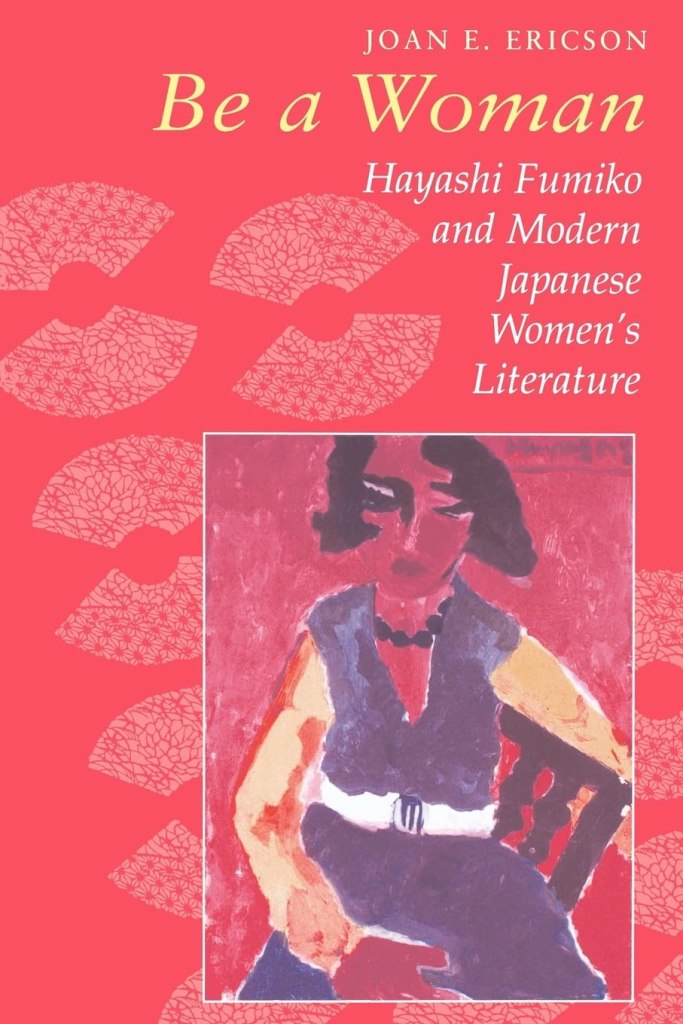
The vicissitudes of women’s literature in Japan have undergone dramatic transformations from the Heian period to modern times, yet they have always been shaped by the persistent tension between gendered cultural expectations and artistic agency. Joan E. Ericson’s Be a Woman: Hayashi Fumiko and Modern Japanese Women’s Literature (1997), now recognised as a seminal work, constitutes an invaluable contribution to the scholarship of modern Japanese literature in English, distinguished by its meticulous historical scope and insightful intervention into the gendered categorisation that has long defined—and limited—the reception of modern Japanese women writers. Ericson problematises “women’s literature” (joryū bungaku), arguing that it should not be spoken of as a neutral, universal category, but as a contested field that was culturally constructed. She does not, however, attempt to offer another reductive—or comprehensive, for that matter—definition of “women’s literature,” but instead advocates for a nuanced, author-centric approach that examines how individual writers navigated and subverted gendered expectations. By taking Hayashi Fumiko as a case study and analysing her engagement with literary institutions, media platforms, and critical reception, Ericson reveals the complex strategies a prominent modern Japanese woman writer employed within a constrained system to establish her literary identity and legitimise her works, thereby allowing for a richer appreciation of their unique contributions and impact.
Ericson discerningly observes that in the field of modern Japanese literary studies, gendered demarcation proved influential in establishing a rigid, often derogatory, categorical framework—epitomised by the term joryū bungaku—which segregated women’s writing from the mainstream (male) canon. This framework shaped critical perceptions of women’s writing as “principally characterised by sentimental lyricism and impressionistic, non-intellectual, detailed observations of daily life,” and ultimately led to its systematic marginalisation within literary history (p. 3). Her critical questioning of this very category first emerged during the conception of her doctoral thesis a decade prior to the publication of Be a Woman, when she encountered surprising resistance from Japanese scholars who naturalised these labels, defending them as unproblematic or even complimentary. Such reactions revealed the deeply entrenched, hegemonic status of gendered literary taxonomies, which for decades had been accepted as self-evident rather than recognised as culturally constructed tools of exclusion. Despite this initial dismissal, Ericson’s work proved pioneering, prefiguring and later converging with a broader wave of feminist critical developments that reevaluated joryū bungaku as a critical concept.
Ericson’s major criticisms of joryū bungaku centre on its function as a hegemonic categorical tool that not only segregated women’s writing but also actively produced and enforced a largely patriarchal, gendered aesthetic ideology mediated by publishing and literary institutions. This ideology obscured artistic individuality, intellectual ambition, and formal experimentation in favour of a narrow, commercially legible “feminine” style. While such reductive practices tended to reduce women’s writing to a homogeneous category defined by gender-based stylistic expectations, in reality women’s literature is far more diverse, encompassing a wide range of genres, themes, and formal innovations—from social realism and proletarian critiques to psychological introspection and modernist experimentation—that actively engaged with, subverted, and transcended the very gendered conventions imposed upon it.
Paradoxically, it is precisely this rich diversity and strategic negotiation that leads Ericson to focus on a single author—Hayashi Fumiko. She argues that a macro-level categorical view often flattens difference and obscures how female literary voices adapted to or resisted gendered expectations. The study of one writer’s work, however, can reveal how “literary conventions appear not as fixed or as determining, but as negotiable” (p. 14). In this way, Ericson shifts the emphasis away from broad patterns to the particular, allowing her to highlight the innovations, originality, and distinctive qualities of the writing and the writer, showing how an individual such as Hayashi Fumiko actively navigated and contested gendered institutional practices.
Be a Woman is divided into two parts: Part One, “Literary History,” and Part Two, “Fiction.” Part One comprises six chapters: “Reading a Woman Writer,” “When Was Women’s Literature,” “Women’s Journals,” “Reading a Woman’s Diary,” “Transformations,” and “A Place in Literary History.” It begins by recognising how the very category of joryū bungaku (“women’s literature”) was a cultural construct of the 1920s, shaped by specific literary trends, market forces, and critical discourses. The book then demonstrates how women writers strategically navigated these constraints through the central case study of Hayashi Fumiko, whose publication of Hōrōki in the journal Nyonin geijutsu exemplifies how a woman writer could achieve fame by operating within, and ultimately transcending, this gendered literary category. In “Women’s Journals,” Ericson offers a detailed historical analysis of early twentieth-century women’s literary magazines in Japan, in particular Seitō and Nyonin geijutsu, arguing that such journals created both a market and a critical space for women’s writing. They fostered a dedicated female readership eager for narratives reflecting their experiences, while also attracting commercial attention that legitimised—yet simultaneously ghettoised—women’s literary production. These conditions, however, also enabled writers to subvert expectations from within. Hayashi Fumiko, for instance, serialised her most notable work “Diary of a Vagabond” in Nyonin geijutsu, using the journal’s platform to craft a raw, autobiographical voice that resonated deeply with young readers who similarly struggled with the economic precarity, social dislocation, and emotional turbulence of modern urban existence. Her depiction of a wandering and impoverished, yet intellectually restless woman offered a counter-narrative to dominant ideals of femininity, capturing the contradictions of a generation negotiating between traditional expectations and new, often unsettling, freedoms. By strategically performing, and at times exaggerating, her image as a struggling and itinerant woman writer, Hayashi leveraged the journal’s niche appeal to achieve broad recognition, while simultaneously transcending the very category that attempted to define and confine her.
The second part of Be a Woman consists of new translations, undertaken by Ericson herself, of two of Hayashi Fumiko’s works: “Diary of a Vagabond” (Hōrōki) and “Narcissus” (Suisen). “Diary of a Vagabond” is connected to the Japanese “I-novel” (shishōsetsu) tradition, yet transcends its personal perspectives to achieve a vividly expansive and sociologically trenchant reflection on modernity. Its confessional, first-person narrative, rooted in the author’s own experiences of poverty and wandering, aligns with the shishōsetsu’s focus on the subjective self and the rendering of personal truth. However, as Ericson astutely observes, Hayashi’s originality lies in her capacity to channel this personal lens into a collective vision, moving beyond individual angst to document the gritty humanity of society’s underclass (p. 58). The protagonist’s rootlessness is not a spiritual ennui but a material condition of urban, industrial modernity, captured in scenes of factory labour where workers are dehumanised, their youth and health slowly extracted as they paint “Kewpie dolls [that] poured out on the world from our lethargic, leaden hands” (p. 142).
Hayashi’s intellectual world is distinctly modern and cosmopolitan. Her narrator does not retreat into Japanese aesthetics but instead seeks solace in the Western canon, invoking Chekhov and Wilde, while her poetic, stream-of-consciousness style reflects a fractured, contemporary consciousness. This is not merely an “I-novel” of personal reflection; it is a sociological portrait. The immediacy Ericson praises is palpable in the raw, unflinching prose that depicts the narrator’s world: the thumbless prostitute with a snake tattoo coiled around her belly (p. 125), the plight of a deranged former miner (p. 125), and the visceral, unrelenting hunger that drives the narrator to fantasise about “a plump steamy pork cutlet” (p. 139). Thus, while grounded in the personal, “Diary of a Vagabond” employs its “I” as a window onto the “underside of Japanese society,” achieving a clarity and power that resonate with universal struggles of class, gender, and the relentless pursuit of self amidst adversity (pp. 58, 65).
“Narcissus” is a bleak and psychologically intense story that examines the toxic, co-dependent relationship between a middle-aged mother, Tamae, and her indolent twenty-two-year-old son, Sakuo. It marks the maturation of Hayashi’s style and the refinement of her postwar prose (p. 86). “Narcissus” masterfully evokes the suffocating atmosphere of the mother–son relationship, in which love has been corroded by resentment and mutual exploitation. Tamae is tormented by her son’s joblessness, a persistent source of bitter conflict that ultimately resolves in his departure for Hokkaidō, leaving Tamae with a powerful sense of liberation and return to youthfulness, ironically expressed through her shoplifting of a cellophane bag of sweets and a decorative soy sauce container (p. 235). Hayashi’s prose is unsparing and detailed, immersing the reader in the grim reality of poverty and emotional decay. The story is a significant achievement for its nuanced and unsentimental portrayal of a failed maternal bond, offering no facile resolution or redemption for its deeply flawed characters.
Be a Woman stands as a major contribution to the study of modern Japanese women’s literature, presenting a groundbreaking, book-length study in English that combines literary history, biography, and translation to centre the pivotal figure of Hayashi Fumiko. Nonetheless, to write a historical account through the lens of a single writer, however prominent, risks sacrificing a broader perspective and over-emphasising individual exceptionalism. While Ericson justifies this concentrated approach as a means of providing depth and exemplifying how individual writers disrupted the homogeneity of the category, readers in search of a comprehensive overview of modern women writers may find themselves somewhat dissatisfied. Moreover, the hybrid nature of the book—at once literary criticism, literary history, and translation—offers a balanced perspective on the writer in focus, yet also creates a fracture between analytical narrative and the presentation of primary source material.
A defining and deliberate feature of Ericson’s methodology is her rejection of high theory, as she declares: “I seek to avoid the presumption that Western theories are the sole measure for any scholarly assessment of gendered literary categorization in Japan. The Japanese debates and dynamics are worth recovering and scrutinizing on their own terms” (xi). This commitment ensures the study’s enduring accessibility and provides a clear, historically grounded contextualisation of Hayashi’s significance, unencumbered by the theoretical jargon then dominating literary studies. Yet this very choice may not satisfy those seeking a theoretically informed textual analysis. As a pioneering English-language study of modern Japanese women’s literature from the 1990s, the book inevitably predates subsequent developments in feminist, queer, and postcolonial theory. These frameworks could further illuminate the gendered and colonial contexts of interwar Japan that shaped Hayashi’s work, and readers may wish to consult more recent research alongside Ericson’s study. Indeed, subsequent scholarship, such as William O. Gardner’s reappraisal of “Diary of a Vagabond” in his article “Mongrel Modernism: Hayashi Fumiko’s Hōrōki and Mass Culture” and his monograph Advertising Tower: Japanese Modernism and Modernity in the 1920s, has built upon Ericson’s foundation to reframe Hayashi not merely as a writer of sentiment but as a bold modernist innovator—an understanding that extends beyond the scope of Ericson’s earlier work.
How to cite: Ng, Charlie. “Re-evaluating ‘Women’s Literature’ as a Category: Hayashi Fumiko as a Woman Writer in Modern Japan.” Cha: An Asian Literary Journal, 9 Sept. 2025, chajournal.blog/2025/09/10/Hayashi-Fumiko.


Charlie Ng is currently teaching at the School of Arts and Social Sciences of Hong Kong Metropolitan University. She studied English at the Chinese University of Hong Kong and graduated with a PhD in English Literature from the University of Edinburgh. Her poetry can be found in Voice & Verse Poetry Magazine. [All contributions by Charlie Ng.]
 Cha
Cha 