

TIFF 2025
▞ 10. The Archivist’s Film: A Conversation on Kunsang Kyirong’s 100 Sunset
▞ 9. She Was Screaming into Silence: A Conversation on Cai Shangjun’s The Sun Rises On Us All
▞ 8. You Don’t Belong to Anyone: A Conversation on Kalainithan Kalaichelvan’s Karupy
▞ 7. The Paper Boy: On Park Chan-wook’s No Other Choice
▞ 6. Saigon Does Not Believe In Tears: On Leon Le’s Ky Nam Inn
▞ 5. The Need for Change: On Kei Ishikawa’s A Pale View of Hills
▞ 4. The Angel of Death: On Jafar Panahi’s It Was Just An Accident
▞ 3. Of Eros & Of Dust: On Ratchapoom Boonbunchachoke’s A Useful Ghost
▞ 2. Light At The End of the Labyrinth: On Genki Kawamura’s Exit 8
▞ 1. Affairs of the Heart: On Cai Shangjun’s The Sun Rises On Us All

Cai Shangjun’s The Sun Rises On Us All, 2025. 131 min.
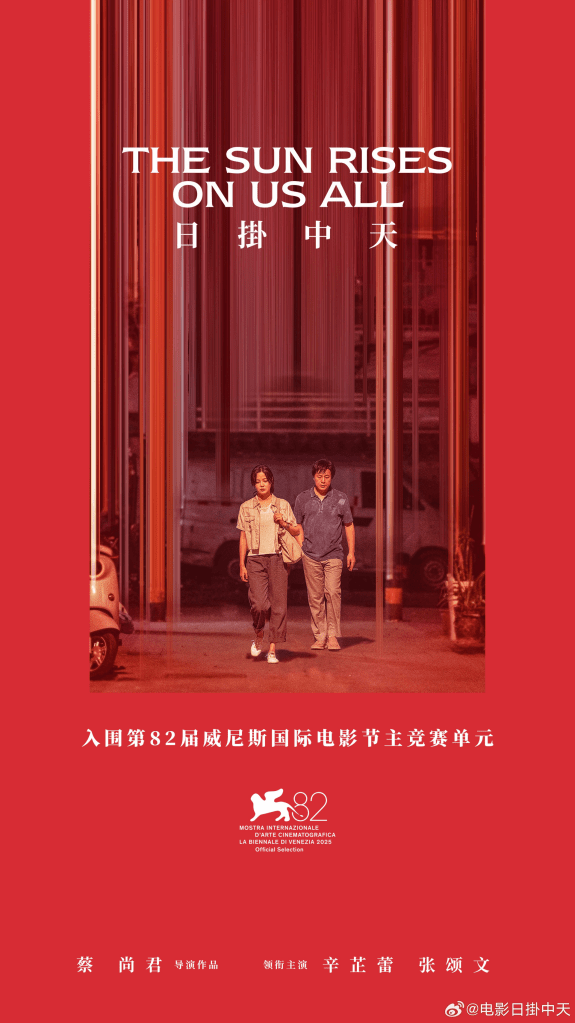
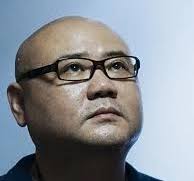
In the middle of The Sun Rises on Us All, the newest film by Cai Shangjun (pictured), which premiered in the main competition of the 2025 Venice Film Festival, the two protagonists find themselves trapped in the elevator of a housing complex. There is Meiyun, a pregnant shop owner played by Xin Zhilei in a star-making performance, and Baoshu, an ex-convict undergoing cancer treatment played by a disappointingly one-note Zhang Songwen. They press all the buttons but nothing responds. They cry for help yet there are no signs of assistance. When the doors open slightly, they grab each side and try to force them apart with their own strength. He tells her to go first and she escapes, but when his turn comes the inward pressure becomes unbearable and he gives up the struggle. The doors close on him while she remains outside the enclosure.
This scene, archetypal and metaphorical, reflects the pair’s complicated relationship, which reveals itself gradually in fragments of Han Nianjin’s screenplay. Their past, never shown but vividly recounted, involves a relationship torn apart by a hit-and-run accident that killed a man, leading to Baoshu’s imprisonment. During his sentence Meiyun abandoned him. When the film opens in a hospital waiting room, where she awaits an ultrasound and he wanders after surgery, they are astonished to encounter each other again, so much so that Baoshu later insists it must be fate.
Once he moves into her small flat in Guangzhou, tensions simmer and it becomes clear there is more to their story. Shangjun, however, is in no hurry to reveal his vision. The camera, in the deft hands of cinematographer Kim Hyunseok, who followed three principles laid out by the director—“Rooted in nature; stripped of artifice; focused on the inner transformation of the characters”—is often positioned behind curtains, outside doors, or inside cars, inching closer to these wounded souls. None is more tormented than Meiyun. Her life appears to be collapsing from every direction: her affair with a married man is ending, her business is failing due to poor-quality suppliers and negative online reviews, and she must contend with the sudden reappearance of an old lover to whom, for reasons eventually revealed, she feels indebted.
At the edges of the frame lie portents of what is to come: a girl suddenly slitting her wrists, glass shattering without warning, a fire erupting without cause. The narrative resists prediction. It might embody the optimism that Meiyun clings to, or it might yield to Baoshu’s jaded nihilism. The greatest pleasure of The Sun Rises on Us All, however, is witnessing Xin Zhilei deliver a stunning, full-bodied performance that recalls Jeon Do-yeon in Lee Chang-dong’s Secret Sunshine (2007) and Émilie Dequenne in the Dardenne brothers’ Rosetta (1999).
Xin Zhilei, who first broke through with her leading role in Yang Chao’s Crosscurrents (2016) and appeared in Wong Kar Wai’s Blossoms Shanghai (2024), carries the film almost entirely on her face. She must suppress a myriad of emotions that surface the moment Baoshu reappears, so that when she finally breaks, as in the extraordinary scene before one of her live-streams, the result is riveting. She powders her face, lines her eyes with kohl, tears streaming as she fails to contain herself in the face of Baoshu’s questions about her last visit with his late mother. “I wish I’d gone to jail,” she confesses, for sometimes life outside, confined by body and memory, is a prison of its own. “I’m the villain.”
What Xin achieves is a complete embodiment of the shifting weight of guilt, set against her intense desire to bear a child, to begin anew, to emerge from inward collapse and present an outward facade. “The sentient cannot be absolved and those who make sacrifices are not compensated,” Shangjun writes in his director’s statement. Yet despite such bleakness, The Sun Rises on Us All — whose title recalls the Paul Valéry-inspired name of Hayao Miyazaki’s The Wind Rises — depicts angels and demons on the same plane, neutralised by the indifference of nature.
The return, the unborn child, the accident, the prison sentence, blame, secrets, guilt, compassion: this film, at two hours and eleven minutes and edited by Matthieu Laclau, Yann-Shan Tsai and Jenson Tay Ti, is pitched at the level of Greek tragedy. Its final primal scream lingers long after the credits roll, reverberating into the near bright future of anyone who has borne witness.
How to cite: Nagendrarajah, Nirris. “Affairs of the Heart: On Cai Shangjun’s The Sun Rises On Us All.” Cha: An Asian Literary Journal, 6 Sept. 2025, chajournal.blog/2025/09/06/sun-rises.


Nirris Nagendrarajah (he/him) is a Toronto-based writer whose work has appeared in paloma, Polyester, Fête Chinoise, In the Mood Magazine, Tamil Culture, in addition to Substack. He is currently at work on a novel about waiting. [All contributions by Nirris Nagendrarajah.]
 Cha
Cha 