

📁 RETURN TO FIRST IMPRESSIONS
📁RETURN TO CHA REVIEW OF BOOKS AND FILMS
Akiko Ohku (director), Hold Me Back, 2020. 133 min.

Akiko Ohku is best known for directing and co-writing Tremble All You Want and Hold Me Back, two films which won the Audience Choice Award at the Tokyo International Film Festival in 2017 and 2020, respectively. Both were adaptations of novels by Risa Wataya, her frequent collaborator, who also served as co-writer of the former.
Her female protagonists are frequently characterised by a combination of traits: single, eccentric, introverted, quirky, introspective, socially anxious, inexperienced in romance, independent, and occasionally lonely. She portrays, with both precision and sensitivity, the challenges and sentiments of these women as they navigate daily life, romance, career, social relationships, and the complexities of independence.
Ohku is among my favourite Asian women filmmakers. Her two aforementioned films, as well as My Sweet Grappa Remedies (2019), are personal favourites for the way they centre on female characters who are late bloomers in romance, often retreat into their inner worlds, and confront society’s expectations of women. Her work has made me feel seen. I have always admired her peculiar and offbeat approach to storytelling, her candid depictions of social anxiety and loneliness, and her ability to illuminate the struggles of contemporary Japanese women.
Compared with Tremble All You Want and My Sweet Grappa Remedies, Hold Me Back addresses darker and more serious themes—trauma, sexual harassment, self-sabotage, and alienation.
The film follows Mitsuko (Non), a solitary woman in her early thirties who sustains herself through daily conversations with “A”, a male voice inside her head. Ohku employs magical realism in her depiction of “A”, who simultaneously embodies society’s expectations of women and Mitsuko’s innermost desires.
Mitsuko is content with her single life until Tada (Kento Hayashi), her neighbour, shows an interest in her. Traumatised by past sexual harassment and inexperienced in romance, she struggles to confront her burgeoning feelings for him. Their interactions are wholesome and tender, marked by their mutual awkwardness. For Mitsuko, yielding to affection for Tada means vulnerability—facing her intimacy issues and relinquishing “A”.
The film also introduces Mitsuko’s small circle of women friends: Nozomi, a colleague, and Satsuki, a university batchmate who has since moved to Europe. Nozomi is her foil, unreserved in her affections and unbothered by how others perceive her persistence. Satsuki, meanwhile, is crucial to the narrative despite some viewers considering her subplot unnecessarily prolonged. Her presence provides insight into Mitsuko’s past—her artistic background and abandoned passions—as well as her prolonged attachment to “A”. Through Satsuki, Ohku also gestures towards the alienation experienced by women during pregnancy and motherhood, particularly those who emigrate alone to Western countries. I also appreciated that the film foregrounds the importance of female friendship more strongly than in Tremble All You Want.
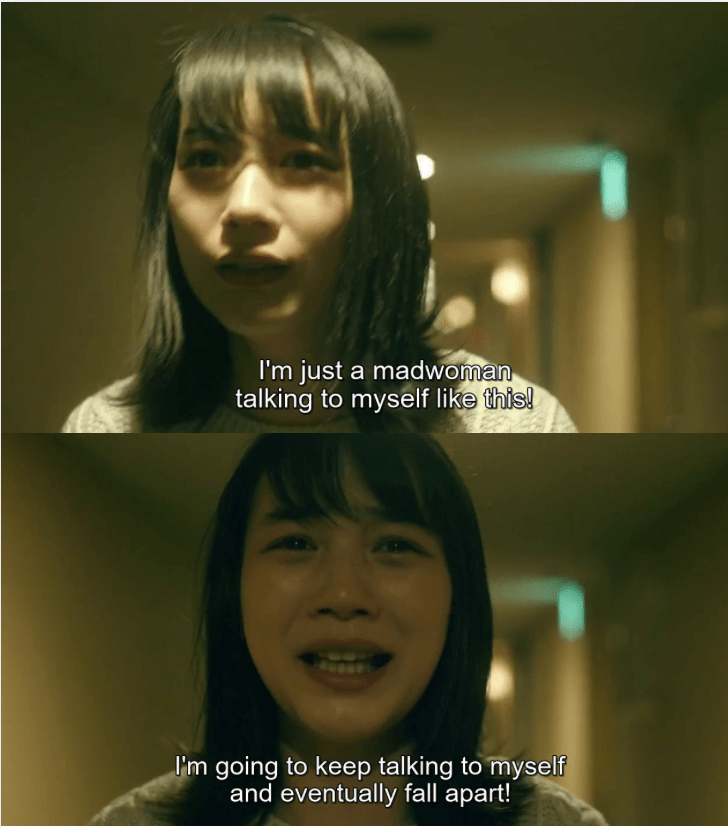
Non delivers a nuanced and captivating performance as Mitsuko, embodying her inhibitions, vulnerability, eccentricities, and tenderness with remarkable balance. She portrays with precision the dissonance of a woman torn between the serenity of solitude and the turbulence of romantic love. She is at her finest in two major scenes that depict trauma’s lingering grip. The second breakdown, in particular—encapsulating Mitsuko’s profound fear of intimacy and commitment, as well as her anxiety at the disappearance of “A”—stands as one of the most memorable and affecting moments not only in Ohku’s filmography but in Japanese romantic comedy as a whole.
As a socially anxious loner who speaks to herself, a victim of harassment, long single, yet ultimately at peace in solitude, I felt profoundly recognised by Hold Me Back. I fully understood Mitsuko’s hesitation, her inner dissonance, and her fears.
In this film, Ohku once again succeeds in creating a complex, relatable female character who, despite inhibitions, anxiety, and trauma, strives—bravely and tenderly—to put herself out there.
How to cite: QP, Danica. “Feeling Seen: Akiko Ohku’s Hold Me Back and the Solitude of Modern Women.” Cha: An Asian Literary Journal, 31 Aug. 2025, chajournal.blog/2025/08/31/hold-me-back/.



Danica QP is a longtime world cinema fan, with a particular bias to Asian cinema. She attributes her early fascination with watching films to her late mother. She loves coming-of-age and slice-of-life stories.
 Cha
Cha 