
📁 RETURN TO FIRST IMPRESSIONS
📁RETURN TO CHA REVIEW OF BOOKS AND FILMS
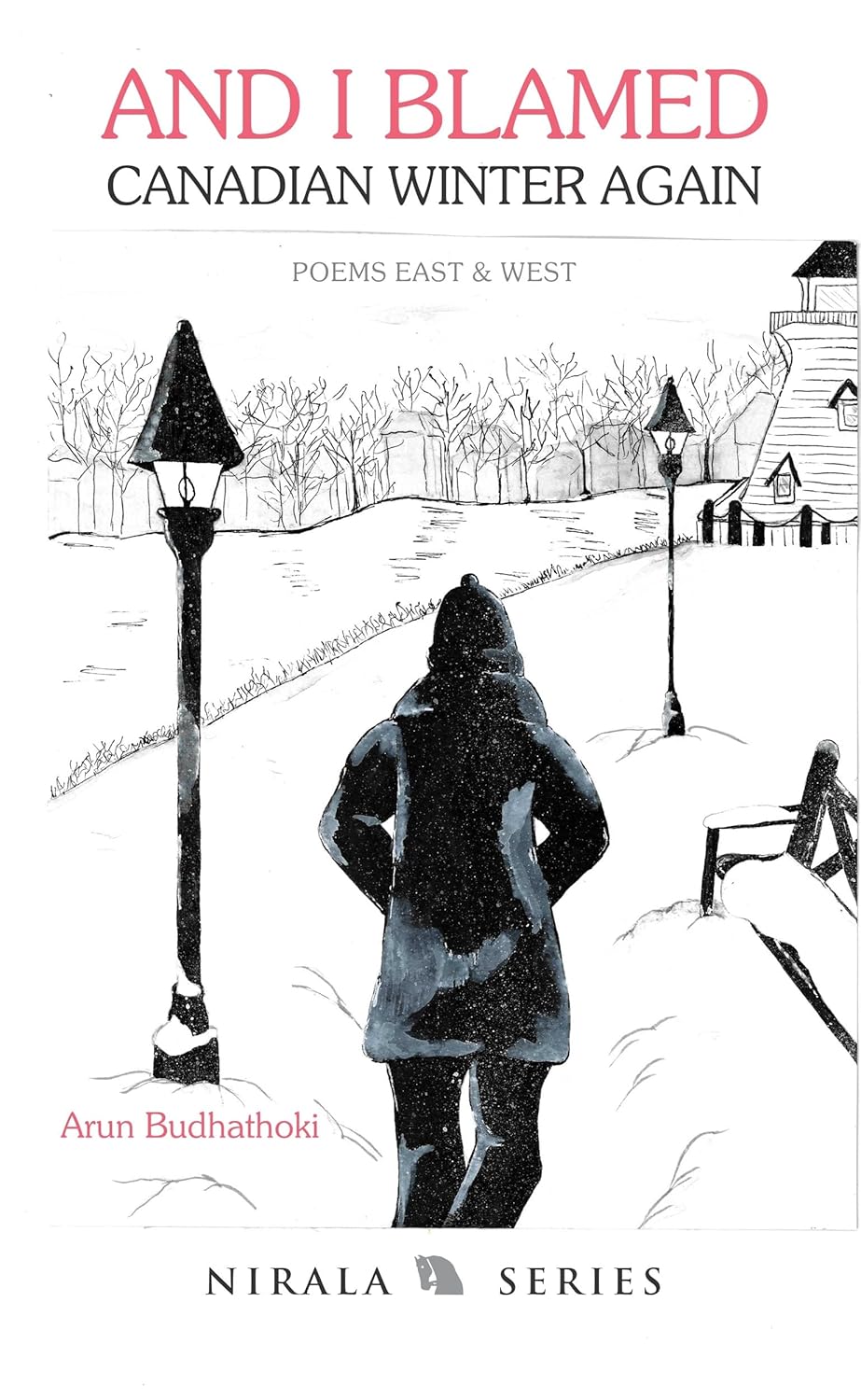
Arun Budhathoki, And I Blamed Canadian Winter Again: Poems East & West, Nirala Publications, 2025. 98pgs.

Nepali poet Arun Budhathoki, who has been living in Canada, has recently published his new collection of poems, And I Blamed Canadian Winter Again: Poems East & West. Returning to poetry after nearly a decade, Budhathoki explores themes of immigration, identity, displacement, memory, and belonging in a deeply resonant way.
The poems in the anthology trace the poet’s journey from the snowy landscapes of New Brunswick, Canada, to the high mountains of Nepal, where he spent his childhood. He moves between East and West, past and present, memory and reality—seeing the world through the eyes of an immigrant poet.
Reflecting on his work, Budhathoki states: “This book is not just my return to poetry, but a restoration of the power of words, which can reveal the depths of emotional life, comfort, and bring distances closer.”
And I Blamed Canadian Winter Again is a vibrant collection that intertwines cold landscapes with the warmth of inner turbulence, identity, and the longings of the diaspora during his years in Canada. The anthology serves as an emotional chronicle of a narrator negotiating past moments, exile, seasonal melancholy, and cultural duality upon the vast, indifferent canvas of Canada’s frigid winters. Here, “winter” is both literal and metaphorical, echoing isolation, dislocation, and a chilling sense of loss not easily thawed.
The collection offers a compelling reflection on displacement, as the narrator—an immigrant, a student, a worker, or a creative spirit marooned between worlds—confronts the emotional and existential costs of migration. Canada, with its postcard beauty and brutal winters, becomes the backdrop for self-reconstruction. The poems do not romanticise migration; rather, they grapple with its illusions and betrayals. His hometown, rendered in poetry, acquires a surreal aura—its streets in Patan appearing through words both lived and remembered.
Budhathoki constructs his testimony of past and present as an observant figure—someone who measures time not merely by the passing of days, but by the layers of memory and emotional armour that are stripped away or added with each season. There is a quiet irony in blaming “Mourning Jerusha’s Disappearance” for things it cannot cause: heartbreak, homesickness, failed relationships, depression.
The voice in this collection is highly personal, yet it often transcends the individual to speak for a larger, invisible community of migrants and exiles who endure the strains of cultural dualism after leaving their native land. The diction is accessible, yet the emotional depth considerable, addressing questions of identity and the reflections of a life in transit. The poems range from tightly wrought free verse to longer, breathless stanzas that echo thought spirals and inner monologues. The deliberate absence of strict form reflects the fragmented, nonlinear nature of memory and healing.
One of the most striking aspects of this work is its candour about mental health and solitude. The poet does not shy away from themes of seasonal depression, anxiety, or the dark thoughts that so often surface during long, isolating winters. Indeed, the title itself suggests a cycle—of blaming, breaking, surviving—that many immigrants and expatriates undergo but seldom articulate while living in alienation. Budhathoki meditates on the fusion of surreal and geographical landscapes—from the Himalayan region of his childhood to the chilling winter nights of Canada. He also critiques, with subtle force, the way one’s native tongue can become alien in a foreign land, while another’s language, though vital for survival, may feel like a borrowed coat. Some poems incorporate code-switching or multilingual textures, lending authenticity and complexity to the narratives. His exploration of linguistic identity is especially poignant in those poems that evoke nostalgic belonging, loss in translation, and the aching absence of the mother tongue.
Poems such as “Departure”, “Ode to Toronto”, “Umbrella”, “The Clock is Dead”, “The House”, “Red Eye”, “Noisy City”, “City of Dust”, “The Fountain Rain is Here”, “Shadows”, and “The Return” explore a wide emotional spectrum without slipping into melodrama, achieving a powerful resonance. Budhathoki demonstrates a fine eye for both visual and emotional imagery, particularly in his depictions of cold climates and inner desolation at life’s crossroads in a foreign land.
The verses in this anthology are not only explorations of the migrant’s inner world, of fractured family bonds and cultural dissonance, but also testimonies to hope and resilience. That said, readers who prefer narrative progression may find the collection somewhat cyclical. The recurrence of certain motifs—snow, silence, shadows, odes to streets, Fredericton—risks monotony by the midpoint. A greater structural variation, or even a few poems set in contrasting climates or memories, might have enriched the texture further.
And I Blamed Canadian Winter Again is not simply a poetry collection—it is a testament. It is a brave and introspective work that does more than mourn or lament: it remembers, endures, and, at times, in hushed verses, even forgives. For anyone who has ever felt caught between two worlds, this book provides not just catharsis, but also language for those truths too often left unspoken.
How to cite: Parajuli, Subash Singh. “Diaspora and Duality: The Emotional Cartography of Subash Singh Parajuli’s And I Blamed Canadian Winter Again.” Cha: An Asian Literary Journal, 29 Aug. 2025, chajournal.blog/2025/08/29/and-i-blamed.



Subash Singh Parajuli is a poet, educator and avid traveller from the eastern region of Nepal. A versatile writer, storyteller and literary organiser, he has published numerous poems in international journals and anthologies. His poetry collections include Mystic Myth (2014), Soil on Pyre (2017), and Symphony of Life (2019). He also edited an international anthology on the coronavirus pandemic, Pandemic Poetry 2020, published by Brosis Publishers and Distributors, Delhi, India. He is a multi-award-winning poet and an ambassador of various peace organisations. As the Ambassador and Core Administrator of the Indo-Nepal Pictorial Forum, he has organised poetry workshops and recitations in Nepal, and in 2019 helped secure a World Book Record for a Pictorial Poetry Exhibition. He also served as editor of the World Pictorial Poetry Coffee Table anthology Just For Love and of Pandemic Poetry 2020. Among his many honours, he received the PENTASI B Universal Inspirational Poet Award in 2017 in the Philippines, the Epitome for Peace and Literature Award from Nigeria in 2018, the Eternity for Peace Award from Odisha, India, in 2018, and the Youth for Peace Ambassador Award by the World Youth Peace Foundation (WYPF) in Korea in 2019. In 2021, he was also honoured with the Sahitto Academy Award of Bangladesh.
 Cha
Cha 