
📁 RETURN TO FIRST IMPRESSIONS
📁 RETURN TO CHA REVIEW OF BOOKS AND FILMS
Sho Miyake (director), Two Seasons, Two Strangers (Tabi to Hibi), 2025. 89 min.
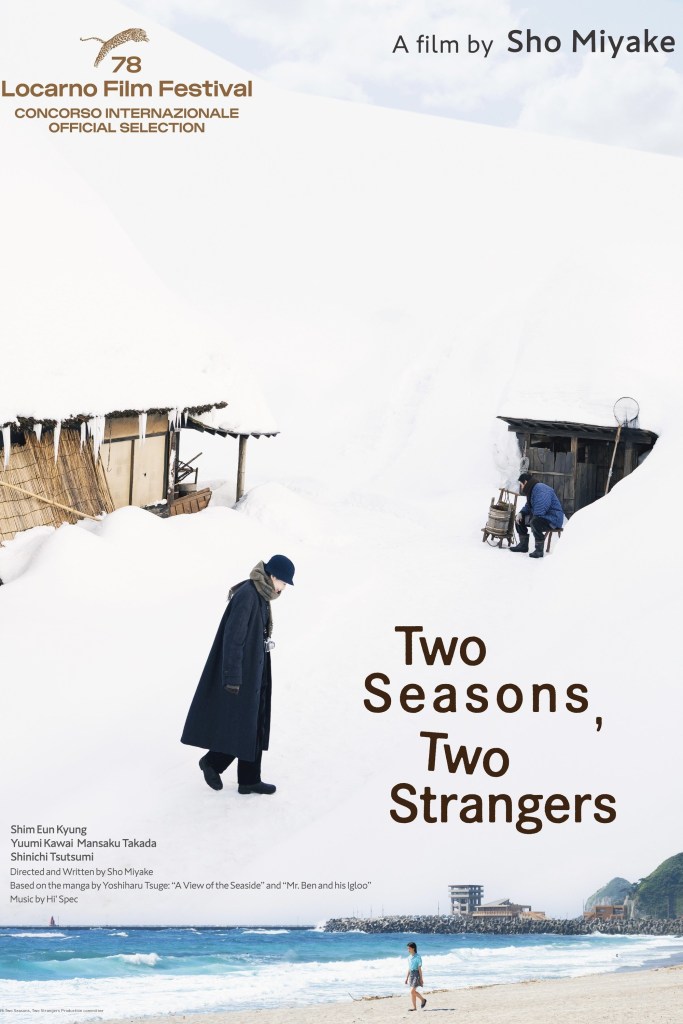
A woman sits at her desk, a pencil poised above a blank page. She has been tasked with turning a text into a film; she perceives the world through its splendour of details. Seaside, summer, man, woman—these are the elements she requires in order to set sail a story about boredom, loneliness, solitude, desire and, pointedly, the peculiarities of travel.
So the pencil descends, and thus begins Tabi to Shabi, a new film by Sho Miyake, which, rather than remaining in the process of creation, plunges into its imaginative realm: a film-within-a-film, distinguished by its vivid palette, poetic imagery, and elusive quality. It tells the tale of two strangers who, each for their own reasons, experience a fleeting encounter one late summer afternoon.
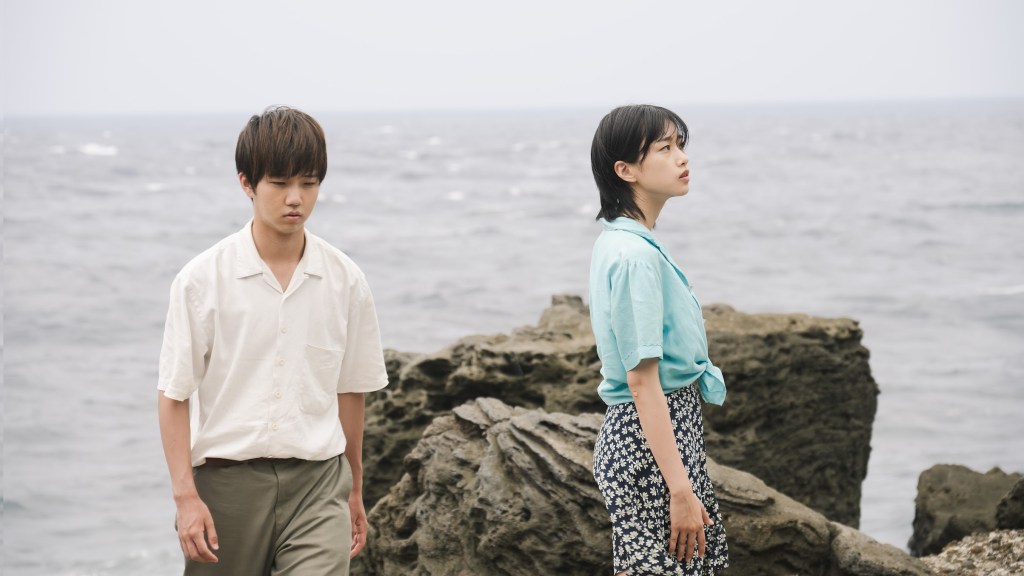
Nagisa (Yumi Kawai) is a listless city girl seeking escape from an act of infidelity; Natsuo (Mansaku Takada) is a restless local, the sort whose inexperience compels him to form attachments too swiftly, drawn to anyone who seems to offer a broader sense of the world. There is a subtle charge between them, but nothing potent or sustained enough to raise the stakes: they are destined to intersect only once—profoundly, emphatically, and no more.

Yuki Kawai plays Nagisa, a young woman from the city on vacation in a seaside town.
In one scene, atop a hill as the sun continues its descent and the waves ripple below, they converse. Natsuo offers the kind of reflection born of private rumination: “My mother used to say boredom fosters imagination,” he remarks. “But I think that sort of mindset is wrong. When people have too much free time, they think too much, and they get depressed. So I wondered what we should do instead. How about keeping ourselves so busy we can’t think about anything?” She pauses, then delivers the single block that topples the precarious edifice of his convictions: “Being too busy makes you depressed, too.” In that moment, she rouses him from the slumber of his narrowness.
What distinguishes Tabi to Shabi is Miyake’s decision to split the narrative in two—to return, at intervals, to the screenwriter, Li, played by the Korean actress Shim Eun-kyung. In doing so, we remain conscious of the framework of the imaginary rather than wandering so far within it that we forget where we began. And then, in a sudden jump cut, we find ourselves in a lecture hall at a university, watching a screening of the film. He jolts us from the comfort of immersion, continuing to unsettle our expectations: a professor (Shirô Sano) collapses the instant he appears, though we are asked to accept that he was a twin, leaving us briefly disoriented. The film then presses forward into the opposite season and setting: a winter in the countryside.

In the film’s second narrative, Benzo (Shinichi Tsutsumi) and Li (Shim Eun-kyung) form a bond.
It is Li, then—of whom we are given very little background—who becomes the drifting centre of the film: a screenwriter who openly questions her own talent, who is not absorbed by the work she is producing, and who speaks in Korean when reading her diary in voiceover but in Japanese during her interactions. Both form and content are thus bifurcated.
These themes of meta-fictional layering and transitory states of being bring Tabi to Shabi into conversation with directors such as Hong Sang-soo (In Another Country and Grass also employ the frame of a writer at work) and Ryusuke Hamaguchi (Happy Hour incorporates extended dream sequences and Q&A sessions to stage debates—albeit longer and more exhaustive—while Asako I & II plays with twinship and doubled lives). Yet Miyake operates on a quieter frequency, aided by the deft editing of Kieko Okawa, the lush cinematography of Yuta Tsukinaga, and a poignant score by Hi’Spec.

In the film’s first narrative, Natsuo (Mansaku Takada) finds himself bored and depressed.
Before she sets out on her journey, Li manages to articulate her vocation: “Everyday life is about naming things and feelings around us and blending in. When I first came to Japan, everything around me was full of mystery and fear. The things and feelings that used to be fresh have now been overtaken by words. I’m in a cage of words.” It is a piercing description of what quotidian life can often feel like: clusters of feelings suspended in the air, which we seek to anchor with words; yet once that labour seems complete, once the slate appears clean, boredom sets in, and we search for another purpose before the descent into despair.
Like Nagisa, her protagonist—who is not, in a sense, hers at all, since she is adapting the work of Yoshiharu Tsuge—Li encounters Benzo, a solitary innkeeper played by Shinichi Tsutsumi, after being turned away from every central hotel. He is a recluse who refuses to speak of his past, though his home bears traces of it: a woman, a daughter. She observes him, follows him in his small eccentricities, and becomes quietly preoccupied—mirroring Natsuo’s raw, adolescent yearning in the film-within-the-film.
Like a dream, Tabi to Shabi discloses its structure and magic only in retrospect: an experience that feels long and eventful, yet afterwards seems suffused with meaning. Writing itself, if one undertakes it seriously, is a continual dance with one’s own life and the deaths of others, generating purpose as the mind is emptied onto the page. That Li’s pencil descends once again comes as no surprise—nor that we are not invited to follow. It is our turn to exit.
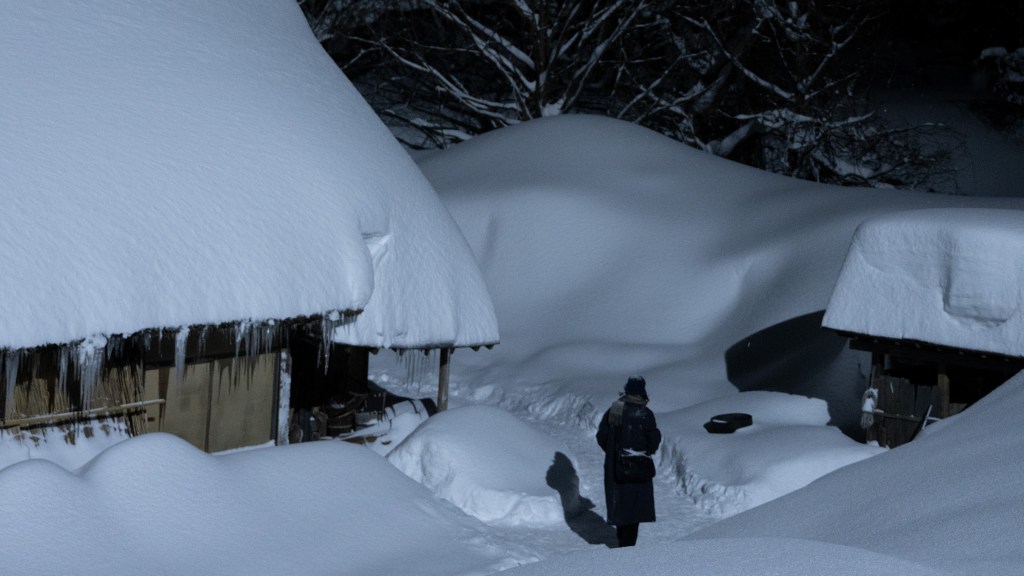
A woman threatens to be subsumed by a wintery landscape.
How to cite: Nagendrarajah, Nirris. “Winter of The Soul: On Sho Miyake’s Two Seasons, Two Strangers.” Cha: An Asian Literary Journal, 18 Aug. 2025, chajournal.blog/2025/08/18/two-seasons.



Nirris Nagendrarajah (he/him) is a Toronto-based writer whose work has appeared in paloma, Polyester, Fête Chinoise, In the Mood Magazine, Tamil Culture, in addition to Substack. He is currently at work on a novel about waiting. [All contributions by Nirris Nagendrarajah.]
 Cha
Cha 